
Struggling with stress or sleep? Discover the best Chinese herbs for calming the mind, improving sleep, and building a simple herbal routine that works. Start Your Herbal Routine Today → The best Chinese herbs for stress and sleep include Suan Zao Ren, Gou Teng, Yuan Zhi, Wu Wei Zi, He Huan Pi, Fu Ling, and Long Gu. These herbs are traditionally used to calm the mind, support the nervous system, and improve sleep quality. Start simple: choose 1–2 herbs based on your main concern—sleep, tension, or mental overload—and use consistently. Struggling with stress or sleep? Discover the best Chinese herbs for calming the mind, improving sleep, and building a simple herbal routine that works. If your mind will not slow down, your sleep feels off, and your body seems stuck in stress mode, you are not alone. In Traditional Chinese Medicine (TCM), this pattern is often connected to a disturbance of the Shen—your spirit, clarity, emotional steadiness, and sense of calm. When the Shen feels unsettled, stress can show up as restlessness, racing thoughts, tension, poor sleep, low resilience, and a body that never seems to fully unwind. The most commonly used Chinese herbs for calm, sleep, and nervous system support include Suan Zao Ren, Gou Teng, Yuan Zhi, Wu Wei Zi, He Huan Pi, Fu Ling, and Long Gu. These herbs are traditionally used to calm the mind, support emotional balance, encourage restful sleep, and help the body handle ongoing stress more effectively. Chinese herbs are not typically chosen just because one symptom is bothering you. In TCM, herbs are selected to support patterns of imbalance. That means the goal is not only to feel calmer in the moment, but to create better long-term balance in the body and mind. That is why people often turn to Chinese herbs when stress affects more than one area of life at the same time—sleep, digestion, tension, mood, focus, or emotional steadiness. Each of these herbs fills a different role. Some are better suited for nighttime routines, while others are used when stress affects physical tension, clarity, energy, or emotional steadiness. That is why comparing them side by side matters. You are not just asking, “What is a good herb for stress?” You are asking, “What kind of stress am I actually dealing with?” That difference is often what helps people build a more useful and more consistent routine. Chinese herbs are often chosen to support the body in a broader way than a one-symptom approach. Instead of only focusing on “feeling calm,” they may also support sleep, steadiness, digestion, clarity, or the ability to handle ongoing stress more gracefully. That is one reason they appeal to people who feel like stress has spread into multiple parts of daily life. Start simple: Most people do better with a simple routine they can actually follow than with an ambitious routine they abandon after a week. Not sure where to start? These guides can help you choose herbs, understand preparation, and use your herbs more confidently: The effectiveness of a herbal routine depends heavily on quality. If the herb is not the correct species, has been poorly handled, or is inconsistent in quality, the routine may not deliver the experience customers are hoping for. Many people assume herbs should work like a one-time quick fix. Then they either stop too soon or keep switching herbs before a routine has had a fair chance to become consistent. Chinese herbs are often best appreciated as part of a rhythm. Clearer decisions, better quality herbs, and consistent use usually matter more than constantly starting over. Choose herbs you can rely on for your daily routine, and start with the formulas or single herbs that match your biggest need first. Start Your Herbal Routine Today Some people notice shifts quickly, but most benefits build over time with regular, consistent use. Many Chinese herbs are traditionally used together, but it is usually best to start with a simple routine and adjust from there. Suan Zao Ren is one of the most commonly used Chinese herbs for supporting restful sleep and calming nighttime restlessness. Fu Ling is often a good herb to consider when stress seems to affect digestion, heaviness, or overall steadiness. Stress may be constant, but how you support your body can change the entire experience. Choose quality herbs, match the herb to the kind of stress you are actually experiencing, and keep your routine simple enough to follow consistently. These statements have not been evaluated by the Food and Drug Administration. These products are not intended to diagnose, treat, cure, or prevent any disease.Best Chinese Herbs for Stress, Sleep & Nervous System Support
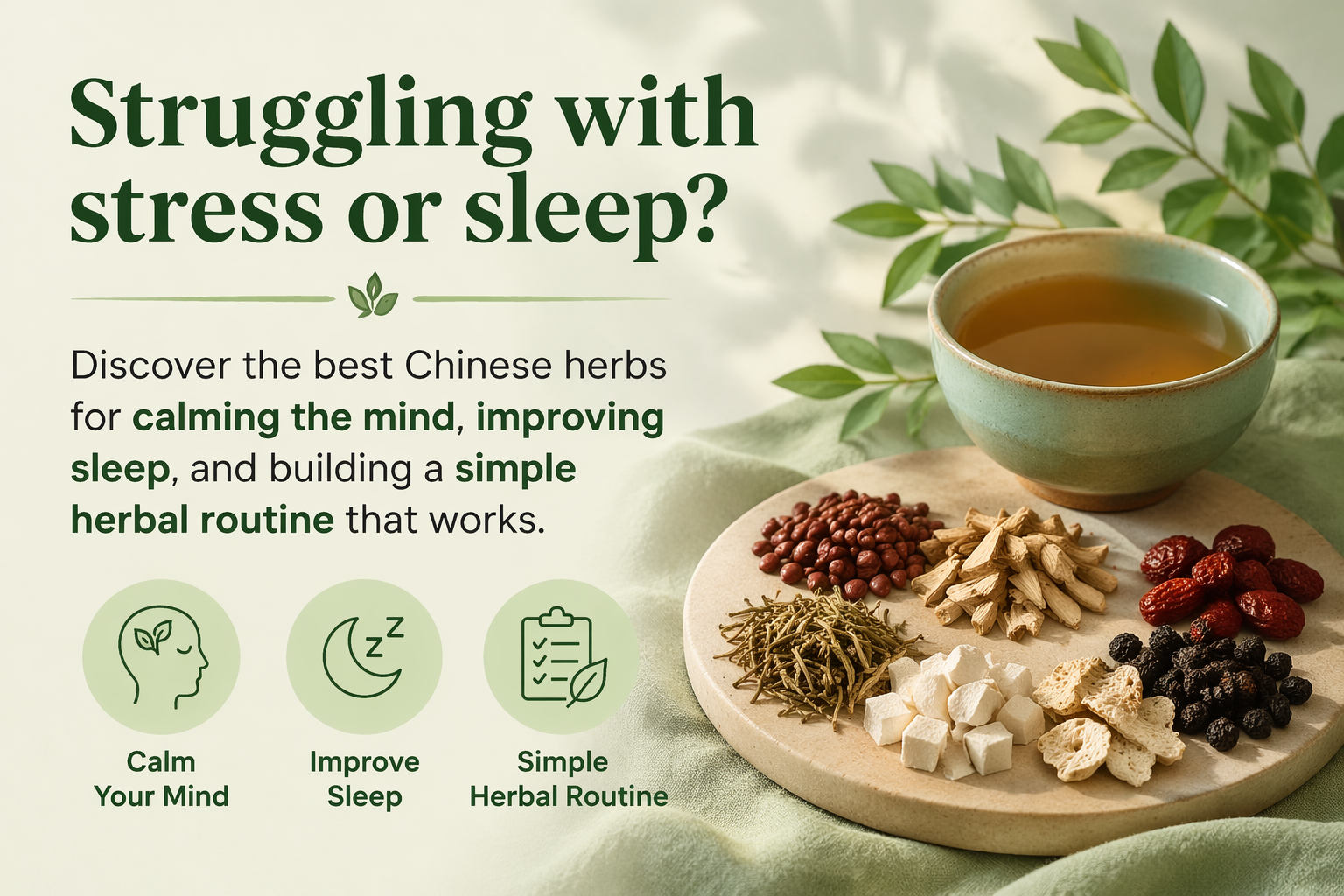
Best Chinese Herbs for Stress & Sleep — Quick Answer
Chinese herbs take a different approach by supporting balance,
consistency, and a calmer foundation over time.Quick Answer: What Are the Best Chinese Herbs for Stress and Sleep?
Who This Guide Is For
Why Chinese Herbs for Stress Support?
The 7 Best Chinese Herbs for Calm & Nervous System Support
Comparison Guide
Herb
Primary Use
Best For
Why Use It
Suan Zao Ren
Sleep Support
Insomnia, restless nights, racing thoughts
One of the most trusted Chinese herbs for calming the mind at night and supporting deeper, more restful sleep.
Gou Teng
Physical Calm
Tension, tightness, overstimulation
Useful when stress becomes physical and the body feels tight, irritated, or overactivated.
Yuan Zhi
Mental Clarity
Brain fog, scattered thinking, poor focus
Traditionally used to support clearer thinking while calming an overactive mind.
Wu Wei Zi
Adaptogenic Support
Fatigue, stress burnout, low resilience
A classic berry used to help the body handle stress more efficiently and support long-term stamina.
He Huan Pi
Emotional Balance
Emotional tension, frustration, moodiness
Often chosen to promote a more relaxed emotional state and help release built-up stress.
Fu Ling
Stress + Digestion Support
Stress affecting digestion, heaviness, instability
Helpful when ongoing stress affects digestion, steadiness, and overall resilience.
Long Gu
Deep Calm
Severe restlessness, intense overstimulation
Traditionally used to anchor the spirit and support a deeper level of calm when stress feels intense.
Why Use These Herbs?
How Chinese Herbs Support Stress and the Nervous System
How to Build a Simple Herbal Routine
Build Your Routine Faster
Why Herb Quality Matters
What Most People Get Wrong
starting a simple herbal routine now can make a meaningful difference over time.Shop Trusted Chinese Herbs
Related Articles
Frequently Asked Questions
How long do Chinese herbs take to work?
Can I combine these herbs?
What is the best Chinese herb for sleep?
Which herb is best when stress affects digestion?
The Bottom Line