Understanding Traditional Chinese Teapills

Understanding Traditional Chinese Teapills: Ancient Formulas, Herbal Wisdom & the Art of Balance

Why Chinese herbal formulas were created, what traditional patterns mean, and how centuries-old herbal knowledge is preserved in convenient teapills.


Understanding traditional Chinese terms and patterns
 

A Tradition Built on Understanding Patterns

For centuries, Chinese herbalists have studied the relationship between the human body, seasonal changes, and the natural environment.

Rather than selecting an herb solely because of one symptom, traditional Chinese medicine (TCM) developed a system of identifying patterns involving concepts such as Wind, Cold, Heat, Dampness, Dryness, Qi, Blood, Yin, and Yang.

These terms are part of a traditional framework for understanding health. They are not interchangeable with modern medical diagnoses.

The remarkable feature of classical Chinese herbal formulas is that each ingredient was traditionally selected for a particular purpose. Some herbs provide the principal action of the formula. Others support that action, address additional aspects of the pattern, or moderate the properties of the combination.

Understanding this philosophy helps explain why some formulas contain only three herbs while others contain ten or more.

Understanding the Language of Traditional Chinese Medicine

To appreciate why classical Chinese herbal formulas were developed, it helps to understand the terminology used by traditional herbalists.

Chinese medicine developed its own framework for describing the body's functions and patterns of balance. Words such as Qi, Yin, Yang, Blood, and Spleen have specific meanings within this traditional system and should not be interpreted as identical to modern medical terminology.

Traditional term Meaning within Chinese medicine
Qi (氣) A traditional concept associated with vitality, movement, and bodily functions.
Yin (陰) Represents nourishing, cooling, moistening, and restorative aspects.
Yang (陽) Represents warming, activating, and transforming aspects.
Blood (Xue, 血) A traditional concept associated with nourishment and circulation; it is not identical to the biomedical definition of blood.
Spleen (Pi, 脾) A functional system associated with the transformation and transportation of food and fluids, rather than simply the anatomical spleen.
Liver (Gan, 肝) A traditional functional system associated with the smooth movement of Qi and the storage of Blood.
Wei Qi (衛氣) Often translated as Defensive Qi, traditionally associated with the body's exterior.
Jin Ye (津液) Body fluids, understood within traditional theory as providing moisture and nourishment.

These concepts form part of the historical foundation of Chinese herbal formulation. Understanding their traditional meanings helps readers appreciate why herbal ingredients were combined in particular ways.

The History of Chinese Herbal Formulas

Chinese herbal formulas developed over many centuries through observation, clinical practice, and the recording of herbal knowledge in medical texts.

One of the most influential early works was the Shang Han Lun (Treatise on Cold Damage), traditionally associated with Zhang Zhongjing near the end of the Han dynasty. It helped establish a systematic approach to selecting formulas according to patterns.

During the Song dynasty, government-sponsored formularies helped organize and standardize many herbal preparations. The Tai Ping Hui Min He Ji Ju Fang preserved formulas that remain recognizable today, including Xiao Yao San (Free & Easy Wanderer).


These formulas were not originally created as modern dietary supplements. They were developed within the diagnostic and therapeutic traditions of Chinese medicine.

Today, teapills provide one way of preserving access to these traditional combinations without requiring customers to prepare a decoction from loose herbs.

Understanding Wind, Cold, Heat, Dampness and Dryness

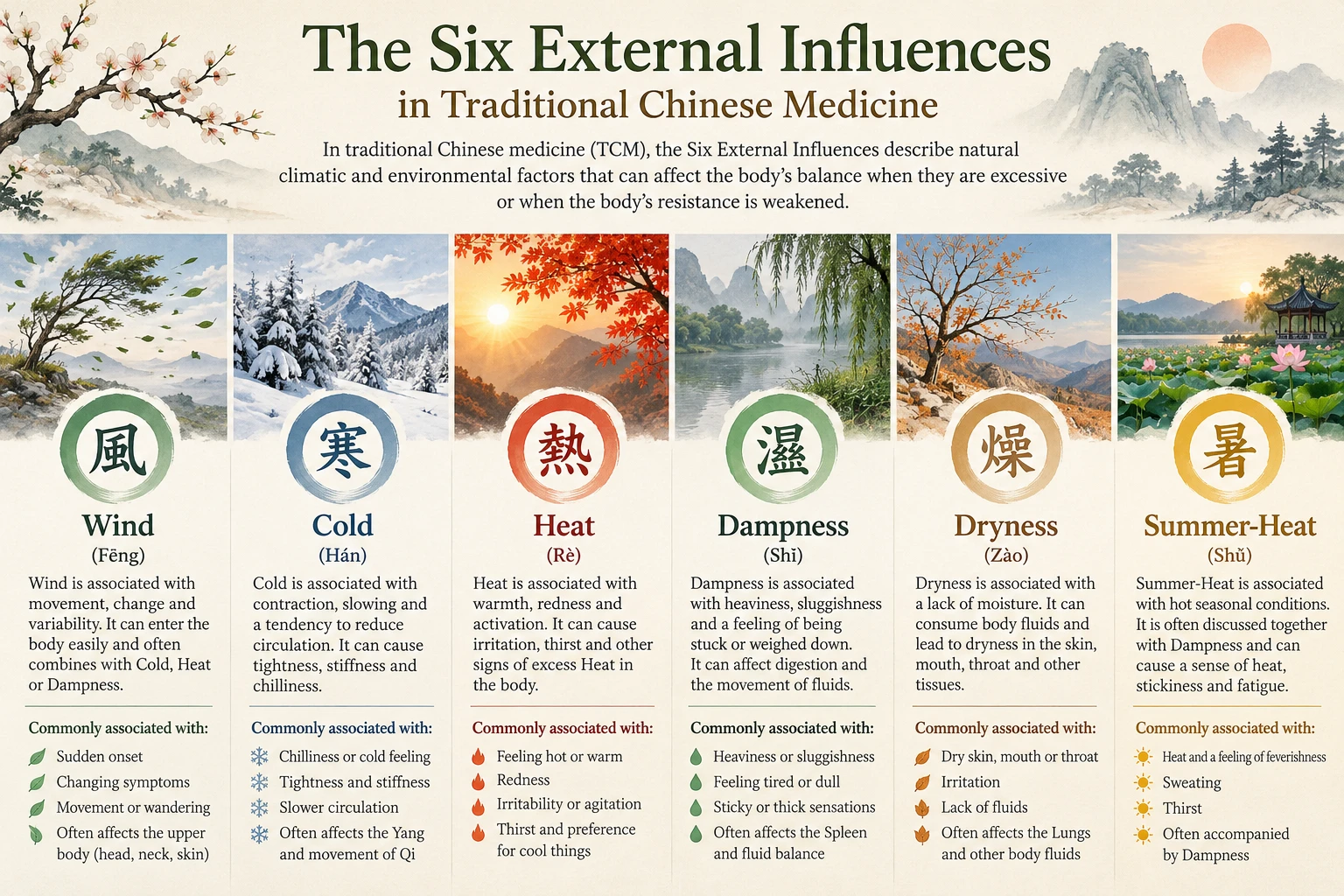
In classical Chinese medicine, environmental influences were organized into six categories often called the Six Excesses (Liu Yin).

Six Excesses Liu Yin

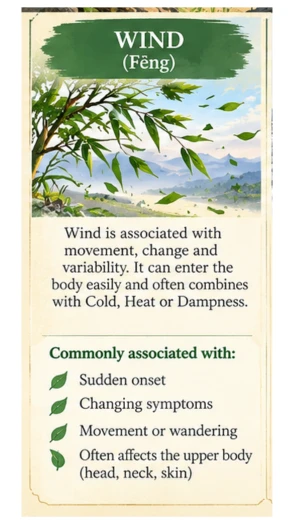
Wind (Feng)

Wind traditionally represents movement, change, and patterns that appear suddenly or shift in location. It may be discussed together with Cold, Heat, or Dampness.


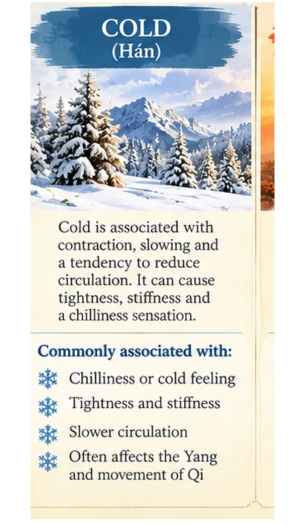
Cold is associated with contraction

 Cold (Han)

Cold is traditionally associated with contraction, slowing, and sensations of chilliness. Herbalists historically distinguished external Cold from internal Cold patterns.   


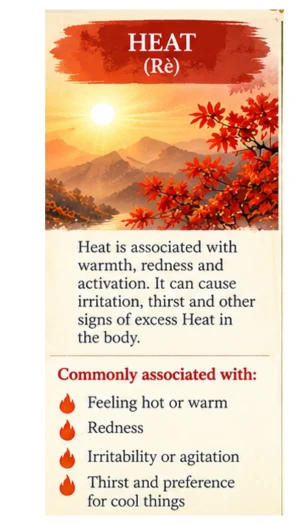
Heat is describes patterns with warmth

Heat (Re)

Heat describes patterns traditionally associated with warmth, redness, agitation, and other signs interpreted as excess Heat or deficient Heat.  


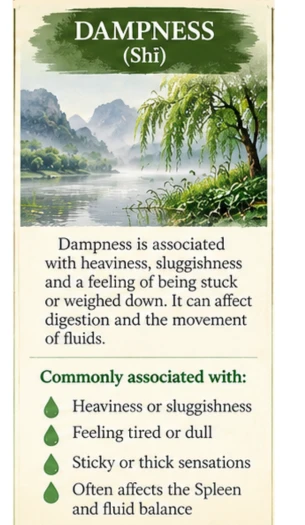
Dampness is associated with sluggishness

Dampness (Shi)

Dampness is associated with heaviness, sluggishness, and impaired fluid transformation in TCM theory. Dampness may combine with Cold or Heat.

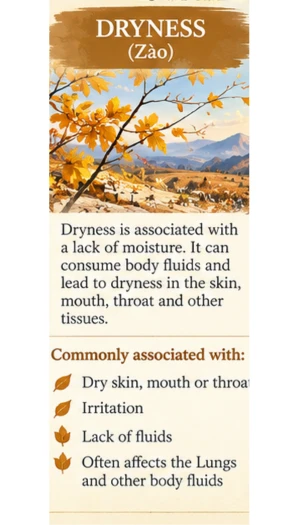
Dryness

Dryness (Zao)

Dryness is traditionally associated with insufficient moisture and the consumption of body fluids. Formulas classified as moistening were developed within this framework.

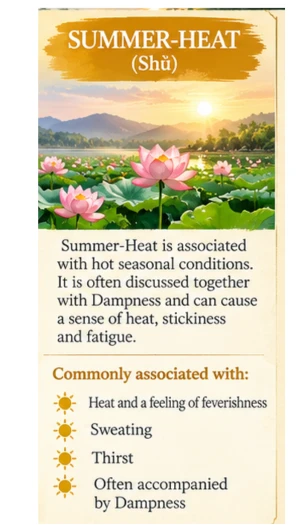
Summer-Heat is associated with hot seasonal conditions  

Summer-Heat (Shu)

Summer-Heat is associated with hot seasonal conditions and is often discussed alongside Dampness in traditional Chinese medical theory.


These terms describe traditional pattern classifications, not literal substances or proven causes of disease. The World Health Organization has documented standardized terminology for these concepts.

Why Are Several Herbs Combined in One Formula?

Classical Chinese herbal formulation often follows the principle of Jun, Chen, Zuo, Shi — Chief, Deputy, Assistant, and Envoy.

Traditional role

Purpose within the formula

Jun — Chief

Provides the primary traditional action

Chen — Deputy

Supports the Chief or addresses a secondary pattern

Zuo — Assistant

Balances, moderates, or adds complementary actions

Shi — Envoy

Harmonizes the combination or guides its traditional action

Not every formula assigns one ingredient to every role, and an herb may serve more than one function.

The important lesson is that classical formulas were designed as organized combinations, not random mixtures of popular herbs.

Why Were Classical Chinese Herbal Formulas Originally Created?

Classical Chinese herbal formulas were developed within a system known as Bian Zheng Lun Zhi, commonly translated as pattern differentiation and treatment determination.

Rather than organizing every formula around one isolated symptom, traditional practitioners considered combinations of signs and characteristics that formed a recognizable pattern.

The formulation process considered several important questions:

Was the traditional pattern classified as Cold or Heat?

Was it considered an Excess or Deficiency pattern?

Did the pattern involve Qi, Blood, Yin, or Yang?

Was Dampness, Dryness, or another traditional influence involved?

Which herbs would provide the principal action, and which would complement or moderate the combination?

A classical formula was therefore more than a collection of individual herbs. Its ingredients were selected and arranged according to a traditional theory of compatibility.

The Importance of Herbal Relationships

The Chief, Deputy, Assistant, and Envoy framework illustrates one way classical herbalists described these relationships.

A Chief herb provides the principal traditional action. Deputy herbs reinforce that action or address related aspects of the pattern. Assistant herbs may provide complementary actions or moderate the combination, while Envoy herbs may harmonize the formula.

Not every classical formula contains four clearly separate roles, and the roles assigned to individual ingredients may differ among traditional interpretations.

This approach explains why the number of herbs alone does not determine the purpose or complexity of a formula.

Jade Screen — Yu Ping Feng San: The Meaning Behind the Name

The name Yu Ping Feng San is commonly translated as Jade Windscreen Powder or Jade Screen Formula.

In traditional Chinese culture, jade has long been associated with something precious and valued. The image of a windscreen provides a memorable metaphor for the formula's traditional relationship to the exterior and Defensive Qi.

The classical combination contains three principal herbs: Huang Qi, Bai Zhu, and Fang Feng.

Within traditional Chinese medicine, Huang Qi is associated with supplementing Qi and consolidating the exterior. Bai Zhu traditionally supports Spleen Qi and fluid transformation, while Fang Feng is associated with dispersing Wind.

Together, these herbs illustrate how a small formula can combine complementary traditional actions.

The formula is often associated with the Dan Xi Xin Fa medical tradition, although its precise textual origins and attribution should be verified against historical sources.

Historical lesson: Classical herbal formulation was not simply about adding more ingredients. A concise combination could be organized around a carefully defined traditional principle.

Free & Easy Wanderer — Xiao Yao San: A Formula Built Around Harmony

Xiao Yao San is recorded in the Song-dynasty Tai Ping Hui Min He Ji Ju Fang, an influential collection of Chinese medical formulas.

The name is commonly translated as Free & Easy Wanderer Powder, suggesting ease, freedom, and harmonious movement within the traditional medical framework.

Its ingredient combination reflects several interconnected traditional concepts.

Chai Hu is associated with spreading constrained Liver Qi. Dang Gui and Bai Shao are traditionally associated with nourishing and regulating Blood. Bai Zhu and Fu Ling support the traditional Spleen system, while Gan Cao helps harmonize the formula. Classical preparation instructions also include ginger and mint.

The historical reasoning behind the combination reflects the relationship between Liver Qi, Blood, and Spleen function as understood in Chinese medicine.

Historical lesson: A classical formula may address several related traditional patterns through complementary ingredient roles rather than focusing on one isolated characteristic.

Four Gentlemen — Si Jun Zi Tang: A Foundation for Later Formulas

Si Jun Zi Tang, commonly translated as Four Gentlemen Decoction, is preserved in Song-dynasty medical literature.

The name reflects the traditional idea of a balanced and orderly combination of four herbs.

The formula contains Ren Shen, Bai Zhu, Fu Ling, and Zhi Gan Cao.

Within traditional theory, Ren Shen serves as the principal Qi-tonifying herb. Bai Zhu complements this role through its association with Spleen Qi. Fu Ling contributes its traditional relationship to fluid transformation, while prepared licorice supports and harmonizes the combination.

Four Gentlemen became an important foundational formula within Chinese herbal traditions. Later practitioners developed related combinations by adding or modifying ingredients according to different traditional patterns.

Historical lesson: Classical formulas were not always isolated recipes. Some became foundations for entire families of related herbal preparations.


Chinese herbal formulas were prepared in several ways

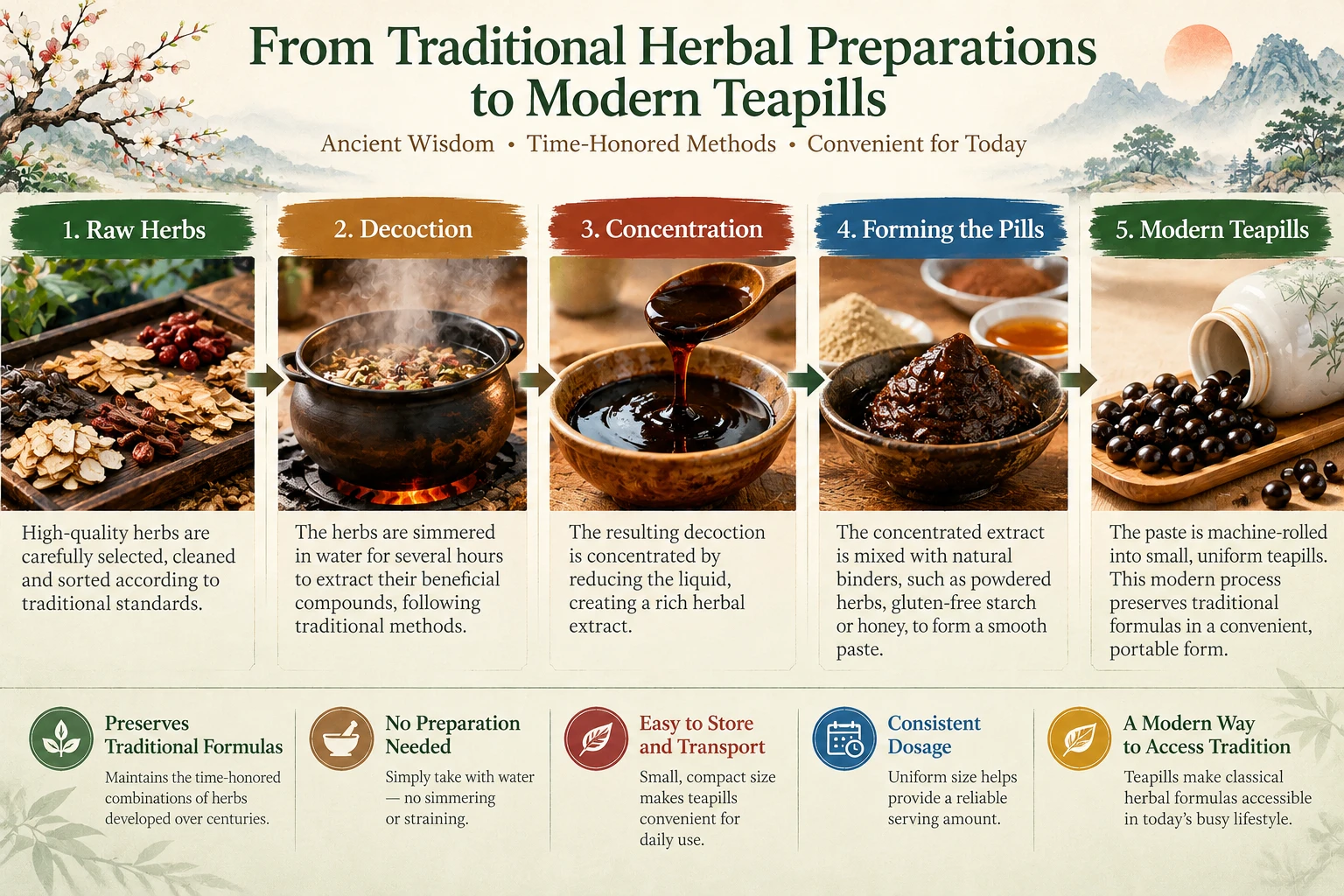
From Traditional Herbal Preparations to Modern Teapills

Historically, Chinese herbal formulas were prepared in several ways, including decoctions, powders, pills, and other forms.

The traditional word Wan means pill, San means powder, and Tang commonly refers to a decoction.

Modern teapills provide a convenient, portable version of many traditional combinations.

Depending on the manufacturer and product, production may involve extracting herbs, concentrating the extract, combining it with other ingredients or binders, and forming small pills. Manufacturing methods vary.

Teapills offer practical advantages:

No simmering or straining is usually required.

They are easy to store and transport.

They offer a convenient way to follow a labeled serving schedule.

They make traditional multi-herb combinations accessible in a compact form.

However, teapills are not necessarily interchangeable with classical decoctions or other extracts. Their concentration, ingredients, preparation, and serving instructions can differ.

Understanding the Different Forms of Chinese Herbal Preparations

Throughout Chinese medical history, herbal formulas have been prepared in several forms. The preparation method can influence convenience, concentration, and how a formula is used.

Preparation Traditional term Description
Herbal decoction Tang (湯) Herbs are simmered in water to prepare a liquid.
Herbal powder San (散) Herbs are processed into powder, sometimes for further preparation.
Traditional herbal pills Wan (丸) Herbal materials are formed into pills using traditional preparation methods.
Modern teapills Commonly labeled Wan Small manufactured pills that may contain herbal powders, extracts, or combinations, depending on the manufacturer.
Concentrated extracts Often labeled as extracts or granules Herbal preparations produced using extraction and concentration methods.

Why Modern Teapills Are Convenient

Modern teapills allow people to use traditional herbal combinations without preparing a fresh decoction.

Their compact form makes them convenient for storage and travel. They can generally be taken with water according to the manufacturer's instructions.

However, a teapill is not automatically equivalent to a traditional decoction, powdered herb, or concentrated extract. Ingredients, extraction methods, concentrations, and labeled serving amounts may differ.

Customers should always consult the specific product label rather than assuming that all versions of a classical formula are interchangeable.

How to Choose and Use Teapills Responsibly

The most important principle in traditional Chinese herbal practice is matching the formula to the appropriate pattern.

A formula traditionally classified as warming is not automatically appropriate for a pattern classified as Heat. Likewise, a formula intended to address Dampness is not necessarily appropriate for Dryness.

Because traditional terminology can be complex, customers should consult a qualified Chinese medicine practitioner when uncertain about formula selection.

Always follow the specific manufacturer's label. Serving sizes differ among brands and products.

Herbal formulas can cause side effects, interact with medications, or be unsuitable for certain medical conditions. Quality and contamination risks also vary, making reputable sourcing and appropriate testing important.

Frequently Asked Questions About Traditional Chinese Teapills

Are teapills actually made from tea?

Despite their name, traditional Chinese teapills are not necessarily made from tea leaves. They are small pills containing herbal ingredients prepared according to a particular manufacturer's formulation.

The name describes a traditional herbal product form rather than a beverage.

Why do some Chinese herbal formulas contain only three ingredients while others contain ten or more?

The number of ingredients reflects the traditional design of the formula.

Some classical formulas use a small number of herbs with complementary roles. Others contain additional ingredients to address several interconnected traditional patterns.

A larger ingredient list does not automatically mean that a formula is stronger or more effective.

Are all brands of the same classical formula identical?

Not necessarily.

Manufacturers may use different extraction methods, ingredient proportions, processing techniques, or serving recommendations. Some products are also modified versions of classical formulas.

Always compare the complete ingredient list and product label.

What is the difference between teapills and herbal extracts?

Teapills are manufactured pills that may contain herbal powders or extracts.

Herbal extracts are preparations made by extracting selected constituents from plant materials. They may be sold as powders, granules, liquids, or incorporated into pills.

The two terms describe different aspects of herbal preparation and should not be assumed to indicate equivalent concentrations.

Can several different teapill formulas be taken together?

Combining herbal formulas requires careful consideration.

Different formulas may contain overlapping ingredients, and some herbs can interact with medications or be unsuitable for particular individuals.

Consult a qualified healthcare professional or appropriately trained Chinese medicine practitioner before combining formulas, particularly when taking prescription medications.

Are traditional Chinese herbal formulas suitable for everyone?

No herbal formula is universally appropriate.

Suitability depends on the ingredients, the individual's circumstances, medications, and other health considerations.

Historical use does not guarantee safety or effectiveness, and traditional Chinese medicine terminology should not replace professional medical evaluation.

Explore Traditional Chinese Teapills at 1st Chinese Herbs

At 1st Chinese Herbs, we've helped customers explore Chinese herbal traditions since 1994.

We believe understanding the history and philosophy behind a formula is an important part of making informed purchasing decisions.

Explore our collections of Plum Flower Teapills
You can also read our Guide to Chinese Herbal Teapills to learn more about teapill forms, preparation, and practical use.

Traditional knowledge becomes more meaningful when we understand the reasoning behind it.

References

Scientific Research & Historical References

The following publications explore traditional Chinese medicine concepts, classical herbal formulation principles, ingredient compatibility, and modern quality-control methods.

These references are provided to help readers understand the historical and scientific study of Chinese herbal medicine. They do not establish that any particular dietary supplement is effective for diagnosing, treating, curing, or preventing disease.

About 1st Chinese Herbs

Since 1994, 1st Chinese Herbs has helped customers explore traditional Chinese herbs, classical herbal combinations, and modern herbal preparations.

Our educational resources are intended to make traditional terminology, historical formulation principles, and product information easier to understand.

Educational content prepared by: Sarah Johnson, Certified Herbalist, M.S. Holistic Healing

Last updated: October 2026

Educational and Safety Information

This article discusses the historical development and traditional theories of Chinese herbal medicine. Traditional concepts such as Qi, Wind, Dampness, Heat, and Cold are not equivalent to modern medical diagnoses.

The historical descriptions of herbal formulas are provided for educational purposes and do not establish clinical effectiveness or safety.

Herbal products may cause adverse reactions or interact with medications. Consult a qualified healthcare professional before using herbal supplements, particularly if you have an existing medical condition or take prescription medications.

FDA Disclaimer

These statements have not been evaluated by the Food and Drug Administration. This product is not intended to diagnose, treat, cure, or prevent any disease.

Recommended For You View all