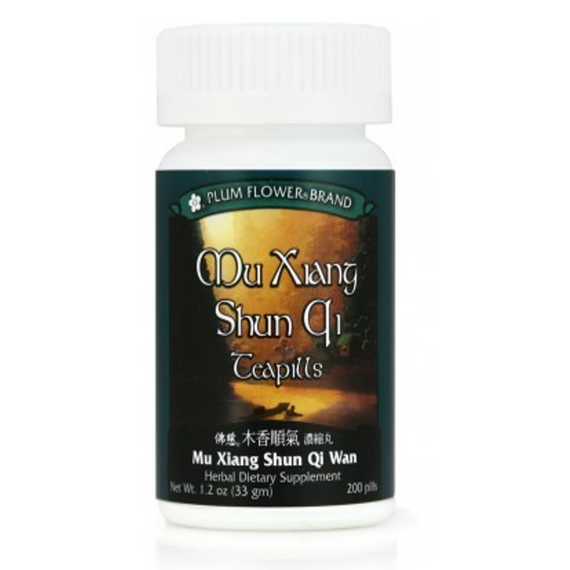


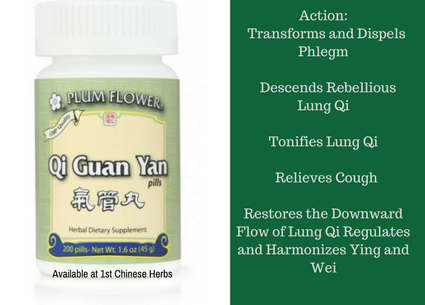
Qi Guan Yan Teapills – Qi Guan Yan Wan – Plum Flower – 200 Teapills
A traditional 13-herb Chinese formula used in TCM to transform Phlegm, support Lung Qi, and restore the normal downward movement of Lung Qi.
Qi Guan Yan Teapills, traditionally known as Qi Guan Yan Wan, combine 13 Chinese herbs in a prepared teapill formula. The combination includes Pi Pa Ye, Xing Ren, Chuan Bei Mu, Qian Hu, Sang Bai Pi, Wu Wei Zi, Dang Shen, and other herbs traditionally selected to work together when Phlegm and disrupted Lung Qi are part of the TCM pattern.
Rather than relying on a single Lung-supporting herb, Qi Guan Yan combines herbs that transform Phlegm and regulate Lung Qi with herbs that support and protect Lung Qi.
What Are Qi Guan Yan Teapills?
Qi Guan Yan Wan, also known as Chi Kuan Yen Wan and Qi Guan Yan Ke Sou Tan Chuan Wan, is a traditional Chinese herbal formula centered on the Lung system.
According to Traditional Chinese Medicine, the formula is traditionally used to:
- Transform and disperse Phlegm
- Restore the downward movement of Lung Qi
- Support Lung Qi
- Regulate and harmonize the Lung system
- Support comfortable respiratory function when appropriate to the traditional TCM pattern
Terms such as Lung Qi, Phlegm, and rebellious Lung Qi have specific meanings within Traditional Chinese Medicine. They are TCM pattern descriptions and should not be interpreted as conventional medical diagnoses.
This product is not intended to diagnose, treat, cure, or prevent bronchitis, pneumonia, influenza, asthma, respiratory infections, or other diseases.
What Does “Rebellious Lung Qi” Mean?
This is one of the most important concepts for understanding why the herbs in Qi Guan Yan are combined.
In Traditional Chinese Medicine, the Lung is said to have a natural descending function. Lung Qi is traditionally expected to move downward smoothly.
When that movement becomes disrupted, TCM practitioners describe the pattern as rebellious Lung Qi or Lung Qi failing to descend.
Several herbs in Qi Guan Yan are traditionally selected specifically because they help direct Lung Qi downward and transform Phlegm, while other herbs help support Lung Qi or maintain fluids.
“Rebellious Lung Qi” is a traditional Chinese medicine concept rather than a conventional medical diagnosis.
Product Details at a Glance
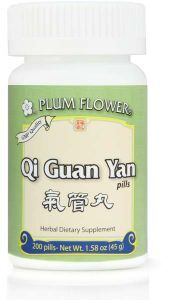
Traditional Name: Qi Guan Yan Wan
Other Names: Chi Kuan Yen Wan, Qi Guan Yan Ke Sou Tan Chuan Wan
Brand: Plum Flower
SKU: 13916
Form: Prepared Chinese herbal teapills
Bottle Size: 200 teapills
Formula Size: 13 traditional herbs
Label Directions: 20 teapills, 2 times per day
Approximate Supply: Approximately 5 days when taking 40 teapills per day
Origin: China
Preparation Required: None — swallow the prepared teapills according to label directions
Allergen Information: Contains tree nuts.
What's in Qi Guan Yan Teapills?
Qi Guan Yan contains 13 traditional herbal ingredients. Each ingredient has a particular role within the formula rather than functioning simply as a collection of individual herbs.
| Pin Yin | Botanical / Ingredient | Traditional Role in the Formula |
|---|---|---|
| Pi Pa Ye | Eriobotrya japonica leaf | Traditionally clears Lung Heat and directs rebellious Lung Qi downward while helping transform Phlegm. |
| Dang Shen | Codonopsis pilosula root | Traditionally tonifies Qi and supports the Lung and Spleen, providing a strengthening component within the formula. |
| Da Zao | Ziziphus jujuba fruit | Traditionally supports the Spleen and Qi while helping harmonize the actions of the other herbs. |
| Sang Ye | Morus alba leaf | Traditionally clears Lung Heat and helps moisten Lung dryness, complementing the formula's Phlegm-transforming herbs. |
| Sheng Jiang | Zingiber officinale fresh rhizome | A warming, harmonizing herb traditionally used to regulate the middle and balance the cooler herbs in the formula. |
| Xing Ren | Prunus armeniaca seed | Traditionally directs Lung Qi downward and helps restore its normal descending action. |
| Chuan Bei Mu | Fritillaria cirrhosa bulb | Traditionally clears Heat, transforms Phlegm, and moistens the Lung. It contributes to both the Phlegm-transforming and moistening sides of the formula. |
| Qian Hu | Peucedanum praeruptorum root | Traditionally transforms Phlegm and directs Lung Qi downward, reinforcing one of the formula's central strategies. |
| Yuan Zhi | Polygala tenuifolia root | Traditionally transforms Phlegm and supports the movement and clearing of Phlegm within the overall formula. |
| Ju Hong | Citrus reticulata exocarp | Traditionally regulates Qi, dries Dampness, and transforms Phlegm, helping prevent stagnation within the formula. |
| Kuan Dong Hua | Tussilago farfara flower | Traditionally moistens the Lung and helps restore normal Lung Qi movement while complementing the formula's Phlegm-transforming herbs. |
| Sang Bai Pi | Morus alba root bark | Traditionally clears Lung Heat and directs Lung Qi downward, reinforcing the formula's descending strategy. |
| Wu Wei Zi | Schisandra chinensis fruit | Traditionally helps contain and preserve Lung Qi while generating fluids, providing a conserving action that balances the formula's dispersing herbs. |
Other Ingredients: Honey, activated carbon, China wax, and dimethicone.
Allergen Information: Contains tree nuts.
How Does Qi Guan Yan Work as a Whole?
The logic of Qi Guan Yan becomes clearer when the 13 ingredients are divided by their traditional roles.
Pi Pa Ye, Xing Ren, Qian Hu, and Sang Bai Pi are particularly important to the formula's strategy of restoring the traditional downward movement of Lung Qi.
Chuan Bei Mu, Qian Hu, Yuan Zhi, and Ju Hong contribute to transforming or dispersing Phlegm according to Chinese herbal theory.
Dang Shen provides an important Qi-supporting component, while Wu Wei Zi traditionally helps preserve Lung Qi and fluids.
Sang Ye and Chuan Bei Mu contribute cooling and moistening actions, while Sheng Jiang and Da Zao help balance and harmonize the overall combination.
This creates a formula that does more than simply transform Phlegm. It combines:
Transform Phlegm + Restore descending Lung Qi + Support Lung Qi + Protect fluids.
That combination is what distinguishes Qi Guan Yan from a simple single-herb Lung formula.
What Does “Phlegm” Mean in Traditional Chinese Medicine?
The word Phlegm has a broader meaning in Traditional Chinese Medicine than it does in everyday English.
In conventional conversation, phlegm generally refers to mucus produced in the respiratory tract. In TCM, Phlegm is part of a broader pattern concept involving the body's transformation and movement of fluids.
When a formula is described as “transforming Phlegm,” this refers to its traditional classification within Chinese herbal medicine. It should not be interpreted as a claim that the product treats a particular respiratory disease.
Why Choose Qi Guan Yan Teapills?
Qi Guan Yan contains 13 different traditional herbs. Preparing the formula from individual bulk herbs could require purchasing and measuring all of those ingredients and then preparing them as a traditional decoction.
Plum Flower Qi Guan Yan provides the complete formula in a prepared teapill form.
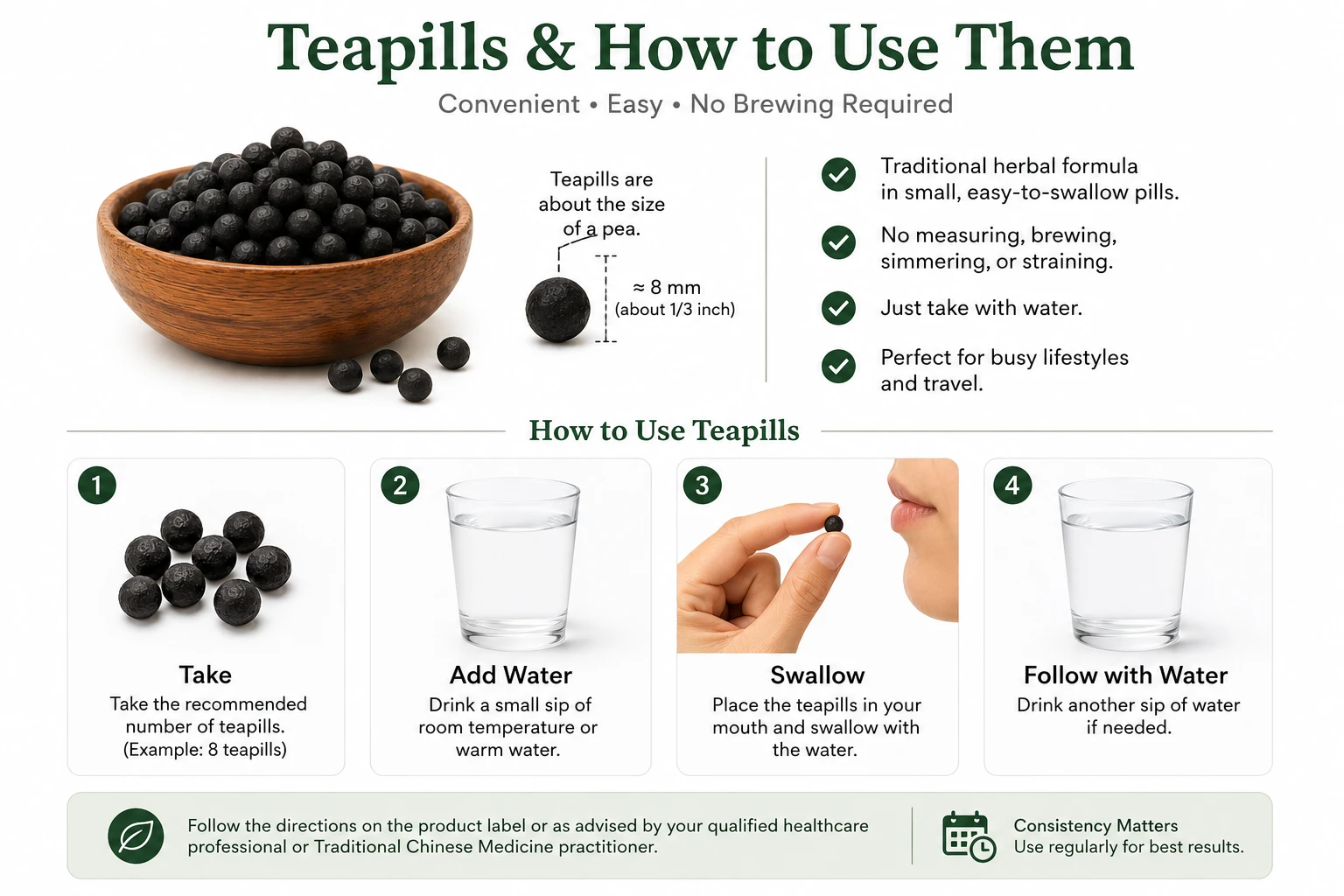
There is no measuring, simmering, brewing, or straining required. Simply take the prepared teapills according to the product directions.
The teapills are also easy to store and transport, making them more convenient than preparing a 13-herb decoction each day.
How Do I Take Qi Guan Yan Teapills?
The dosage stated on the bottle is:
Take 20 teapills, 2 times per day.
Swallow the teapills with water. No brewing or other preparation is required.
At the label amount of 40 teapills per day, a 200-count bottle provides approximately 5 days of use.
This dosage is different from many other Plum Flower teapill formulas. Follow the directions specifically printed on the Qi Guan Yan bottle rather than using a general teapill dosage.
Consult your qualified healthcare practitioner if you have questions about how to use this formula.
Who Should Use Extra Caution?
Do not use during pregnancy or while nursing unless specifically directed by a qualified healthcare professional.
Allergen Warning: Contains tree nuts.
Qi Guan Yan contains 13 herbal ingredients. People taking prescription medications or managing a chronic medical condition should discuss its use with their physician, pharmacist, or qualified herbal practitioner.
Seek appropriate medical care for difficulty breathing, chest pain, coughing up blood, blue or gray lips or skin, high or persistent fever, severe wheezing, or respiratory symptoms that are persistent or worsening.
California Proposition 65 Warning
Frequently Asked Questions About Qi Guan Yan Teapills
What are Qi Guan Yan Teapills?
Qi Guan Yan Teapills are a 13-herb traditional Chinese formula. According to Traditional Chinese Medicine, the formula is designed to transform Phlegm, restore the downward movement of Lung Qi, and support Lung Qi.
What is Qi Guan Yan traditionally used for?
Within Traditional Chinese Medicine, Qi Guan Yan is traditionally associated with patterns involving Phlegm and disrupted or rebellious Lung Qi. These are TCM pattern descriptions rather than conventional medical diagnoses.
What does “rebellious Lung Qi” mean?
Traditional Chinese Medicine describes Lung Qi as naturally moving downward. When that movement is disrupted, practitioners may describe the pattern as rebellious Lung Qi or Lung Qi failing to descend.
Does Qi Guan Yan contain Chuan Bei Mu?
Yes. Chuan Bei Mu (Fritillaria cirrhosa) is one of the 13 herbs in the formula. It is traditionally used to clear Heat, transform Phlegm, and moisten the Lung.
How many herbs are in Qi Guan Yan?
The formula contains 13 traditional herbal ingredients, including Pi Pa Ye, Dang Shen, Xing Ren, Chuan Bei Mu, Qian Hu, Sang Bai Pi, and Wu Wei Zi.
How do I take Qi Guan Yan Teapills?
The bottle directions state 20 teapills, 2 times per day. Follow the directions printed on the product you receive or the instructions provided by your qualified healthcare practitioner.
Why is the dosage higher than many other teapills?
Dosage varies among traditional Chinese herbal products. The directions for this particular product state 20 teapills twice daily. Customers should follow the directions for Qi Guan Yan rather than assuming that the dosage used for another Plum Flower formula applies to this product.
How long does a 200-count bottle last?
At the label amount of 20 teapills twice daily, or 40 teapills per day, a 200-count bottle provides approximately 5 days of use.
Do I need to brew Qi Guan Yan as tea?
No. The 13-herb formula has already been prepared into small teapills. There is no measuring, simmering, brewing, or straining required.
Can I take Qi Guan Yan with prescription medications?
Because Qi Guan Yan contains 13 herbal ingredients, people taking prescription medications should discuss its use with their physician, pharmacist, or qualified herbal practitioner before use.
Qi Guan Yan – A 13-Herb Traditional Lung Formula
Qi Guan Yan brings together 13 traditional Chinese herbs with complementary roles. Some ingredients traditionally transform Phlegm and restore the downward movement of Lung Qi, while others support Lung Qi, generate or preserve fluids, and harmonize the overall combination.
For customers who have already identified Qi Guan Yan Wan as the traditional formula they are looking for, Plum Flower teapills provide the complete 13-herb combination without the work involved in preparing the individual herbs as a decoction.
200 teapills • 13-herb traditional formula • 20 teapills twice daily • Approximately 5 days per bottle • No brewing required
Research on Herbs Found in Qi Guan Yan Teapills
Several individual herbs found in Qi Guan Yan have been studied in modern scientific research. The links below are provided for educational purposes. Research on individual herbs does not establish that Qi Guan Yan Teapills diagnose, treat, cure, or prevent any disease.
Pi Pa Ye – Eriobotrya japonica (Loquat Leaf)
PubMed: Loquat Leaf – Traditional Uses, Phytochemistry, Pharmacology & Safety
Pi Pa Ye – Eriobotrya japonica (Loquat Leaf)
PubMed: Loquat Leaf – Antioxidant & Anti-Inflammatory Research
Chuan Bei Mu – Fritillaria cirrhosa
PubMed: Fritillaria cirrhosa – Traditional Uses, Phytochemistry, Pharmacology & Safety
Chuan Bei Mu – Fritillaria cirrhosa
PubMed: Fritillaria cirrhosa – Phytochemistry & Pharmacological Research
Xing Ren – Apricot Seed / Amygdalin
PubMed: Amygdalin – Pharmacology & Toxicology Review
Disclaimer: These statements have not been evaluated by the Food and Drug Administration. This product is not intended to diagnose, treat, cure, or prevent any disease. Information concerning traditional uses refers to Traditional Chinese Medicine theory and is provided for educational purposes only. Consult a qualified healthcare professional before using dietary supplements, particularly if you have a medical condition, take medications, are pregnant, nursing, or are preparing for surgery.