The Herbal Buyer's Guide
Herbal Extracts vs. Tinctures vs. Glycerites: Which Should You Choose?
Three different preparations. Sometimes the very same herb. But three surprisingly different experiences.
Discover what sets powdered concentrates, alcohol tinctures, and glycerites apart—and how to choose a format that fits your preferences.
1st Chinese Herbs | Family-Owned Since 1994
The Herbal Extract Dilemma: Same Herb, Three Different Choices
Imagine you're shopping for a familiar botanical such as ginger.
You find a powdered extract, a bottle of alcohol tincture, and a sweet-tasting glycerite.
All three labels feature the same botanical name. Yet the preparations look different, contain different ingredients, and may have different manufacturing specifications.
Which one should you choose?
The answer isn't as simple as selecting the highest extract ratio or the most concentrated-looking bottle.
Each preparation has its own characteristics, and the extraction process influences which botanical constituents are present in the finished product.
The most important thing to know: The best herbal format is not automatically the one with the biggest number on its label. It's the one whose ingredients, manufacturing specifications, and intended preparation suit your needs.
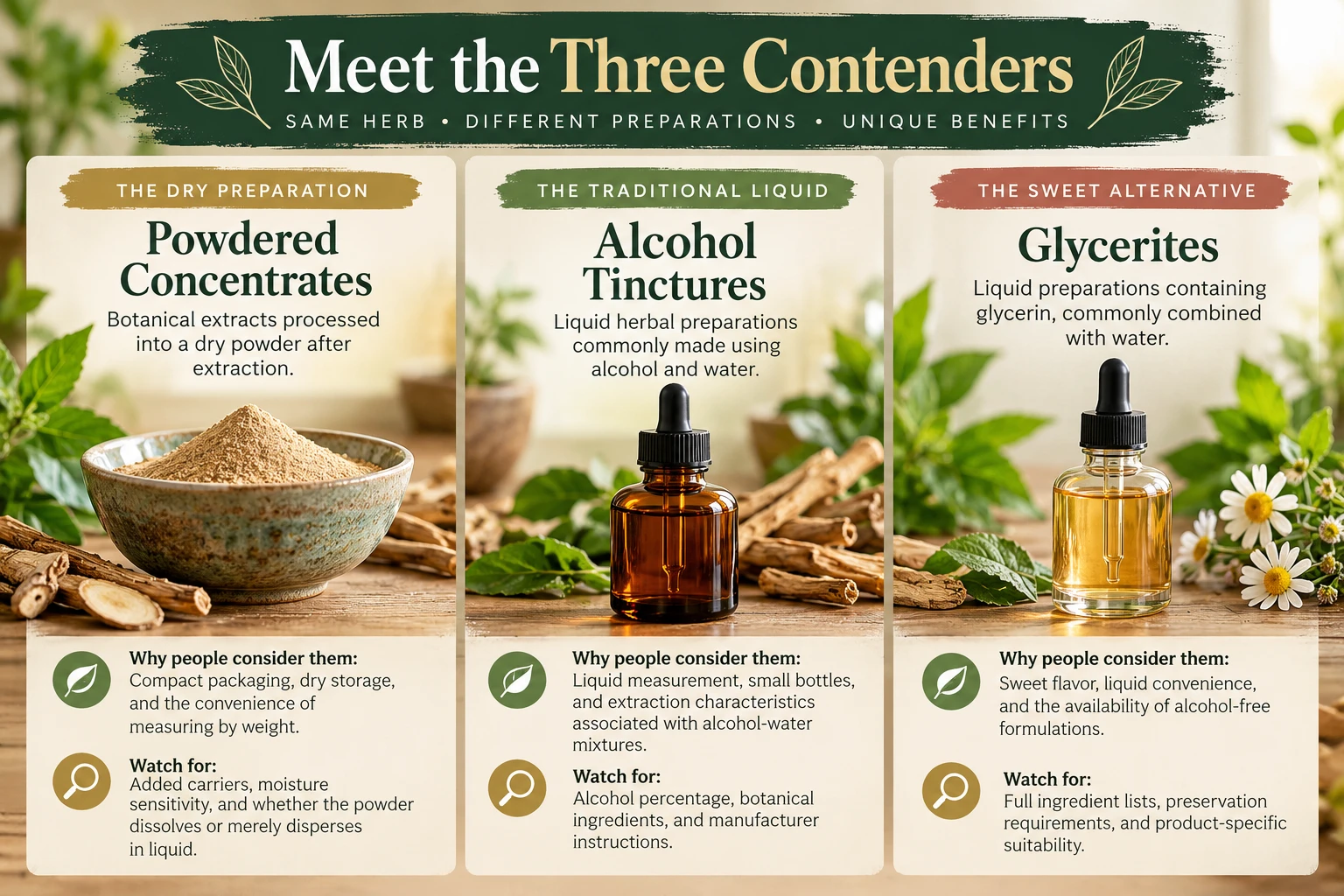
Meet the Three Contenders
The Dry Preparation
Powdered Concentrates
Botanical extracts processed into a dry powder after extraction.
Why people consider them: Compact packaging, dry storage, and the convenience of measuring by weight.
Watch for: Added carriers, moisture sensitivity, and whether the powder dissolves or merely disperses in liquid.
The Traditional Liquid
Alcohol Tinctures
Liquid herbal preparations commonly made using alcohol and water.
Why people consider them: Liquid measurement, small bottles, and extraction characteristics associated with alcohol-water mixtures.
Watch for: Alcohol percentage, botanical ingredients, and manufacturer instructions.
The Sweet Alternative
Glycerites
Liquid preparations containing glycerin, commonly combined with water.
Why people consider them: Sweet flavor, liquid convenience, and the availability of alcohol-free formulations.
Watch for: Full ingredient lists, preservation requirements, and product-specific suitability.
At a Glance: How Do They Compare?
| What Matters | Powdered Extract | Alcohol Tincture | Glycerite |
|---|---|---|---|
| Form | Dry powder | Liquid | Liquid |
| Typical extraction approach | Extraction followed by drying | Alcohol-water extraction | Glycerin-water extraction or formulation |
| Flavor | Botanical, earthy, or bitter | Botanical flavor with alcohol taste | Usually sweeter |
| Measurement | Weight or specified measure | Drops or milliliters | Drops or milliliters |
| Storage priority | Protect from moisture | Protect bottle integrity and follow label | Follow preservation and storage instructions |
| Alcohol considerations | Check extraction and residual-solvent details | Usually contains alcohol | Often alcohol-free; verify label |
| Best practical feature | Dry, compact format | Convenient liquid measurement | Sweet-tasting liquid format |
These are general characteristics, not universal rules. The finished composition depends on the botanical, manufacturing process, and additional ingredients.
A Little Herbal History: From Teapots to Droppers to Powders
Long before modern extraction equipment existed, people prepared botanicals using methods such as infusions, decoctions, and maceration.
In traditional Chinese herbal practices, roots, fruits, bark, and other botanical materials have often been prepared through simmering or steeping in water.
Western herbal traditions also developed numerous liquid preparations, including alcohol-based tinctures.
As botanical manufacturing evolved, extraction, concentration, and drying technologies made it possible to produce powdered extracts with defined manufacturing specifications.
Today, shoppers encounter all these preparations in different forms.
What's interesting is that newer does not automatically mean better. Each method produces its own type of botanical preparation.
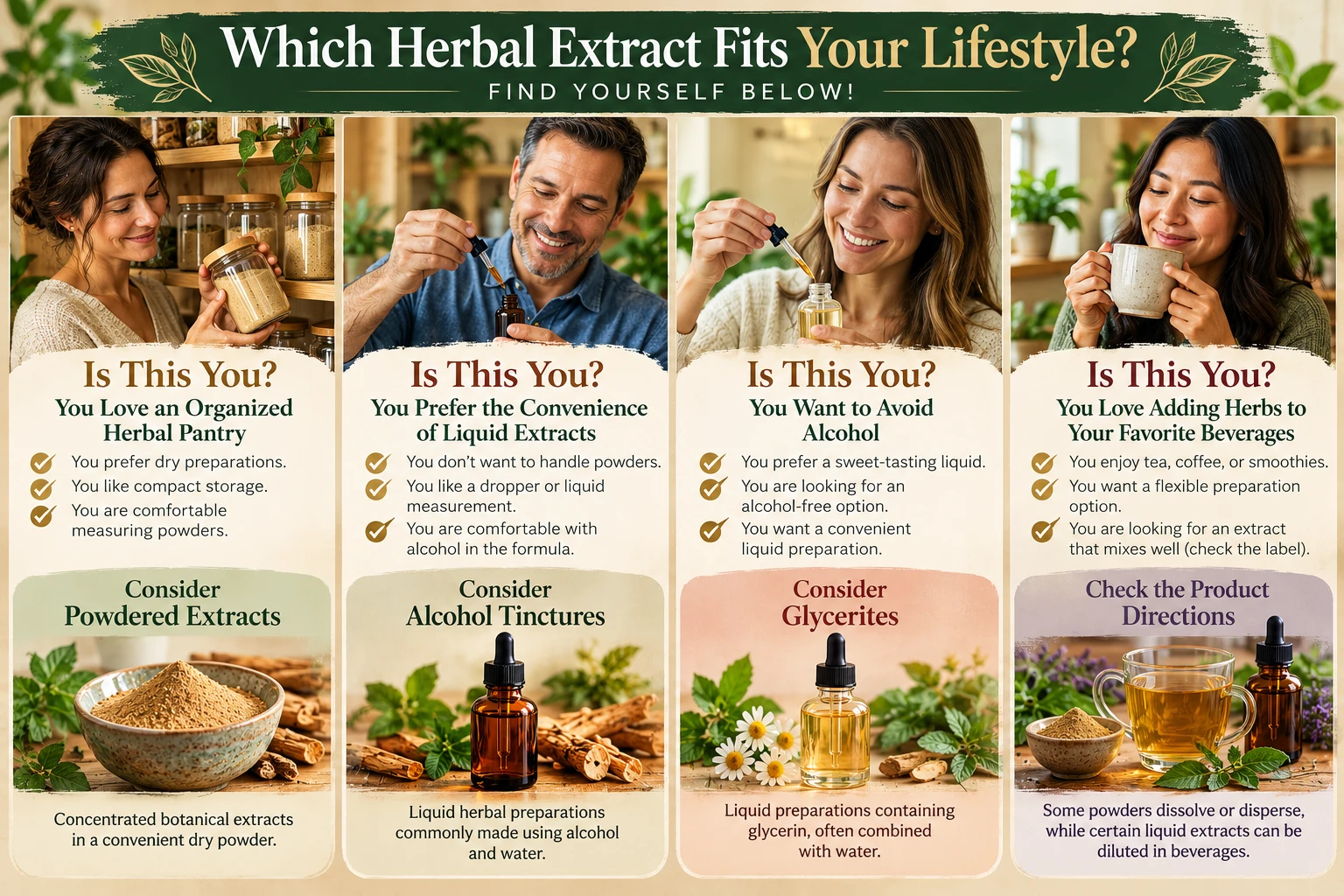
Which Form Fits Your Everyday Routine?
Instead of asking which extract is the strongest, consider what handling and preparing the product would actually look like.
Is This You? You Love an Organized Herbal Pantry
You enjoy keeping botanicals in sealed containers and prefer measuring dry ingredients.
A powdered extract may appeal to you, provided the specific product is appropriate for your intended preparation.
Or Maybe This Is You? You Prefer the Convenience of Liquid Extracts
You don't want to handle powders and prefer a dropper or liquid measuring device.
A tincture may be convenient if its ingredients and alcohol content are appropriate for you.
What About This One? Is This You? You Want to Avoid Alcohol
You prefer a sweeter liquid and are looking for an alcohol-free formulation.
A glycerite may fit that preference, but you still need to check the botanical and product ingredients.
Is This You? You Love Adding Herbs to Your Favorite Beverages
Some powdered extracts disperse in water, while certain liquid preparations can be diluted according to their labels.
Not every extract is intended for mixing into tea, coffee, smoothies, or food. Always check the manufacturer's directions.
Which Herbal Preparation Fits Your Preferences?
Use this quick guide to narrow your choices. Open the question that best describes what you're looking for.
I want a dry preparation that's easy to store.
Consider powdered extracts. They offer a compact dry format. Check the ingredient list, storage instructions, and whether the product is suitable for your intended preparation.
I prefer a liquid and don't mind alcohol.
Consider an alcohol tincture. Check the botanical species, alcohol percentage, extraction specifications, and product directions.
I want a sweet-tasting liquid without alcohol.
Consider a glycerite. Many are alcohol-free, but always verify the ingredients. Alcohol-free does not automatically mean suitable for every person.
I want the most concentrated product available.
Look beyond the ratio. Compare botanical identity, constituent specifications, manufacturing methods, and additional ingredients. A higher ratio alone does not establish greater effectiveness.
I want the best value for my money.
Compare equivalent products carefully. Review package quantity, formulation, ingredient transparency, and manufacturer directions. Different extract formats cannot always be compared by price per ounce.
This decision guide is intended to help compare product formats, not recommend treatment for a medical condition.
Six Herbal Extract Myths That Confuse Shoppers
Myth 1: A 20:1 extract must be better than a 5:1 extract.
Fact: Extract ratios describe aspects of manufacturing. They do not guarantee greater effectiveness or overall product quality.
Myth 2: A powdered extract is just a finely ground herb.
Fact: Regular herb powders generally contain milled botanical material. Extract powders undergo an additional extraction process.
Myth 3: Alcohol tinctures always work faster.
Fact: Absorption and biological effects vary by botanical, formulation, route of administration, and individual circumstances. No universal onset time applies.
Myth 4: Glycerites are automatically safe for children.
Fact: Avoiding alcohol does not eliminate botanical risks. Children's use requires appropriate professional guidance.
Myth 5: Every herbal extract dissolves in water.
Fact: Some powders dissolve, others disperse, and some leave sediment. Preparation depends on the formulation.
Myth 6: A Certificate of Analysis guarantees that an extract works.
Fact: A COA reports specified test results. It does not independently establish clinical effectiveness or guarantee freedom from every possible contaminant.
What Herbal Extract Labels Don't Always Tell You
Two products can display the same botanical name yet contain different ingredients and have different manufacturing specifications.
Before buying, look for the scientific name, plant part, extraction details, and any additional ingredients.
Example: Reading a Powdered Extract Label
The following is a fictional example to demonstrate label-reading. It is not a real product specification.
EXAMPLE BOTANICAL EXTRACT
Botanical: Astragalus membranaceus
Plant Part: Root
Form: Powdered Extract
Stated Extract Ratio: 5:1
Additional Ingredients: See manufacturer listing
Lot Number: SAMPLE-001
Illustration only — not a product for sale.
Botanical: Astragalus membranaceus
Plant Part: Root
Form: Powdered Extract
Stated Extract Ratio: 5:1
Additional Ingredients: See manufacturer listing
Lot Number: SAMPLE-001
Illustration only — not a product for sale.
What can we learn?
- The scientific name helps identify the botanical.
- The plant part tells us which material was used.
- The extract ratio gives manufacturing context.
- Additional ingredients should be checked.
- The lot number supports traceability.
What the label does not establish is that the extract is automatically more effective than another preparation.
Are You Really Getting Your Money's Worth?
One of the most misleading ways to compare herbal extracts is to look only at the price of the bottle or package.
A powdered extract may be priced by weight. A tincture or glycerite is often priced by fluid volume.
These measurements cannot be directly compared without additional information.
A Smarter Shopping Checklist
- Confirm the same botanical species. Similar common names do not always mean identical plants.
- Check the plant part. Root, fruit, leaf, and other parts may differ.
- Review all ingredients. Look for carriers, glycerin, alcohol, and other formulation components.
- Understand the ratio. Manufacturing ratios are not direct measures of clinical potency.
- Compare relevant specifications. Standardized markers, when present, may help compare certain products.
- Consider preparation and storage. A format you cannot conveniently handle may not suit your preferences.
Our shopping philosophy: Better information leads to better-informed purchases. Don't let an impressive number or marketing phrase replace careful label reading.
Behind the Label: What Makes a Quality Herbal Extract?
Quality involves more than appearance, flavor, or the extract ratio printed on a package.
When evaluating botanical products, consider:
- Botanical identity: Is the scientific name provided?
- Plant part: Does the label identify the part used?
- Manufacturer transparency: Is the supplier or brand clearly identified?
- Ingredient disclosure: Are carriers and additional ingredients listed?
- Testing documentation: Are relevant test results available?
- Lot traceability: Can the product be associated with a manufacturing batch?
- Organic certification: If advertised, is certification specific to the product?
What About Certificates of Analysis?
A Certificate of Analysis, commonly called a COA, reports results for specified tests associated with a product or batch.
Depending on the product and manufacturer, testing may address botanical identity, selected marker compounds, heavy metals, microorganisms, or other specifications.
Not every COA contains the same tests, and a COA does not automatically guarantee effectiveness.
At 1st Chinese Herbs, product-specific documentation may be available upon request, depending on the supplier and product.
Why Herbal Experience Matters
Since 1994, 1st Chinese Herbs has helped customers explore Chinese and Western botanicals in a variety of traditional and modern forms.
We believe herbal shopping should begin with understanding what you're buying—not simply choosing whichever product advertises the highest concentration.
Different botanicals, different plant parts, and different preparation methods all deserve careful attention.
That's why we encourage customers to examine botanical names, product descriptions, manufacturer specifications, and preparation instructions before making a purchase.
Our goal is to make the world of herbs easier to understand, one informed choice at a time.
Frequently Asked Questions
Are powdered herbal extracts stronger than tinctures?
Not necessarily. Different extraction methods produce different constituent profiles. Neither format is universally stronger or more effective.
What is the difference between a tincture and a glycerite?
Tinctures commonly use alcohol and water, while glycerites contain glycerin, often with water. The finished formulations may differ in taste, ingredients, and chemical composition.
Are glycerites alcohol-free?
Many are, but check the full ingredient list and manufacturing information for the specific product.
Can powdered extracts contain alcohol residues?
Some powders are manufactured using alcohol during extraction. Finished-product residual-solvent specifications depend on the process and manufacturer.
Can I use a powdered extract instead of a tincture?
Do not assume that different extract formats are interchangeable. Their concentrations and constituent profiles may differ. Seek appropriate professional guidance for health-related substitutions.
Can herbal extracts be added to tea or smoothies?
Some can, depending on the formulation. Follow the manufacturer's preparation instructions.
Which format is easiest to store?
Powders offer compact dry storage, while liquids are convenient in sealed bottles. All formats require appropriate storage according to the manufacturer.
Is a 10:1 powdered extract stronger than a 1:5 tincture?
The ratios describe different manufacturing relationships and cannot be directly compared to determine biological effectiveness.
Ready to Explore Herbal Preparations?
Now that you understand the differences among powdered concentrates, alcohol tinctures, and glycerites, you can evaluate products with a clearer understanding of their ingredients and manufacturing methods.
At 1st Chinese Herbs, we offer educational resources to help customers compare botanical preparations and explore our available Chinese and Western herbs.
Explore More at 1st Chinese Herbs
Discover herbal powders, learn how concentrated extracts are made, and browse our botanical selection.
Understand Extract Ratios Shop Herbal Powders Browse Herbs A–ZThe Bottom Line
Powdered herbal concentrates, alcohol tinctures, and glycerites each offer a different way to prepare botanical ingredients.
Powders provide a dry format. Tinctures offer alcohol-based liquid preparations. Glycerites provide a sweet-tasting liquid alternative, often without alcohol.
None is automatically the best choice for every botanical or every person.
Look beyond the label's biggest number. Understand the plant, the preparation, and the product specifications before buying.
Important Information: This article is for general educational purposes and does not constitute medical advice. Herbal products may cause adverse effects or interact with medications. Consult a qualified healthcare professional before using herbal supplements, particularly if you have a medical condition, take medications, or are pregnant or nursing.
1st Chinese Herbs — Family-Owned Since 1994.