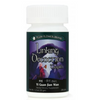


Linking Decoction – Yi Guan Jian Wan Teapills – Plum Flower – 200 Pills
A classic six-herb Traditional Chinese Medicine formula traditionally associated with nourishing Yin while supporting the smooth movement of Liver Qi within its appropriate TCM pattern.
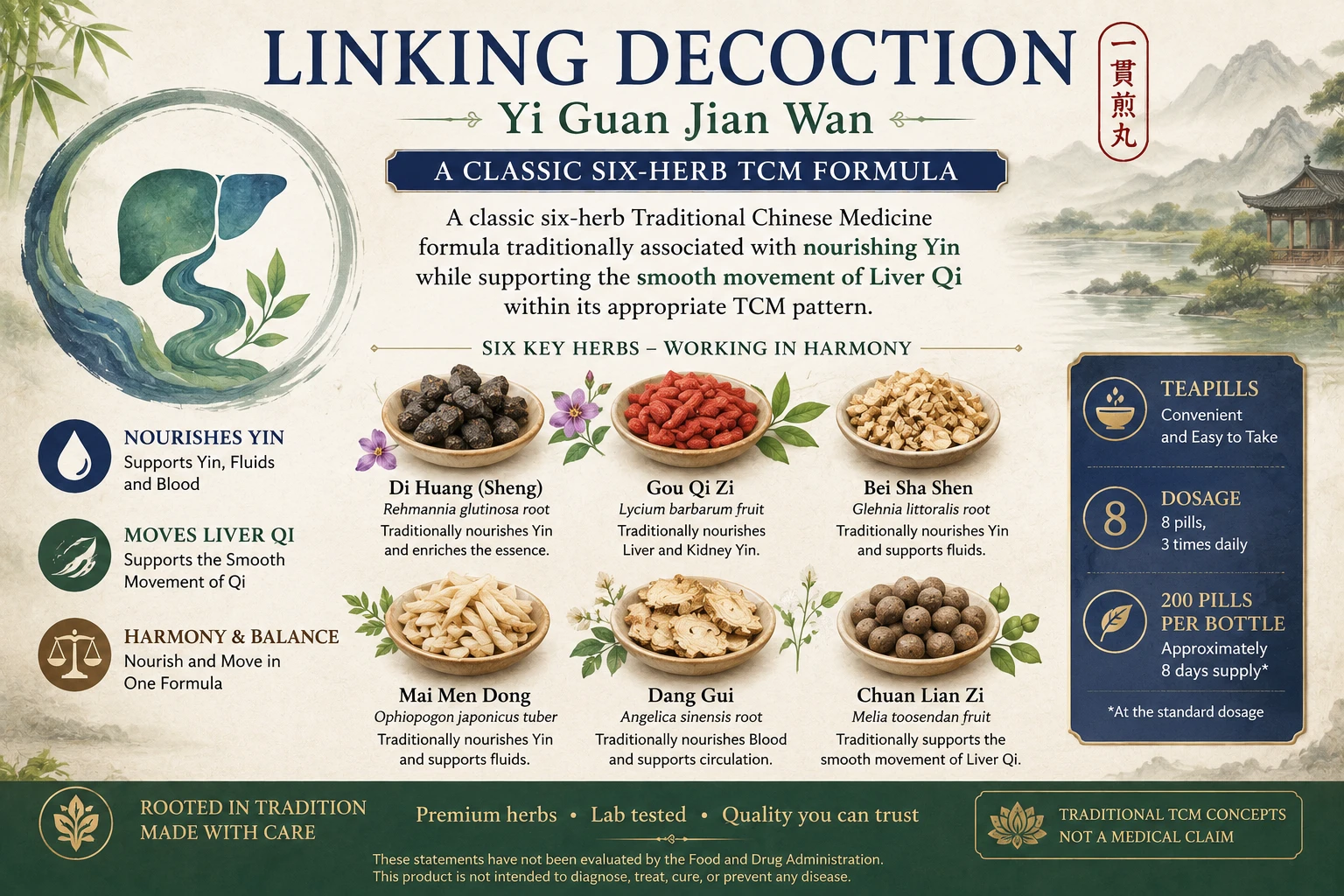
Some Chinese herbal formulas primarily nourish. Others primarily move Qi. Yi Guan Jian Wan, commonly known as Linking Decoction, is interesting because its traditional strategy brings these two approaches together.
The formula combines Sheng Di Huang, Gou Qi Zi, Bei Sha Shen, Mai Men Dong and Dang Gui with Chuan Lian Zi. Within Traditional Chinese Medicine, the first group provides the nourishing foundation of the formula, while Chuan Lian Zi contributes a traditional Qi-moving component.
This makes Yi Guan Jian an important formula to understand when exploring a traditional pattern involving insufficient Yin together with constrained Liver Qi.
Important: Terms such as Liver, Kidney, Yin, Blood and Qi on this page describe Traditional Chinese Medicine concepts. They are not Western medical diagnoses or descriptions of liver or kidney function.
What Is Yi Guan Jian Wan?
Yi Guan Jian Wan is the prepared teapill form of the traditional Chinese herbal formula Yi Guan Jian, commonly translated as Linking Decoction or One Linking Decoction.
The traditional formula has a focused six-herb composition. Its traditional strategy combines nourishing Yin with supporting the smooth movement of Liver Qi.
This combination is what makes Yi Guan Jian distinctive. Rather than looking at it simply as a “Liver formula” or a “Yin formula,” it is more useful to understand the relationship between its nourishing and Qi-moving components.
Product Details at a Glance
Traditional Name: Yi Guan Jian Wan
English Name: Linking Decoction Teapills
Also Known As: Yi Guan Jian; One Linking Decoction; Liver Reinforcing Decoction
Brand: Plum Flower
Form: Prepared Chinese herbal teapills
Bottle Size: 200 teapills
Formula Size: 6 traditional herbal ingredients
Label Directions: 8 teapills, 3 times daily
Approximate Supply: Approximately 8 days when used at the standard label directions
Origin: China
Preparation Required: None — swallow the prepared teapills with water
What's in Linking Decoction Yi Guan Jian Wan?
The current formula contains six traditional herbal ingredients:
| Pin Yin | Botanical Ingredient | Traditional TCM Role |
|---|---|---|
| Di Huang (Sheng) | Rehmannia glutinosa root | Traditionally associated with nourishing Yin within TCM. |
| Gou Qi Zi | Lycium barbarum fruit | Traditionally associated with nourishing Liver and Kidney Yin within TCM. |
| Bei Sha Shen | Glehnia littoralis root | Traditionally associated with nourishing Yin and supporting fluids within its appropriate TCM pattern. |
| Mai Men Dong | Ophiopogon japonicus tuber | Traditionally associated with nourishing Yin and supporting fluids within TCM. |
| Dang Gui | Angelica sinensis root | Traditionally associated with nourishing Blood within Chinese herbal theory. |
| Chuan Lian Zi | Melia toosendan fruit | Traditionally associated with supporting the smooth movement of Liver Qi within its appropriate TCM pattern. |
Other Ingredients: Hydrated magnesium silicate, activated carbon, maltose and China wax.
Why Are These Six Herbs Used Together?
The easiest way to understand Yi Guan Jian is to look at the two sides of the traditional formula.
The Nourishing Side
Sheng Di Huang, Gou Qi Zi, Bei Sha Shen, Mai Men Dong and Dang Gui form the nourishing foundation.
Within TCM theory, these herbs are traditionally associated with concepts involving Yin, Blood and fluids.
The Qi-Moving Side
Chuan Lian Zi provides an important contrast. Rather than simply adding another nourishing herb, it is traditionally associated with supporting the smooth movement of Liver Qi.
That creates the central traditional strategy behind Yi Guan Jian:
Nourish without forgetting movement.
This traditional combination of nourishing Yin while supporting Liver Qi movement is a defining feature of the formula. Traditional references likewise describe Yi Guan Jian as an Yin-enriching formula that also soothes or spreads Liver Qi. :contentReference[oaicite:1]{index=1}
What Traditional Pattern Is Yi Guan Jian Associated With?
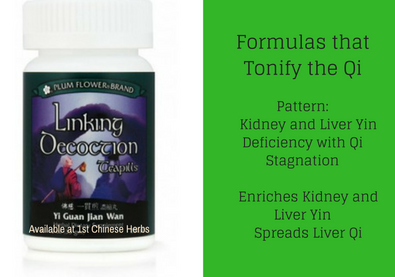
Yi Guan Jian is traditionally associated with a TCM pattern involving insufficient Liver and Kidney Yin together with constrained Liver Qi.
This is an important distinction because not every traditional Liver pattern is the same.
One person may have a pattern centered primarily on constrained Qi. Another traditional presentation may include signs that lead a TCM practitioner to consider insufficient Yin as an important part of the overall pattern.
Yi Guan Jian belongs to the latter traditional strategy: nourishing while also supporting appropriate Qi movement.
This traditional pattern association is also described in Chinese medicine formula references. :contentReference[oaicite:2]{index=2}
What Does “Liver Yin” Mean in Traditional Chinese Medicine?
This is one of the most important concepts to understand before buying this formula.
When Chinese herbal literature says that Yi Guan Jian traditionally nourishes Liver Yin, it does not mean that the product treats liver disease, repairs the liver or changes laboratory liver values.
Liver in this context refers to the traditional TCM Liver system, while Yin describes another concept within the traditional Chinese medicine framework.
The same applies to Kidney Yin.
A TCM practitioner discussing Kidney Yin is not necessarily saying that something is medically wrong with the kidneys. Kidney Yin deficiency in TCM and kidney disease in Western medicine are different concepts.
TCM pattern terminology should never be used as a substitute for a medical diagnosis.
Is Yi Guan Jian Simply a “Liver Teapill”?
No. That description would oversimplify the formula.
Traditional Chinese Medicine contains many formulas associated with the Liver system, but they are not interchangeable.
Yi Guan Jian is distinguished by the relationship between its nourishing ingredients and Chuan Lian Zi's traditional Qi-moving role.
That is why looking only at the word “Liver” can lead someone toward the wrong formula.
The complete traditional pattern matters more than one symptom or one organ name.
Why Teapills & How Do I Use Them?
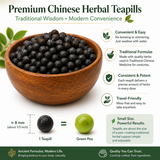
Linking Decoction is supplied as prepared Plum Flower teapills. There is no brewing or herbal decoction preparation required.
The label directions are 8 teapills, 3 times per day.
That equals 24 teapills per day. At the standard label directions, a 200-count bottle provides approximately 8 days of use.
Swallow the teapills with water and follow the product label unless an appropriate healthcare professional or qualified Traditional Chinese Medicine practitioner has provided individualized guidance.
Important Safety Information
Consult an appropriate healthcare professional before using Yi Guan Jian Wan if you are pregnant or nursing, take prescription medications, have a medical condition, or are uncertain whether this traditional formula is appropriate for you.
Traditional formula references also distinguish Yi Guan Jian from patterns dominated by Dampness, Phlegm or other forms of stagnation, reinforcing the importance of appropriate TCM pattern identification rather than selecting the formula from one characteristic alone. :contentReference[oaicite:3]{index=3}
Do not use terms such as Liver Yin deficiency or Kidney Yin deficiency as a substitute for medical evaluation. They describe traditional Chinese medicine patterns and are not diagnoses of liver or kidney disease.
Seek appropriate medical evaluation for new, severe, persistent or unexplained symptoms.
Frequently Asked Questions About Yi Guan Jian Wan
What is Yi Guan Jian Wan?
Yi Guan Jian Wan is a prepared teapill form of the traditional Chinese herbal formula commonly known as Linking Decoction or Yi Guan Jian.
How many herbs are in Linking Decoction?
This Plum Flower formula contains six traditional herbal ingredients: Sheng Di Huang, Gou Qi Zi, Bei Sha Shen, Mai Men Dong, Dang Gui and Chuan Lian Zi.
What is Yi Guan Jian traditionally associated with?
Within Traditional Chinese Medicine, Yi Guan Jian is traditionally associated with nourishing Yin while supporting the smooth movement of Liver Qi within its appropriate traditional pattern.
What makes Yi Guan Jian different from other Liver formulas?
Its traditional strategy combines nourishment and movement. Several herbs provide the Yin- and Blood-nourishing foundation of the formula, while Chuan Lian Zi contributes a traditional Liver Qi-moving component.
Does nourishing Liver and Kidney Yin mean Yi Guan Jian treats liver or kidney disease?
No. Liver, Kidney and Yin in this context are Traditional Chinese Medicine concepts. They should not be interpreted as claims that Yi Guan Jian treats liver disease, kidney disease or impaired organ function.
How many Linking Decoction teapills do I take?
The label directions are 8 teapills, 3 times per day. Follow the product label or individualized guidance from an appropriate healthcare professional.
How long does a 200-count bottle last?
At the standard label directions of 24 teapills per day, a 200-count bottle provides approximately 8 days of use.
Linking Decoction: Understanding the Formula as a Whole
Yi Guan Jian Wan becomes much easier to understand when you look beyond individual ingredients and consider why the six herbs were traditionally combined.
Sheng Di Huang, Gou Qi Zi, Bei Sha Shen, Mai Men Dong and Dang Gui create the nourishing foundation, while Chuan Lian Zi contributes a traditional Qi-moving component.
For customers comparing Chinese herbal formulas, that combination of nourishing Yin while supporting the smooth movement of Liver Qi is the important traditional characteristic that distinguishes Linking Decoction.
Before choosing a formula, compare the complete traditional pattern, ingredients and cautions rather than selecting a teapill based on a single symptom.
PubMed Research & Further Reading
- Rehmannia glutinosa (Sheng Di Huang) – Botany, Chemistry & Pharmacology Review
- Rehmannia glutinosa – Recent Research Review
- Lycium barbarum (Gou Qi Zi/Goji) – Phytochemistry, Pharmacology & Safety Review
- Lycium Species – Ethnobotany, Phytochemistry & Pharmacology Review
- Glehnia littoralis (Bei Sha Shen) – Traditional Use, Chemistry & Pharmacology Review
- Angelica sinensis (Dang Gui) – Traditional Uses, Phytochemistry & Research Review
Traditional Use & FDA Disclaimer
References to Liver, Kidney, Yin, Blood, fluids and Qi on this page describe concepts within Traditional Chinese Medicine. They are not Western medical diagnoses or descriptions of organ function.
These statements have not been evaluated by the Food and Drug Administration. This product is not intended to diagnose, treat, cure, or prevent any disease.