

Angelica – Dang Gui Wan – Plum Flower Teapills
Dang Gui Wan (當歸丸) is a traditional Chinese herbal formula centered around Dang Gui (Angelica sinensis), one of the most widely recognized herbs in Traditional Chinese Medicine (TCM) for nourishing and harmonizing Blood.
This Plum Flower formula combines Dang Gui, Chuan Xiong, Bai Zhu, and Da Zao in convenient prepared teapills. Rather than relying on Dang Gui alone, the formula combines nourishing, moving, and supporting herbs according to traditional Chinese herbal principles.
For people looking specifically for a traditional Dang Gui teapill formula, this 200-count bottle provides the complete prepared formula without measuring, simmering, or straining individual bulk herbs.
What Is Dang Gui Wan?
Dang Gui Wan (當歸丸) is a traditional Chinese herbal formula built around Dang Gui (Angelica sinensis root).
Dang Gui is one of the best-known herbs in Chinese herbalism. In Traditional Chinese Medicine, it is traditionally associated with nourishing Blood, invigorating Blood, harmonizing Blood, and supporting healthy circulation.
However, Dang Gui Wan is not simply a bottle of single-herb Dang Gui.
This Plum Flower formula combines four herbs:
- Dang Gui – Angelica sinensis root
- Chuan Xiong – Ligusticum chuanxiong rhizome
- Bai Zhu – Atractylodes macrocephala rhizome
- Da Zao – Ziziphus jujuba fruit
Together, they create a more balanced traditional formula in which nourishing herbs are combined with herbs traditionally used to move Blood and support Qi and digestion.
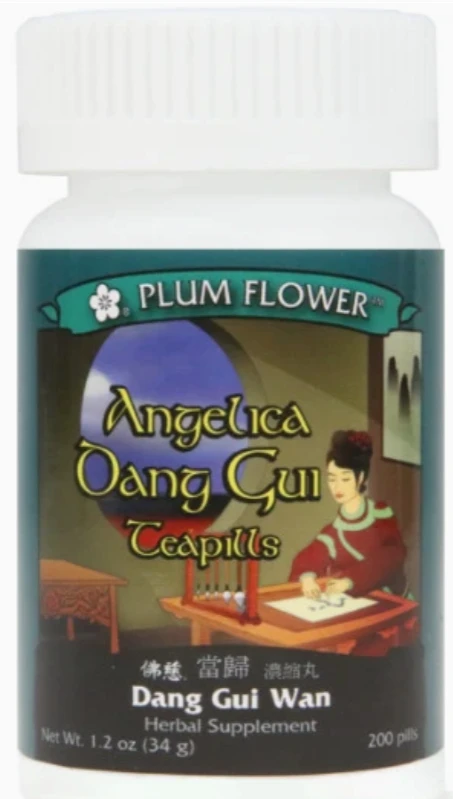 Product Details at a Glance
Traditional Name: Dang Gui Wan (當歸丸)
Alternate Name: Dang Gui San
Brand: Plum Flower
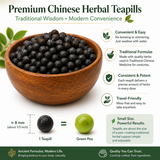
Form: Prepared Chinese herbal teapills
Bottle Size: 200 teapills
Formula Size: 4 traditional herbal ingredients
Label Directions: 8 teapills, 3 times daily
Approximate Supply: Approximately 8 days when taking 24 teapills per day
Origin: China
Preparation Required: None — swallow the prepared teapills with water
Important Allergen Information: Contains wheat. Bai Zhu is processed with wheat bran.
Pregnancy: Contraindicated during pregnancy.
What Herbs Are in Dang Gui Wan?
Dang Gui Wan contains four traditional botanical ingredients. Each contributes a different role within the traditional formula.
| Pin Yin | Botanical Ingredient | Traditional Role |
|---|---|---|
| Dang Gui | Angelica sinensis root | Traditionally nourishes, invigorates, and harmonizes Blood. |
| Chuan Xiong | Ligusticum chuanxiong rhizome | Traditionally invigorates Blood and promotes the movement of Qi and Blood. |
| Bai Zhu (Mi Fu) | Atractylodes macrocephala rhizome, honeyed and bran-fried | Traditionally tonifies Spleen Qi and supports transformation and transportation according to TCM theory. |
| Da Zao | Ziziphus jujuba fruit | Traditionally supports Qi and helps harmonize the herbs in a formula. |
Other Ingredients
Maltose, hydrated magnesium silicate, activated carbon, China wax.
Allergen Notice: Contains wheat. The Bai Zhu (Atractylodes macrocephala rhizome) is processed with wheat bran.
Why These Four Herbs?
The usefulness of a traditional Chinese formula comes from the relationship between its ingredients, not simply from adding several herbs together.
Dang Gui gives this formula its name and much of its traditional character. In Chinese herbalism, Dang Gui is especially associated with nourishing and invigorating Blood.
Chuan Xiong adds movement. Dang Gui and Chuan Xiong are a well-established herb pairing in traditional Chinese formulas. Rather than only nourishing, this pairing combines traditional nourishment with movement.
Bai Zhu contributes a different strategy. In TCM theory, it supports Spleen Qi — an important concept because the traditional Spleen system is associated with transforming food and drink and contributing to the production of Qi and Blood.
Da Zao traditionally supports Qi while helping harmonize the other ingredients.
The overall traditional strategy can therefore be thought of as:
Nourish + Move + Support + Harmonize.
That is why taking Dang Gui Wan is not the same as taking a single Dang Gui supplement.
What Does “Nourishing Blood” Mean in TCM?
Blood (Xue) is a Traditional Chinese Medicine concept. Although there is overlap with the ordinary meaning of blood, TCM Blood is part of a broader traditional system of pattern identification.
When Chinese herbal references say an herb such as Dang Gui “nourishes Blood,” they are describing its traditional role within that system.
It does not mean that Dang Gui Wan has been shown to treat anemia, blood disorders, abnormal bleeding, or another medical condition.
TCM practitioners traditionally evaluate the person's complete pattern before choosing a formula. Therefore, experiencing fatigue, feeling cold, menstrual changes, or another individual symptom does not by itself establish a TCM diagnosis of Blood deficiency.
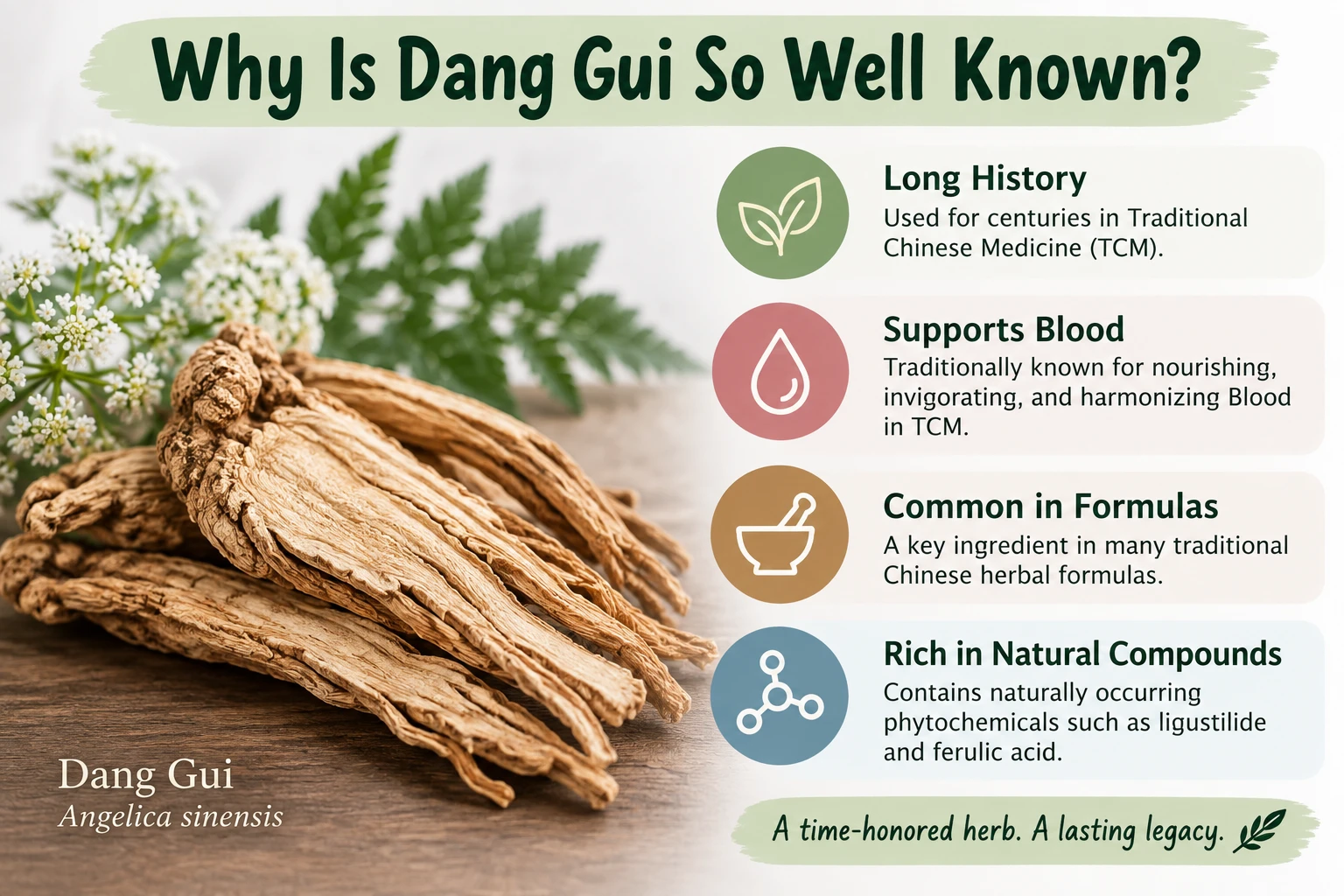
Why Is Dang Gui So Well Known?
Dang Gui is the Chinese name for Angelica sinensis root. It is also commonly encountered under names such as Chinese Angelica and Dong Quai.
Its long history in Chinese herbalism has made it one of the most recognizable Chinese herbs, particularly in formulas traditionally concerned with Blood.
Modern researchers have identified numerous naturally occurring constituents in Angelica sinensis, including phthalides, organic acids, polysaccharides, and other phytochemicals.
Two compounds frequently discussed in research on Dang Gui are ligustilide and ferulic acid.
Research into these constituents helps scientists understand the chemistry of the plant, but research on isolated compounds or extracts should not be interpreted as evidence that this finished Plum Flower teapill product treats a disease.
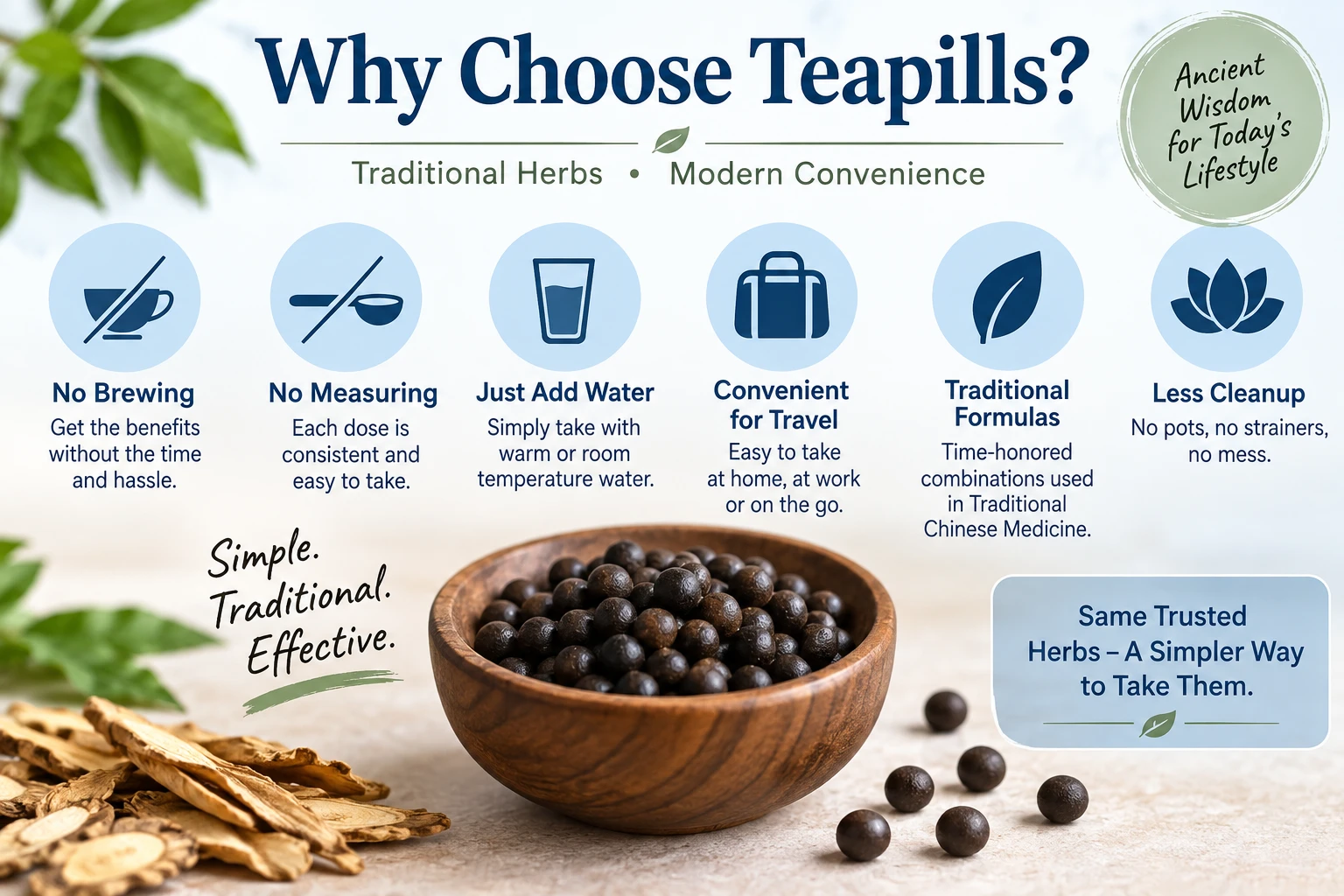
Why Teapills & How Do I Use Them?
Traditional Chinese formulas can be prepared as bulk-herb decoctions, powders, extracts, tablets, or pills.
Preparing a multi-herb decoction at home requires measuring the herbs, simmering them in water, straining the liquid, and cleaning the preparation equipment afterward.
Teapills eliminate those preparation steps.
- No measuring individual herbs
- No simmering a decoction
- No straining
- No herbal preparation cleanup
- Easy to carry and use away from home
Manufacturer's standard dosage: 8 teapills, 3 times per day.
At 24 teapills per day, a 200-count bottle provides approximately 8 days of use.
Follow the directions on the bottle you receive unless your qualified healthcare practitioner has provided different instructions.
Is Dang Gui Wan the Same as Dang Gui?
No. This distinction is important when shopping for Chinese herbs.
Dang Gui refers to the individual herb Angelica sinensis root.
Dang Gui Wan is a prepared herbal formula containing Dang Gui along with Chuan Xiong, Bai Zhu, and Da Zao.
If you are looking specifically for the complete Plum Flower Dang Gui Wan formula, check the ingredient list rather than assuming every product labeled “Dong Quai” or “Dang Gui” contains the same combination.
Dang Gui vs. Dong Quai — Are They the Same?
Dang Gui and Dong Quai generally refer to Angelica sinensis. Dang Gui is the Pin Yin spelling commonly used in Chinese herbalism, while Dong Quai is a spelling widely encountered on Western dietary supplements.
However, a product labeled “Dong Quai” may contain only Angelica sinensis, while Dang Gui Wan is a multi-herb traditional formula.
Always compare the botanical ingredients when choosing between products.
Research on Dang Gui & the Herbs in This Formula
Angelica sinensis has been extensively studied because of its long history of traditional use. Modern research has examined its botany, traditional uses, phytochemistry, processing, quality control, pharmacology, and safety.
A comprehensive review published in the Journal of Ethnopharmacology examined the traditional uses and chemistry of Angelica sinensis and discussed naturally occurring constituents including polysaccharides, ligustilide, and ferulic acid.
A newer 2026 scientific review provides an updated examination of the botany, traditional use, phytochemistry, pharmacology, safety, and applications of Angelica sinensis. The authors report that more than 290 chemical constituents have been identified while also noting the continuing need for high-quality clinical evidence and internationally recognized quality standards.
Researchers have also reviewed the traditional and scientific issues surrounding Dang Gui specifically, including plant identity, processing, preparation, safety, and herb-drug interactions.
The pairing of Dang Gui and Chuan Xiong has also been examined in scientific literature reviewing traditional herb combinations containing Angelica sinensis.
Chuan Xiong itself has an extensive history of traditional use and modern phytochemical investigation.
Bai Zhu (Atractylodes macrocephala) has likewise been the subject of research examining its traditional uses, phytochemistry, processing, pharmacology, and safety.
Research note: These studies are provided for educational purposes. Research involving individual herbs, extracts, isolated compounds, laboratory models, or preparations different from this product does not demonstrate that Plum Flower Dang Gui Wan produces the same effects or treats a medical condition.
Safety & Important Considerations
Pregnancy: The manufacturer lists this formula as contraindicated during pregnancy. Do not use during pregnancy.
Wheat Allergy / Gluten Concerns: This product contains wheat because the Bai Zhu is processed with wheat bran.
Prescription Medications: Consult your physician or pharmacist before using this product if you take prescription medications.
Bleeding or Anticoagulant Concerns: If you use anticoagulant or antiplatelet medication, have a bleeding disorder, or are preparing for surgery, discuss herbal supplement use with your healthcare professional before taking this product.
Medical Conditions: Consult your qualified healthcare professional before beginning a new herbal formula if you have a significant medical condition.
Important: Traditional descriptions such as “nourishes Blood,” “invigorates Blood,” and “tonifies Spleen Qi” refer to Traditional Chinese Medicine theory. They are not statements that this product treats anemia, circulatory disease, menstrual disorders, digestive disease, or another medical condition.
California Proposition 65 Warning
Why Buy Plum Flower Dang Gui Wan?
When shopping for Chinese herbal formulas, it is important to distinguish between single-herb Dang Gui products and the complete Dang Gui Wan formula.
This Plum Flower product contains the complete four-herb combination of Dang Gui, Chuan Xiong, Bai Zhu, and Da Zao in a convenient prepared teapill form.
- Complete 4-herb traditional formula
- 200-count bottle
- Clearly identified botanical ingredients
- Prepared teapill format
- No measuring individual bulk herbs
- No simmering or straining
- Easy to carry and use
Frequently Asked Questions About Dang Gui Wan
What is Dang Gui Wan?
Dang Gui Wan (當歸丸) is a traditional Chinese herbal formula containing Dang Gui, Chuan Xiong, Bai Zhu, and Da Zao. This Plum Flower version is supplied as 200 prepared teapills.
What is Dang Gui?
Dang Gui is the Pin Yin name for Angelica sinensis root, one of the best-known herbs in Traditional Chinese Medicine. It is traditionally associated with nourishing and invigorating Blood.
Is Dang Gui the same as Dong Quai?
Yes. Dang Gui and Dong Quai commonly refer to Angelica sinensis. Dang Gui is the Pin Yin spelling commonly used in Chinese herbalism, while Dong Quai is widely used on Western supplement labels.
Is Dang Gui Wan the same as Dong Quai capsules?
Not necessarily. Many Dong Quai capsules contain only Angelica sinensis. This Plum Flower Dang Gui Wan is a four-herb formula containing Dang Gui, Chuan Xiong, Bai Zhu, and Da Zao.
What herbs are in Plum Flower Dang Gui Wan?
The herbal ingredients are Dang Gui (Angelica sinensis root), Chuan Xiong (Ligusticum chuanxiong rhizome), Bai Zhu (Atractylodes macrocephala rhizome), and Da Zao (Ziziphus jujuba fruit).
What does Dang Gui Wan traditionally do?
According to Traditional Chinese Medicine theory, the formula centers on nourishing and harmonizing Blood while incorporating herbs traditionally used to move Blood and support Qi.
What does “nourishing Blood” mean?
Nourishing Blood is a Traditional Chinese Medicine concept. It describes a traditional herbal strategy and should not be interpreted as meaning that this product treats anemia, blood loss, or another blood disorder.
How do I take Dang Gui Wan teapills?
The manufacturer's standard dosage is 8 teapills, 3 times per day. Follow the directions on the product you receive or instructions from your qualified healthcare practitioner.
How long does a 200-count bottle last?
At 8 teapills three times daily, a person takes 24 teapills per day. A 200-count bottle therefore provides approximately 8 days of use.
Do Dang Gui Wan teapills need to be brewed?
No. The formula has already been prepared into small teapills. Simply take them according to the product directions. No decoction, simmering, or straining is required.
Does Dang Gui Wan contain wheat?
Yes. The manufacturer states that this product contains wheat because the Bai Zhu is processed with wheat bran.
Can I take Dang Gui Wan during pregnancy?
No. The manufacturer lists this formula as contraindicated during pregnancy.
Can I take Dang Gui Wan while breastfeeding?
Consult your healthcare professional before using Dang Gui Wan while breastfeeding.
Can I take Dang Gui Wan with blood thinners?
If you take an anticoagulant, antiplatelet medication, or other medicine that affects bleeding, consult your physician or pharmacist before using Dang Gui or a Dang Gui-containing formula.
Is Dang Gui Wan just for women?
Dang Gui is strongly associated with women's herbal traditions, but Chinese herbal formulas are traditionally selected according to an individual's TCM pattern rather than gender alone.
What is the difference between Dang Gui and Chuan Xiong?
In traditional Chinese herbal theory, Dang Gui is particularly associated with nourishing and harmonizing Blood, while Chuan Xiong has a stronger traditional association with moving Qi and Blood. Their combination is found in numerous traditional formulas.
Dang Gui Wan — More Than a Single-Herb Dong Quai Supplement
Dang Gui Wan is useful to understand as a complete traditional formula rather than simply another name for Dong Quai.
Dang Gui provides the formula's central nourishing and harmonizing character. Chuan Xiong contributes movement, Bai Zhu supports Spleen Qi according to traditional theory, and Da Zao helps support and harmonize the combination.
If you already know that Dang Gui Wan is the traditional formula you are looking for, Plum Flower provides the complete four-herb combination in an easy-to-use 200-count teapill bottle.
No measuring. No brewing. No straining. Take the prepared teapills according to the label directions.
Important Disclaimer
These statements have not been evaluated by the Food and Drug Administration (FDA). This product is not intended to diagnose, treat, cure, or prevent any disease. Traditional uses described on this page refer to Traditional Chinese Medicine theory and are provided for educational purposes.