

Gou Teng – Uncaria Ramulus Vine with Hooks | Premium Cut Chinese Herb
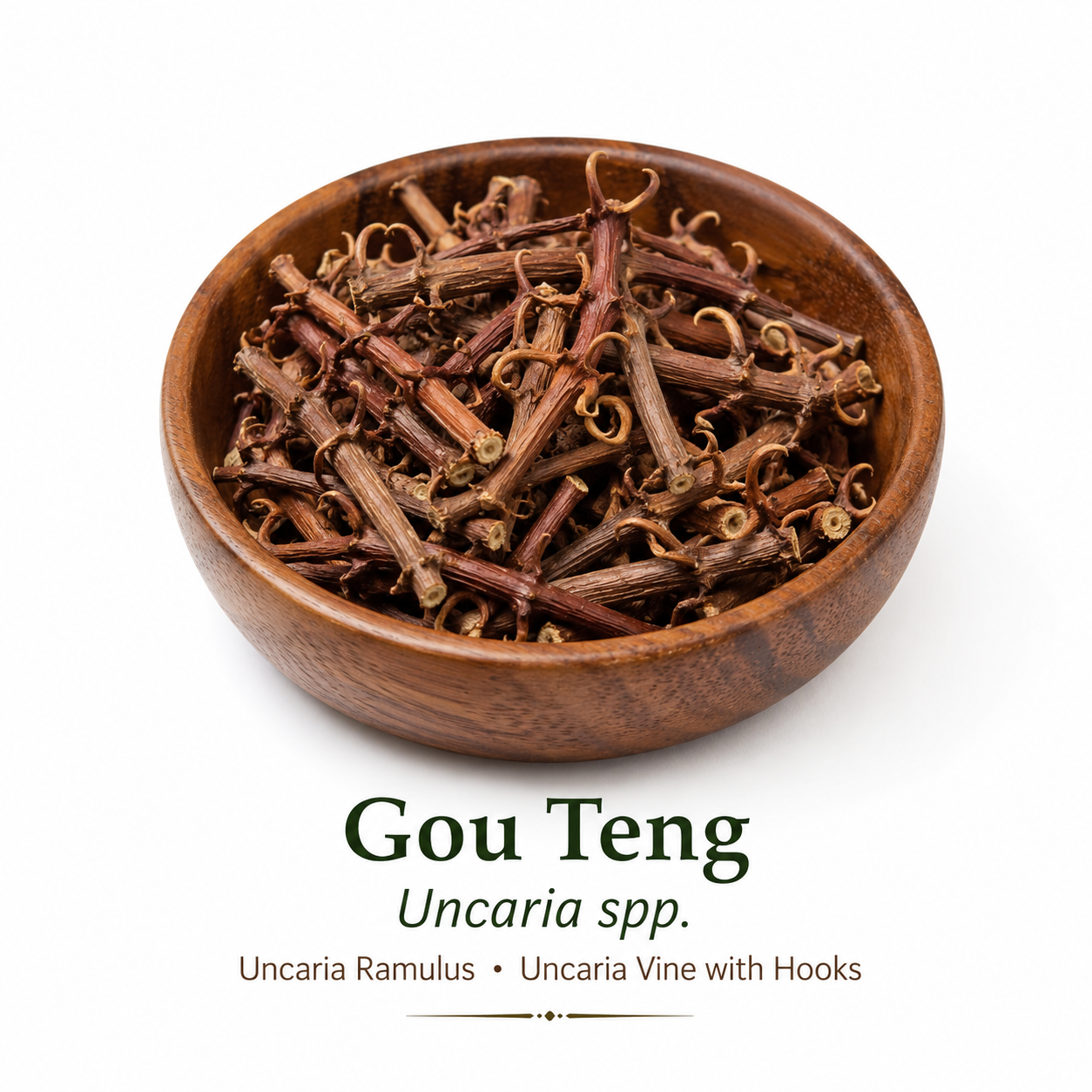
Gou Teng, also known as Uncaria Ramulus or Uncaria Vine with Hooks, is a traditional Chinese herb valued for its distinctive hooked stems and its long history of use in classical Chinese herbal formulas. In Traditional Chinese Medicine, Gou Teng is most often associated with the Liver and Pericardium channels and is traditionally used to support balance, calmness, and internal harmony.
This premium cut Gou Teng is offered in its natural dried form, making it suitable for traditional decoctions, custom herbal formulas, and educational herbal use. Because Gou Teng is sometimes confused with Western Cat's Claw, this page explains what Gou Teng is, how it is identified, how it differs from other Uncaria species, and why quality matters when choosing this herb.
Quick Summary
| Common Name | Uncaria Vine with Hooks |
| Pin Yin Name | Gou Teng |
| Botanical Name | Uncaria spp.; Ramulus |
| Other Names | Chinese Cat's Claw, Choto-ko, Uncariae Uncis Cum Ramulus |
| Form | Cut dried vine stem with hooks |
| Package Size | 1 pound |
| Origin | China |
| Brand | NuHerbs Lab Tested |
| Traditional Channels | Liver, Pericardium, Heart |
| Traditional Properties | Cool, Sweet |
On This Page
What Is Gou Teng?
Gou Teng is the dried hooked stem of plants in the Uncaria genus. The name refers to the vine's small curved hooks, which are one of the most recognizable features of the herb. These hooks are not just a visual detail; they are an important part of traditional identification and help distinguish Gou Teng from many other dried vine herbs.
In Chinese herbal tradition, Gou Teng is valued as a cooling herb associated with the Liver channel. It is commonly discussed in relation to traditional concepts such as internal wind, rising yang, irritability, restlessness, and heat-related imbalance. For website and product education, it is best described as a traditional herb used to support calm balance and classical formula harmony rather than as a treatment for disease.
Gou Teng is typically prepared as a decoction, but it is often added near the end of cooking rather than boiled for the entire preparation time. This traditional method helps preserve its delicate constituents and is one of the details that separates a well-written herbal page from a basic product description.
Why Herbalists Have Valued Gou Teng for Centuries
Gou Teng has earned an important place in traditional Chinese herbal practice because it fills a specific role that many other herbs do not. It is cooling, light, and traditionally used when the goal is to settle excess movement, clear heat, and support a smoother sense of internal balance.
In classical formulas, Gou Teng is rarely chosen randomly. It is usually paired with other herbs that help anchor, nourish, cool, or guide the formula. This is why Gou Teng often appears beside herbs such as Tian Ma, Ju Hua, Shi Jue Ming, Niu Xi, and Dan Shen. Each pairing gives the formula a different traditional direction.
Traditional Reasons Gou Teng Is Chosen
- Traditionally used in formulas that focus on Liver channel balance.
- Commonly paired with herbs that settle rising yang in Chinese herbal theory.
- Valued for its cooling nature and light, flexible quality.
- Used in classical formulas where calmness, clarity, and internal steadiness are the traditional goals.
- Recognized by its hooked vine stems, which help identify the herb visually.
Gou Teng Product Information
| Product Name | Gou Teng – Uncaria Ramulus Vine with Hooks |
| Common Name | Uncaria Vine with Hooks |
| Pin Yin | Gou Teng |
| Botanical Name | Uncaria spp.; Ramulus |
| Other Ingredients | None. Nothing has been added to this product. |
| Form | Cut dried herb |
| Package Size | 1 pound |
| Origin | China |
| Brand | NuHerbs Lab Tested |
| Quality Notes | Lab tested, properly dried, cut form, packaged for freshness. |
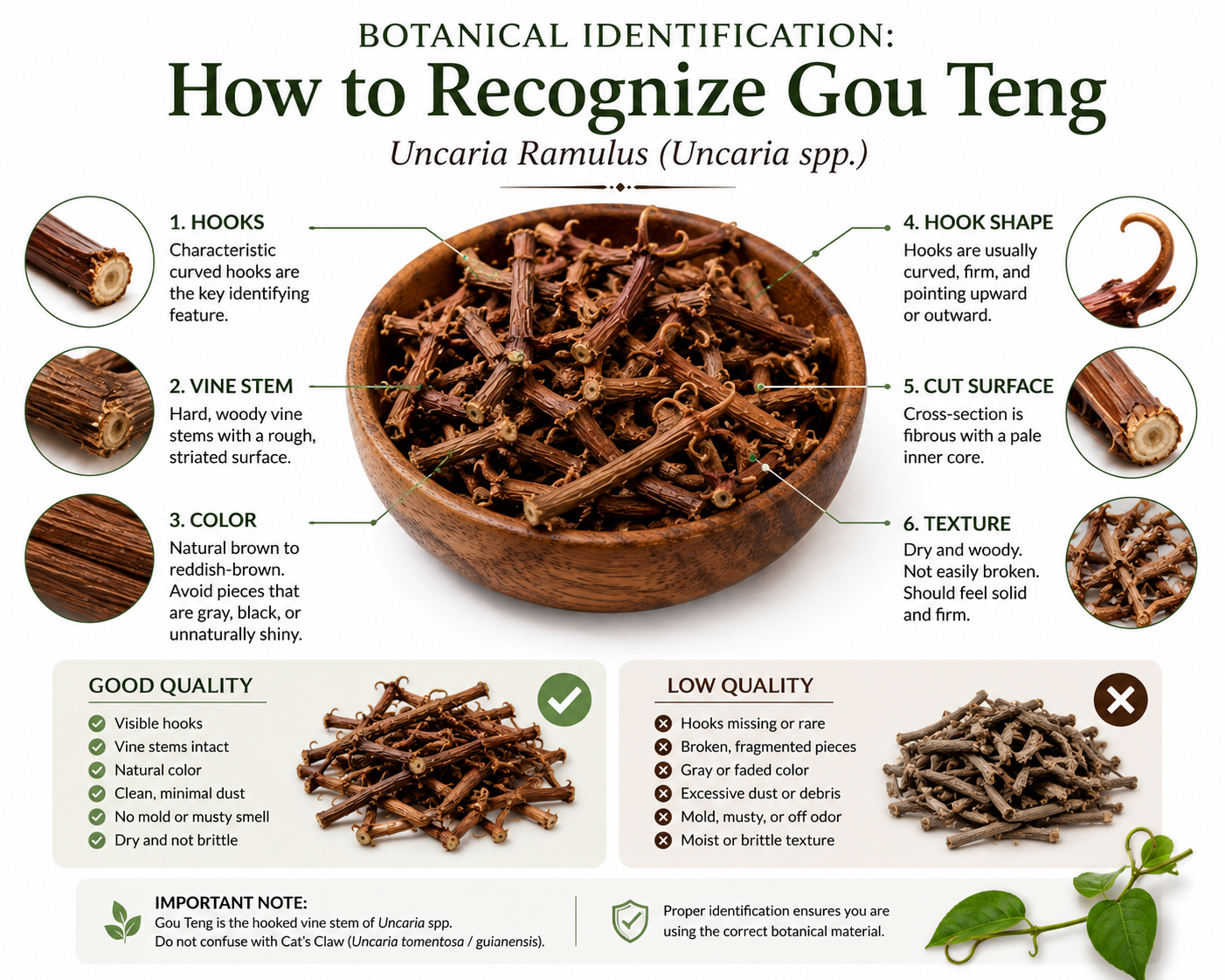
Botanical Identification: How to Recognize Gou Teng
The most important identifying feature of Gou Teng is the curved hook found along the vine stem. These hooks are where the herb gets its common English name, Uncaria Vine with Hooks. In quality dried material, the pieces should be clean, properly cut, and recognizable as vine stem portions rather than random woody fragments.
| Identification Feature | What to Look For | Why It Matters |
|---|---|---|
| Hooked Stem | Small curved hooks attached to vine pieces. | This is the signature feature of Gou Teng. |
| Cut Form | Short, manageable pieces suitable for decoction. | Cut herbs are easier to measure and prepare. |
| Color | Natural brown to reddish-brown stem color. | Color can help indicate proper drying and storage. |
| Aroma | Mild, natural, woody aroma. | Strong musty odors may suggest poor storage. |
| Cleanliness | Free from excess dust, debris, and unrelated plant matter. | Cleaner herbs are easier to prepare and more professional in quality. |
Gou Teng Species Comparison
The name Gou Teng may refer to several related Uncaria species used in Chinese herbal commerce. The most recognized species in traditional Chinese herbal practice is Uncaria rhynchophylla, although other related species may also appear under the broader Uncaria Ramulus category.
| Name | Description | Use in Herbal Commerce |
|---|---|---|
| Uncaria spp.; Ramulus | A broad label referring to the dried stem and hooks of plants within the Uncaria genus. | Often used for bulk herb listings when several accepted species may be represented. |
| Uncaria rhynchophylla | A specific species traditionally associated with Gou Teng in Chinese herbal practice. | Commonly considered one of the preferred species for traditional use. |
| Uncaria macrophylla | Another Uncaria species sometimes included within the broader Gou Teng category. | May appear in commerce depending on sourcing and regional standards. |
| Uncaria sinensis | A related Chinese Uncaria species. | Sometimes used as part of the accepted Gou Teng group. |
Gou Teng vs Cat's Claw: Are They the Same?
Gou Teng is sometimes called Chinese Cat's Claw, but it should not be confused with the Western herb commonly known as Cat's Claw, usually Uncaria tomentosa or Uncaria guianensis. They come from the same broader genus, but they are not used the same way in traditional herbal systems.
This distinction is important for customers because someone searching for Cat's Claw may accidentally purchase the wrong herb. Gou Teng belongs to Chinese herbal practice and is used in traditional formulas very differently from Peruvian Cat's Claw.
| Comparison | Gou Teng | Cat's Claw |
|---|---|---|
| Common Botanical Sources | Uncaria rhynchophylla and related Chinese Uncaria species. | Uncaria tomentosa or Uncaria guianensis. |
| Traditional System | Traditional Chinese Medicine. | Western and South American herbal traditions. |
| Plant Part Used | Hooked vine stem. | Usually inner bark or root bark. |
| Traditional Focus | Cooling, calming, Liver channel balance, formula harmony. | Often discussed for immune and inflammatory support in Western herbalism. |
| Should They Be Used Interchangeably? | No. Gou Teng has a specific role in Chinese herbal formulas. | No. Cat's Claw is a different herb with different traditional uses. |
Important Buying Tip
If you are looking for Gou Teng, choose a product labeled with Uncaria Ramulus, Uncaria Vine with Hooks, or Gou Teng. Do not assume that regular Cat's Claw is the same herb. They are different products used in different herbal traditions.
Is Gou Teng Right for You?
Gou Teng is best understood through the lens of traditional Chinese herbal pattern selection. In TCM, herbs are not chosen only by a single symptom. They are selected based on the overall pattern, constitution, accompanying signs, and the purpose of the formula. For that reason, Gou Teng is often used as part of a broader herbal strategy rather than as a stand-alone choice.
If you are unsure whether Gou Teng is the correct herb for your needs, consider working with a qualified herbalist, acupuncturist, or licensed healthcare professional familiar with Chinese herbal medicine.
Why Customers Choose 1st Chinese Herbs
- Trusted Since 1994 – Serving customers for over 30 years.
- Lab-Tested Herbs – Quality testing helps support confidence and transparency.
- Species-Focused Sourcing – Herbs are selected with proper identity and traditional use in mind.
- No Added Ingredients – This product contains only the herb listed.
- Traditional Cut Form – Suitable for decoctions and custom herbal preparation.
- Customer Support – We help customers understand product form, preparation, and traditional use.
Traditional Chinese Medicine Perspective
For more than a thousand years, Gou Teng (Uncaria Ramulus) has been an important herb in Traditional Chinese Medicine (TCM). Rather than focusing on a single symptom, TCM evaluates the body's overall pattern of balance and selects herbs that traditionally complement one another within carefully designed formulas.
Within traditional Chinese herbal theory, Gou Teng is considered a cooling herb that enters the Liver and Pericardium channels. Classical texts describe it as a herb traditionally chosen when the goal is to calm excessive internal movement, support harmony, and help restore balance according to traditional diagnostic principles.
Unlike many herbs that are used individually, Gou Teng is most commonly included as one component of a larger herbal formula. Experienced practitioners traditionally combine it with herbs that nourish, anchor, circulate, or harmonize depending on the individual's overall presentation.
Traditional Characteristics
| Traditional Nature | Cool |
| Traditional Flavor | Sweet |
| Traditional Channels | Liver • Heart • Pericardium |
| Plant Part | Hooked Vine Stem (Ramulus) |
| Traditional Preparation | Usually prepared as a decoction and commonly added near the end of cooking. |
Modern Scientific Interest
Modern researchers have become increasingly interested in Gou Teng because of the wide variety of naturally occurring plant compounds it contains. Scientists have investigated these constituents for their biological activity in laboratory and pre-clinical settings, particularly in relation to the nervous system, antioxidant activity, and vascular function.
Although modern research continues to expand, it is important to understand that traditional Chinese herbal medicine and contemporary scientific investigation approach herbs from different perspectives. Traditional use is based on centuries of observation and pattern-based herbal practice, while modern studies examine individual plant compounds and their mechanisms.
Major Naturally Occurring Plant Constituents
Every herb contains hundreds of naturally occurring compounds. Rather than one "active ingredient," Gou Teng contains numerous phytochemicals that work together within the plant. Researchers continue to study these compounds to better understand their characteristics.
| Compound Group | Examples | Why Researchers Study Them |
|---|---|---|
| Oxindole Alkaloids | Rhynchophylline, Isorhynchophylline | Among the best-known compounds identified in Gou Teng. |
| Flavonoids | Catechin, Epicatechin | Widely researched antioxidant plant compounds. |
| Phenolic Acids | Chlorogenic Acid | Common natural constituent found in many botanicals. |
| Triterpenes | Ursolic Acid, Oleanolic Acid | Naturally occurring plant compounds under continuing investigation. |
How to Recognize Premium Quality Gou Teng
Not all Gou Teng sold online is harvested, processed, or stored to the same standard. Quality begins long before the herb reaches your kitchen. The maturity of the vine, harvesting practices, drying methods, and storage conditions all contribute to the final product.
High-quality Gou Teng should be clean, naturally colored, properly dried, and contain recognizable hooked stems. Excessive dust, broken woody fragments, moldy odors, or faded gray coloring may indicate poor handling or extended storage.
| Quality Feature | Premium Quality | Lower Quality |
|---|---|---|
| Hooks | Clearly visible. | Few or missing. |
| Color | Natural brown. | Gray or faded. |
| Aroma | Fresh, mild, woody. | Musty or stale. |
| Cleanliness | Minimal dust and debris. | Large amounts of dust or foreign material. |
| Storage | Dry, sealed packaging. | Poorly sealed or moisture exposure. |
Why Quality Matters
When selecting any traditional Chinese herb, quality begins with proper species identification and continues through harvesting, drying, storage, laboratory testing, and packaging. At 1st Chinese Herbs, we believe customers deserve to know exactly what they are purchasing and how that herb fits within traditional Chinese herbal practice.
- Species-focused sourcing
- Traditional cut form
- Proper drying practices
- Quality laboratory testing
- No added ingredients
- Freshly packaged for storage
- Trusted herbal supplier since 1994
How to Use Gou Teng
One of the reasons Gou Teng has remained an important herb in Traditional Chinese Medicine for centuries is its versatility. Depending on your preferences and the guidance of your healthcare practitioner, it can be prepared in several different ways. The traditional preparation is a decoction, but modern herbalists may also use powders, concentrated extracts, capsules, or prepared formulas. Choosing the best preparation depends on convenience, desired strength, and whether Gou Teng is being used alone or as part of a traditional herbal formula.
The Four Most Common Ways to Use Gou Teng
| Preparation | Ease of Use | Traditional Use | Best For |
|---|---|---|---|
| Decoction | ★★★★☆ | ★★★★★ | Traditional herbal formulas |
| Tea | ★★★★★ | ★★★☆☆ | Beginners |
| Powder | ★★★★★ | ★★★★☆ | Smoothies or capsules |
| Extract | ★★★★★ | ★★★★☆ | Convenience |
Traditional Decoction (Recommended)
Preparing Gou Teng as a decoction is the traditional method used in Chinese herbal medicine. Unlike ordinary herbal tea, a decoction gently simmers tougher plant materials to extract their naturally occurring constituents. One unique characteristic of Gou Teng is that it is traditionally added near the end of the cooking process rather than simmered for the entire duration. This traditional technique helps preserve delicate plant compounds.
Ingredients
- 10–15 grams of Gou Teng
- 2–3 cups of filtered water
Traditional Preparation
- Bring water to a gentle boil.
- Add the remaining herbs in the formula first if preparing a traditional combination.
- Add Gou Teng during the last 10–15 minutes of simmering.
- Strain before drinking.
- Prepare fresh whenever possible.
Many classical Chinese formulas add Gou Teng toward the end of cooking rather than boiling it for a prolonged period.
How to Prepare Gou Teng Tea
Although decoctions remain the traditional choice, some people enjoy preparing a lighter herbal tea for educational and culinary purposes.
Basic Tea Preparation
- 1–2 teaspoons cut herb
- 8 ounces hot water
- Steep approximately 10–15 minutes
- Strain before drinking
Tea produces a lighter preparation than a traditional decoction and is often chosen for convenience.
Using Gou Teng Powder
Powdered Gou Teng offers convenience because it can be mixed into liquids or encapsulated. Some people prefer powder when preparing individual servings or when incorporating herbs into daily routines.
- Mix into warm water.
- Add to smoothies if appropriate.
- Place into empty capsules.
- Follow the recommendations provided by your qualified practitioner.
Concentrated Extracts
Concentrated extracts provide a smaller serving size while retaining the convenience many customers appreciate. Because extraction ratios vary between manufacturers, always follow the specific product directions.
What Does Gou Teng Taste Like?
Customers often ask what to expect before preparing Gou Teng. Fortunately, it is generally considered milder than many traditional Chinese herbs.
| Aroma | Light, woody, earthy. |
| Flavor | Mild with subtle sweetness. |
| Aftertaste | Clean and gentle. |
Proper Storage
Proper storage helps preserve freshness and quality.
- Store in an airtight container.
- Keep away from direct sunlight.
- Avoid excessive moisture.
- Store in a cool, dry location.
- Do not refrigerate unless humidity is a concern.
Common Beginner Mistakes
| Mistake | Better Approach |
|---|---|
| Confusing Gou Teng with Cat's Claw. | Verify the botanical name before purchasing. |
| Boiling Gou Teng for too long. | Traditionally add it near the end of the decoction. |
| Improper storage. | Keep sealed and dry. |
| Choosing herbs by name alone. | Learn about traditional herbal patterns and consult a qualified practitioner when appropriate. |
Choosing the Best Form of Gou Teng
If you're new to traditional Chinese herbs, cut Gou Teng is an excellent starting point because it reflects the way the herb has traditionally been prepared for generations. It also allows you to see the characteristic hooked stems that help identify authentic material. For customers who prioritize convenience, powders, capsules, or concentrated extracts may be more practical. The best choice ultimately depends on your personal preferences, preparation style, and the guidance of your healthcare practitioner.
Traditional Herbal Pairings for Gou Teng
In Traditional Chinese Medicine, Gou Teng is most often used as part of a balanced herbal formula rather than by itself. It is traditionally paired with herbs that help cool, anchor, nourish, move, or harmonize depending on the overall pattern being addressed.
The combinations below are provided for educational purposes and reflect traditional Chinese herbal theory. They are not intended as medical advice or as a substitute for guidance from a qualified practitioner.
| Traditional Pairing | Why They Are Compared or Combined | Traditional Formula Role |
|---|---|---|
| Gou Teng + Tian Ma | One of the most well-known classical pairings for internal wind patterns in TCM. | Gou Teng cools and settles; Tian Ma supports calm internal balance. |
| Gou Teng + Ju Hua | Often discussed together when Liver heat and head or eye-related traditional patterns are considered. | Both are cooling herbs traditionally associated with the Liver channel. |
| Gou Teng + Shi Jue Ming | A traditional pairing used when anchoring and cooling actions are desired in a formula. | Gou Teng settles movement; Shi Jue Ming anchors rising yang in TCM theory. |
| Gou Teng + Niu Xi | Commonly paired when formulas are designed to guide activity downward. | Niu Xi helps direct the formula downward while Gou Teng supports calm balance. |
| Gou Teng + Dan Shen | Sometimes discussed in formulas where movement, circulation, and calmness are considered together. | Dan Shen supports movement in traditional theory; Gou Teng supports settling. |
| Gou Teng + Bai Ji Li | Both are associated with the Liver channel and wind-related traditional patterns. | Bai Ji Li disperses; Gou Teng cools and settles. |
Expert Tip
Gou Teng is traditionally added near the end of a decoction. This small preparation detail is important because it reflects the way the herb has been handled in classical Chinese herbal practice.
Classical Chinese Formulas Featuring Gou Teng
Gou Teng appears in several well-known traditional Chinese formulas. These formulas are included here for educational reference so customers can better understand how Gou Teng has historically been used within complete formula systems.
| Formula Name | Traditional Focus | Role of Gou Teng |
|---|---|---|
| Tian Ma Gou Teng Yin | A famous formula traditionally associated with Liver yang rising and internal wind patterns. | Gou Teng helps cool, settle, and harmonize the formula. |
| Ling Jiao Gou Teng Tang | A classical formula traditionally used in intense heat and wind-pattern discussions. | Gou Teng contributes its cooling and settling traditional qualities. |
| Zhen Gan Xi Feng Tang | A formula traditionally discussed for anchoring and calming rising internal movement. | Gou Teng supports the formula’s traditional settling direction. |
Frequently Compared Herbs
Many customers compare Gou Teng with other traditional Chinese herbs because they appear together in formulas or are discussed in similar TCM categories. The table below helps clarify the differences.
| Herb | Why Customers Compare It | Simple Difference |
|---|---|---|
| Tian Ma | Often paired with Gou Teng in classical formulas. | Tian Ma is a root-like rhizome; Gou Teng is a hooked vine stem. |
| Ju Hua | Both are cooling herbs associated with the Liver channel. | Ju Hua is a flower; Gou Teng is a vine with hooks. |
| Dan Shen | Sometimes appears in formulas where circulation and calmness are both considered. | Dan Shen is a red root; Gou Teng is a hooked vine herb. |
| Bai Ji Li | Both are associated with wind-related traditional discussions. | Bai Ji Li is a fruit; Gou Teng is a vine stem. |
| Cat's Claw | The names are often confused online. | Gou Teng is Chinese Uncaria Ramulus; Cat's Claw is usually Uncaria tomentosa or guianensis. |
Gou Teng Quality Checklist
Before purchasing Gou Teng, use this simple checklist to help evaluate quality. A good product page should do more than sell the herb; it should help you become a more confident herbal buyer.
- Correct Name: Labeled as Gou Teng, Uncaria Ramulus, or Uncaria Vine with Hooks.
- Correct Plant Part: Hooked vine stem, not root bark or unrelated vine material.
- Visible Hooks: The characteristic hooks should be recognizable.
- Natural Color: Brown to reddish-brown, not bleached or unnaturally bright.
- Clean Aroma: Mild and woody, not musty or moldy.
- Proper Cut: Pieces should be suitable for decoction.
- No Added Ingredients: The product should contain only the listed herb.
- Quality Testing: Lab testing and sourcing transparency support customer confidence.
- Fresh Packaging: Sealed packaging helps protect the herb from moisture and air exposure.
Why Buy Gou Teng From 1st Chinese Herbs?
When customers buy Chinese herbs online, they are not just buying a plant. They are trusting the seller to provide proper identity, clean handling, careful packaging, and honest product information. At 1st Chinese Herbs, we have served customers since 1994 and continue to focus on quality, education, and transparency.
| Trusted Since 1994 | Over 30 years of herbal experience serving customers. |
| Lab-Tested Herbs | Quality testing helps support purity, identity, and confidence. |
| No Added Ingredients | This product contains the herb listed and nothing else. |
| Traditional Cut Form | Suitable for decoctions and traditional herbal preparation. |
| Educational Support | We help customers understand preparation, form, storage, and traditional use. |
| Ships From Washington | Orders are packed and shipped from our U.S.-based business. |
Continue Your Herbal Journey
To make this page stronger for SEO and easier for customers to navigate, link this section to related product pages, guides, and educational articles on your website.
- How to Make a Traditional Chinese Herbal Decoction
- Beginner’s Guide to Chinese Herbs
- Tian Ma – Gastrodia Root
- Ju Hua – Chrysanthemum Flower
- Dan Shen – Salvia Root
- How to Choose High Quality Chinese Herbs
Frequently Asked Questions About Gou Teng
The following questions are designed to help customers better understand Gou Teng, how it is traditionally used, how it is prepared, and how to choose a quality product.
What is Gou Teng?
Gou Teng is a traditional Chinese herb made from the hooked vine stem of plants in the Uncaria genus. It is also known as Uncaria Ramulus or Uncaria Vine with Hooks.
What does Gou Teng mean?
Gou Teng means “hook vine” or “vine with hooks,” referring to the small curved hooks found on the stem.
What is the botanical name for Gou Teng?
Gou Teng is commonly listed as Uncaria spp.; Ramulus. One well-known species associated with Gou Teng is Uncaria rhynchophylla.
Is Gou Teng the same as Cat's Claw?
No. Gou Teng is sometimes called Chinese Cat's Claw, but it is not the same as the Western herb Cat's Claw, which is usually Uncaria tomentosa or Uncaria guianensis.
Can Gou Teng and Cat's Claw be used interchangeably?
No. They come from related plant groups but are used differently in traditional herbal systems.
What part of the plant is used?
The hooked vine stem is used. This is why Gou Teng is often described as Uncaria Vine with Hooks.
What does Gou Teng look like?
Good quality Gou Teng should contain recognizable vine pieces with small curved hooks. The color is usually natural brown to reddish-brown.
What does Gou Teng taste like?
Gou Teng has a mild, slightly woody, earthy taste. It is generally less intense than many stronger Chinese herbs.
How is Gou Teng traditionally prepared?
Gou Teng is traditionally prepared as a decoction. It is commonly added near the end of the cooking process rather than boiled for the entire decoction time.
Why is Gou Teng added near the end of a decoction?
In traditional preparation, Gou Teng is often added near the end to help preserve its delicate plant constituents and traditional character.
Can Gou Teng be made as tea?
Yes. Gou Teng can be prepared as a lighter tea, though decoction is the more traditional method.
How much Gou Teng is commonly used?
Traditional use often varies by formula and practitioner guidance. Many traditional references list Gou Teng in the general range of 6–15 grams, but customers should follow professional guidance when using herbs.
Can Gou Teng be used alone?
It can be prepared alone, but in Traditional Chinese Medicine it is more commonly used as part of a balanced formula.
What herbs are commonly paired with Gou Teng?
Gou Teng is often discussed with Tian Ma, Ju Hua, Shi Jue Ming, Niu Xi, Dan Shen, and Bai Ji Li in traditional Chinese herbal theory.
What is Tian Ma Gou Teng Yin?
Tian Ma Gou Teng Yin is a classical Chinese herbal formula that features both Tian Ma and Gou Teng. It is included here for educational reference only.
What is the traditional nature of Gou Teng?
Gou Teng is traditionally considered cool in nature and sweet in flavor.
What channels is Gou Teng associated with?
In Traditional Chinese Medicine, Gou Teng is associated with the Liver, Pericardium, and Heart channels.
Is Gou Teng a root?
No. Gou Teng is not a root. It is a hooked vine stem.
Is Gou Teng a flower?
No. Gou Teng is not a flower. It is the hooked stem of the Uncaria plant.
Is Gou Teng beginner-friendly?
Gou Teng can be beginner-friendly when customers understand that it is traditionally used according to Chinese herbal pattern selection and is often part of a larger formula.
What should I look for when buying Gou Teng?
Look for proper labeling, visible hooks, natural color, clean aroma, sealed packaging, and quality testing whenever available.
Why do visible hooks matter?
The hooks are the signature identifying feature of Gou Teng and help confirm that the product is the correct plant part.
Should Gou Teng smell strong?
No. Gou Teng usually has a mild woody aroma. A musty or moldy smell may indicate poor storage.
How should Gou Teng be stored?
Store Gou Teng in a cool, dry place away from sunlight, moisture, and strong odors. Keep the package sealed when not in use.
Does Gou Teng contain caffeine?
Gou Teng is not a caffeinated tea leaf and does not naturally contain caffeine like green tea or black tea.
Is Gou Teng commonly used in Chinese herbal formulas?
Yes. Gou Teng appears in several classical Chinese formulas and is often used as part of a broader traditional formula strategy.
What makes Gou Teng different from Tian Ma?
Gou Teng is a hooked vine stem, while Tian Ma is a rhizome. They are often paired but are not the same herb.
What makes Gou Teng different from Ju Hua?
Ju Hua is chrysanthemum flower. Gou Teng is a hooked vine stem. Both are cooling herbs in traditional Chinese theory but have different roles.
Can Gou Teng be powdered?
Yes. Gou Teng may be available as powder, though cut form is commonly used for traditional decoctions.
Can Gou Teng be encapsulated?
Powdered Gou Teng can be placed into capsules, but customers should follow appropriate professional guidance.
What is the best form of Gou Teng?
Cut Gou Teng is often preferred for traditional decoction because it allows customers to see the characteristic hooked stem pieces.
Is Gou Teng used in cooking?
Gou Teng is generally used as an herbal decoction ingredient rather than as a culinary spice.
Is Gou Teng warming or cooling?
Gou Teng is traditionally considered cooling.
Is Gou Teng sweet or bitter?
In traditional Chinese herbal classification, Gou Teng is generally described as sweet.
Does Gou Teng need to be rinsed before use?
Some customers briefly rinse cut herbs before decocting. Avoid soaking for long periods unless directed by a practitioner.
Can Gou Teng be combined with other herbs?
Yes. Gou Teng is commonly combined with other herbs in traditional formulas, but combinations should be selected based on the overall pattern and purpose.
Who commonly purchases Gou Teng?
Gou Teng is often purchased by students of Chinese medicine, herbal practitioners, acupuncturists, tea enthusiasts, and customers learning about traditional Chinese herbs.
Why buy Gou Teng from 1st Chinese Herbs?
1st Chinese Herbs has served customers since 1994 and focuses on quality herbs, lab-tested sourcing, clear product information, and customer education.
Does this product contain anything besides Gou Teng?
No. This product contains Gou Teng only. Nothing has been added.
Where does this Gou Teng come from?
This Gou Teng is sourced from China and offered in cut dried form.
Is Gou Teng lab tested?
This Gou Teng is listed as NuHerbs Lab Tested. Quality testing supports customer confidence and sourcing transparency.
Is Gou Teng right for everyone?
No herb is right for everyone. Gou Teng should be selected based on individual needs, traditional pattern considerations, and professional guidance when appropriate.
Are there cautions for Gou Teng?
Do not use if pregnant or nursing unless directed by a qualified healthcare professional. Customers taking medication or managing a health condition should consult a qualified practitioner before use.
Can Gou Teng interact with medications?
Gou Teng may not be appropriate for everyone, especially individuals taking medications or managing blood pressure, heart, neurological, or bleeding-related concerns. Consult a qualified healthcare professional before use.
Is this information medical advice?
No. This page is for educational purposes only and is not intended to diagnose, treat, cure, or prevent any disease.