

Ping Chuan Wan Teapills – 200 Pills – Plum Flower
Ping Chuan Wan (平遄丸) is a traditional Chinese herbal formula associated with patterns involving wheezing, difficult breathing, Phlegm, and weakness of the Lung and Kidney systems according to Traditional Chinese Medicine theory.
This 11-ingredient formula combines herbs traditionally used to support the Lung's descending function, transform Phlegm, regulate Qi, and strengthen underlying Qi. Its composition includes Xing Ren, Sang Bai Pi, Chen Pi, Bai Qian, Ren Shen, Cordyceps mycelium, and other traditional ingredients.
Ping Chuan Wan is best understood as a pattern-specific traditional formula rather than as a general respiratory supplement. In TCM, the combination of symptoms and the underlying pattern are important when selecting a formula.
What Is Ping Chuan Wan?
Ping Chuan Wan (平遄丸) is a traditional Chinese herbal formula containing 11 ingredients.
The words associated with Ping Chuan traditionally refer to calming or easing wheezing. However, this traditional terminology should not be interpreted as a claim that the product treats asthma or another diagnosed respiratory disease.
The formula combines several traditional strategies. Some ingredients are associated with directing Lung Qi downward and addressing Phlegm, while others support Qi and the Lung and Kidney systems according to TCM theory.
This combination gives Ping Chuan Wan both a respiratory-pattern focus and a supportive or tonifying component.
Product Details at a Glance
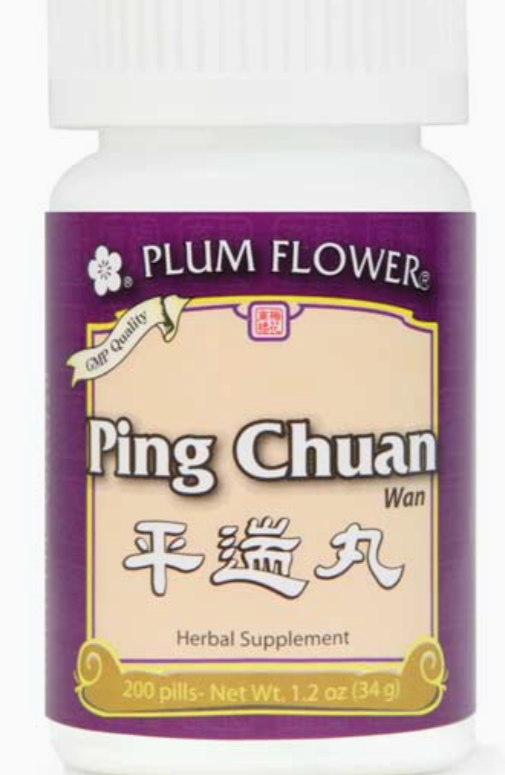
Traditional Name: Ping Chuan Wan (平遄丸)
Brand: Plum Flower
Form: Prepared Chinese herbal teapills
Bottle Size: 200 teapills
Formula Size: 11 traditional ingredients
Label Directions: 8 teapills, 3 times daily
Approximate Supply: Approximately 8 days when taking 24 teapills per day
Origin: China
Preparation Required: None — swallow the prepared teapills with water
Manufacturer Contraindication: Contraindicated during pregnancy
Allergen Information: Contains apricot kernel and walnut
What Ingredients Are in Ping Chuan Wan?
The current Plum Flower Ping Chuan Wan formula contains 11 traditional ingredients. This includes herbs, Cordyceps mycelium, and the traditional mineral ingredient Qing Meng Shi.
| Pin Yin | Ingredient | Traditional Role |
|---|---|---|
| Xing Ren (Ku) | Prunus armeniaca seed | Traditionally directs Lung Qi downward and is used in formulas involving cough and wheezing patterns. |
| Hu Tao Ren | Juglans regia nut | Traditionally supports the Kidney system and is used in TCM formulas when the Kidneys are considered unable to adequately grasp Qi. |
| Man Hu Tui Zi Ye | Elaeagnus glabra leaf | Included as part of the formula's traditional respiratory strategy. |
| Wu Zhi Mao Tao | Ficus simplicissima root | Traditionally used to support Qi and strengthen the body's functional systems according to Chinese herbal practice. |
| Gan Cao | Glycyrrhiza uralensis root | Traditionally supports Qi and harmonizes the other ingredients in the formula. |
| Sang Bai Pi | Morus alba root-bark | Traditionally clears the Lung and directs Lung Qi downward. |
| Chen Pi | Citrus reticulata peel | Traditionally regulates Qi and helps transform Phlegm. |
| Bai Qian | Cynanchum stauntonii root & rhizome | Traditionally directs Lung Qi downward and transforms Phlegm. |
| Ren Shen (Hong) | Panax ginseng root, steamed | Steamed red ginseng traditionally strongly supports Yuan Qi and Lung Qi. |
| Dong Chong Xia Cao Jun Si Ti | Cordyceps mycelium | Traditionally associated with supporting the Lung and Kidney systems. |
| Qing Meng Shi | Lapis chloriti mineral | A traditional mineral ingredient used in Chinese medicine in formulas designed to address stubborn Phlegm patterns. |
Other Ingredients
Dextrin (maltose), hydrated magnesium silicate, activated carbon, China wax.
Allergen Information: Contains apricot kernel and walnut.
Why These 11 Ingredients?
Ping Chuan Wan brings together several traditional strategies rather than relying on a single type of herb.
Xing Ren, Sang Bai Pi, and Bai Qian contribute to the formula's traditional emphasis on directing Lung Qi downward.
Chen Pi and Bai Qian contribute to the management of Phlegm according to TCM theory, while Qing Meng Shi provides an additional traditional Phlegm-focused component.
The formula also contains a distinctly supportive group. Ren Shen, Cordyceps mycelium, and Hu Tao Ren contribute to the formula's traditional Lung, Kidney, and Qi-supporting strategy.
This helps distinguish Ping Chuan Wan from a formula designed only to disperse an exterior pattern. It combines herbs addressing the immediate traditional respiratory pattern with ingredients traditionally used to support an underlying deficiency.
What Does Lung Qi Not Descending Mean?
Traditional Chinese Medicine describes the Lung as having an important role in the normal downward movement or descending of Qi.
When this function is disrupted, TCM practitioners may describe Lung Qi as rebelling upward or failing to descend normally. Traditional respiratory signs such as coughing or wheezing may be evaluated as part of this larger pattern.
Ingredients such as Xing Ren, Sang Bai Pi, and Bai Qian have traditionally been used in Chinese herbal formulas to help restore this downward movement of Lung Qi.
This is a Traditional Chinese Medicine concept and is not a diagnosis of asthma, COPD, bronchitis, pneumonia, or another respiratory disease.
Why Are Both the Lung and Kidney Systems Important?
In Traditional Chinese Medicine, normal breathing is not attributed exclusively to the Lung system.
The Lungs are traditionally said to govern Qi and respiration, while the Kidneys have a traditional role in receiving or “grasping” Qi.
When weakness is part of a traditional respiratory pattern, TCM practitioners may therefore consider both systems rather than focusing only on the Lungs.
The inclusion of ingredients such as Hu Tao Ren, Ren Shen, and Cordyceps mycelium helps explain the supportive side of the Ping Chuan Wan formula.
Why Does Ping Chuan Wan Contain Cordyceps Mycelium?
Dong Chong Xia Cao Jun Si Ti is Cordyceps mycelium.
Within traditional Chinese herbal practice, Cordyceps has a longstanding association with the Lung and Kidney systems. Its presence is particularly relevant in a formula such as Ping Chuan Wan because the formula is not constructed solely around dispersing or clearing herbs.
It also includes ingredients traditionally intended to support the body's underlying Qi and Lung-Kidney relationship.
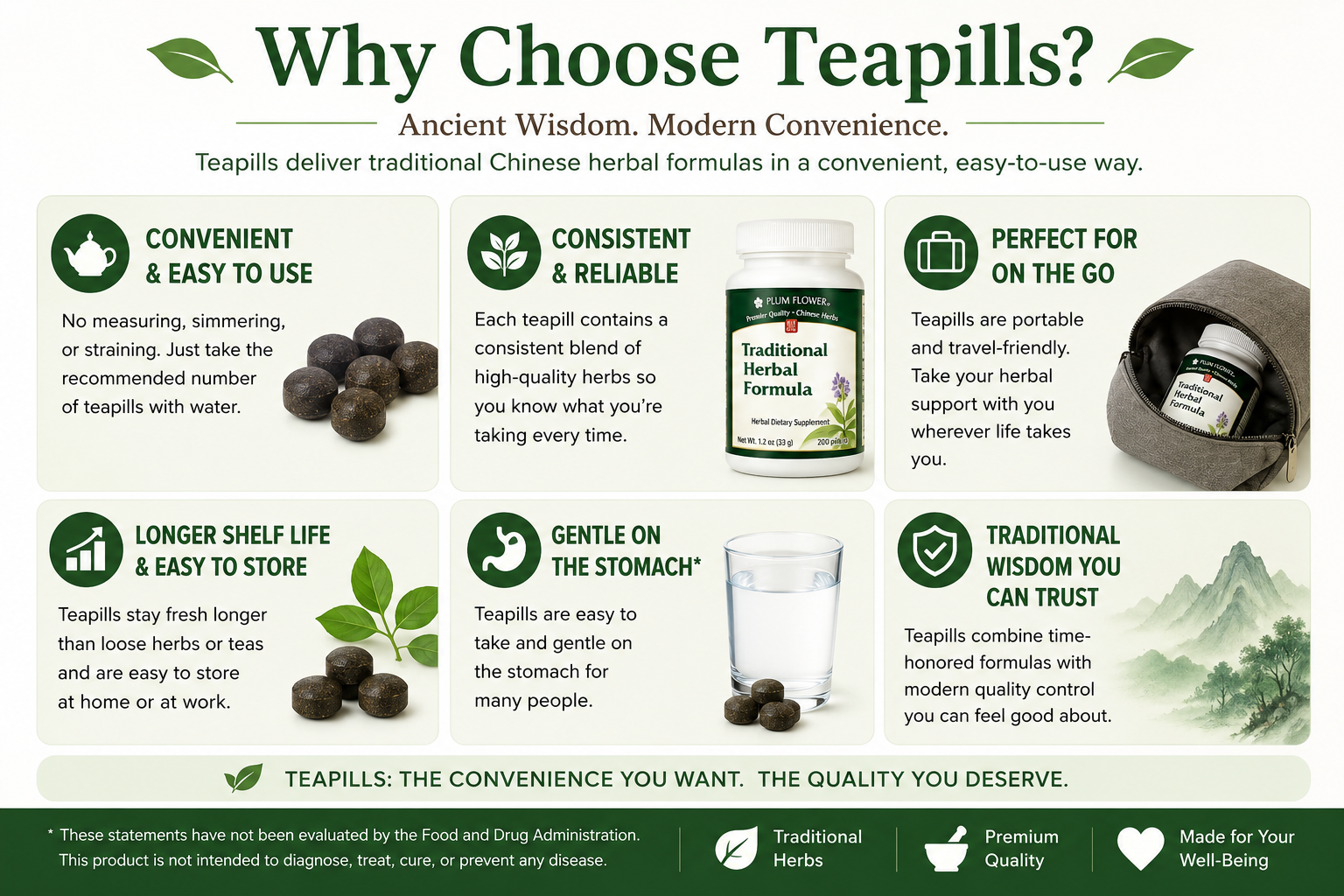
Why Teapills & How Do I Use Them?
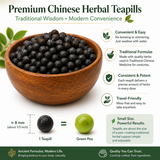
Ping Chuan Wan contains 11 traditional ingredients in a prepared teapill form.
There is no measuring individual bulk ingredients, no simmering, no straining, and no herbal preparation cleanup. The prepared teapills can be swallowed with water according to the product directions.
Manufacturer's standard dosage: 8 teapills, 3 times per day.
At 24 teapills per day, a 200-count bottle provides approximately 8 days of use.
Follow the directions on the product you receive unless your qualified healthcare practitioner has provided different instructions.
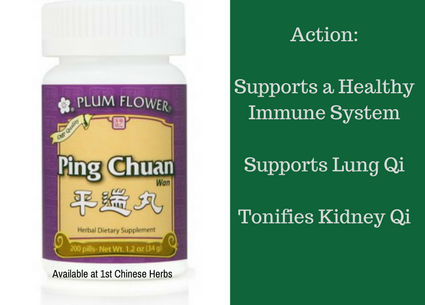 Is Ping Chuan Wan the Right Traditional Formula?
Ping Chuan Wan is traditionally associated with a respiratory pattern involving disrupted Lung Qi, Phlegm, and an underlying weakness involving Qi and the Lung-Kidney relationship.
That makes pattern identification particularly important.
A person experiencing respiratory symptoms does not automatically fit the Ping Chuan Wan pattern. Traditional Chinese Medicine recognizes many different patterns that may involve coughing, wheezing, Phlegm, or breathing discomfort, and the appropriate herbal strategy can differ considerably among them.
If you are uncertain about the traditional pattern, a qualified Traditional Chinese Medicine practitioner can help determine whether Ping Chuan Wan or another formula is more appropriate.
Understanding Some of the Key Ingredients
| Ingredient | Why It Stands Out in the Formula |
|---|---|
| Xing Ren | A major traditional Lung herb used to direct Lung Qi downward. |
| Sang Bai Pi | Traditionally focuses on the Lung and helps direct Lung Qi downward. |
| Bai Qian | Traditionally combines downward Lung-Qi movement with a Phlegm-focused action. |
| Chen Pi | Traditionally regulates Qi and transforms Phlegm. |
| Ren Shen | Steamed Panax ginseng provides an important Qi-supporting component. |
| Cordyceps Mycelium | Traditionally associated with supporting both the Lung and Kidney systems. |
| Qing Meng Shi | A traditional mineral ingredient included in Chinese formulas addressing Phlegm patterns. |
Research on Ping Chuan Wan & Its Ingredients
Modern research has investigated several ingredients found in Ping Chuan Wan. These PubMed searches provide a starting point for customers interested in exploring the scientific literature.
- Ping Chuan Wan Research – PubMed
- Xing Ren (Prunus armeniaca) Research – PubMed
- Sang Bai Pi (Morus alba) Research – PubMed
- Chen Pi (Citrus reticulata) Research – PubMed
- Bai Qian (Cynanchum stauntonii) Research – PubMed
- Ren Shen (Panax ginseng) Research – PubMed
- Cordyceps Mycelium Research – PubMed
- Gan Cao (Glycyrrhiza uralensis) Research – PubMed
Research note: Research may involve individual ingredients, extracts, isolated compounds, different formulas, animal models, or dosages that differ from this Plum Flower product. These links are provided for educational purposes and do not establish that Ping Chuan Wan Teapills diagnose, treat, cure, or prevent any disease.
Safety & Important Considerations
Pregnancy: The manufacturer states that Ping Chuan Wan is contraindicated during pregnancy.
Allergens: This formula contains apricot kernel and walnut. Do not use this product if you have an allergy to an ingredient in the formula.
Prescription Medications: This is a multi-ingredient formula that includes Panax ginseng and Glycyrrhiza uralensis. If you take prescription medications or have an ongoing medical condition, consult your physician or pharmacist before use.
Breathing Problems: Difficulty breathing can have many causes and should not automatically be assumed to represent a Traditional Chinese Medicine pattern. New, unexplained, worsening, or significant breathing difficulty requires appropriate medical evaluation.
Emergency Symptoms: Severe difficulty breathing, blue or gray lips or skin, chest pain or pressure, confusion, fainting, or rapidly worsening respiratory symptoms require immediate medical attention.
Important: Lung Qi, Kidney Qi, Phlegm, and related terminology on this page describe Traditional Chinese Medicine concepts and are not Western medical diagnoses.
California Proposition 65 Warning
Why Buy Plum Flower Ping Chuan Wan?
Ping Chuan Wan is a distinctive 11-ingredient traditional Chinese formula combining herbs traditionally associated with Lung Qi, Phlegm, and respiratory patterns with ingredients traditionally used to support underlying Qi and the Lung-Kidney relationship.
The current formula includes recognizable traditional ingredients such as Xing Ren, Sang Bai Pi, Chen Pi, Bai Qian, steamed Ren Shen, and Cordyceps mycelium, together with the other components of the complete formula.
The product is supplied in a 200-count bottle with manufacturer directions of 8 teapills, 3 times daily.
Frequently Asked Questions About Ping Chuan Wan
What is Ping Chuan Wan?
Ping Chuan Wan (平遄丸) is an 11-ingredient traditional Chinese herbal formula associated with respiratory patterns involving Lung Qi, Phlegm, and underlying Qi weakness according to Traditional Chinese Medicine theory.
What is Ping Chuan Wan traditionally used for?
In Traditional Chinese Medicine, Ping Chuan Wan is traditionally associated with patterns involving wheezing, difficult breathing, Phlegm, disrupted Lung Qi, and underlying weakness. These are traditional pattern descriptions rather than Western medical diagnoses.
Is Ping Chuan Wan an asthma medicine?
No. Ping Chuan Wan is a traditional Chinese herbal formula and should not be considered a replacement for medical diagnosis or prescribed asthma treatment. Wheezing or breathing difficulty should be appropriately medically evaluated.
What herbs are in Ping Chuan Wan?
The Plum Flower formula contains Xing Ren, Hu Tao Ren, Man Hu Tui Zi Ye, Wu Zhi Mao Tao, Gan Cao, Sang Bai Pi, Chen Pi, Bai Qian, Ren Shen, Cordyceps mycelium, and Qing Meng Shi.
Does Ping Chuan Wan contain ginseng?
Yes. The formula contains Ren Shen (Hong), identified by the manufacturer as steamed Panax ginseng root.
Does Ping Chuan Wan contain Cordyceps?
Yes. The manufacturer lists Dong Chong Xia Cao Jun Si Ti, or Cordyceps mycelium, as an ingredient.
Does Ping Chuan Wan contain walnut?
Yes. The manufacturer specifically identifies walnut in the allergen information.
Does Ping Chuan Wan contain apricot kernel?
Yes. Xing Ren is Prunus armeniaca seed, and the manufacturer identifies apricot kernel in the allergen information.
Can Ping Chuan Wan be taken during pregnancy?
No. The manufacturer states that Ping Chuan Wan is contraindicated during pregnancy.
How do I take Ping Chuan Wan Teapills?
The manufacturer's standard dosage is 8 teapills, 3 times per day. Follow the directions on the product you receive or instructions from your qualified healthcare practitioner.
How long does a 200-count bottle last?
At the manufacturer's standard dosage of 24 teapills per day, a 200-count bottle provides approximately 8 days of use.
What other ingredients are in Ping Chuan Wan?
The manufacturer lists dextrin (maltose), hydrated magnesium silicate, activated carbon, and China wax.
Ping Chuan Wan — A Lung, Phlegm & Qi-Focused Traditional Formula
What makes Ping Chuan Wan distinctive is the way its 11 ingredients address several parts of a traditional pattern at once.
Xing Ren, Sang Bai Pi, and Bai Qian contribute to the downward movement of Lung Qi; Chen Pi and Qing Meng Shi contribute to the formula's Phlegm-focused strategy; and Ren Shen, Hu Tao Ren, and Cordyceps mycelium add the underlying supportive component.
This combination helps explain why Ping Chuan Wan occupies a more specific place within traditional Chinese herbal practice than a general-purpose respiratory supplement.
Important Disclaimer
These statements have not been evaluated by the Food and Drug Administration (FDA). This product is not intended to diagnose, treat, cure, or prevent any disease. Traditional uses and patterns described on this page refer to Traditional Chinese Medicine theory and are provided for educational purposes.