

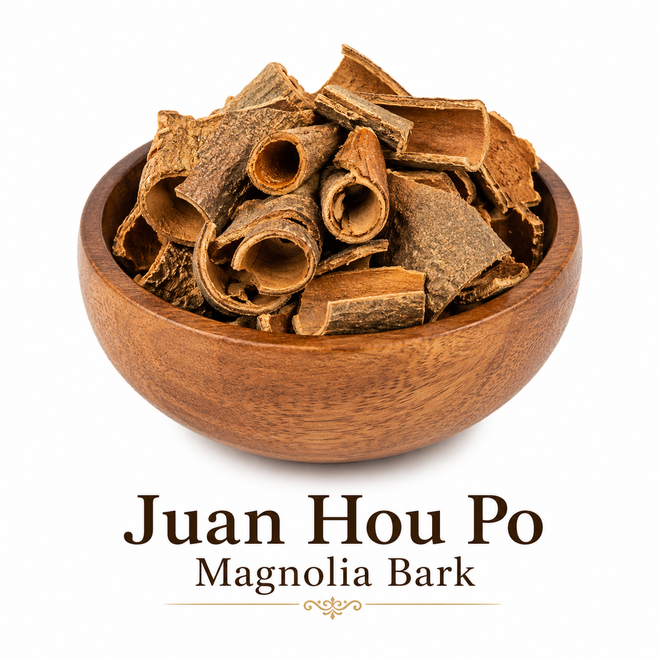
Nuherbs • Traditional Cut Bark • One-Pound Package
Magnolia Bark – Juan Hou Po – Cut – Nuherbs – 1 Pound
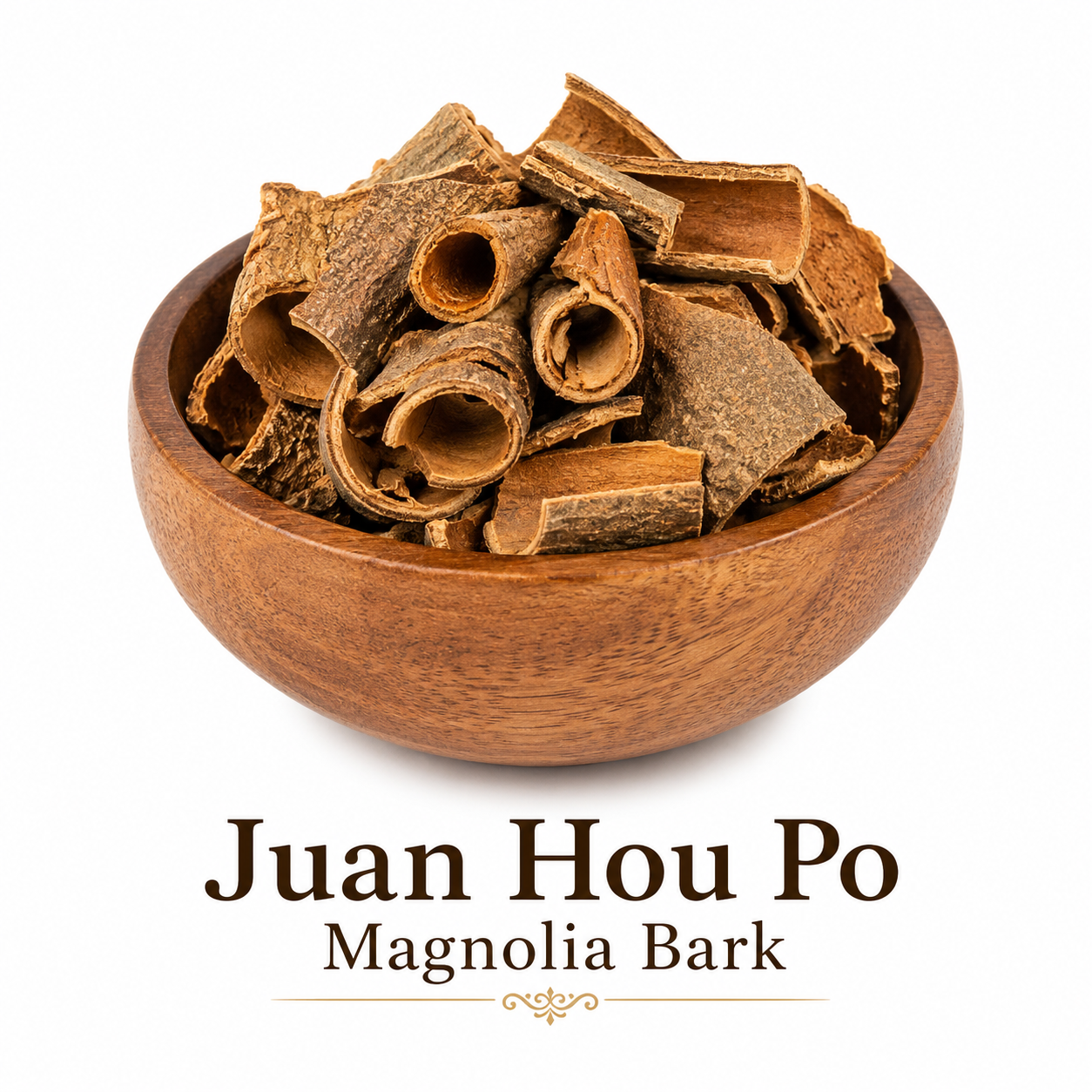 A Distinctive Traditional Bark for the Well-Stocked Herbal Pantry
Some botanicals are remembered for their flowers. Magnolia Bark is remembered for what lies beneath them.
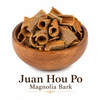
Known in Chinese herbal traditions as Hou Po or Juan Hou Po, Magnolia Bark has been valued for generations as a distinctive aromatic bark used in carefully selected traditional preparations. Its curled shape, layered texture, warm woody aroma, and long history make it immediately recognizable to experienced herbalists.
This Nuherbs product preserves Magnolia Bark in its traditional cut form. Instead of receiving a capsule, unidentified powder, or highly concentrated extract, you receive visible pieces of dried Magnolia officinalis bark that can be examined, measured, and prepared according to established herbal instructions.
It is a practical choice for practitioners, herbal students, educators, formula makers, and experienced home users who want a clearly identified bulk botanical from a trusted herbal supplier.
Magnolia Bark at a Glance
Botanical Name: Magnolia officinalis
Traditional Name: Juan Hou Po or Hou Po
Plant Part: Dried bark
Product Form: Cut strips, slices, fragments, and naturally curled pieces
Package Size: 1 pound
Brand: Nuherbs
Ingredients: Magnolia Bark with nothing added
Country of Origin: China
Fulfilled From: Washington State, USA
Recommended Storage: Keep tightly sealed in a cool, dry location
What Is Magnolia Bark?
Magnolia Bark is the dried bark of Magnolia officinalis, a deciduous tree native to regions of China. The species is known for its large leaves, fragrant flowers, and thick bark. In Chinese herbal commerce and traditional reference materials, the prepared bark is commonly called Hou Po.
The bark is harvested, dried, and cut into usable pieces. As it loses moisture, many sections curve or roll inward. This creates the characteristic curled strips and irregular fragments seen in traditional bulk Magnolia Bark.
Because bark protects and supports a living tree, it is naturally denser and more fibrous than flowers or leaves. That physical difference influences both its appearance and its traditional preparation. Rather than being steeped briefly like a delicate flower tea, bark materials are generally simmered as part of a decoction.
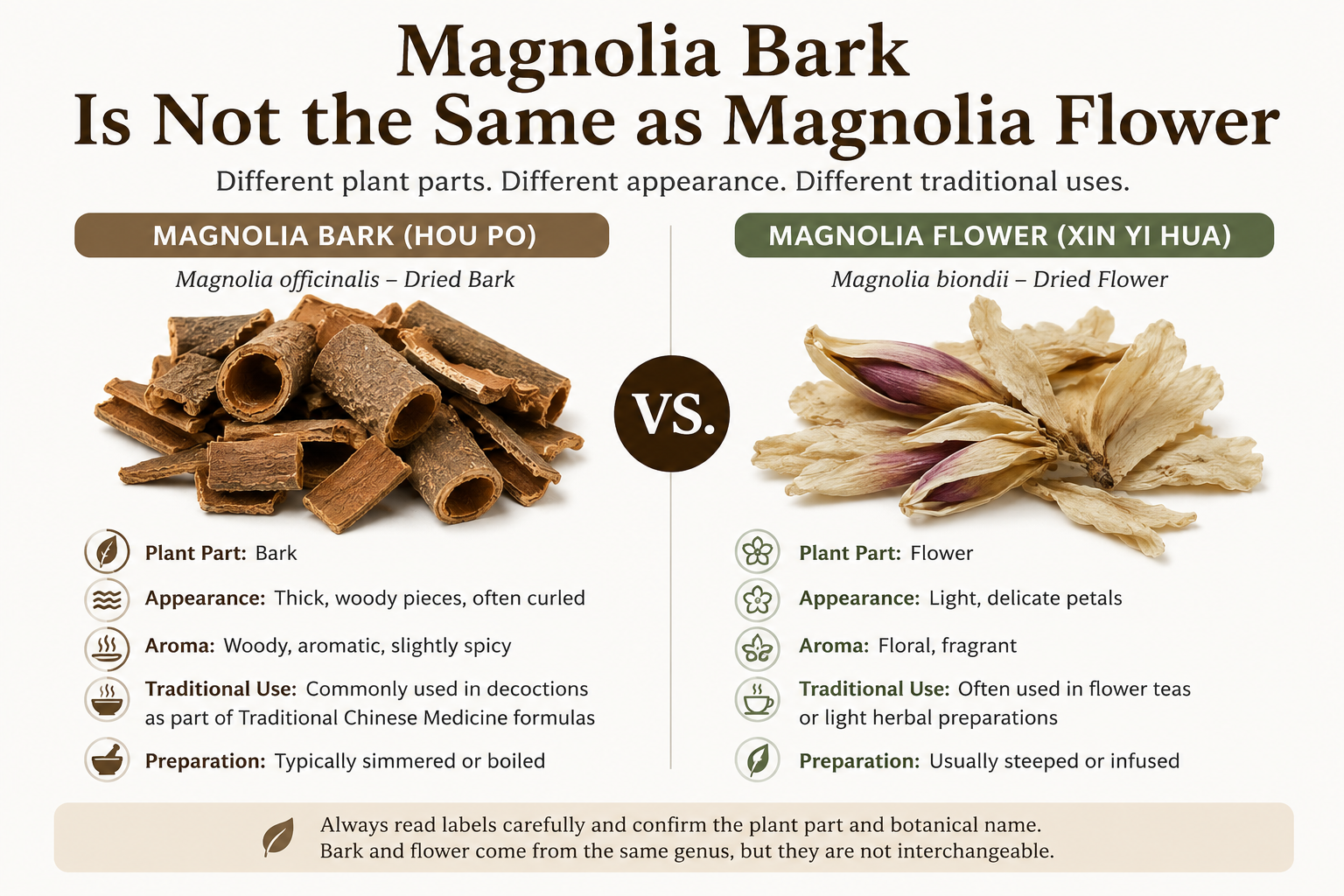
Magnolia Bark Is Not the Same as Magnolia Flower
The common name “magnolia” can refer to several botanical materials. Magnolia flowers, flower buds, leaves, bark, powders, extracts, and isolated compounds are not interchangeable.
This listing is specifically for dried cut bark from Magnolia officinalis. It is not a magnolia flower tea, flower-bud product, essential oil, capsule, standardized extract, or purified honokiol or magnolol supplement.
Why Botanical Identification Matters
Common names can be shared by more than one plant. A product labeled only as “Magnolia” does not tell you which species or plant part it contains. The botanical name provides a more precise form of identification and helps customers compare products accurately.
Species identification is especially important when purchasing traditional herbs because different species, plant parts, and manufacturing methods may be associated with different historical uses, preparation instructions, concentrations, and safety considerations.
How to Recognize Cut Magnolia Bark
If this is your first time purchasing Hou Po, its appearance may be surprising. It does not arrive as uniform chips or neatly matched slices. Authentic cut bark is an agricultural material, so natural variation should be expected.
Shape
A package may contain narrow strips, broader slices, small chips, broken fragments, curved sections, and tightly rolled pieces. Some pieces may resemble short tubes, while others may be flatter or only slightly curved.
Color
Colors can range from tan and warm brown to reddish-brown, gray-brown, or deeper brown. The inner and outer surfaces may look different. An outer surface may appear rougher or darker, while an exposed inner layer may be lighter or more fibrous.
Texture
The bark should generally feel dry, firm, woody, and layered. It may be difficult to bend, especially when the pieces are thick. Smaller fragments can occur naturally when dried bark is cut, packaged, and transported.
Aroma
Magnolia Bark has a noticeable natural scent often described as woody, warm, earthy, slightly spicy, or resinous. Aroma strength can vary between harvests and lots. A natural change in scent intensity does not automatically indicate that the product is old or poor quality.
Traditional Taste Description
Traditional Chinese herbal references commonly classify Hou Po as bitter and acrid. These taste descriptions are part of a traditional system used to characterize herbs and do not refer to added flavoring.
Hou Po in Traditional Chinese Herbal Practice
Magnolia Bark (Hou Po) has been an important botanical in Traditional Chinese Medicine (TCM) for centuries. Rather than being used alone, it was traditionally included as one component of carefully balanced multi-herb formulas selected according to established herbal principles.
Traditional Characteristics of Hou Po
- Traditional Chinese Name: Hou Po (厚朴) or Juan Hou Po
- Botanical Name: Magnolia officinalis
- Traditional Nature: Warm
- Traditional Taste: Bitter and Acrid
- Traditional Qualities: Aromatic
- Associated Meridians: Lung, Spleen, Stomach, and Large Intestine
Understanding Traditional Chinese Herbal Terminology
Traditional Chinese Medicine classifies herbs according to characteristics such as taste, temperature, aroma, movement, and meridian association. These descriptions were developed over centuries to help practitioners understand how herbs fit within traditional herbal formulas and should be viewed as part of a historical system of herbal practice.
References to concepts such as Qi, meridians, warmth, bitterness, acridity, or aromatic qualities describe traditional Chinese herbal theory. They are included for educational and historical purposes and should not be interpreted as modern medical diagnoses or scientifically established physiological effects.
Why Hou Po Was Commonly Used in Formulas
Traditional Chinese formulas are carefully constructed combinations in which each ingredient may have a particular role. The selection of Hou Po depended on the full traditional pattern, the other herbs included, the intended balance of the formula, and the individual circumstances of the person receiving it.
This is why a traditional herb cannot be evaluated only by reading a list of general uses. The same botanical may appear in several formulas, but the meaning of its inclusion changes according to the complete combination.
Traditional-use notice: References to Qi, meridians, dampness, temperature, taste, or other TCM terminology are included for cultural, historical, and educational context. They are not statements that this product diagnoses, treats, cures, or prevents disease.
Naturally Occurring Compounds in Magnolia Bark
Modern botanical analysis has identified a range of naturally occurring plant compounds in Magnolia officinalis. The best-known are magnolol and honokiol, two lignans frequently discussed in scientific publications.
Other reported constituents include related lignans, phenolic compounds, and aromatic components. The amount and balance of these compounds can differ according to growing region, climate, tree age, harvest timing, processing, storage conditions, and individual lot.
- Magnolol
- Honokiol
- Isomagnolol
- 6'-O-Methylhonokiol
- Syringaresinol
- Other naturally occurring lignans
- Phenolic and aromatic plant compounds
Modern researchers continue studying Magnolia officinalis because it naturally contains a variety of plant compounds. Two of the best-known are magnolol and honokiol, although dozens of naturally occurring constituents have also been identified. Their presence contributes to scientific interest in the plant, but the amount of each compound varies naturally and should not be assumed to match concentrated extracts or purified ingredients.
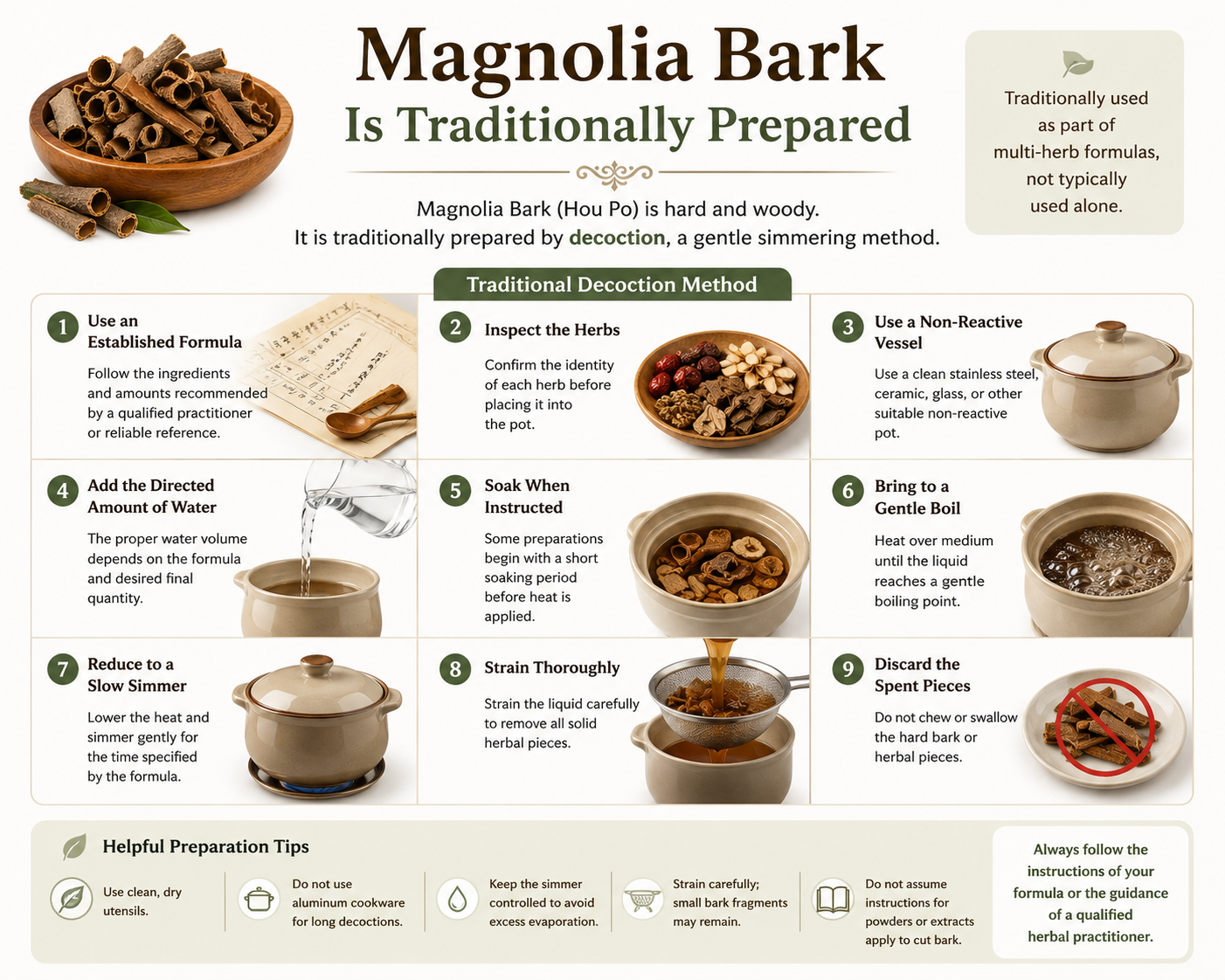
How Cut Magnolia Bark Is Traditionally Prepared
Magnolia Bark is firm and woody. It is therefore generally prepared by decoction, a traditional method that uses gentle simmering to work with dense materials such as roots, bark, seeds, and woody stems.
It is often included with other herbs rather than prepared alone. The quantity, soaking time, simmering period, water volume, and order in which ingredients are added can vary according to the complete formula.
General Decoction Method
- Follow an established formula. Use the ingredients and amounts recommended by a qualified practitioner or a reliable traditional formula reference.
- Inspect the herbs. Confirm the identity of each botanical before placing it into the pot.
- Use a non-reactive vessel. Place the herbs in a clean stainless-steel, ceramic, glass, or other suitable non-reactive pot.
- Add the directed amount of water. The proper volume depends on the formula and desired final quantity.
- Soak when instructed. Some preparations begin with a short soaking period before heat is applied.
- Bring to a gentle boil. Avoid an unnecessarily vigorous rolling boil.
- Reduce to a slow simmer. Continue for the period specified by the complete formula instructions.
- Strain thoroughly. Remove the woody bark and other solid botanical materials before the prepared liquid is used.
- Discard the spent pieces. Do not chew or swallow the hard bark fragments.
Helpful Preparation Tips
- Measure herbs with clean, dry utensils.
- Do not use aluminum cookware for long herbal decoctions.
- Keep the simmer controlled so excess water does not evaporate too quickly.
- Strain carefully because small bark fragments may remain in the liquid.
- Do not assume that instructions for a powder or extract apply to cut bark.
- Prepare only the quantity recommended by the formula instructions.
For more information about working with roots, bark, seeds, and other traditional bulk materials, visit our How to Use Bulk Herbs Guide.
How to Store Magnolia Bark
Proper storage helps preserve the herb’s natural aroma, dry texture, and overall condition. Heat, light, moisture, and repeated exposure to humid air can reduce the quality of dried botanicals.
- Keep the package tightly closed when it is not in use.
- Store it in a cool and consistently dry location.
- Protect it from direct sunlight and excess heat.
- Do not store it near a stove, sink, dishwasher, or humid window.
- Use only clean and completely dry measuring utensils.
- Avoid storing it beside strongly scented foods, cleaners, or fragrances.
- Retain the original label for botanical and lot identification.
- Keep it out of reach of children and pets.
Freezing is generally unnecessary. Condensation introduced when a frozen package is opened may expose the bark to moisture. A stable, cool, dry cabinet is usually more practical for routine storage.
If you transfer the herb to another container, choose one that closes securely and place the complete original label on or inside the container. Do not rely on memory to identify an unlabeled botanical later.
Nuherbs Quality and Product Documentation
Quality evaluation for an imported botanical involves more than checking whether the package looks attractive. Supplier qualification, botanical identity, organoleptic review, handling practices, manufacturing controls, and appropriate testing may all contribute to the quality program.
Nuherbs describes its quality approach as including botanical evaluation, in-house capabilities, supplier oversight, and independent laboratory procedures. Depending on the product, lot, specification, and available documentation, review may include areas such as:
- Botanical identity
- Visual and organoleptic characteristics
- Microbial quality
- Pesticide residues
- Selected heavy metals or elemental contaminants
- Moisture levels
- Selected chemical markers
Certificate of Analysis Requests
Testing requirements and available reports can differ between herbs and lots. A general description of a supplier’s quality program does not mean every possible analysis is performed on every package.
If a particular test, limit, specification, or Certificate of Analysis is essential to your purchase, contact 1st Chinese Herbs before ordering. We can confirm which documentation is currently available for the applicable product or lot.
Customers should never assume that a product has been tested for a specific substance merely because the phrase “lab tested” appears in general brand information. Ask before ordering when a particular report is required.
Why Purchase From 1st Chinese Herbs?
Buying an unfamiliar botanical should not feel like guessing. A useful product page should tell you what the herb is, which plant part you are receiving, how the product is prepared, what natural variation to expect, and where to ask questions.
Serving Herbal Customers Since 1994
For more than three decades, 1st Chinese Herbs has supplied Chinese and Western botanicals to practitioners, students, educators, experienced home users, and customers building personal herbal collections.
Specialized Product Knowledge
Our focus is herbs. We provide botanical names, traditional names, product forms, plant parts, preparation context, storage guidance, and brand information whenever available.
Established Suppliers
We work with recognized herbal brands rather than depending only on anonymous marketplace sources or vague private-label listings.
Responsive Customer Support
Customers can contact us with questions about package size, product form, current availability, lot documentation, and general product identification before placing an order.
Fulfilled From Washington State
Orders are processed and shipped from our location in Washington, allowing customers to purchase imported traditional botanicals from an established United States retailer.
Free US Shipping Over $40
Qualifying United States orders of $40 or more ship at no additional charge under our current shipping policy.
Frequently Asked Questions About Magnolia Bark
What is included in this package?
The package contains one pound of cut dried Magnolia officinalis bark supplied by Nuherbs. No sweeteners, flavorings, colors, or fillers are added.
Are Juan Hou Po and Hou Po the same thing?
Both names are used for Magnolia Bark in traditional Chinese herbal references and commerce. Product naming and transliteration may vary. The botanical name is the most useful point of confirmation.
Is this Magnolia Bark a powder?
No. It consists of visible cut pieces of bark. It is not milled powder, a capsule, a liquid tincture, or a concentrated extract.
Why are the pieces curled?
Sections of bark often curl naturally as they dry. The degree of curl varies according to the thickness, position, cutting, drying, and handling of each piece.
Why are the pieces different colors?
Natural bark includes inner and outer surfaces with different shades and textures. Harvest conditions, drying, age, thickness, and individual plant variation can also influence color.
What does Magnolia Bark smell like?
It generally has a naturally woody, warm, earthy, and somewhat resinous aroma. The intensity can vary from lot to lot.
Can I chew or swallow the bark pieces?
No. The pieces are hard, fibrous, and woody. When used in a traditional decoction, the solid bark is strained out and discarded.
Can Magnolia Bark be prepared as an ordinary tea?
A brief tea steep is generally more appropriate for delicate leaves and flowers. Dense bark is traditionally simmered as a decoction according to established formula instructions.
Is this product standardized for honokiol or magnolol?
No stated standardization is provided for this cut-bark product. It should not be treated as equivalent to a standardized extract or isolated compound.
Where does this Magnolia Bark come from?
The bark is sourced from China, supplied by Nuherbs, and fulfilled by 1st Chinese Herbs from Washington State.
Can I request lot documentation?
Available documentation may differ by lot. Contact us before ordering when a specific Certificate of Analysis, test result, or specification is required.
Who commonly buys a one-pound package?
The bulk quantity is commonly chosen by practitioners, herbal educators, students, experienced formula users, and customers who prepare traditional botanicals regularly.
Scientific and Botanical References
The following publications provide additional information about Magnolia officinalis, its botanical constituents, and areas of scientific investigation. They are included for education and further reading.
- Biological Activity and Toxicity of the Chinese Herb Magnolia officinalis and Its Constituents
- Safety and Toxicology of Magnolol and Honokiol
- Scientific Review of Magnolia officinalis
- Botanical and Scientific Review of Magnolia officinalis
- Neuropharmacological Research Concerning Magnolol and Honokiol
- Research Concerning Honokiol and Magnolol Derivatives
Research context: Many scientific studies involve isolated compounds, standardized extracts, laboratory models, or animal research. These publications do not establish that ordinary cut Magnolia Bark produces the same concentrations, absorption, safety profile, or effects in people.
Safety and Responsible Use
- Consult a qualified healthcare professional before use during pregnancy or while nursing.
- Seek professional guidance before use if you have a medical condition.
- Discuss possible interactions with a physician or pharmacist if you take prescription medications.
- Use traditional multi-herb formulas under appropriate professional guidance.
- Do not chew or swallow the hard bark pieces.
- Stop using the product and seek professional advice if an unexpected reaction occurs.
- Keep the product out of reach of children and pets.
Important Product Disclaimer