


Revive Kidney Qi Teapills – Suo Yang Bu Shen Wan
Traditional Kidney Yang & Kidney Qi Tonic | Plum Flower | 200 Teapills
Feeling depleted, lacking warmth or vitality, or looking for a traditional Chinese formula specifically associated with Kidney Yang and Kidney Qi?
Revive Kidney Qi Teapills, traditionally known as Suo Yang Bu Shen Wan (鎖陽補腎丸), is a four-herb Traditional Chinese Medicine formula centered around Suo Yang (Cynomorium), Shu Di Huang (prepared Rehmannia), Tu Si Zi (Cuscuta seed) and Wu Wei Zi (Schisandra fruit).
In Traditional Chinese Medicine, the formula is traditionally used to warm Kidney Yang, strengthen Kidney Qi, nourish Yin and Blood, and support Jing-essence.
An important distinction: “Kidney” in Traditional Chinese Medicine describes a traditional functional system and does not simply mean the anatomical kidneys or kidney function measured by Western medicine.
Revive Kidney Qi comes in small prepared teapills, so there are no individual herbs to measure and no decoction to prepare.
What Is Suo Yang Bu Shen Wan?
Suo Yang Bu Shen Wan is a traditional Chinese herbal formula associated with deficiency patterns involving Kidney Qi and Kidney Yang.
The name highlights Suo Yang (Cynomorium songaricum), one of the formula's four herbs.
According to Traditional Chinese Medicine principles, the formula is traditionally associated with:
-
Warming Kidney Yang
-
Strengthening Kidney Qi
-
Nourishing Yin and Blood
-
Supporting Jing-essence
-
Moistening the bowels
These are traditional TCM functions rather than claims about treating kidney disease or improving laboratory kidney function.
What Does Kidney Yang Deficiency Mean?
Kidney Yang deficiency is a Traditional Chinese Medicine pattern — not a diagnosis of kidney disease.
In TCM, Kidney Yang is associated with warmth, vitality and foundational Yang energy.
A practitioner considering a Kidney Yang deficiency pattern looks at the person's overall presentation rather than one isolated symptom.
Traditional pattern descriptions may include:
-
Feeling depleted or lacking vitality
-
Feeling unusually cold
-
Cold hands or feet
-
Weakness or soreness of the lower back and knees
-
Reduced stamina
-
Changes associated traditionally with Jing or reproductive vitality
-
Other signs of deficiency and insufficient warmth
These symptoms can have many different causes. Persistent or unexplained symptoms should be medically evaluated rather than assumed to represent Kidney Yang deficiency.
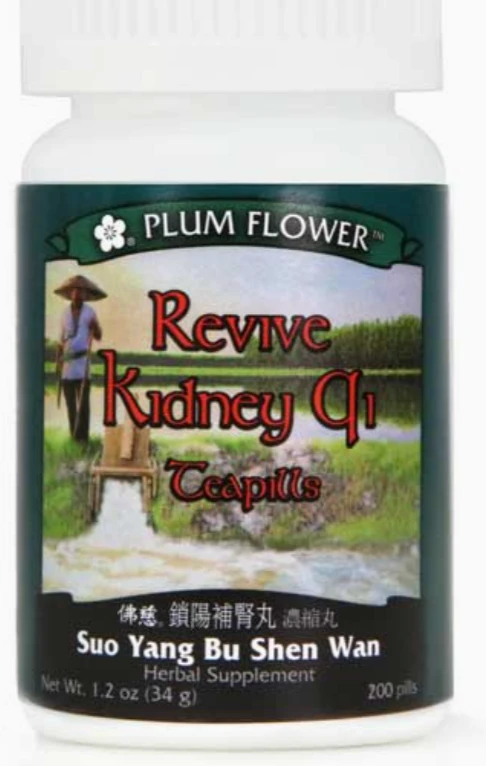 Product Details at a Glance
Product Name: Revive Kidney Qi Teapills
Pin Yin Name: Suo Yang Bu Shen Wan
Chinese Name: 鎖陽補腎丸
Brand: Plum Flower
Form: Small prepared teapills
Bottle Size: 200 teapills
Formula Size: 4 herbs
Traditional TCM Focus: Kidney Qi and Kidney Yang deficiency patterns
Traditional Functions: Warms Kidney Yang, strengthens Kidney Qi, nourishes Yin and Blood
Label Directions: 8 teapills, 3 times daily
Approximate Supply: About 8 days at label directions
Preparation Required: None — swallow with water
Origin: China
What's in Revive Kidney Qi Teapills?
Suo Yang Bu Shen Wan combines four traditional herbs with complementary roles.
| Pin Yin | Botanical Ingredient | Traditional Role |
|---|---|---|
| Shu Di Huang | Rehmannia glutinosa root, prepared | Traditionally nourishes Blood and Yin and supports Jing |
| Suo Yang | Cynomorium songaricum herb | Traditionally tonifies Kidney Yang and supports Jing |
| Tu Si Zi | Cuscuta chinensis seed | Traditionally tonifies Kidney Yang and supports Kidney essence |
| Wu Wei Zi | Schisandra chinensis fruit | Traditionally astringes and helps preserve Jing and body fluids |
Other Ingredients
Maltose, microcrystalline cellulose, hydrated magnesium silicate, activated carbon and China wax.
Always check the ingredient panel on the bottle you receive because manufacturers may occasionally update product formulations.
Why These Four Herbs?
Suo Yang — Cynomorium
Suo Yang (Cynomorium songaricum) is the defining herb in the formula and gives Suo Yang Bu Shen Wan its name.
In Traditional Chinese Medicine, Suo Yang is traditionally associated with tonifying Kidney Yang and supporting Jing-essence.
It contributes the warming, Yang-tonifying direction of the formula.
Shu Di Huang — Prepared Rehmannia
Shu Di Huang (prepared Rehmannia root) provides a complementary nourishing component.
Rather than simply emphasizing warmth and Yang, Shu Di Huang is traditionally associated with nourishing Blood and Yin and replenishing Jing.
Tu Si Zi — Cuscuta Seed
Tu Si Zi (Cuscuta chinensis seed) is traditionally associated with tonifying the Kidney and supporting Jing.
Its inclusion further emphasizes the formula's traditional Kidney deficiency focus.
Wu Wei Zi — Schisandra Fruit
Wu Wei Zi (Schisandra chinensis fruit) is traditionally classified as an astringing herb.
Within traditional formulas, it is associated with helping secure and preserve what the body might otherwise lose, complementing the nourishing and tonifying herbs in the formula.
Is Revive Kidney Qi the Formula You're Looking For?
Revive Kidney Qi is worth investigating when you're specifically searching for a traditional Chinese herbal formula associated with Kidney Yang, Kidney Qi and Jing deficiency patterns.
Someone researching this formula might recognize descriptions such as:
“I feel depleted and lack my usual vitality.”
“I tend to feel cold rather than overheated.”
“I'm looking specifically for a traditional Kidney Yang tonic.”
“I've been told to look for Suo Yang Bu Shen Wan.”
“I want a formula containing Suo Yang, Rehmannia, Cuscuta and Schisandra.”
The key is the traditional pattern, not simply the presence of one symptom.
Revive Kidney Qi should therefore not be presented as a product for treating kidney disease or as a substitute for medical care.
TCM “Kidney” vs. Your Physical Kidneys
This distinction is important when researching Chinese herbal formulas.
In Western medicine, the kidneys are physical organs that filter blood, regulate fluids and electrolytes, and perform other essential physiological functions.
In Traditional Chinese Medicine, the Kidney system is a much broader traditional concept associated with areas including Jing-essence, development, aging, reproductive vitality, bones, lower back, fluids and foundational Yin and Yang.
Therefore:
“Tonifies Kidney Qi” does NOT mean “improves kidney filtration.”
“Warms Kidney Yang” does NOT mean “treats kidney disease.”
If you have kidney disease, abnormal kidney laboratory results or another diagnosed medical condition, discuss herbal supplement use with your healthcare professional.
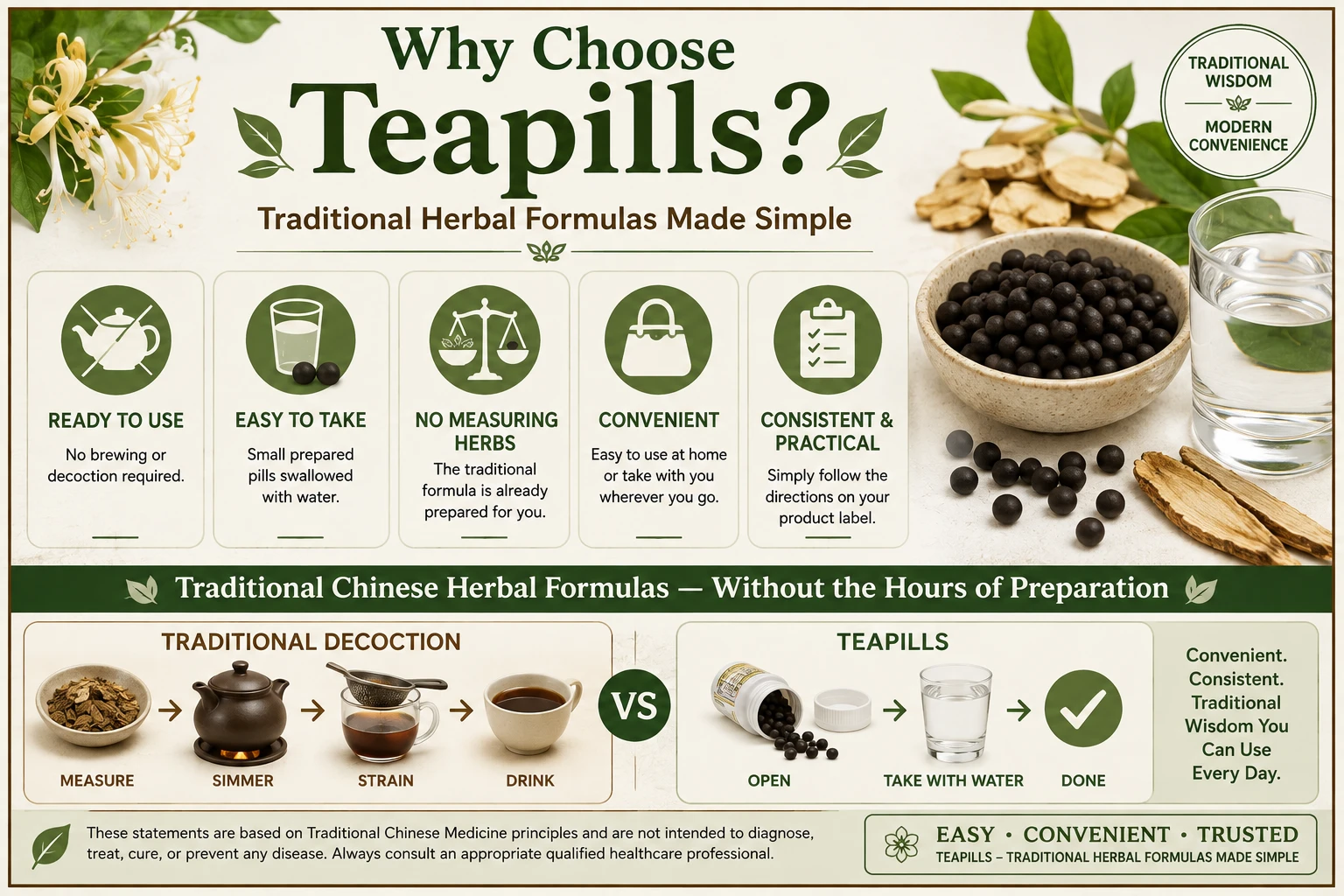
Why Teapills & How Do I Use Them?
Suo Yang Bu Shen Wan could traditionally be prepared from individual herbs, requiring the ingredients to be obtained, measured and prepared.
Teapills provide the traditional herbal combination in a convenient prepared form.
There is no measuring, simmering or straining, and you don't need to prepare a daily herbal decoction.
Label Directions
Take 8 teapills, 3 times per day.
Swallow the teapills with water according to the product directions.
At 24 teapills per day, one 200-count bottle provides approximately 8 days of use.
Follow the product label unless your qualified healthcare professional or Traditional Chinese Medicine practitioner has provided different instructions.
Why Is This Formula Called Revive Kidney Qi?
The English product name Revive Kidney Qi reflects the formula's traditional association with Kidney Qi.
Its Chinese name is:
Suo Yang Bu Shen Wan — 鎖陽補腎丸
The name Suo Yang refers to Cynomorium, the formula's defining Yang-tonifying herb.
“Bu Shen” refers to the traditional concept of tonifying or supplementing the Kidney system, while Wan indicates a pill preparation.
Again, these terms describe Traditional Chinese Medicine theory, not treatment of anatomical kidney disease.
An Interesting Detail About Today's Formula
The current Plum Flower Revive Kidney Qi formula is based on the traditional Cong Rong Bu Shen Wan.
According to Mayway, Rou Cong Rong (Cistanche deserticola) was replaced with Suo Yang (Cynomorium songaricum) because Cistanche deserticola is listed under CITES Appendix II and sourcing it presented sustainability and import/export challenges.
The resulting formula uses Suo Yang while maintaining the traditional Yang-tonifying direction of the formula.
This is particularly useful information for customers comparing older references or wondering why they encounter different ingredients when researching similar formulas.
Modern Research on the Four Herbs
Prepared Rehmannia, Cynomorium, Cuscuta and Schisandra all have histories of traditional use and have also been subjects of modern scientific investigation.
Researchers have studied their naturally occurring compounds and potential biological activities.
Traditional use and modern scientific research are not interchangeable, however. Laboratory, animal or preliminary human studies should not be interpreted as evidence that Revive Kidney Qi Teapills diagnose, prevent, treat or cure kidney disease or another medical condition.
-
PubMed links:
Frequently Asked Questions
What are Revive Kidney Qi Teapills?
Revive Kidney Qi is the English product name for Suo Yang Bu Shen Wan, a four-herb Traditional Chinese Medicine formula associated with Kidney Yang, Kidney Qi and Jing deficiency patterns.
What is Suo Yang Bu Shen Wan traditionally used for?
In Traditional Chinese Medicine, the formula is traditionally associated with warming Kidney Yang, strengthening Kidney Qi, nourishing Yin and Blood, and supporting Jing-essence.
These are TCM functions rather than Western medical treatment claims.
Does Revive Kidney Qi treat kidney disease?
No. Kidney Qi and Kidney Yang are Traditional Chinese Medicine concepts and should not be confused with anatomical kidney function or kidney disease.
Anyone with kidney disease or abnormal kidney laboratory results should consult an appropriate healthcare professional before using herbal supplements.
What herbs are in Suo Yang Bu Shen Wan?
The four herbal ingredients are Shu Di Huang (prepared Rehmannia), Suo Yang (Cynomorium), Tu Si Zi (Cuscuta seed) and Wu Wei Zi (Schisandra fruit).
What is Suo Yang?
Suo Yang is Cynomorium songaricum, an herb traditionally associated in Chinese medicine with tonifying Kidney Yang and supporting Jing.
Does this formula contain Rehmannia?
Yes. It contains prepared Rehmannia glutinosa root, known as Shu Di Huang.
Does Revive Kidney Qi contain Cistanche?
The current Plum Flower formula contains Suo Yang (Cynomorium songaricum) rather than Cistanche deserticola.
Is this a Kidney Yang formula or a Kidney Yin formula?
The formula has a strong traditional Kidney Yang and Kidney Qi focus, but it is not exclusively Yang-tonifying. Prepared Rehmannia contributes traditional Yin, Blood and Jing nourishment, giving the formula a more balanced composition.
How many teapills are in the bottle?
Each bottle contains 200 teapills.
How do I take Revive Kidney Qi Teapills?
The manufacturer directions are 8 teapills, 3 times per day. Swallow with water unless your qualified healthcare practitioner has provided different instructions.
How long does one bottle last?
At 24 teapills per day, a 200-count bottle provides approximately 8 days of use.
Do I have to brew Suo Yang Bu Shen Wan as tea?
No. The formula is already prepared as teapills, so there is no need to measure herbs, simmer a decoction or strain herbal tea.
Safety Information
Do not use during pregnancy or while nursing unless directed by an appropriate qualified healthcare professional.
Consult your physician, pharmacist or other qualified healthcare professional before using this product if you take prescription medications, have a medical condition or are preparing for surgery.
This is particularly important for people with diagnosed kidney disease or abnormal kidney function because the TCM term “Kidney” should not be interpreted as evidence that this product is appropriate for kidney disease.
Keep out of reach of children.
Do not exceed the labeled directions unless instructed by an appropriate healthcare professional.
Revive Kidney Qi – Four Traditional Herbs in a Convenient Teapill
For customers specifically looking for Suo Yang Bu Shen Wan, Revive Kidney Qi combines four traditional herbs — Suo Yang, Shu Di Huang, Tu Si Zi and Wu Wei Zi — in an easy-to-use prepared formula.
No individual herbs to measure. No decoction to prepare. Just the traditional formula in convenient prepared teapills.
Traditional Use & FDA Disclaimer
Information describing Chinese herbal functions and patterns is based on principles of Traditional Chinese Medicine and is provided for educational purposes.
These statements have not been evaluated by the Food and Drug Administration. This product is not intended to diagnose, treat, cure or prevent any disease.
Consult an appropriate qualified healthcare professional regarding medical conditions, medications, pregnancy, nursing or persistent symptoms.