
Da Qing Ye vs Ban Lan Gen: How One Plant Creates Two Completely Different Chinese Herbs
Quick Answer:
Da Qing Ye is the leaf of the Isatis plant. Ban Lan Gen
is the root. They may come from the same plant,
but traditional herbalists treat them as separate herbs because
different plant parts are used differently.
Imagine ordering Ban Lan Gen for the first time. The package arrives. You open it.
A few weeks later you discover another herb called Da Qing Ye.
Then someone tells you both herbs come from the same plant.
Your first thought is usually:
"Wait...did I accidentally buy the same herb twice?"
You're not alone. This is one of the most common points of confusion in Chinese herbalism.
In fact, Da Qing Ye and Ban Lan Gen may be the perfect example of something that surprises almost every beginner:
Chinese herbalists don't just care about the plant.
They care about which part of the plant is being used.
That single idea helps explain why one Isatis plant produces two separate herbs, two separate names, and two separate entries in Chinese herb books.
Once you understand this comparison, you'll understand Chinese herbalism at a much deeper level.
 Quick Answer
If you're looking for the fastest answer possible:
Da Qing Ye is the leaf.
Ban Lan Gen is the root.
Same plant.
Different plant part.
Different appearance.
Different preparation.
Different role in traditional herbal systems.
And that's why herbalists treat them as separate herbs.
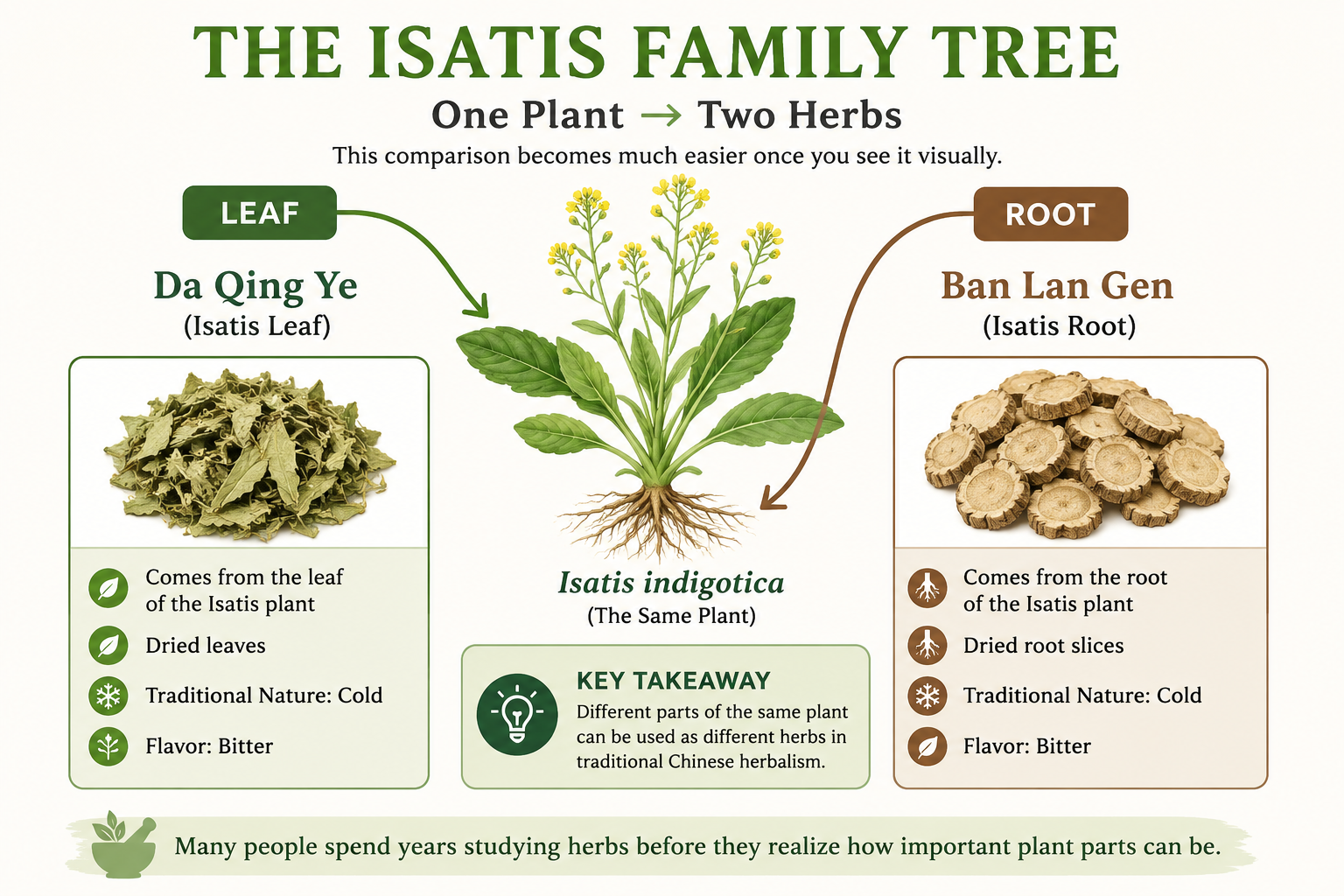
The Isatis Family Tree
This comparison becomes much easier once you see it visually.
One Plant → Two Herbs
- Leaf → Da Qing Ye
- Root → Ban Lan Gen
Many people spend years studying herbs before they realize how important plant parts can be.
This comparison teaches that lesson immediately.
The Ultimate Comparison Chart
| Feature | Da Qing Ye | Ban Lan Gen |
|---|---|---|
| Plant Part | Leaf | Root |
| Source Plant | Isatis indigotica | Isatis indigotica |
| Appearance | Dried Leaves | Dried Root Slices |
| Traditional Nature | Cold | Cold |
| Flavor | Bitter | Bitter |
| Most Common Form | Bulk Herb | Bulk Herb, Granules, Extracts |
| Beginner Friendly | Good | Very Good |
| Frequently Confused With | Ban Lan Gen | Da Qing Ye |
| Most Interesting Feature | Comes From The Leaf | Comes From The Root |
What Most Customers Really Want To Know
Did I buy the wrong herb?
No.
If you ordered Ban Lan Gen, you received the root.
If you ordered Da Qing Ye, you received the leaf.
Both are legitimate herbs.
Can I substitute one for the other?
Traditional herbalists generally recognize them as separate herbs because different plant parts have different traditional uses.
Why are both sold if they come from the same plant?
Because Chinese herbalism often values different parts of the same plant separately.
This is common throughout Chinese herbal traditions.
Which herb do beginners usually buy first?
Ban Lan Gen often wins because it is commonly available in granules and extract forms.
What Do They Actually Taste Like?
Let's be honest.
Nobody buys either herb because they're hoping for a delicious afternoon beverage.
Most people describe both herbs as bitter.
However, customers often describe Da Qing Ye as having a greener, leafier character, while Ban Lan Gen tends to have a deeper root-like profile.
Neither herb belongs in the same flavor category as Goji Berries, Red Dates, Chrysanthemum, or Hawthorn.
These are herbs chosen for traditional herbal reasons, not because they taste like dessert.
Who Usually Buys Each Herb?
People Who Buy Da Qing Ye Often:
- Use bulk herbs regularly
- Build their own formulas
- Enjoy learning traditional herbology
- Want to understand the Isatis plant more completely
People Who Buy Ban Lan Gen Often:
- Prefer convenient preparations
- Purchase granules or extracts
- Are newer to Chinese herbs
- Want an easy entry point into traditional herbology
5 Weird Facts Most People Don't Know About Isatis
- One plant creates both Da Qing Ye and Ban Lan Gen.
- Most beginners assume they are identical.
- The leaf and root look nothing alike.
- Many herbalists keep both in their inventory.
- This comparison is one of the best examples of how Chinese herbalism views plant parts differently.
The Herb Hall Of Fame
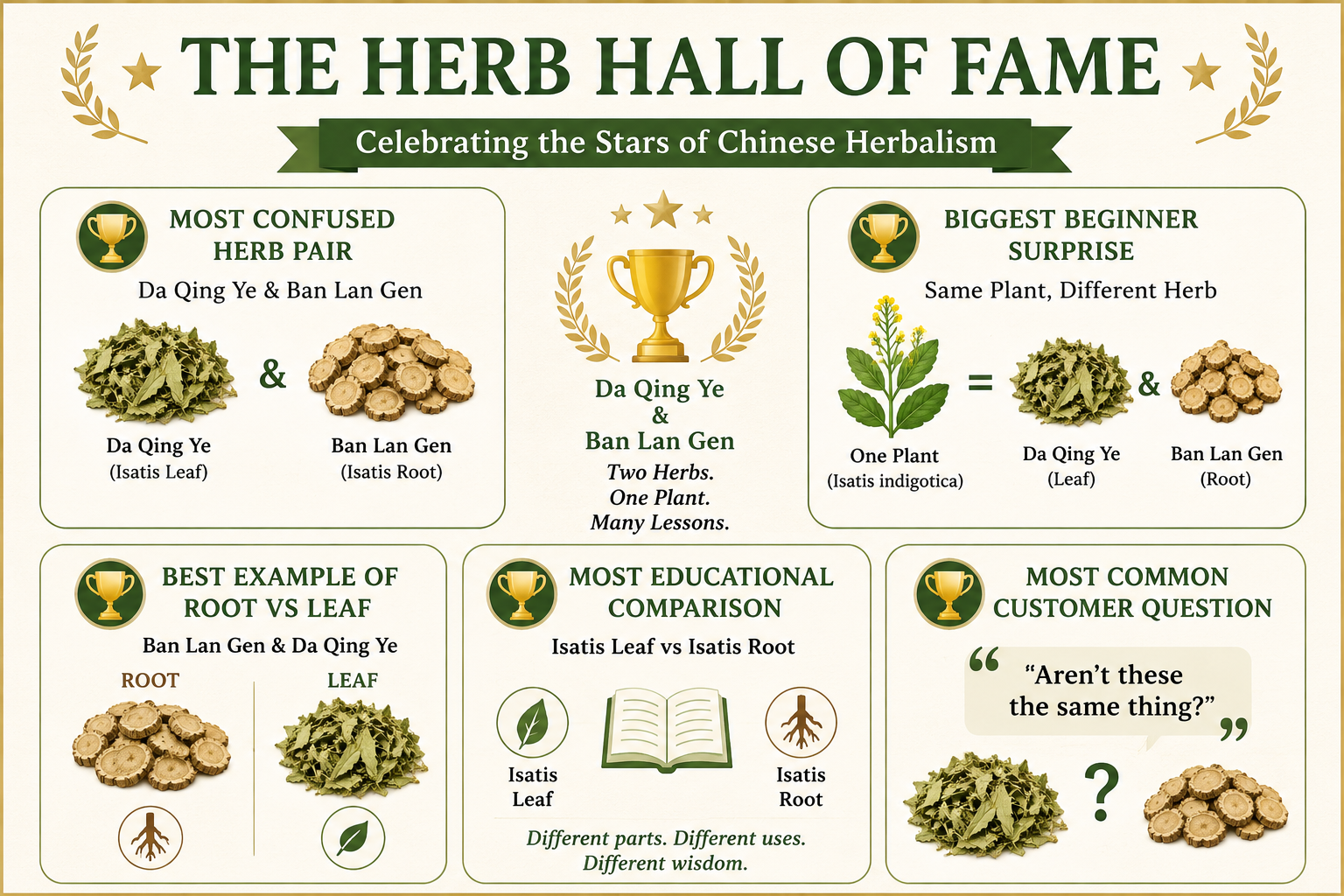
If This Comparison Fascinates You, Explore These Next
- Honeysuckle vs Forsythia
- Qing Hao vs Yin Chen Hao
- Sang Ye vs Chrysanthemum
- Yu Xing Cao vs Ban Lan Gen
- Leaf Herbs vs Root Herbs
The Aha Moment
Here's the most important thing to remember.
This page isn't really about choosing between Da Qing Ye and Ban Lan Gen.
It's about understanding one of the foundational ideas behind Chinese herbalism.
The plant matters.
But the part of the plant matters too.
Once you understand that, hundreds of other herbs suddenly make more sense.
And that's why this simple comparison may teach you more about Chinese herbalism than almost any other herb pair.
Research & Traditional References
This comparison is based on traditional Chinese herbal materia medica sources including:
- Bensky's Chinese Herbal Medicine Materia Medica
- Chinese Pharmacopoeia
- Chinese Medical Herbology and Pharmacology
- Wong LW, et al. Bioactive Compounds and Therapeutic Insights of Isatis indigotica. PMID: 35139772.
-
Chen J, et al. Isatidis Radix and Isatidis Folium: A systematic review on ethnopharmacology, phytochemistry and pharmacology. Journal of Ethnopharmacology. 2022. PMID: 34543684.
- Feng J, et al. Isatis indigotica: From ethnobotany, biochemistry to synthetic biology. Frontiers in Plant Science. PMID: 37789475.
Modern Isatis research continues to explore the plant's phytochemical composition and traditional applications.
Author: Sarah Johnson, Certified Herbalist
Last Updated: June 10, 2026
Trusted Since 1994
Helping customers discover Chinese herbs, roots, leaves, flowers, berries, mushrooms, and traditional herbal knowledge.