
Dang Gui vs Bai Shao: Which Traditional Chinese Herb Should You Choose?
• Best for beginners: Bai Shao
• Most famous women’s herb: Dang Gui
• Stronger herbal taste: Dang Gui
• Gentlest tea: Bai Shao
• Can they be used together? Absolutely
One herb moves.
One herb softens.
One is warming and aromatic.
The other is cooling and deeply nourishing.
Dang Gui and Bai Shao are two of the most famous herbs in traditional Chinese herbal medicine.
They are often discussed together.
They are often paired together.
And they are often confused with one another.
That is where most people get stuck.
Because while these herbs work beautifully together, they are not interchangeable.
They taste different.
They feel different.
And they serve different traditional purposes.
So which one belongs in your herbal pantry?
Let’s make this easy.
The Quick Answer
If you want a warming, aromatic herb with a bold personality, start with Dang Gui.
If you want a gentler, softer herb with a calmer personality, start with Bai Shao.
That is the short answer.
Now let’s look at why.
Why Are Dang Gui and Bai Shao Always Compared?
Because they are two of the most important traditional blood herbs.
Both are famous in women’s wellness traditions.
Both appear in classic formulas.
Both are frequently used to support nourishment and balance.
And both are foundational herbs in traditional Chinese herbalism.
That is why customers compare them constantly.
See The Difference
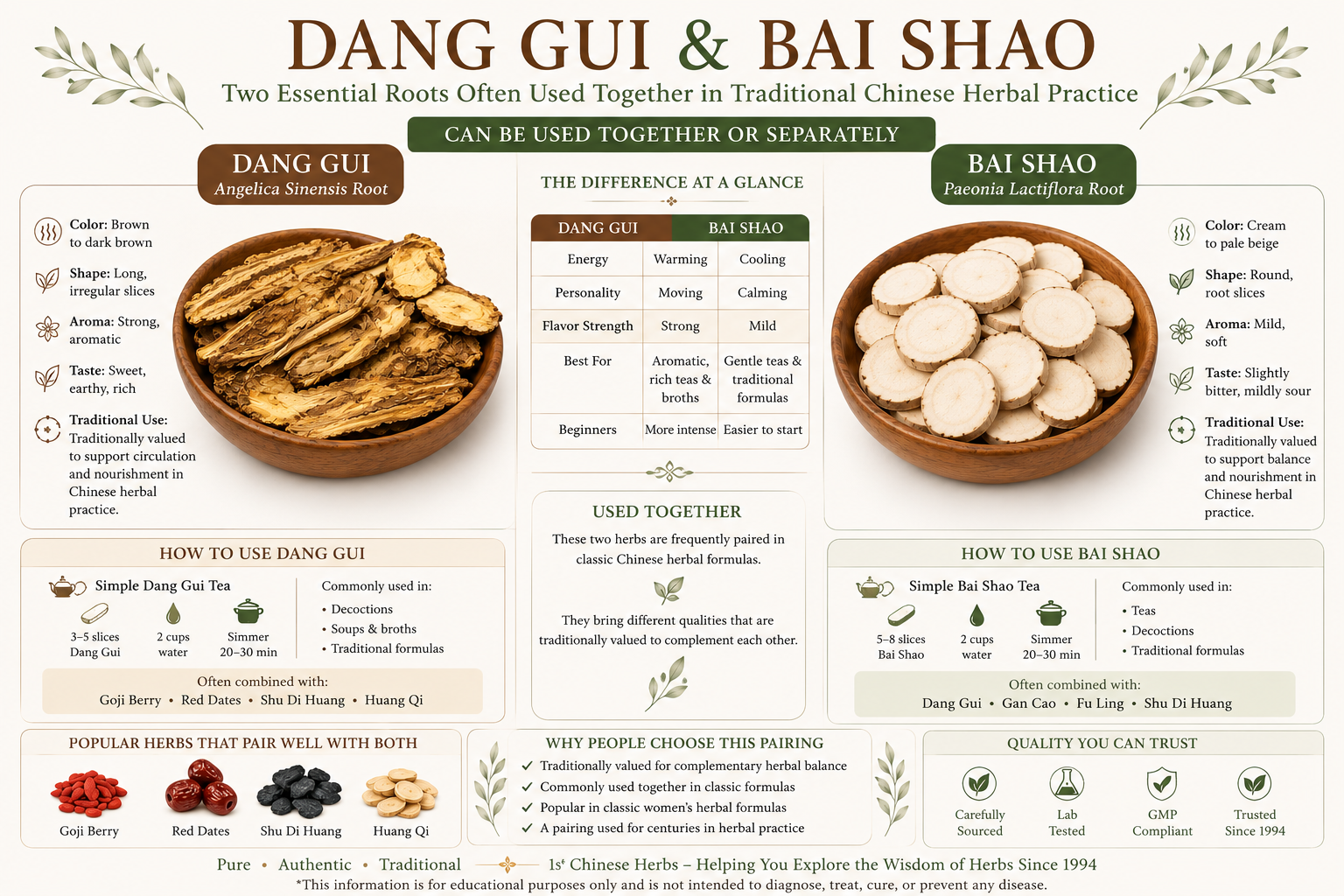
| Feature | Dang Gui | Bai Shao |
|---|---|---|
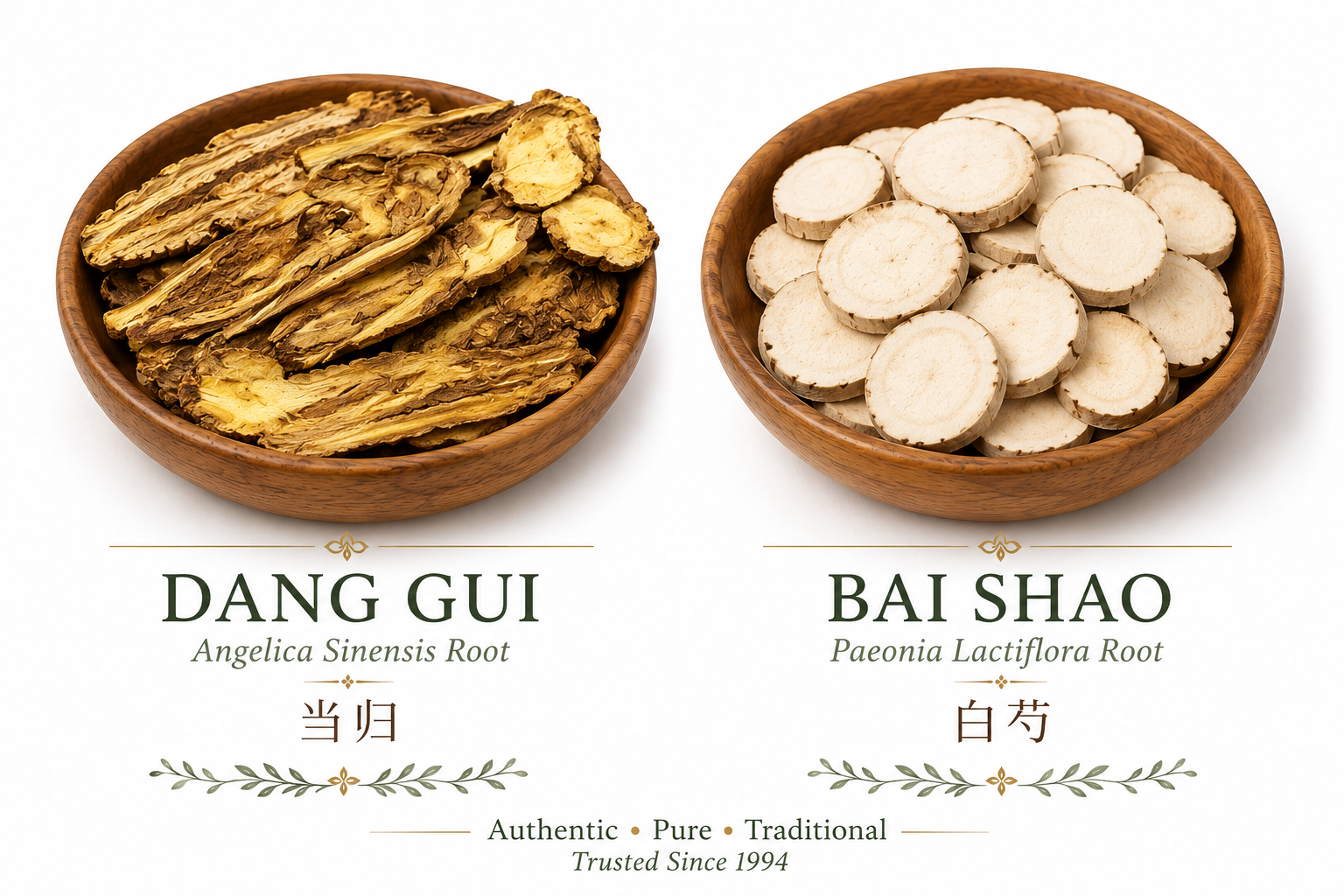
| Color | Brown to dark brown | Cream to pale beige |
| Shape | Thin tooth-like slices | Round root slices |
| Smell | Strong and aromatic | Mild and soft |
| Taste | Sweet, earthy, rich | Slightly bitter, mildly sour |
| Personality | Moving | Calming |
Meet The Herbs
Dang Gui: The Famous Angelica Root
Dang Gui is one of the most famous herbs in Chinese herbal medicine.
Some call it the queen of women’s herbs.
Others call it female ginseng.
Whatever name you use, Dang Gui has earned a legendary reputation.
Its sliced root is dark brown, aromatic, and often shaped like large curved teeth.
It has a rich, unmistakable herbal smell.
Dang Gui has personality.
You know when it is in a formula.
Bai Shao: The Elegant White Peony Root
Bai Shao comes from white peony root.
Compared to Dang Gui, Bai Shao feels quieter.
Gentler.
More balanced.
Its appearance is cleaner and lighter.
Its aroma is softer.
Its traditional personality is more calming and nourishing.
If Dang Gui enters the room first, Bai Shao quietly brings balance.
Which One Tastes Better?
This matters more than most people admit.
After all, the best herb in the world is useless if you hate drinking it.
Dang Gui Flavor
Dang Gui tastes earthy, sweet, warm, and aromatic.
It has a strong herbal smell many people instantly recognize.
Some love it immediately.
Others find it intense.
Bai Shao Flavor
Bai Shao is much softer.
Slightly bitter.
Mildly sour.
Much gentler than Dang Gui.
Most beginners find Bai Shao easier to drink.
How Are Dang Gui and Bai Shao Commonly Used?
This is one of the biggest questions customers ask.
Understanding how these herbs are traditionally prepared makes choosing between them much easier.
Both herbs are commonly used in decoctions, teas, soups, and traditional herbal formulas.
However, they are often used a little differently.
How To Use Dang Gui
Dang Gui is most commonly used in:
- Traditional herbal decoctions
- Herbal soups and broths
- Long-simmered tonic recipes
- Classic Chinese herbal formulas
Because Dang Gui has a rich aroma and stronger taste, it is often simmered rather than lightly steeped.
Simple Dang Gui Tea
- 3–5 slices Dang Gui
- 2 cups water
Simmer for 20–30 minutes.
The tea is warming, earthy, aromatic, and rich.
Many people pair Dang Gui with:
- Goji Berry
- Red Dates
- Shu Di Huang
- Huang Qi
How To Use Bai Shao
Bai Shao is commonly used in:
- Traditional herbal teas
- Herbal decoctions
- Classic herbal formulas
- Traditional balancing formulas
Bai Shao has a gentler flavor and is often easier for beginners.
Simple Bai Shao Tea
- 5–8 slices Bai Shao
- 2 cups water
Simmer for 20–30 minutes.
The tea is softer, milder, and easier to drink than Dang Gui.
Many people pair Bai Shao with:
- Dang Gui
- Gan Cao
- Fu Ling
- Shu Di Huang
Which Herb Is Easier To Use?
| Question | Winner |
|---|---|
| Easiest Tea for Beginners | Bai Shao |
| Best for Soups & Broths | Dang Gui |
| Most Versatile in Formulas | Tie |
| Easiest Flavor to Drink | Bai Shao |
How Are These Herbs Traditionally Used?
This is where their differences really matter.
Dang Gui is traditionally valued for supporting circulation and nourishment in Chinese herbal practice.
Bai Shao is traditionally associated with nourishing blood while supporting softness and balance.
Think of it this way:
Dang Gui moves.
Bai Shao softens.
That simple distinction helps explain why they are so often paired together.
Why Herbalists Love This Pairing
This is one of the most famous herb pairings in Chinese herbal medicine.
Why?
Because they balance each other beautifully.
Dang Gui brings warmth and movement.
Bai Shao brings softness and nourishment.
Together, they create harmony.
This pairing appears in some of the most respected traditional formulas.
Classic Herbal Formulas Featuring Both
- Si Wu Tang
- Xiao Yao San
- Dang Gui Shao Yao San
Who Usually Chooses Which?
Customers Often Choose Dang Gui If They:
- Prefer warming herbs
- Like stronger herbal flavors
- Want classic women’s herbs
- Prefer aromatic roots
Customers Often Choose Bai Shao If They:
- Prefer gentler herbs
- Want milder tea
- Prefer softer herbal flavors
- Want balancing herbs
Which Herb Is Easier For Beginners?
If someone walked into our store and said:
“I am completely new to Chinese herbs. Which should I try first?”
We would usually suggest Bai Shao.
Its flavor is easier.
Its energy feels gentler.
Its tea is more approachable.
Dang Gui is wonderful, but it has a much stronger personality.
What Most Customers Really Want To Know
| Question | Winner |
|---|---|
| Easiest Herb For Beginners | Bai Shao |
| Most Famous Women’s Herb | Dang Gui |
| Strongest Herbal Flavor | Dang Gui |
| Gentlest Tea | Bai Shao |
| Most Aromatic | Dang Gui |
| Softest Flavor | Bai Shao |
So Which One Should You Buy First?
If you want a warming, aromatic classic blood herb, choose Dang Gui.
If you want a gentler, softer, more beginner-friendly herb, choose Bai Shao.
Neither choice is wrong.
They simply offer different strengths.
At 1st Chinese Herbs, we have helped customers choose quality herbs since 1994.
We believe understanding herbs should feel simple, clear, and approachable—not confusing.
That is why we build comparison guides like this.
Because the more you understand your herbs, the better choices you can make.
Trusted Since 1994
Helping customers explore traditional Chinese herbs, roots, berries, flowers, mushrooms, and botanical wellness products.
Author: 1st Chinese Herbs Research Team
Last Updated July 2026
Research & References
The following scientific publications provide additional information regarding Dang Gui (Angelica sinensis) and Bai Shao (Paeonia lactiflora). These studies are provided for educational purposes only and do not constitute medical claims.
- Angelica sinensis (Oliv.) Diels: Chemistry, traditional uses and pharmacology
- Pharmacological activities of Angelica sinensis
- Paeonia lactiflora Pall: Traditional uses and pharmacological studies
- Pharmacological properties of Paeonia lactiflora
- Paeoniflorin: chemistry and biological activities
Note: Traditional herbal use and modern scientific research are not always equivalent. The information presented in this article is intended for educational purposes only.