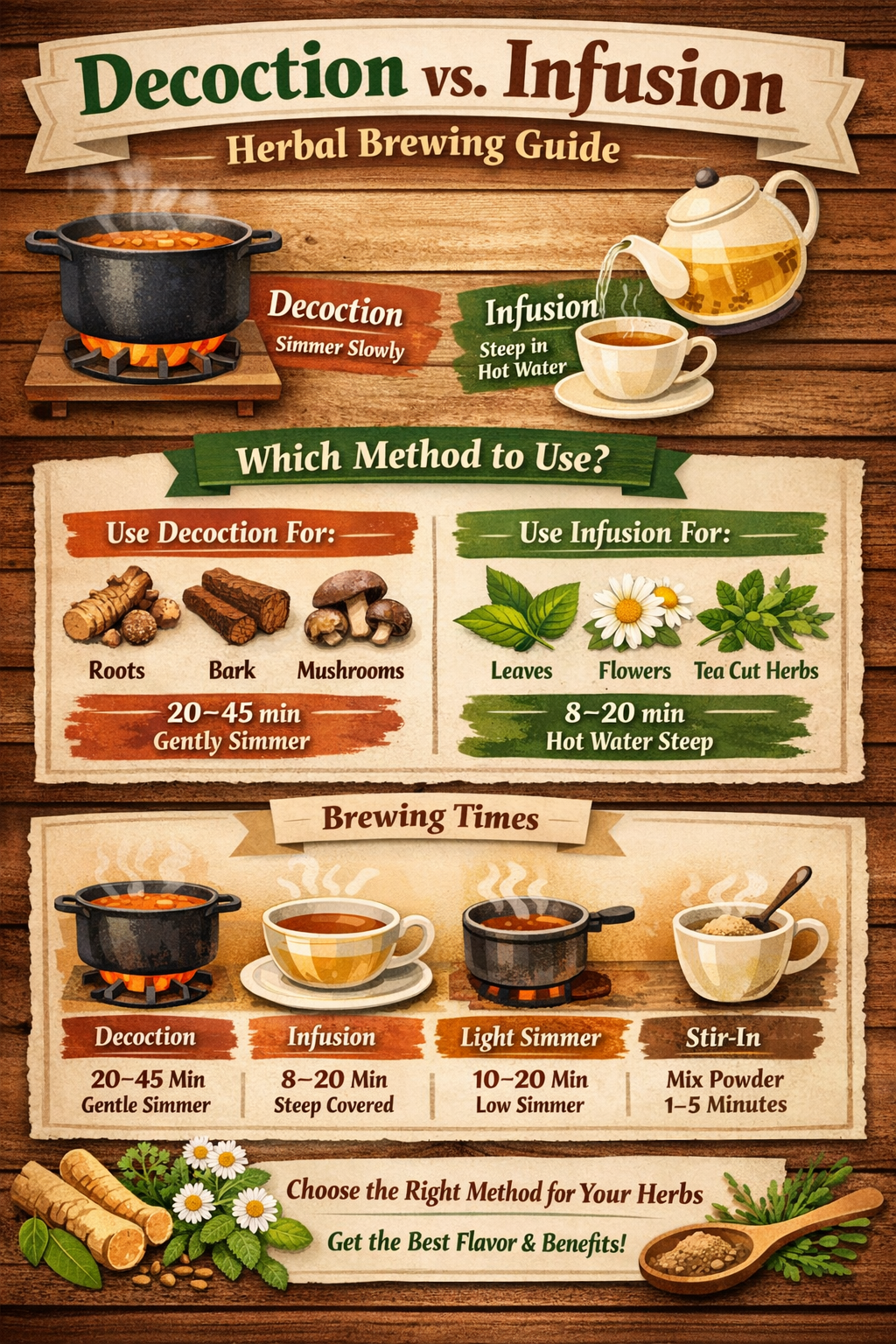
Decoction vs. Infusion Tool
Many people are unsure whether herbs should be steeped like tea or simmered like a decoction. The difference matters because different plant parts release their constituents differently. This tool helps you quickly determine the best brewing method for roots, leaves, flowers, mushrooms, bark, berries, seeds, powders, and tea cut herbs.
Quick Visual Brewing Guide
This simple visual helps customers understand which herb forms are usually steeped and which are usually simmered.
→ Infusion
→ Infusion
→ Decoction
→ Decoction
→ Decoction
→ Infusion or Light Simmer
Decoction vs. Infusion Comparison Chart
| Method | Best For | Typical Time | Heat Level |
|---|---|---|---|
| Infusion | Leaves, flowers, many tea cut herbs | 8–20 minutes | Hot water steep |
| Decoction | Roots, bark, mushrooms, hard berries | 20–45 minutes | Gentle simmer |
| Light Simmer | Seeds, stems, softer berries | 10–20 minutes | Low simmer |
| Stir-In | Powdered herbs | Immediate to 5 minutes | Warm water or tea |
Use the Herbal Brewing Tool
Select your herb form and your preferred brew strength to get more accurate preparation guidance.
Choose your herb form to begin
This tool will show the best brewing method, how much to use, brew time, why that method works, and examples.
General Herbal Brewing Guidelines
- Most roots require simmering because they are dense and firm.
- Leaves and flowers are usually steeped because they are lighter and more delicate.
- Mushrooms often need a longer simmer than leaves or flowers.
- Seeds may brew better when lightly crushed first.
- Whole herbs often need more time than tea cut herbs because water takes longer to penetrate them.
- Powdered herbs are commonly stirred directly into warm liquid instead of being strained like tea.
Herbs Commonly Brewed as Decoctions
These herbs are often simmered because they are roots, bark, or dense materials that usually need more time in hot water.
Herbs Commonly Brewed as Infusions
These herbs are often prepared by pouring hot water over them and letting them steep covered.
Herbal Preparation Guidance from 1st Chinese Herbs
1st Chinese Herbs has supplied bulk herbs since 1994 and provides educational resources to help customers learn traditional herbal preparation methods. We believe customers should know not only which herbs to choose, but also how to prepare them correctly for the best traditional brewing experience.
Common Mistakes When Brewing Herbs
- Boiling delicate flowers too long and losing aroma.
- Not simmering roots long enough to extract properly.
- Using too little herb for the amount of water.
- Leaving infusions uncovered while steeping.
- Trying to steep very dense bark like a light tea.
- Not crushing seeds first when needed.
- Treating whole herbs the same as tea cut herbs.
Frequently Asked Questions
What herbs should be decocted?
Roots, bark, mushrooms, and many hard berries are commonly decocted because they are dense and usually need more time and heat than leaves or flowers.
Can you decoct leaves?
Some leaves can handle longer brewing, but most delicate leaves are usually better as infusions. Prolonged boiling can reduce aroma and change taste.
How long should a decoction simmer?
Many decoctions simmer for about 20 to 45 minutes depending on the herb form, cut size, and desired strength.
Can mushrooms be steeped instead of simmered?
Some mushroom powders may be stirred into warm liquids, but sliced or chunk mushrooms such as reishi are commonly simmered for a longer time.
Can powdered herbs be brewed like tea?
Powders are often stirred directly into warm water, tea, broth, or smoothies rather than steeped and strained like cut herbs.
External Herbal Education References
These educational resources can help readers learn more about traditional herbal preparation and botanical education:
Important Herbal Preparation Information
The information on this page is provided for educational and informational purposes only. It is intended to help customers understand traditional herbal preparation methods such as infusions, decoctions, simmering, and stir-in preparations for different herb forms, including roots, bark, mushrooms, leaves, flowers, berries, seeds, powders, and tea cut herbs.
The content on this page is based on general traditional-use preparation guidance and does not guarantee any particular outcome, effect, or result. Herbal preparation methods may vary depending on the herb, cut size, processing method, strength desired, and individual preference.
These statements have not been evaluated by the U.S. Food and Drug Administration. The information and products referenced on this page are not intended to diagnose, treat, cure, or prevent any disease.
The information on this page should not be used as a substitute for medical advice, diagnosis, or treatment, and should not be relied upon for prescribing any medication or addressing any health condition. Always consult a qualified healthcare professional before using herbs or herbal products, especially if you are pregnant, nursing, taking medications, have a medical condition, are preparing herbs for children, or are unsure whether a particular herb is appropriate for you.
Herbs and herbal products may interact with medications or may not be suitable for every individual. Use herbs responsibly and follow appropriate preparation guidance.