
How Do You Know the Herbs You Are Buying Are Worth Trusting?
A practical, behind-the-scenes guide to GMP manufacturing, botanical identity, laboratory testing, traceability, and the quality steps that help protect herbal products from the field to your cup.
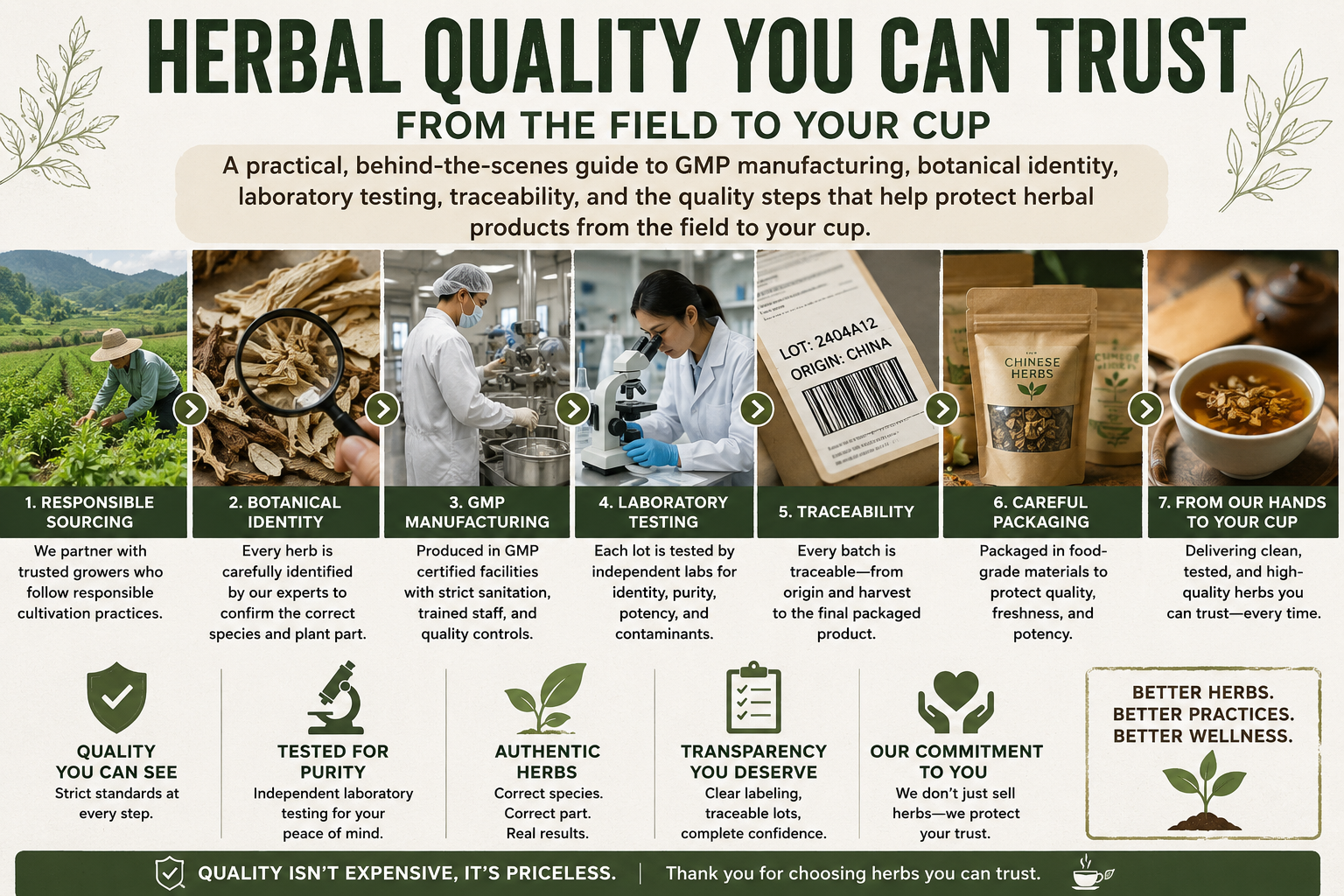
Buying herbs online requires a surprising amount of trust.
You do not see the farm where the plants were grown. You do not watch the harvest. You do not visit the drying room, inspect the warehouse, meet the laboratory technicians, or stand beside the equipment while the herbs are cut, powdered, packaged, and labeled.
You see a photograph, a product description, a price, and an “Add to Cart” button.
Then you are expected to put the product into your tea, soup, capsules, tincture, or herbal formula.
That raises a reasonable question:
How do you know the herb in the package is actually the herb named on the label—and that it was handled responsibly before it reached you?
This is where quality assurance becomes important.
Quality assurance is not a fancy seal, a reassuring phrase, or a laboratory coat added to a product photograph. It is the collection of systems used to help verify identity, evaluate quality, reduce preventable contamination, control manufacturing, maintain accurate records, and trace a product when questions arise.
One of the most important parts of that system is GMP, or Good Manufacturing Practices.
GMP may not sound exciting. It sounds a little like something written in a binder that nobody opens unless an inspector walks through the door.
But GMP is what helps keep a facility from operating under the highly questionable philosophy of:
“That looks about right. Toss it in the grinder.”
Responsible manufacturing requires much more than that.
This guide explains what customers rarely get to see: how quality herbs should be received, identified, tested, processed, packaged, stored, and traced—and why every one of those steps matters to you.
The Trust Problem When Buying Herbs Online
Imagine walking into a restaurant where you are not allowed to see the kitchen.
You do not know where the ingredients came from. You do not know whether the refrigerator works. You do not know whether anyone cleaned the cutting boards. You do not know whether yesterday’s chicken is sharing a workspace with today’s salad.
The dining room may look beautiful, but the condition of the kitchen is what really matters.
Buying herbs online is similar. The product page is the dining room. The sourcing, testing, manufacturing, documentation, and storage systems are the kitchen.
A polished website cannot tell you by itself whether:
- The correct botanical species was used.
- The correct part of the plant was harvested.
- The herb was adequately dried.
- The shipment was exposed to moisture.
- The material met microbial specifications.
- Manufacturing equipment was cleaned properly.
- The right label was placed on the right product.
- The finished product can be traced to a particular lot.
This is why responsible manufacturers rely on systems rather than appearance.
A root can look respectable and still be the wrong species. A powder can look perfectly ordinary while hiding a labeling error. A package can look premium even when the company behind it provides little information about its sourcing or testing.
The customer sees the bag. Quality assurance controls the story behind the bag.
What Does GMP Really Mean?
GMP stands for Good Manufacturing Practices. In the United States, dietary-supplement regulations commonly use the term CGMP, meaning Current Good Manufacturing Practice.
The word “current” matters because manufacturing methods are expected to remain appropriate and up to date. A company should not rely on a method simply because someone’s grandfather used it next to a dusty scale in 1974.
Tradition is valuable in herbal practice. Improvised manufacturing is not.
Good
“Good” means procedures are designed to protect product quality and reduce avoidable errors. This includes suitable facilities, appropriate equipment, trained employees, written instructions, established specifications, quality review, and records.
Manufacturing
Manufacturing includes much more than turning on a grinder. It may include receiving, holding, cleaning, drying, cutting, milling, blending, extracting, encapsulating, packaging, labeling, storing, and distributing herbs.
Practices
“Practices” means important tasks should be performed through repeatable, documented procedures rather than memory, guesswork, or the classic manufacturing instruction:
“Just do what Linda usually does.”
Linda may be wonderful. Linda may also be on vacation.
A reliable system should still work.
GMP Controls What Customers Cannot See
GMP is often misunderstood as a single laboratory test or one annual inspection.
It is much larger than that.
GMP is a quality system that asks questions throughout the life of a product:
- Who supplied the herb?
- Was the supplier evaluated?
- Was the shipment damaged?
- Was the herb placed on hold until it was approved?
- Was its identity verified?
- Did it meet established specifications?
- Was the equipment clean?
- Were employees trained?
- Were the correct amounts used?
- Was the correct label applied?
- Was the finished batch reviewed?
- Can the company trace the product later?
The customer rarely sees these steps, but these are the steps that matter.
The Important Realization
When you buy a carefully manufactured herb, you are not paying only for dried plant material.
You are also paying for supplier review, botanical identification, sanitation, testing, trained personnel, controlled production, accurate labeling, quality review, appropriate storage, and traceable records.
Quality is not merely what is inside the package. It is everything responsible companies did before closing the package.
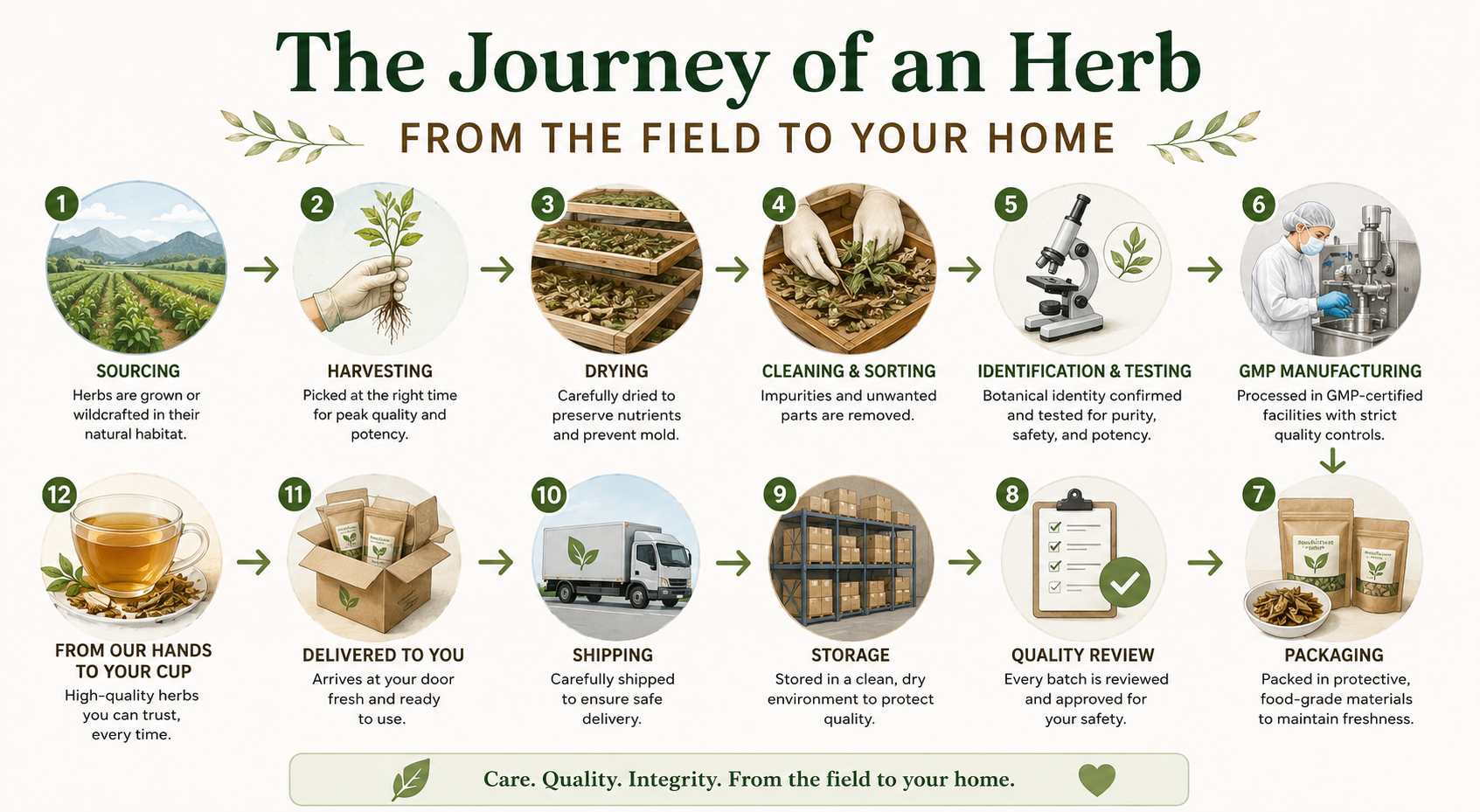
The Journey of an Herb from the Field to Your Home
Consider a common herb such as Astragalus root.
Before it becomes a cut herb or powder in your kitchen, it may travel through many stages:
- The correct botanical species is selected.
- The plant is cultivated or responsibly harvested.
- The root is collected at an appropriate stage of maturity.
- Soil and unwanted plant matter are removed.
- The root is dried.
- The material is sorted and graded.
- It is shipped to a supplier or manufacturer.
- The shipment is inspected and assigned a lot number.
- A representative sample is collected.
- The botanical identity is examined.
- The material is evaluated against quality specifications.
- The approved root is cut, sliced, or milled.
- The equipment is cleaned and documented.
- The product is packaged and labeled.
- Quality personnel review the production record.
- The finished product is stored under appropriate conditions.
- It is shipped to the retailer.
- It is stored and packed for the customer.
- It finally arrives at your home.
That is a long journey for something that eventually sits quietly in a cupboard.
Every stage offers an opportunity to protect quality—or to lose it.
Step 1: Choosing Reliable Suppliers
Quality begins before the herb arrives at a manufacturing facility.
A company must decide which farms, collectors, processors, brokers, and ingredient suppliers it is willing to trust.
Supplier qualification may include:
- Reviewing the supplier’s history.
- Evaluating previous shipments.
- Confirming the botanical species and plant part.
- Reviewing testing documentation.
- Checking consistency between lots.
- Reviewing handling and drying methods.
- Examining how rejected materials are managed.
- Determining whether materials can be traced.
Why this matters to the customer
A laboratory can test many things, but testing should not be used as an excuse to buy carelessly from unknown sources.
The strongest quality systems reduce risk before the material is purchased.
This is similar to cooking. A careful chef chooses good ingredients first. The chef does not buy a suspicious chicken and announce, “No problem. We will inspect it after dinner.”
Step 2: Inspecting Herbs When They Arrive
When herbs reach a responsible facility, they should not automatically move into production.
The receiving team may check:
- The supplier’s identity.
- The purchase order.
- The product name.
- The number of bags, boxes, or drums.
- The condition of the packaging.
- Evidence of moisture or water damage.
- Unusual odors.
- Signs of insects or pests.
- The supplier’s lot number.
- The date of arrival.
Why this step matters
A shipment may have left the supplier in acceptable condition but been damaged during transportation.
A torn bag, leaking truck, hot shipping container, or labeling mix-up can affect the material before the manufacturer receives it.
Receiving inspection gives the company an early opportunity to stop a problem from moving farther into production.
Step 3: Why Herbs May Be Quarantined
In manufacturing, quarantine does not necessarily mean the herb is dangerous. It means the material has not yet been approved for use.
Incoming herbs may be held in a designated area while identity examinations, tests, document reviews, or quality decisions are completed.
Materials may be marked:
- Quarantined
- Pending testing
- Approved
- Rejected
- On hold for investigation
Why this matters
Without clear status controls, an employee could accidentally use a material before it was examined.
A bag sitting in a warehouse should not become an ingredient simply because it looks lonely and someone needs to finish a production run before lunch.
Quarantine helps prevent unapproved materials from being used.
How Botanical Identity Is Verified
Botanical identity answers one of the most important questions in herbal quality:
Is this actually the herb named on the label?
This matters because similar-looking plants may have different traditional uses, chemical profiles, safety considerations, or plant parts.
Buying an incorrectly identified herb is not like receiving the wrong color towel.
It is more like ordering coffee and receiving a bag of roasted beans that merely resemble coffee. The resemblance is not enough.
Botanical identification may use one or more appropriate methods, depending on the herb and its form.
| Identification Method | What It Examines | Why It Is Useful | Its Limitation |
|---|---|---|---|
| Macroscopic examination | Visible shape, size, color, surface, and internal structures | Useful for whole and cut herbs | Less useful after fine grinding |
| Organoleptic examination | Aroma, taste, appearance, and texture | Can reveal expected or unusual characteristics | Requires training and may not separate close relatives |
| Microscopy | Cells, fibers, hairs, vessels, crystals, and plant tissues | Especially useful for cut and powdered herbs | Processing may damage identifying features |
| Chromatography | Patterns of naturally occurring chemical compounds | Can compare a sample with an expected fingerprint | Related plants may share some compounds |
| Spectroscopy | How a sample interacts with infrared or other energy | Can provide a rapid material fingerprint | Requires suitable reference materials |
| DNA-based testing | Genetic material associated with the plant | May help distinguish species | Does not prove chemical quality or plant condition |
Why more than one method may be needed
A whole root may be identified by shape, surface, internal color, texture, aroma, taste, and microscopy.
Once that root is ground into powder, much of its visible structure disappears. Microscopy or chemical fingerprinting may become more important.
An extract may contain very little recognizable plant tissue, so a method designed for whole roots would not be appropriate.
There is no single magical test that solves every botanical question. Quality comes from choosing the right method for the right material.
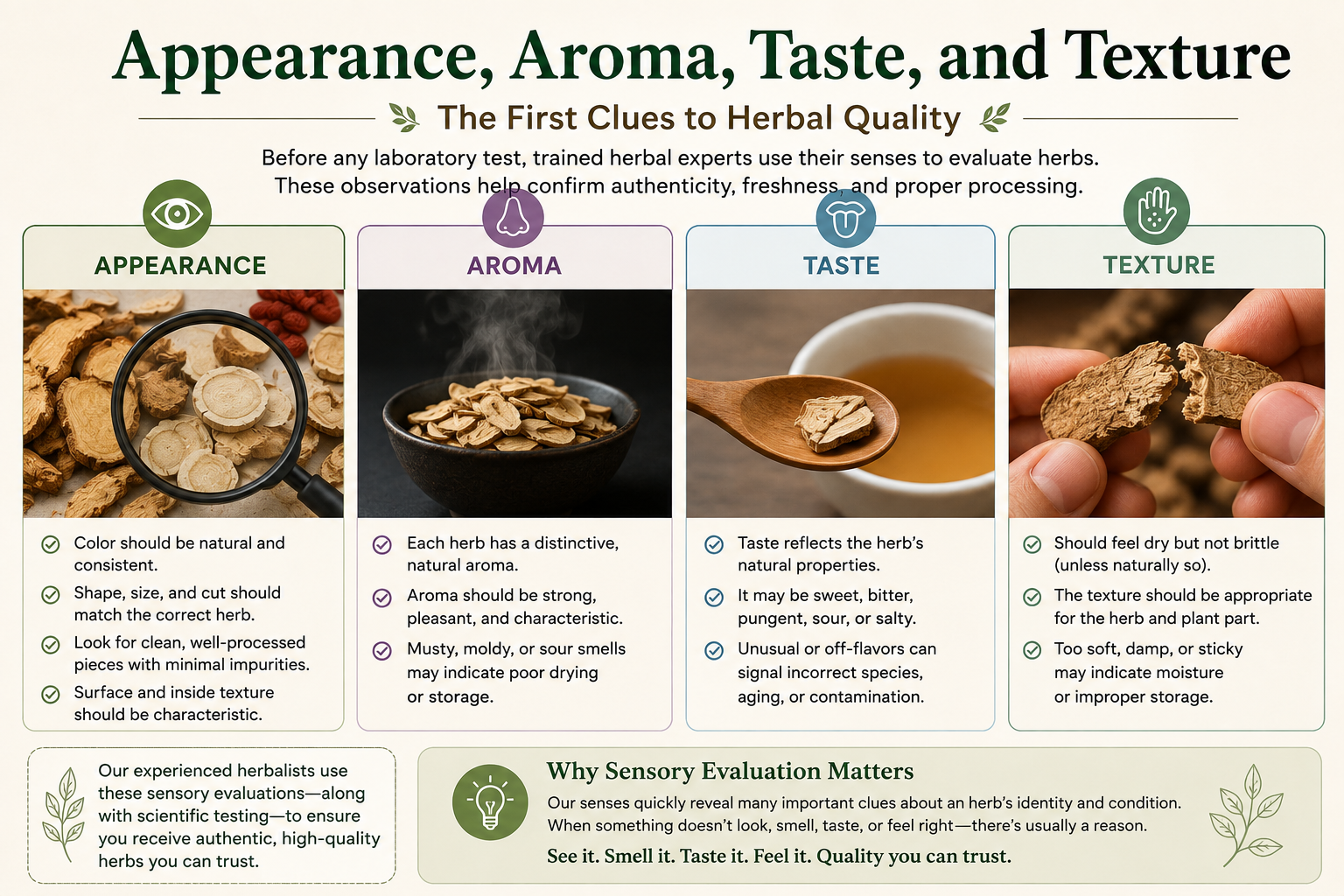
Appearance, Aroma, Taste, and Texture
Experienced botanical specialists often begin with their senses. This is called an organoleptic examination.
They may look at:
- Color
- Shape
- Size
- Surface markings
- Texture
- Fracture pattern
- Aroma
- Taste
- Foreign material
For example, citrus peel should possess recognizable aromatic qualities. A root may have a distinctive fibrous pattern. A fruit may have a characteristic internal structure or seed arrangement.
Why this matters
A trained examiner may quickly notice that a herb is stale, damp, unusually colored, incorrectly cut, musty, or inconsistent with the expected material.
This is not the same as someone opening a bag, taking a dramatic sniff, and announcing, “Smells herbal.”
Meaningful sensory identification requires knowledge, reference materials, and experience.
Microscopic Identification
Microscopy allows analysts to examine plant structures that cannot be seen with the unaided eye.
Depending on the herb, an analyst may look for:
- Plant hairs
- Fibers
- Vessels
- Starch grains
- Oil cells
- Crystals
- Pollen
- Stone cells
- Secretory structures
Why microscopy is valuable for powders
Grinding destroys the overall shape of a plant, but many tiny structures remain. These microscopic clues may help confirm that the expected botanical tissues are present.
Why it is not perfect
Closely related species may share similar structures. Extracts may contain little intact plant tissue. Heat or processing may change what can be seen.
That is why microscopy may be combined with other identity methods.
Chemical Fingerprinting
Plants naturally contain many chemical constituents. Laboratories can examine the pattern of these constituents much like a fingerprint.
Methods may include:
- High-performance liquid chromatography
- Thin-layer chromatography
- Gas chromatography
- Mass spectrometry
- Infrared spectroscopy
What chemical fingerprinting can help show
- Whether expected marker compounds are present
- Whether a sample resembles an established reference
- Whether one lot differs unexpectedly from another
- Whether substitution or adulteration may have occurred
What it cannot prove by itself
Finding one expected compound does not always prove that the entire herb is authentic. The same compound may occur in several plants.
It is the difference between confirming that a cake contains sugar and confirming that it is definitely your grandmother’s chocolate cake.
Sugar is helpful evidence. It is not the entire identity.
DNA Testing and Its Limitations
DNA-based testing can help identify genetic material associated with a plant species.
It can be very useful, but it is sometimes marketed as though it answers every possible question. It does not.
DNA testing may be limited because:
- Heat can damage DNA.
- Processing can reduce usable genetic material.
- Extracts may contain little or no intact DNA.
- DNA may identify the species but not the plant part.
- DNA does not measure freshness.
- DNA does not determine pesticide or heavy-metal levels.
- DNA does not show whether a product was stored properly.
DNA testing can help answer, “What plant appears to be present?”
It does not answer, “Was this herb properly dried, cleanly processed, chemically consistent, and responsibly stored?”
What Laboratories Test For
After identity is addressed, manufacturers may evaluate herbs for unwanted contaminants and other quality characteristics.
Testing may include:
- Microbial quality
- Yeast and mold
- Selected pathogens
- Selected heavy metals
- Pesticide residues
- Mycotoxins when relevant
- Residual solvents when relevant
- Moisture
- Foreign matter
Not every herb requires the exact same test panel. Testing should reflect the ingredient, source, processing method, intended use, known risks, and established specifications.
A root grown underground may present different concerns than a flower grown above ground. An extract powder may require different testing than whole dried fruit.
Good testing is thoughtful. It is not merely a long list printed for marketing purposes.
Microbial Quality Testing
Herbs grow in the natural environment, where microorganisms exist in soil, water, and air.
Responsible drying, handling, and storage help control microbial growth. Laboratory testing may evaluate:
- Total aerobic microbial count
- Yeast and mold
- Indicator organisms
- Specific organisms when appropriate
Why this matters
Microbial testing can help identify problems related to drying, sanitation, storage, or handling.
Does this mean dried herbs are sterile?
No.
Herbs are agricultural products, not surgical instruments. The goal is not to pretend that nature has been removed from the product. The goal is to ensure the material meets appropriate quality specifications.
Heavy-Metal Screening
Heavy metals occur naturally in the environment. Plants may absorb trace elements from soil and water, while pollution or processing can create additional exposure.
Testing programs commonly evaluate metals such as:
- Lead
- Arsenic
- Cadmium
- Mercury
Why this matters
You cannot identify heavy-metal levels by looking at or smelling an herb.
A root will not politely turn purple and display a small warning sign when lead is present.
Instrumental laboratory testing is required to measure these elements.
Results must be interpreted according to the amount present, serving size, exposure, specifications, and applicable requirements. Modern instruments can detect extremely small quantities, so “detected” does not automatically mean “unsafe.”
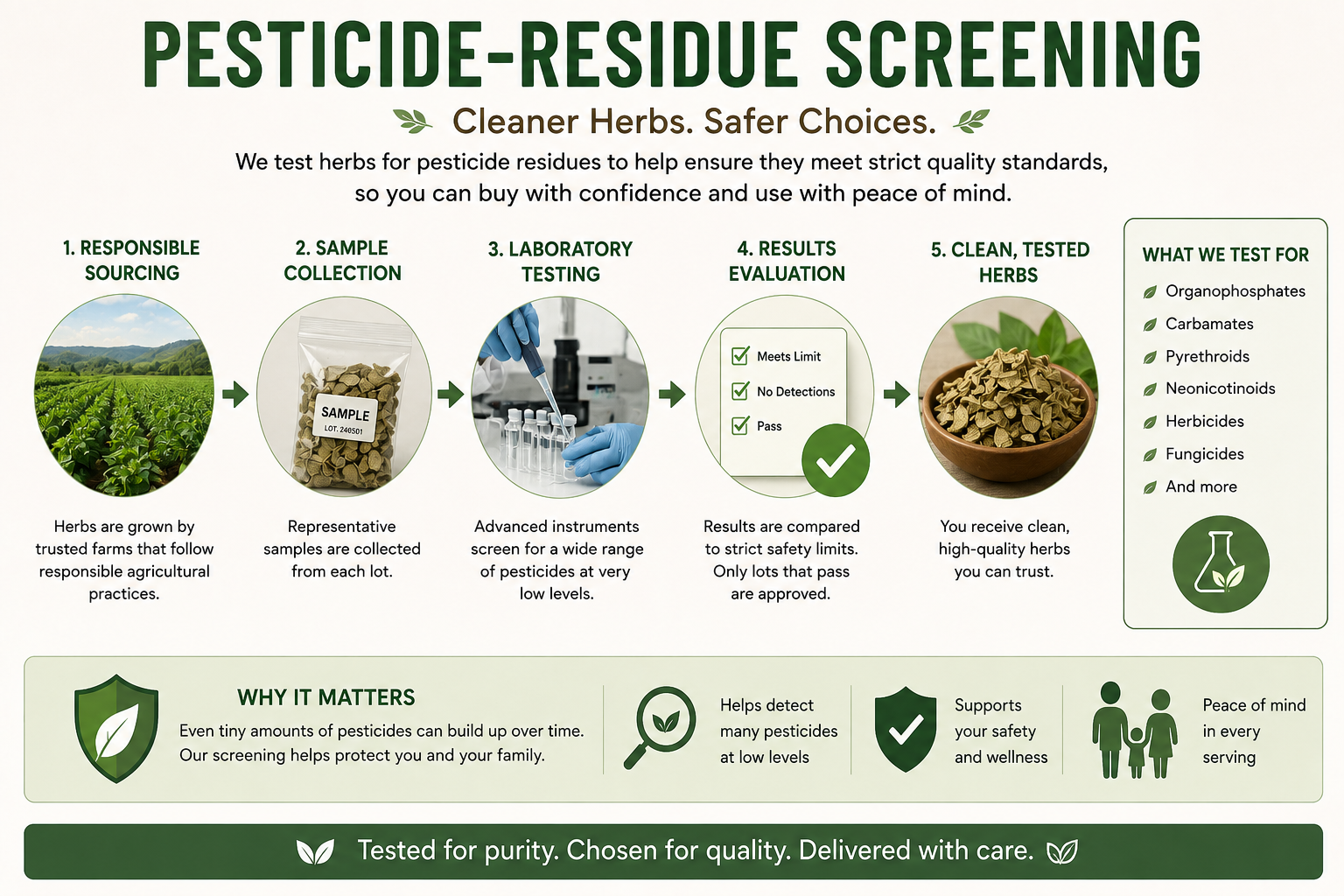
Pesticide-Residue Screening
Pesticides may be used during agricultural production to protect crops from insects, weeds, fungi, and other threats.
Laboratories may use multi-residue methods to screen for many compounds.
What “pesticide tested” should mean
It should mean the material was evaluated according to an established testing panel and specification.
It should not be used to imply that every chemical ever invented was tested at every possible level.
Responsible quality language is specific. Vague promises may sound impressive, but details are more useful than dramatic adjectives.
Why Moisture Matters
Moisture is one of the most practical threats to dried herbs.
Excess moisture can contribute to:
- Clumping
- Musty odors
- Mold growth
- Faster deterioration
- Changes in texture
- Reduced storage stability
Manufacturers may evaluate moisture content or water activity.
Moisture content measures how much water is present. Water activity evaluates how available that water is to support microbial growth or other changes.
This is why storing herbs beside a steamy stove or humid sink is not ideal.
Your herbs do not need a spa day.
Cleaning, Sorting, and Processing
After harvest, botanical materials may need cleaning and sorting before cutting, milling, or packaging.
Depending on the plant, this may involve:
- Removing soil
- Removing stones
- Removing foreign plant material
- Trimming unwanted portions
- Washing where appropriate
- Brushing or mechanical cleaning
- Sorting by size or quality
- Drying
- Cutting or slicing
- Milling into powder
Why different herbs require different handling
A delicate flower cannot be processed like a dense root. A fragrant peel must be handled differently from bark. Some Chinese herbs undergo intentional traditional processing, such as steaming or frying, that changes their finished characteristics.
Quality processing respects the botanical material instead of forcing every plant through the same procedure.
Why Manufacturing Equipment Must Be Clean
Imagine that a facility mills turmeric on Monday, Licorice root on Tuesday, and Astragalus on Wednesday.
If the equipment is not cleaned properly, Monday’s turmeric may become an uninvited guest in Tuesday’s Licorice.
By Wednesday, the grinder could be producing a botanical family reunion nobody ordered.
GMP procedures may address:
- Cleaning equipment between products
- Documenting cleaning
- Inspecting equipment before use
- Controlling dust
- Maintaining food-contact surfaces
- Separating materials when needed
- Preventing unintended carryover
Why this matters
Cross-contamination or unintended mixing can make a finished product incorrectly labeled.
Cleaning is not merely about appearance. Equipment can look clean while still containing residue in seams, screens, blades, or hidden surfaces.
Employee Training and Hygiene
Even the best written procedures are useless if employees are not trained to follow them.
Training may cover:
- Handwashing
- Protective clothing
- Illness reporting
- Sanitation
- Equipment use
- Sampling procedures
- Material handling
- Recordkeeping
- Label controls
- Warehouse practices
- Reporting unusual events
Why training records matter
A company should be able to demonstrate that employees received appropriate instruction for the work they perform.
“He watched someone else do it once” is not a serious training program.
Why GMP Requires So Much Documentation
Manufacturing records are rarely glamorous.
Nobody has ever watched a quality technician complete a batch record and whispered, “This is the most thrilling moment of my life.”
But records are essential.
They document:
- Which ingredients were used
- Which ingredient lots were used
- How much was weighed
- Who performed the work
- Which equipment was used
- When each step occurred
- What yields were obtained
- Whether checks were completed
- Whether anything unusual happened
Why this matters to consumers
If a question arises later, the company can investigate the actual production history rather than relying on memory.
There is a common quality principle:
If it was not documented, it is difficult to prove that it happened.
Documentation creates accountability.
The Role of Quality Control
Quality-control personnel review important manufacturing decisions.
They may:
- Approve or reject incoming herbs
- Review specifications
- Review laboratory results
- Approve manufacturing instructions
- Review production records
- Investigate deviations
- Review complaints
- Approve or reject finished batches
Why quality control should be separate from production
The production team is responsible for making the product.
The quality team is responsible for asking whether it was made correctly.
This separation provides oversight. Otherwise, the same person might make a mistake, review the mistake, and congratulate themselves for finding no problems.
Packaging and Labeling Controls
An accurately identified herb placed under the wrong label is still a serious failure.
Packaging and labeling controls help verify:
- The correct herb enters the correct container.
- The correct label is used.
- The package size is accurate.
- The lot number is correct.
- The seal is properly applied.
- The packaging protects the product.
- Unused labels are controlled.
Why packaging matters
Herbs can be affected by moisture, heat, light, oxygen, pests, strong odors, and damaged containers.
A package is not merely decoration. It helps protect the herb during storage and shipping.
Why Lot Numbers Matter
A lot number connects a finished product with its manufacturing history.
It may allow a company to determine:
- Which supplier provided the herb
- Which supplier lot was used
- When the herb arrived
- Which tests were performed
- Which batch used the material
- When it was packaged
- Where the finished products were distributed
Why this protects customers
Suppose a concern is discovered involving one shipment.
Without lot numbers, a company may struggle to identify which packages were affected.
With traceable lots, the investigation can focus on the relevant material rather than every package sold since the beginning of recorded time.
What Is a Certificate of Analysis?
A Certificate of Analysis, or COA, is a document that summarizes selected specifications or test results for a particular ingredient or finished-product lot.
A COA may include:
- Product name
- Botanical name
- Plant part
- Lot number
- Dates
- Test methods
- Specifications
- Results
- Pass or fail conclusions
Why a COA is useful
It organizes quality information for a specific lot and may show whether the tested material met established specifications.
What a COA does not replace
A COA does not replace proper sampling, supplier qualification, sanitation, identity verification, production records, or quality review.
A beautiful document cannot rescue a careless process.
Why Some Herbs Cost Less
Herbal prices vary for many legitimate reasons.
Differences may reflect:
- Species and plant part
- Growing region
- Harvest method
- Organic certification
- Wildcrafted availability
- Seasonal supply
- Processing requirements
- Testing programs
- Documentation
- Package size
- Shipping costs
A lower price does not automatically mean a poor product. A higher price does not automatically guarantee excellence.
However, responsible sourcing, identity verification, laboratory testing, GMP manufacturing, documentation, and controlled storage all cost money.
When two products appear identical but have dramatically different prices, it is reasonable to ask what information, testing, sourcing, or quality systems stand behind each one.
The least expensive herb is not a bargain if it is incorrectly identified, poorly stored, or unsupported by reliable quality information.
What GMP Does Not Mean
Understanding GMP also means understanding its limits.
GMP does not mean FDA approved
Dietary supplements are not individually approved by the FDA before sale in the same way prescription drugs are approved.
GMP does not mean sterile
Herbs remain agricultural products. GMP controls manufacturing quality; it does not convert dried plants into sterile surgical supplies.
GMP does not mean every company is equal
Companies may differ in supplier standards, specifications, testing programs, employee training, equipment, experience, and how effectively procedures are followed.
GMP does not guarantee a health result
Manufacturing quality and health effectiveness are separate questions.
GMP does not replace responsible use
Customers should still read labels, follow preparation directions, consider medication interactions, store products correctly, and seek professional guidance when appropriate.
Should You Wash Herbs Before Using Them?
Many customers feel more comfortable giving whole or cut herbs a brief rinse before making tea, soup, or a decoction.
That is usually a reasonable personal-preference step for suitable whole and cut materials.
Whole roots, bark, fruits, and cut herbs
Place the measured herb in a strainer and rinse briefly under cool running water. Drain promptly and continue with the preparation.
Leaves and flowers
Rinse gently if desired. Avoid prolonged soaking because delicate herbs may lose aroma or break apart.
Powdered herbs
Do not rinse herbal powders. The powder would simply wash away.
Extract powders and granules
These are generally dissolved or mixed according to their instructions rather than washed.
Does rinsing remove every possible contaminant?
No.
A quick rinse may remove loose surface particles. It cannot verify species identity or reliably remove internal contamination, heavy metals, or every pesticide residue.
Rinsing is an optional preparation step. It is not a substitute for responsible sourcing and manufacturing.
Questions Every Herbal Buyer Should Ask
You should not need a laboratory degree to make a more informed purchase.
Start with these questions:
- Is the botanical name listed?
- Is the plant part identified?
- Is the form clearly described as whole, cut, powder, granule, or extract?
- Is the brand or manufacturer disclosed?
- Is the country of origin provided when available?
- Does the company explain its quality standards?
- Does it discuss testing honestly and specifically?
- Are all ingredients disclosed?
- Are cautions provided?
- Can you contact a real person with questions?
- Does the supplier provide preparation information?
- Does the company avoid miracle-cure language?
A responsible herbal company should help you make an informed decision rather than asking you to trust a green leaf logo and several impressive-sounding adjectives.
Why Quality Has Mattered to 1st Chinese Herbs Since 1994
1st Chinese Herbs has supplied Chinese and Western herbs since 1994.
Over the years, we have learned that customers do not merely want a long product list. They want to know what they are buying, how to use it, and why they should feel confident choosing it.
That is why we work with established herbal brands and manufacturers that emphasize areas such as:
- Botanical identification
- Species authentication
- GMP manufacturing
- Laboratory quality programs
- Microbial screening
- Heavy-metal testing
- Pesticide-residue screening
- Traceable production lots
- Proper packaging
- Controlled storage
Testing methods and specifications vary by product, brand, and lot. We do not believe customers are served by exaggerated promises or claims that no agricultural supplier can honestly make.
We believe trust is built through transparency, accurate product descriptions, realistic cautions, established suppliers, practical preparation guidance, and a willingness to answer questions.
Our Approach to Quality
We cannot promise that an agricultural product is completely sterile or untouched by the natural environment.
What we can do is choose products from manufacturers that invest in identity, testing, controlled manufacturing, documentation, traceability, and responsible handling.
Real confidence does not come from pretending risk does not exist. It comes from understanding the systems used to reduce it.
Frequently Asked Questions About GMP and Herbal Quality
What does GMP stand for?
GMP stands for Good Manufacturing Practices. CGMP means Current Good Manufacturing Practice. These practices establish quality controls for manufacturing, packaging, labeling, and holding dietary supplements.
Does GMP mean the product was laboratory tested?
GMP includes requirements related to specifications, examinations, testing, sanitation, records, production controls, and quality review. The exact testing varies by ingredient and product.
Does GMP mean FDA approved?
No. Dietary supplements are not individually approved by the FDA before sale in the same manner as prescription drugs.
How is botanical identity verified?
Identity may be evaluated through macroscopic examination, aroma, taste, microscopy, chromatography, spectroscopy, DNA-based testing, authenticated references, or an appropriate combination of methods.
Is DNA testing always the best method?
No. DNA testing can be useful, but processing may damage DNA, and DNA does not determine plant condition, chemical quality, freshness, or contaminant levels.
Why can two batches of the same herb look different?
Natural variation may result from climate, harvest season, maturity, growing region, drying, processing, and the natural character of the plant.
Can clean herbs still contain a little plant dust?
Whole and cut herbs may contain loose plant particles or minor surface dust from cutting and handling. Many customers choose to rinse suitable whole or cut herbs briefly before preparation.
Should powdered herbs be washed?
No. Washing would carry away the powder.
Does boiling remove every possible problem?
No. Heating may reduce some microorganisms, but it does not correct the wrong botanical species or reliably remove heavy metals and every pesticide residue.
What is third-party testing?
Third-party testing is performed by a laboratory separate from the manufacturer. It can provide additional verification when appropriate sampling, methods, and specifications are used.
What is a lot number?
A lot number identifies a particular production group and links the finished product with manufacturing and quality records.
What is a Certificate of Analysis?
A Certificate of Analysis is a document that summarizes selected specifications or results for a particular ingredient or finished-product lot.
Does GMP guarantee that an herb will work?
No. GMP addresses manufacturing quality. It does not guarantee that a product is suitable for every individual or will produce a particular result.
The Bottom Line: The Package Is Only the Final Step
When you hold a package of quality herbs, you are seeing the final step in a much longer process.
Behind that package should be people responsible for cultivation, harvesting, botanical identification, testing, sanitation, manufacturing, documentation, labeling, quality review, storage, and distribution.
Every step has a purpose:
- Supplier qualification helps reduce risk before purchasing.
- Receiving inspection catches visible shipping problems.
- Quarantine prevents unapproved ingredients from being used.
- Botanical identification helps confirm the correct herb.
- Laboratory testing evaluates defined quality characteristics.
- Equipment cleaning helps prevent unintended mixing.
- Training helps employees perform work consistently.
- Documentation creates accountability.
- Label controls help ensure the package matches the product.
- Lot numbers allow traceability.
- Proper storage helps preserve quality.
That is what GMP is really about.
It is not a decorative phrase.
It is not one test.
It is not a guarantee that nature can be made completely risk-free.
GMP is a system of responsibility designed to help protect the quality of the products customers are expected to trust.
At 1st Chinese Herbs, we believe you deserve to know what stands behind the herbs you purchase—not merely what is printed on the front of the package.