
Honeysuckle vs Forsythia: Why These Two Herbs Seem To Follow Each Other Everywhere
If you've spent any amount of time exploring Chinese herbs, you've probably noticed something curious.
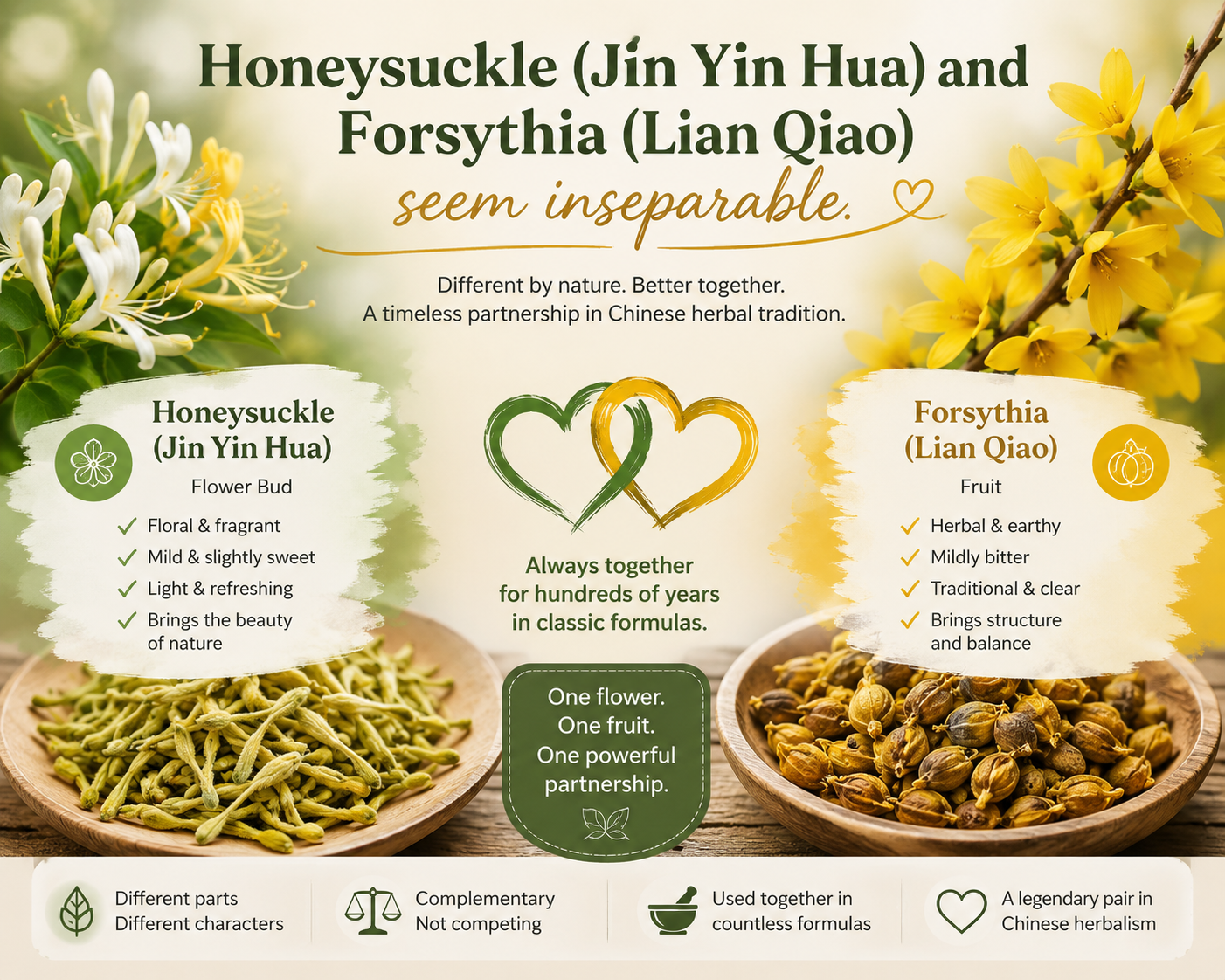
Honeysuckle (Jin Yin Hua) and Forsythia (Lian Qiao) seem inseparable.
You see Honeysuckle. A few pages later, there is Forsythia. You read a traditional formula.
There they are again. You open a Chinese herbal reference book. Still together.
After a while, most beginners start wondering:
"Are these two herbs basically the same thing?"
That's exactly what many customers ask us.
And honestly, it's a fair question. After all, how many herb pairs show up together so often that people start thinking they're related?
But here's the surprise. They couldn't be more different. One is a flower. One is a fruit.
One grows on a vine. One grows on a shrub.
One looks delicate enough to belong in a spring garden. The other looks like it came to work.
And yet, for hundreds of years, herbalists have continued pairing them together.
Why? That's the real story.
 Let's Make This Easy
The Quick Answer
Honeysuckle and Forsythia became famous together not because they're similar.
They became famous because they're different.
Traditional herbalists often looked for combinations of herbs that complemented one another rather than duplicated one another.
Instead of asking:
"Which herb is best?"
They asked:
"Which herbs work well together?"
That simple idea created some of the most famous herb pairings in Chinese herbalism.
And few became more recognizable than Honeysuckle and Forsythia.
Quick Comparison Chart
| Feature | Honeysuckle (Jin Yin Hua) | Forsythia (Lian Qiao) |
|---|---|---|
| Plant Part Used | Flower Bud | Fruit |
| Botanical Name | Lonicera japonica | Forsythia suspensa |
| Appearance | Delicate Flower Buds | Dried Fruit |
| Flavor | Floral, Mild, Slightly Sweet | Herbal, Slightly Bitter |
| Tea Experience | Light & Pleasant | Earthy & Traditional |
| Beginner Friendly | ★★★★★ | ★★★★☆ |
| Most Famous For | Beautiful Flower Buds | Famous Herbal Pairings |
| Usually Seen With | Forsythia | Honeysuckle |
What You Should Know
This is where everything suddenly makes sense. Most people assume herbs that appear together must be similar. But that's often the opposite of how traditional formulas were built.
Think about cooking. Salt and pepper aren't the same. Coffee and cream aren't the same.
Peanut butter and jelly definitely aren't the same. Yet we naturally think of them as pairs.
The relationship between Honeysuckle and Forsythia is similar.
They became famous because they brought different characteristics to the same conversation.
Once you understand that, countless Chinese herbal formulas become easier to understand.
If Honeysuckle And Forsythia Were People
This might be the easiest way to remember them.
Honeysuckle
Honeysuckle is the person everyone notices first.
Friendly. Bright. Beautiful. The one bringing homemade cookies to the gathering.
The one whose garden everyone admires. Most people immediately understand why Honeysuckle became popular.
Forsythia
Forsythia is the dependable friend. The one who shows up early. The one making sure everything actually works. Less flashy. More practical. Not always the center of attention. But absolutely essential.
Different personalities.
Different strengths.
One famous partnership.
What Do They Actually Taste Like?
Here's the big question: if it doesn't taste good, I am not using it. This is often the question people really want answered.
Honeysuckle Flavor
Most people describe Honeysuckle as:
-
Floral
-
Fresh
-
Light
-
Mildly sweet
-
Pleasant in tea blends
Many customers are surprised by how approachable it is.
Forsythia Flavor
Forsythia is usually described as:
-
Herbal
-
Slightly bitter
-
Earthy
-
More traditional tasting
If Honeysuckle reminds you of a flower garden, Forsythia reminds you that you're drinking an herb.
Which Herb Is Better For Beginners?
If your goal is simply enjoying a pleasant herbal tea experience, Honeysuckle is often easier for beginners.
The floral character tends to feel familiar. Forsythia can be a little more traditional in flavor.
That doesn't make it better or worse. Just different.
And that's the recurring lesson throughout this comparison.
Different is exactly why these herbs became famous.
Why Customers Keep Confusing Them
After helping customers explore herbs for decades, we've noticed something.
People tend to confuse herbs that appear together often. It's understandable.
When two herbs are constantly mentioned side by side, it's natural to assume they're interchangeable.
Honeysuckle and Forsythia are one of the best examples of why that assumption can be misleading.
They're companions. Not duplicates.
The Herb Hall Of Fame
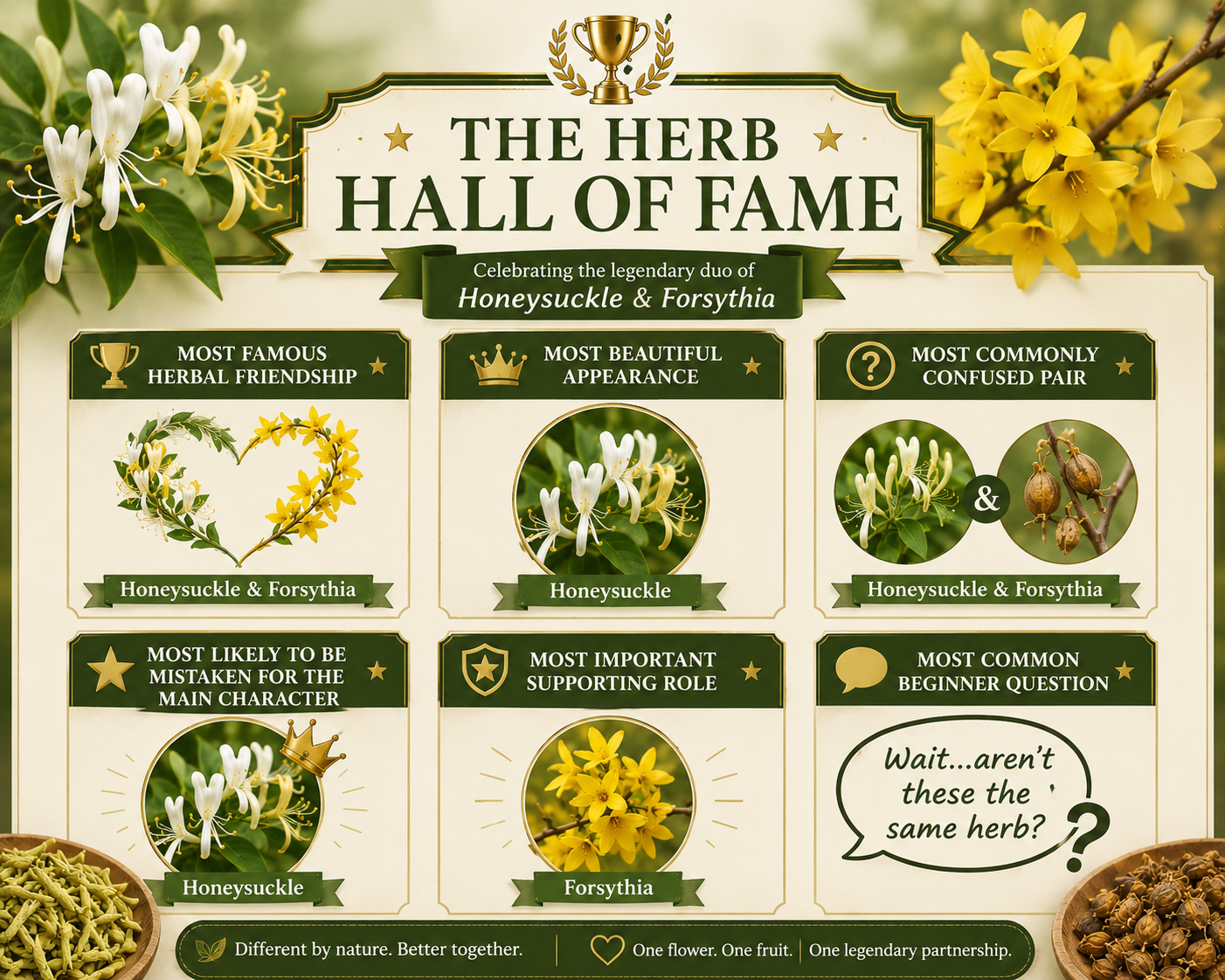
What This Pair Teaches About Chinese Herbalism
The biggest lesson isn't about Honeysuckle.
The biggest lesson isn't about Forsythia.
The biggest lesson is how traditional herbalists thought.
Many beginners spend years trying to find the single "best" herb.
Traditional herbal systems often focused on combinations.
Balance.
Partnerships.
Complementary strengths.
Honeysuckle and Forsythia became famous because they help illustrate that principle beautifully.
Once you understand this pair, you'll start noticing the same pattern throughout Chinese herbalism.
Which One Should You Choose?
Choose Honeysuckle if:
-
You enjoy floral herbs.
-
You prefer lighter tasting teas.
-
You're new to Chinese herbs.
-
You appreciate flower-based botanicals.
Choose Forsythia if:
-
You enjoy learning about traditional formulas.
-
You don't mind slightly more herbal flavors.
-
You're exploring classic Chinese herb pairings.
-
You want to better understand traditional herbal traditions.
Many experienced herb enthusiasts eventually explore both.
Not because they're the same.
Because they're different.
Final Takeaway
Most people start this comparison expecting to discover which herb is better.
That's the wrong question.
The real question is:
Why did herbalists keep pairing these two herbs together for centuries?
The answer is surprisingly simple.
One is a flower.
One is a fruit.
One is delicate.
One is practical.
One partnership.
Hundreds of years of history.
And one of the clearest examples of how traditional herbalists thought about combining herbs.
Once that idea clicks, you've learned something much bigger than the difference between Honeysuckle and Forsythia.
You've learned one of the core principles behind traditional Chinese herbal formulas.
About The Author
Author: 1st Chinese Herbs Research Team
Last Updated: June 13, 2026
The 1st Chinese Herbs Research Team combines decades of experience researching traditional Chinese herbs, medicinal mushrooms, roots, flowers, berries, teas, and botanical ingredients. Our mission is to help customers understand not only what herbs are, but why they have remained valued for generations.
Trusted Since 1994
Helping customers discover real herbs and traditional herbal knowledge for more than 30 years.
Research & References
Honeysuckle (Jin Yin Hua)
-
Shang X, Pan H, Li M, Miao X, Ding H. Lonicera japonica Thunb.: Ethnopharmacology, Phytochemistry and Pharmacology of an Important Traditional Chinese Medicine. Journal of Ethnopharmacology. 2011.
PMID: 21371574
-
Li Y, But PPH, Ooi VEC. Antiviral Activity and Mode of Action of Caffeoylquinic Acids from Lonicera japonica. Antiviral Research. 2005.
PMID: 16102819
-
Peng LY, Mei SX, Jiang B, Zhou H, Sun HD. Constituents from Lonicera japonica and Their Biological Activities.
PMID: 16872531
Forsythia (Lian Qiao)
-
Wang Z, Xia Q, Liu X, et al. Phytochemistry, Pharmacology, Quality Control and Future Research of Forsythia suspensa.
PMID: 25965562
-
Qu H, Zhang Y, Wang Y, Li B, Sun W. Antioxidant and Antibacterial Activity of Forsythia suspensa Extracts.
PMID: 20334153
-
Chinese Pharmacopoeia Commission. Monograph Review of Forsythia suspensa (Lian Qiao).
Honeysuckle & Forsythia In Traditional Herbal Formulas
-
Li S, Zhang B. Traditional Chinese Medicine Network Pharmacology: Theory, Methodology and Application.
PMID: 22305972
-
Wang Y, Fan X, Qu H, Gao X, Cheng Y. Strategies and Techniques for Multi-Component Drug Research in Traditional Chinese Medicine.
PMID: 21944205
Additional Reading
-
Chinese Pharmacopoeia (Latest Edition)
-
Bensky D, Clavey S, Stöger E. Chinese Herbal Medicine: Materia Medica.
-
Chen J, Chen T. Chinese Medical Herbology and Pharmacology.