
At 1st Chinese Herbs, we love root herbs for one simple reason: they’re often the “engine room” of Traditional Chinese Medicine—deep, foundational botanicals that are best used with clarity, consistency, and respect for potency. Used correctly, potent root herbs can support daily wellness routines in a traditional way. Used incorrectly, they can be wasted, overly strong for your constitution, or simply mismatched.
This guide gives you the real-world answers people search for:
-
what “potent” means in practice
-
how to prepare root herbs correctly (tea vs decoction)
-
how to start safely (and when to avoid)
-
what to track for better results
-
how to buy quality roots that are worth your money
What Are Potent Root Herbs?
Potent root herbs like Ginger (Sheng Jiang), Ginseng (Ren Shen), and Rehmannia (Di Huang) are cornerstone botanicals in Traditional Chinese Medicine (TCM). “Potent” doesn’t mean “stronger is better.” It usually means one (or more) of the following:
-
Dense plant material (roots extract differently than leaves/flowers)
-
Concentrated traditional action (used strategically in formulas)
-
More likely to interact with medications or sensitive constitutions
-
More preparation-dependent (wrong method = weak or harsh results)
Benefits of Potent Root Herbs
-
Ginger (Sheng Jiang): Traditionally used to support digestion and warming, often included in formulas to help “harmonize” the middle (TCM language).
-
Ginseng (Ren Shen): Traditionally used to support vitality and stamina in classic Qi-tonic strategies (TCM language).
-
Rehmannia (Di Huang): Traditionally used in “blood/yin” nourishing strategies in TCM and commonly used as part of formulas rather than solo.
Did You Know?
Root herbs often need simmer time to extract well. A quick steep can be too weak for dense roots—or too harsh if the herb is mismatched.
Why Follow Dosage Guidelines?
1. Maximizing Health Benefits
Dosage guidelines help you get a consistent, repeatable result instead of random “hit or miss” experiences.
2. Enhancing Safety
Root herbs can be powerful. Following recommended guidelines reduces the chance of digestive upset, overstimulation, or using an herb that doesn’t match your body’s current needs.
3. Facilitating Personalization
When you start with a known range and track your response, it becomes much easier to personalize your routine safely.
4. Preventing Interactions
Some roots can interact with medications or conditions. Staying within appropriate ranges and getting qualified guidance matters.
5. Supporting Long-Term Health
Herbs are often used as routines, not one-time “fixes.” Safe, steady use supports better long-term consistency.
Best Practices for Using Potent Root Herbs
1. Consult Qualified Professionals
If you’re pregnant, nursing, immunocompromised, managing a chronic condition, or using prescription medications, talk with a qualified professional before using potent herbs.
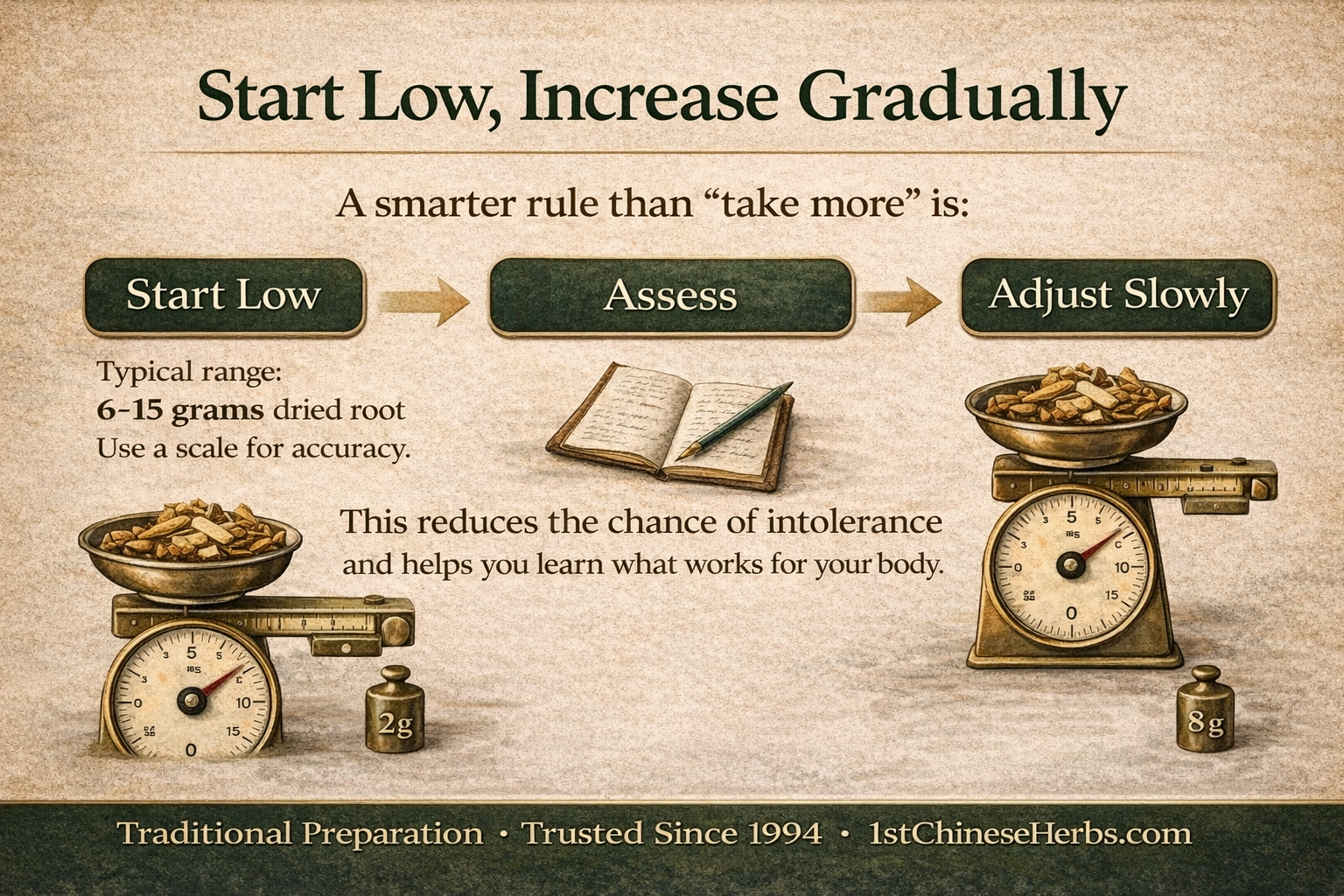
2. Start Low, Increase Gradually
A smarter rule than “take more” is:
Start low → assess → adjust slowly.
This reduces the chance of intolerance and helps you learn what works for your body.
3. Follow Clear Dosage Instructions
At 1st Chinese Herbs, we provide product form details (cut root, powder, extract) because form changes usage. Cut roots, powders, and extract granules are not interchangeable 1:1.
Pro Tip: Our How To Use Herbs Is An Easy To Follow Step By Step Articles
4. Document Your Experiences
Track these three items for 7–14 days:
-
how you prepared it (tea vs decoction vs powder)
-
how much you used
-
what you noticed (energy, digestion, sleep, appetite, comfort)
5. Educate Yourself on Herbs
The fastest way to improve results is to learn:
-
whether the herb is traditionally warming or cooling
-
whether it’s best used alone or in formulas
-
whether it’s best for short-term or long-term routines
Common Questions Consumers Ask
How quickly will I see results?
Some roots are noticed quickly (like warming digestive support herbs), while others are used as longer-term routine builders. Your preparation method and constitution matter.
Can I mix multiple root herbs safely?
Sometimes—but don’t guess. Traditional formulas combine herbs for a reason (balance, direction, tolerance). If you’re new, start with one root and learn it first.
What side effects should I monitor?
Common “too much / not a fit” signals can include digestive discomfort, headaches, feeling overstimulated, or feeling too cooled/down. Stop and reassess if this happens.
Are these herbs organic or wildcrafted?
We stock both, depending on the herb. Check each product listing for sourcing notes and quality details.
What if I encounter unwanted side effects?
Stop using the herb and consult a qualified professional—especially if symptoms persist.
Customer Testimonials
“I finally learned how to prepare roots correctly. The difference between steeping and decocting was huge.”
— Sarah J., Customer
“What I appreciate is the transparency—clear labeling, quality standards, and education that helps you use herbs responsibly.”
— Matthew K., Practitioner
“The herbs arrive clean, well-packed, and easy to store. I feel confident buying here because it’s consistent.”
— Anita L., Holistic Wellness Customer
Trusted Signals
-
Lab-Tested Quality: We prioritize quality screening and consistent sourcing practices.
-
COI/COA Transparency: Documentation is available upon request for many items (by lot).
-
Freshness Practices: Sealed packing + storage guidance to help maintain quality.
-
Education First: We help customers understand preparation methods and safe use.
Ready to Transform Your Health?
If you want to use root herbs the right way—without guesswork—start with the fundamentals:
-
choose the correct form (cut vs powder vs extract)
-
prepare it correctly
-
start low and track your response
Shop Root Herbsand build a routine you can trust.
How to Prepare Root Herbs Correctly: Comparison Guide
| Form | Best For | Preparation Method | Strength | Convenience |
|---|---|---|---|---|
| Cut Root (Slices / Pieces) | Traditional use, full-spectrum extraction | Simmer 30–60 minutes (decoction) | Strongest traditional method | Moderate |
| Tea Cut / Small Pieces | Lighter roots, convenience | Simmer or steep longer | Moderate | Easy |
| Powder | Convenience, faster routines | Stir into hot water | Moderate to strong | Very easy |
| Extract Granules | Precision, consistency | Dissolve in hot water | Concentrated | Easiest |
Pro Tip:
Dense roots almost always work best with simmering (decoction), not simple steeping.
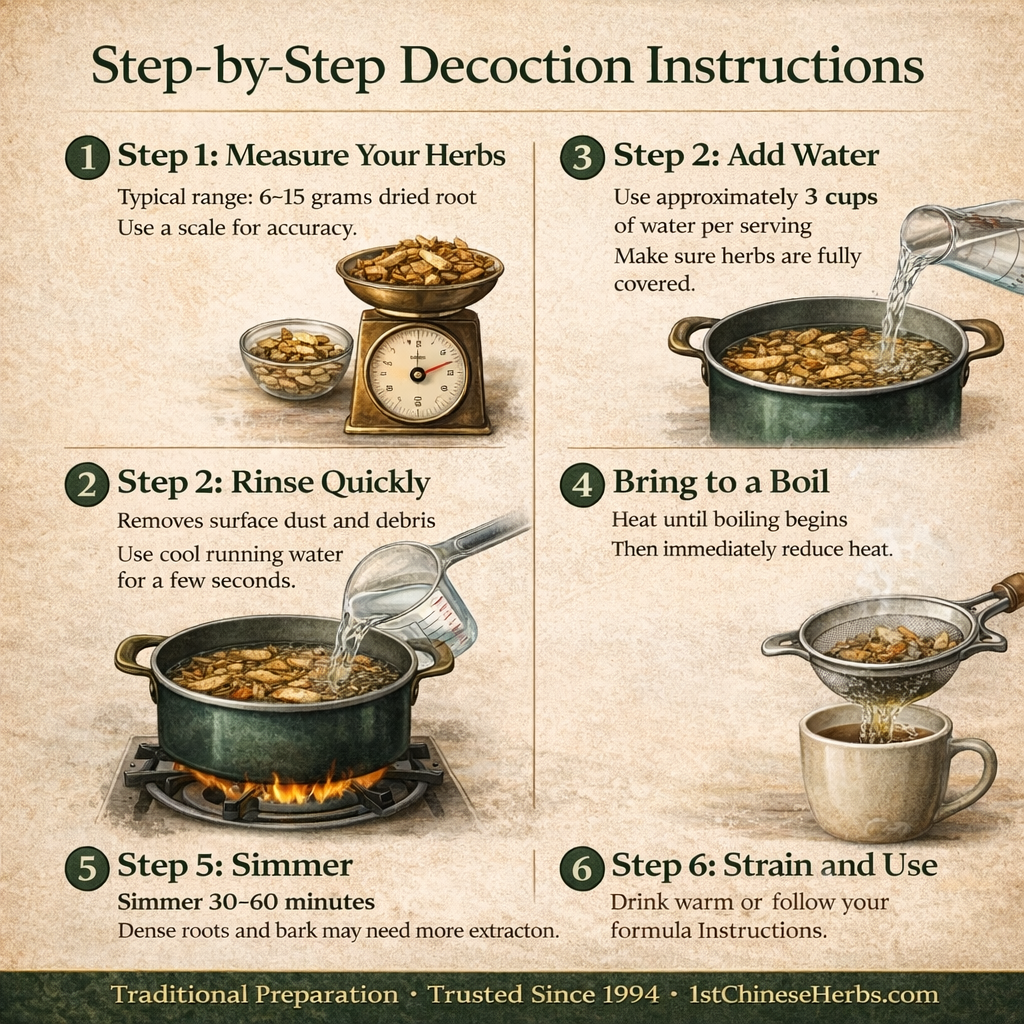
Step-by-Step: How to Make a Root Herb Decoction
Step-by-Step Decoction Instructions
Step 1: Measure your herbs
Typical educational range: 6–15 grams dried root
Step 2: Rinse quickly
Removes surface dust.
Step 3: Add water
Use approximately:
3 cups water per serving
Step 4: Bring to boil
Then reduce to low simmer.
Step 5: Simmer
30–60 minutes
Dense roots and bark may need longer.
Step 6: Strain and use
Drink warm or as directed.
Root Herb Safety Checklist
Use extra caution if:
-
Pregnant or nursing
-
Taking prescription medications
-
Using blood thinners
-
Managing liver conditions
-
Managing kidney conditions
-
Preparing herbs for children
-
Using multiple herbs together
When in doubt, consult a qualified professional.
Frequently Asked Questions
Are root herbs stronger than leaves?
Often yes. Roots typically contain more concentrated compounds.
Why simmer instead of steep?
Roots are dense and release compounds more effectively with simmering.
Can I use root herbs every day?
Some are suitable for routine use, others are used short-term.
It depends on the herb and your constitution.
How long do dried root herbs last?
Properly stored:
1–3 years
How do I store root herbs?
Store:
-
airtight
-
cool
-
dry
-
away from sunlight
Helpful Links
About 1st Chinese Herbs
1st Chinese Herbs is a family-owned herbal company established in 1994.
We specialize in:
-
Traditional Chinese herbs
-
Lab-tested sourcing practices
-
Species-authenticated botanicals
-
Education on safe and proper herbal preparation
Our mission is to help customers use herbs safely, responsibly, and effectively.
Written by 1st Chinese Herbs Research Team
References
https://pubmed.ncbi.nlm.nih.gov/30670235/
https://pubmed.ncbi.nlm.nih.gov/29627802/