
Licorice Root vs Ginger: Which Traditional Herb Belongs In Your Herbal Pantry?
If you opened a traditional herbalist's cupboard, there is a good chance you would find both Licorice Root and Ginger sitting on the shelf.
That is not an accident.
Let's Make This Easy.
These two herbs have been used for centuries, appear in countless traditional formulas, and remain among the most popular herbs purchased by beginners and experienced herbal enthusiasts alike.
Yet despite often appearing together, they serve very different roles.
Licorice Root is known for its naturally sweet flavor and its reputation as the "Great Harmonizer."
Ginger is famous for its warming character, bold flavor, and nearly universal presence in kitchens around the world.
So if you could only choose one, which herb is right for you?
Let's compare them side-by-side.
Quick Comparison: Licorice Root vs Ginger
| Feature | Licorice Root (Gan Cao) | Ginger (Sheng Jiang) |
|---|---|---|
| Flavor | Sweet | Spicy & Warming |
| Plant Part Used | Root | Rhizome |
| Traditional Nature | Neutral to Slightly Cooling | Warm |
| Most Famous For | Harmonizing Formulas | Warming Teas |
| Tea Flavor | Sweet & Smooth | Zesty & Spicy |
| Beginner Friendly | ★★★★★ | ★★★★★ |
| Kitchen Use | Occasional | Extensive |
| Common Pairing | Ginger | Licorice Root |
The Biggest Difference Between Licorice Root And Ginger
The simplest way to understand these herbs is to think about what they bring to a tea cup.
Licorice Root brings balance.
Ginger brings energy.
Licorice Root softens stronger flavors, adds natural sweetness, and helps create a smoother tea experience.
Ginger does the opposite.
It announces its presence immediately with warmth, spice, and aroma.
This difference explains why both herbs have remained popular for thousands of years.
They do different jobs.
Which Herb Tastes Better?
This is often the deciding factor for many customers.
The best herb is usually the one you'll actually drink.
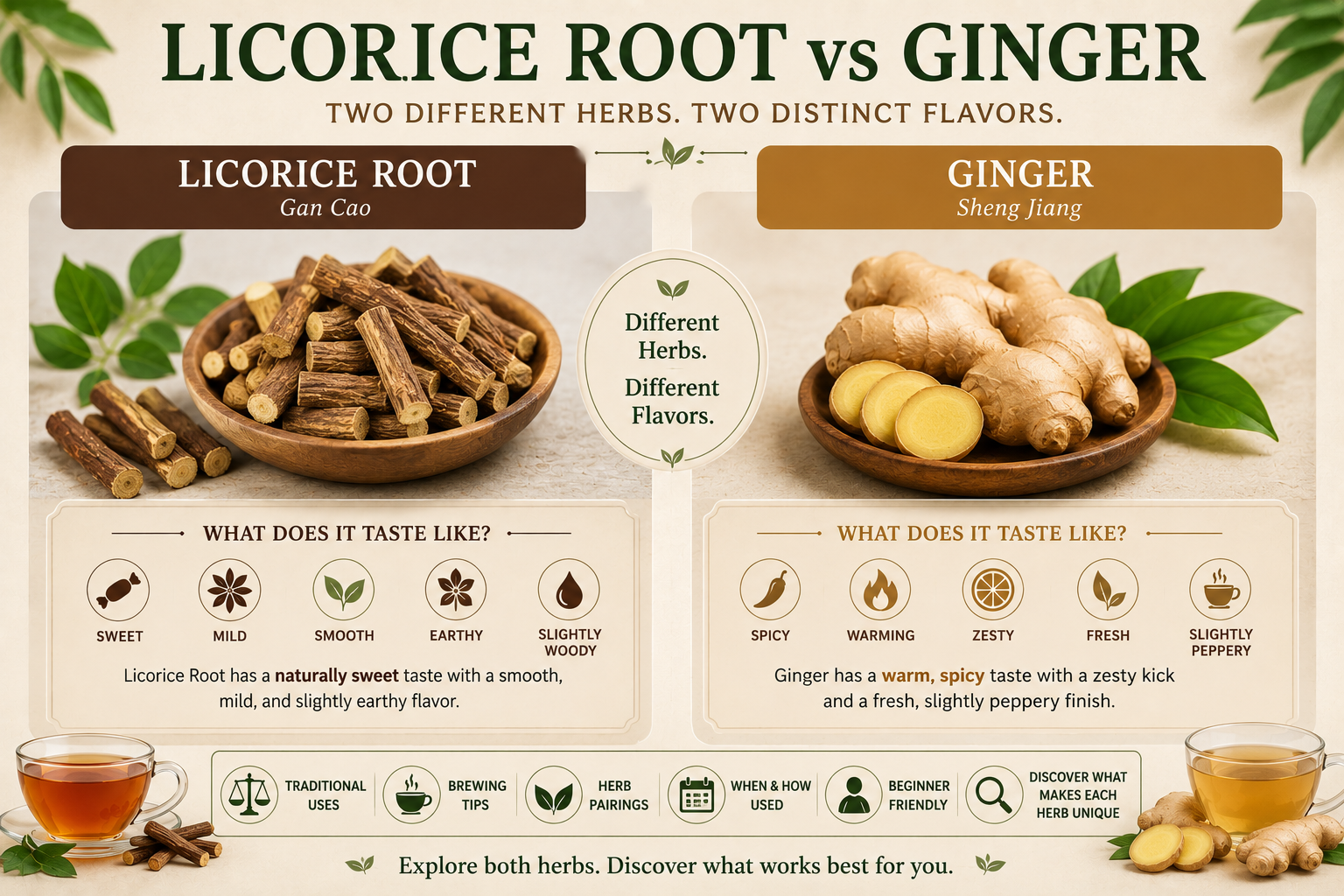
Licorice Root Flavor
Licorice Root is naturally sweet.
Many people compare the flavor to:
- Root beer
- Anise
- Fennel
- Mild caramel notes
- Sweet herbal tea
Because of its sweetness, Licorice Root is often added to tea blends to improve flavor.
Ginger Flavor
Ginger is bold, spicy, warming, and instantly recognizable.
Many people describe it as:
- Zesty
- Peppery
- Bright
- Warming
- Slightly citrus-like
If Licorice Root is a comfortable blanket, Ginger is a crackling campfire.
How Are These Herbs Traditionally Used?
Although both herbs appear in traditional Chinese herbalism, they are traditionally valued for different reasons.
Licorice Root has long been included in formulas associated with overall balance and harmony.
Traditional herbalists frequently use it alongside other herbs because it combines well with a wide range of ingredients.
Ginger, meanwhile, is traditionally associated with warmth, movement, and digestive comfort.
It is equally at home in a soup pot, a tea mug, or a traditional herbal formula.
This versatility is one reason Ginger has become one of the most widely recognized herbs on earth.
Which Herb Is Better For Beginners?
The good news is that both herbs are excellent choices.
If you enjoy sweet flavors, Licorice Root often feels easier and more approachable.
If you already enjoy spicy foods, Ginger will probably feel familiar from the very first cup.
Neither herb requires advanced preparation techniques.
Neither herb has an intimidating flavor profile.
That makes both ideal beginner herbs.
Can Licorice Root And Ginger Be Used Together?
Absolutely.
In fact, this is one of the most classic herbal pairings.
Many herbalists appreciate how Licorice Root softens Ginger's sharper edges while Ginger adds warmth and character to Licorice Root.
The result is a tea that feels balanced, flavorful, and easy to enjoy.
Rather than competing with one another, these herbs often complement one another.
What Herbs Are Commonly Paired With Them?
Licorice Root Is Commonly Paired With:
- Astragalus Root (Huang Qi)
- Red Dates (Da Zao)
- Reishi Mushroom
- Hawthorn Berry
- Chrysanthemum Flowers
- Ginger
Ginger Is Commonly Paired With:
- Licorice Root
- Red Dates
- Cinnamon Twig
- Astragalus Root
- Goji Berry
- Jujube Fruit
What Most Customers Really Want To Know
Which Herb Is Sweeter?
Licorice Root.
Which Herb Is More Warming?
Ginger.
Which Makes A Better Tea Blend Ingredient?
Licorice Root.
Which Herb Is More Common In Cooking?
Ginger.
Which Herb Is More Versatile?
Both, but in different ways.
Which Herb Should I Buy First?
Choose the flavor profile you enjoy most.
What Does Modern Research Say?
Researchers continue studying both Licorice Root and Ginger for their chemical constituents, traditional uses, and historical applications.
Licorice contains naturally occurring compounds such as glycyrrhizin and flavonoids that have attracted scientific interest.
Ginger contains gingerols and shogaols, compounds that have also been extensively studied.
While traditional use and modern research are not the same thing, both herbs remain among the most researched botanicals in the world.
Research & References
- Pastorino G, Cornara L, Soares S, Rodrigues F, Oliveira MBPP. Liquorice (Glycyrrhiza glabra): A Phytochemical and Pharmacological Review.
- Wang ZY, Nixon DW. Licorice and Cancer.
- Mashhadi NS, Ghiasvand R, Askari G, et al. Anti-Oxidative and Anti-Inflammatory Effects of Ginger in Health and Physical Activity.
- Mao QQ, Xu XY, Cao SY, et al. Bioactive Compounds and Bioactivities of Ginger.
- Ali BH, Blunden G, Tanira MO, Nemmar A. Some Phytochemical, Pharmacological and Toxicological Properties of Ginger.
Final Verdict
If you enjoy sweet herbal teas, experimenting with tea blends, and learning why Licorice Root appears in so many traditional formulas, start with Licorice Root.
If you enjoy warming flavors, spicy teas, and versatile herbs that can move effortlessly between the kitchen and tea cup, start with Ginger.
The reality is that many herbal enthusiasts eventually keep both.
One brings sweetness.
One brings warmth.
Together they form one of the most timeless pairings in herbal traditions around the world.
About The Author
Author: Sarah Johnson, Certified Herbalist
Last Updated: June 9, 2026
Sarah Johnson has worked with traditional Chinese herbs, medicinal mushrooms, roots, berries, flowers, and herbal products for decades. Through 1st Chinese Herbs, she has helped thousands of customers better understand herbal traditions, tea preparation methods, and how to choose herbs that fit their interests and preferences.
Trusted Since 1994
Helping customers discover Chinese herbs, mushrooms, roots, berries, flowers, and traditional herbal teas.