
Lyme Education Hub • Bulk Chinese Herbs • Teapills • Research-Informed • Practical
Lyme Disease & Chinese Herbs: Top 10 Herbs + Teapills (How to Use Them Safely)
If Lyme has you stuck in the loop of fatigue, aches, brain fog, or “why do I feel like this again?”—this page is for you. We’ll cover the top 10 Chinese herbs people use for Lyme support (not a cure), how to choose bulk herbs vs extracts vs teapills, simple routines you can actually follow, and the safety details most pages skip.
Medical note: This page is educational and not medical advice. If you suspect Lyme disease, seek clinician evaluation promptly. Dietary supplements are not intended to diagnose, treat, cure, or prevent disease. Early Lyme is commonly treated with antibiotics under clinician guidance. (See CDC/clinical references below.)
What’s new (quick Lyme updates you can trust)
- Lyme burden remains high: CDC surveillance and records-based estimates continue to show a large gap between reported cases and estimated diagnoses/treatments annually in the U.S. (about 476,000/year). CDC stats
- Tick range expansion: regional reports continue to document tick spread into new counties/regions, increasing the need for prevention education. Example report
- Longer seasons & more bites: warmer temperatures are associated with tick thriving/extended seasons, and public-facing reports highlight rising tick-bite concerns. Season coverage
- Prevention gaps: prevention knowledge and risk awareness remain inconsistent as risk areas expand. CIDRAP summary
This section is designed to be updated quarterly
1st Chinese Herbs Editorial Promise
Experience
We’ve supplied bulk Chinese herbs and teapills for decades and hear directly from customers about what’s practical (and what’s not).
Expertise
We explain traditional use, modern research (clearly labeled as human vs lab data), preparation methods, and safety notes.
Authority
We cite primary sources whenever possible (CDC, PubMed/PMC) and avoid overpromising.
Trust
COAs available on request. Quality and sourcing transparency matter—especially for long routines.
Update: This content does not replace medical care. Early Lyme is commonly treated with antibiotics; prompt evaluation matters. CDC treatment overview
Reality check: Lyme care + where herbs fit
Lyme disease is a tick-borne infection, and early medical evaluation matters. CDC notes most cases can be treated with a course of antibiotics, and people treated early often recover well. Herbs do not replace medical care. Instead, many people use herbs to support comfort, immune balance, inflammatory response, sleep, and resilience during recovery.
Evidence transparency: Some botanicals have in vitro anti-Borrelia activity reported, while human clinical data for Lyme is limited. A 2023 review summarizes that many herbs used by integrative/alternative approaches are anti-inflammatory, but clinical trial data is lacking.
Start here: 3 routines you can actually follow
The biggest reason people quit is complexity. Start with the routine that matches your life. If you’re sensitive, start with one item for 7–10 days before adding another.
Beginner (2 items)
- Huang Qi (Astragalus) daytime tea or slices
- Jin Yin Hua + Lian Qiao as a simple tea blend
Goal: consistency, resilience, simple support.
Pro Note: Do NOT use Astragalus root if you have had Lyme Disease more than 6 months. Always check your physician.
Intermediate (4 items)
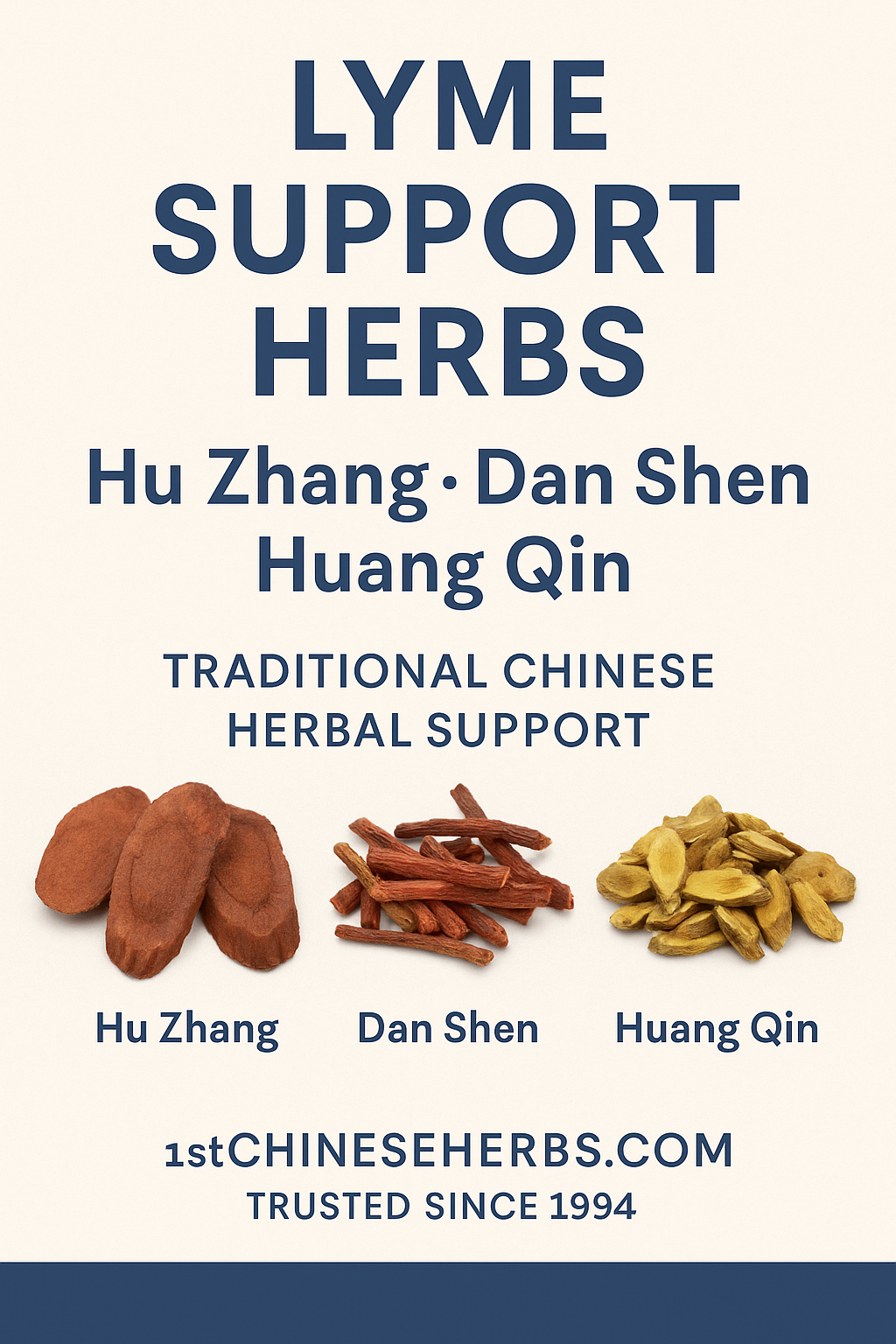
- Hu Zhang (powder/cut/extract or decoction)
- Chuan Xin Lian (powder/cut/powder/extract)
- Huang Qin (cut/powder/extract or decoction)
- Dan Shen (comfort/circulation support) *
* Avoid with blood thinners unless clinician-approved.
Easy mode (teapills + 1 tea)
- Teapill routine (for consistency)
- One tea: Jin Yin Hua + Lian Qiao OR Ban Lan Gen seasonally
Goal: “best plan is the one you follow.”
Top 10 Chinese herbs for Lyme support
These are the Chinese herbs most commonly discussed in Lyme-supportive herbal conversations. Some overlap with what readers call “Buhner-style” protocols (not medical care, not proof—just common community practice). We label evidence honestly: Human / Animal / Lab (in vitro).
1) Hu Zhang (Japanese Knotweed) — Polygonum cuspidatum
Traditional role: supports “blood movement” and heat-clearing patterns.
Why people use it: widely referenced in Lyme herb communities; lab research has evaluated botanical medicines (including knotweed) for activity against forms of B. burgdorferi in vitro.
Evidence label: Lab (in vitro) for anti-Borrelia activity; human Lyme trials are limited.
How to use (common practice): extract powder in warm water or capsules; or decoction (roots/barks simmered 20–40 min).
Cautions: review if using anticoagulants/antiplatelets or if you bruise easily.
Hu Zhang (Bulk / Powder / Extract) →
2) Chuan Xin Lian (Andrographis) — Andrographis paniculata
Traditional role: bitter “heat-clearing” support.
Why people use it: frequently referenced in community Lyme protocols for immune and inflammatory-response support.
Evidence label: strong mechanistic and review literature on anti-inflammatory/immunomodulatory actions; Lyme-specific human trials are limited.
How to use (common practice): capsules or extract powder (easy to keep consistent).
Cautions: can cause GI upset in some people; start low.
Andrographis (Caps / Extract) →
3) Qing Hao — Artemisia annua
Traditional role: “deficient heat” support; historically used for fever patterns.
Why people use it: used by many in cyclical-feeling protocols; evaluated in botanical screening research for in vitro anti-Borrelia activity.
Evidence label: Lab (in vitro) for anti-Borrelia activity; Lyme-specific human trials are limited.
How to use (common practice): extract powders or tea blends (follow supplier directions).
Cautions: pregnancy/breastfeeding and medication review recommended.
Qing Hao (Bulk / Extract) →
4) Huang Qin — Scutellaria baicalensis
Traditional role: supports damp-heat/heat patterns; commonly used for inflammatory comfort.
Why people use it: popular for “inflammation response” support; also included in botanical Lyme screening research in vitro.
Evidence label: Lab (in vitro) + broad mechanistic literature on baicalin/baicalein.
How to use (common practice): extract powder/capsules or decoction.
Cautions: if you run “cold” or have weak digestion, go slow and consider practitioner guidance.
Huang Qin (Bulk / Extract) →
5) Dan Shen — Salvia miltiorrhiza
Traditional role: “moves blood,” supports circulation and recovery comfort.
Why people use it: chosen by many for “stuck” discomfort and recovery support; widely studied for anti-inflammatory and microcirculation-related mechanisms.
Evidence label: strong mechanistic and review literature (not Lyme-curative claims).
How to use (common practice): tea/decoction, tincture, or capsules.
Cautions: avoid with anticoagulants/antiplatelets unless clinician-approved.
Dan Shen (Bulk / Powder) →
6) Yu Xing Cao — Houttuynia cordata
Traditional role: supports heat-clearing patterns (often used for lung/urinary comfort).
Why people use it: often chosen for “heat/toxin” style support; review literature describes anti-inflammatory and other activities (not Lyme cure claims).
Evidence label: review/mechanistic literature (not Lyme-specific human trials).
How to use (common practice): tea/decoction or powder in warm water.
Cautions: strong taste; start low if sensitive.
Yu Xing Cao (Bulk / Powder) →
7) Ban Lan Gen — Isatis root (Radix Isatidis)
Traditional role: heat-clearing, “resolve toxicity” tradition.
Why people use it: common “immune season” staple; literature describes antiviral/anti-inflammatory and immunomodulatory activity (general, not Lyme-curative).
Evidence label: mechanistic/review literature for immune/inflammation support.
How to use (common practice): granules, tea/decoction, or capsules.
Cautions: if you run cold/weak digestion, use carefully or with warming balance.
Ban Lan Gen (Bulk / Granules) →
8) Jin Yin Hua — Honeysuckle (Lonicera japonica)
Traditional role: classic “heat-toxin” herb; often paired with Lian Qiao.
Why people use it: supportive for immune-season routines; reviews summarize anti-inflammatory and related pharmacological actions.
Evidence label: review/mechanistic literature (not Lyme-specific human trials).
How to use (common practice): tea infusion or combined decoction.
Cautions: check allergies/sensitivities.
Jin Yin Hua (Bulk) →
9) Lian Qiao — Forsythia (Forsythiae Fructus)
Traditional role: “clear heat and toxins;” often used for swollen/heat-type presentations.
Why people use it: commonly paired with honeysuckle; researched broadly for anti-inflammatory/antimicrobial-related actions.
Evidence label: review/mechanistic literature (not Lyme-specific human trials).
How to use (common practice): tea blend with Jin Yin Hua; decoction.
Cautions: if very cold/deficient, use with balance.
Lian Qiao (Bulk) →
10) Huang Qi (Astragalus) — Astragalus membranaceus
Traditional role: Qi support and resilience; commonly used in soups/teas.
Why people use it: often chosen for fatigue-style patterns and “terrain support,” especially during recovery routines.
Evidence label: broad mechanistic and traditional-use support; Lyme-specific trials are limited.
How to use (common practice): slices simmered into tea/broth; powders; capsules.
Cautions: if on immune-suppressing therapy, review with clinician.
Huang Qi (Slices / Powder) →
Bulk herbs vs extract powders vs teapills (what to choose)
Bulk herbs (tea/decoction)
- Best for traditional preparation and “full kitchen” routines
- Great value per serving
- Decoction: roots/barks simmer 20–40 minutes
Extract powders
- Most convenient for consistent daily use
- Mix into warm water or capsule
- Helpful when taste is a barrier
Teapills
- Best for travel and long-term consistency
- Simple “take and go” routine
- Often easiest to stick with
7 common mistakes (that quietly ruin results)
- Starting 6 things at once → start one, add slowly.
- Confusing “detox” with dehydration → support hydration + minerals.
- Ignoring sleep → sleep is where recovery happens.
- Overdoing bitter herbs with weak digestion → balance matters.
- Skipping safety reviews (blood thinners, pregnancy, immune meds) → don’t guess.
- No tracking → if you don’t measure, you won’t know what helped.
- No clinician partnership → especially with new neurologic, cardiac, or severe symptoms.
Tell us your top 2 symptoms (fatigue, sleep, aches, anxiety, digestion, etc.) and what form you’ll actually use (tea, extract, teapills).
Contact Us →Related Links
FAQs: Lyme disease
1) Can herbs cure Lyme disease?
No. Supplements are not intended to diagnose, treat, cure, or prevent disease. Herbs are used as supportive wellness tools.
2) Should I delay antibiotics and try herbs first?
No. Early evaluation and clinician-guided treatment matters. Herbs can be supportive, but they do not replace medical care.
3) What’s the difference between reported Lyme cases and estimated annual diagnoses?
Reported cases reflect surveillance reporting; records-based estimates suggest many more people are diagnosed/treated annually than surveillance counts alone.
4) Why do symptoms sometimes persist after treatment?
Some people experience prolonged symptoms after treatment (often discussed as PTLDS). A clinician can help evaluate contributing factors and rule out other causes.
5) What are the best herbs to start with?
Start with the simplest plan you’ll follow: beginner tea routine, or extract/teapill routine if consistency is hard.
6) Which herbs have lab (in vitro) anti-Borrelia activity research?
Botanical screening studies have evaluated multiple botanicals for activity against forms of B. burgdorferi in vitro. Human Lyme trials remain limited.
7) Can I take multiple herbs at once?
You can, but starting too many at once is the fastest way to create confusion and side effects. Add slowly.
8) What’s the easiest form—tea, powder, or teapills?
Teapills and extract powders are usually easiest for consistency. Tea is great if you enjoy brewing.
9) Are bulk herbs stronger than teapills?
Not necessarily. Consistency and the right form for you matters more than “strongest.”
10) What if I have a sensitive stomach?
Start low, choose gentler options first, and avoid stacking bitter herbs quickly.
11) Can Dan Shen be taken with blood thinners?
Use caution and get clinician guidance if using anticoagulants/antiplatelets.
12) Are these herbs safe in pregnancy?
Pregnancy/breastfeeding requires qualified supervision—do not self-prescribe.
13) How long until I notice support from herbs?
Usually gradual—think weeks. Track sleep, energy, and discomfort weekly.
14) Is “Herxheimer reaction” guaranteed?
No. Feeling worse can have many causes (sleep loss, dehydration, medication effects, stress). If severe, seek medical advice.
15) What’s the best time of day to take herbs?
Daytime for energizing routines; evenings for calming routines. Follow product directions and your tolerance.
16) Do I need a practitioner?
Not always, but it helps—especially with medications, pregnancy, complex symptoms, or autoimmune/immune-suppressing therapy.
17) What’s the safest first step after a tick bite?
Remove tick promptly, document, watch symptoms, and consult a clinician early if symptoms appear.
18) Can I combine Chinese herbs with prescription medicines?
Sometimes, but you must review interactions—especially blood thinners, immune meds, and sedatives.
19) What’s the best way to brew bulk herbs?
Roots/barks: simmer 20–40 minutes; flowers/leaves: steep 10–15 minutes.
20) Where can I learn the basics before starting?
Start with our “How to Use Bulk Herbs” guide and avoid common mistakes.
References
- CDC: Lyme surveillance + estimates (476,000/year)
- CDC: Treatment overview (antibiotics; early care)
- CDC EID: estimate of annual diagnoses
- Feng et al., 2020 (PubMed): botanical medicines evaluated for activity against forms of B. burgdorferi (in vitro)
- Feng et al., 2020 (PMC full text)
- Thompson et al., 2023: review of herbal supplements used by patients with persistent Lyme-attributed symptoms
- Andrographis review (anti-inflammatory/immunomodulatory actions)
- Danshen review (anti-inflammatory, microcirculation-related mechanisms)
- Houttuynia cordata review
- Honeysuckle (Lonicera) pharmacology review