

Mei Gui Hua (玫瑰花) — Unsulfured Chinese Rose Buds in Bulk (Plum Flower)
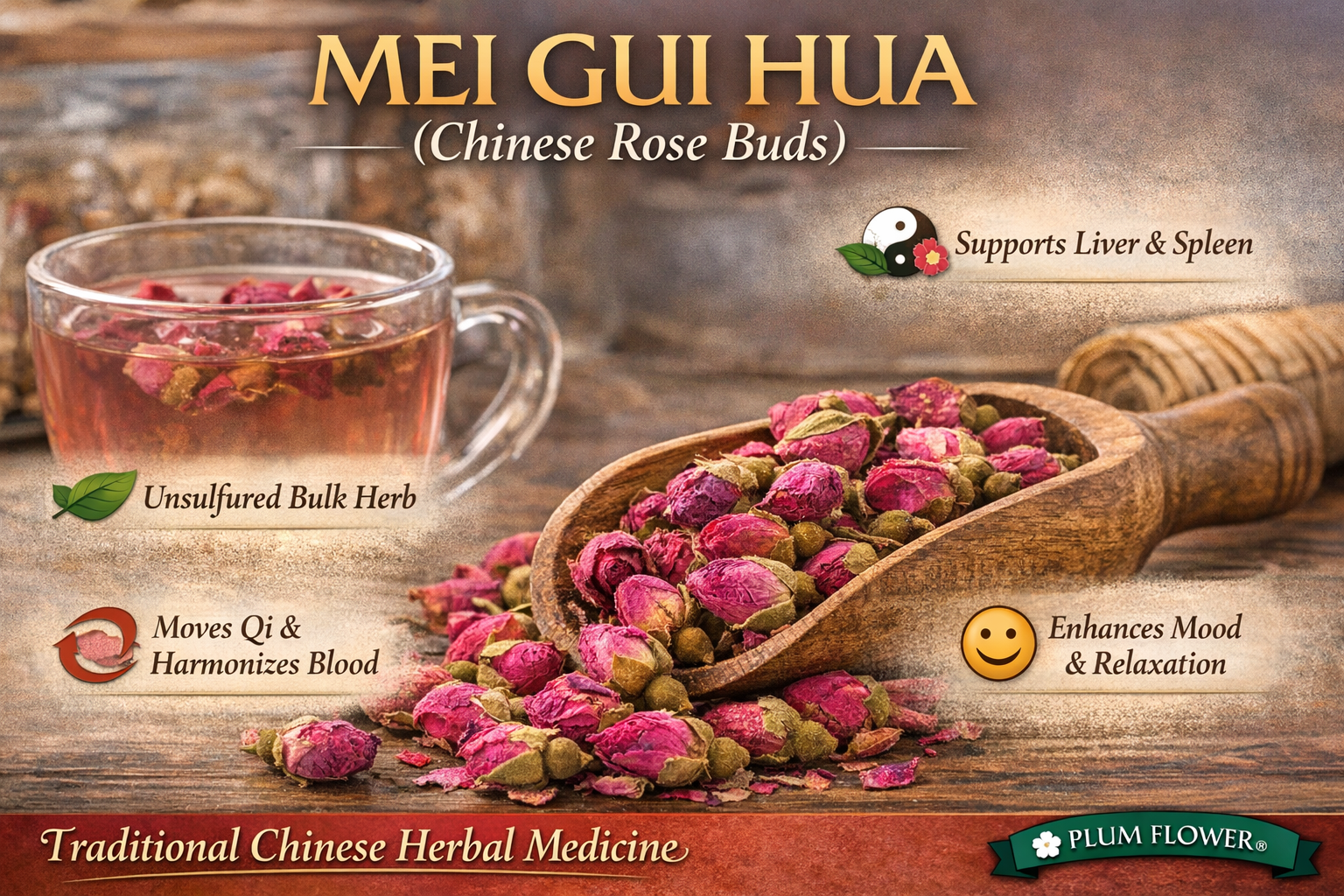
If you’ve ever wished your tea could feel like a deep exhale, Mei Gui Hua (Chinese rose buds) is that cup. In Traditional Chinese Medicine (TCM), this fragrant flower is prized for helping Qi move smoothly—especially when stress, tightness, or emotional “stuckness” shows up in the body. It’s also traditionally used to gently “activate” circulation patterns associated with Blood stasis—without being harsh.
Shop Mei Gui Hua today (bulk 500g / 1.1 lb) and keep a premium, unsulfured floral herb on hand for daily tea rituals, practitioner formulas, and pantry-level herbal versatility.
Quick Facts
-
Pin Yin: Mei Gui Hua (玫瑰花)
-
Botanical name: Rosa rugosa flower
-
Nature & taste: Warm; sweet, slightly bitter
-
Channels/Meridians: Liver, Spleen
-
Traditional actions (TCM): Moves Qi, relieves constraint, harmonizes Blood, disperses stasis
-
Form: Whole/large pieces (bulk cut/whole presentation varies by lot)
-
Package size: 500g (1.1 lb)
-
Brand: Plum Flower
-
Origin: China
-
Cautions: Do not use if pregnant or nursing (see Safety section)
Table of Contents
-
What Is Mei Gui Hua?
-
What Makes “Unsulfured” Matter
-
Traditional Uses in TCM (How It’s Used and Why)
-
Modern Research Lens (What Scientists Study About Roses)
-
How to Make Mei Gui Hua Tea (Best Taste + Best Use)
-
How Much to Use (General Guidance)
-
Who This Herb Is Best For
-
Safety, Interactions, and Prop 65
-
Mei Gui Hua vs Rose Petals vs Rose Hips vs Gui Hua
-
FAQs
-
Shop Mei Gui Hua + Related Links
-
Research & References (PubMed/NIH)
1) What Is Mei Gui Hua?
Mei Gui Hua is the dried flower (commonly the bud) of Rosa rugosa, used in Chinese herbalism as an aromatic, Qi-regulating herb that’s especially associated with the Liver (Qi movement + emotional flow) and Spleen (digestion + “stress in the gut” patterns).
In classic TCM language, it is used to:
-
Move Qi and relieve “constraint” (stuck, tense, sighy, tight-chested, irritable patterns)
-
Harmonize Blood and disperse stasis in gentle, supportive ways
This is why you’ll often see it in practitioner blends aimed at restoring a smoother “flow” feeling—physically and emotionally.
2) What Makes “Unsulfured” Matter
A lot of dried botanicals are sulfur-fumigated to reduce insects/mold and preserve appearance during storage. Regulators and researchers note that sulfur fumigation can leave SO₂/sulfite residues and can also change the chemistry of herbs (including losses/transformations of natural constituents).
Choosing unsulfured herbs matters if you care about:
-
Purity and plant integrity (less processing interference)
-
Sulfite sensitivity concerns, especially for people with asthma or known sulfite reactions
Plum Flower / 1st Chinese Herbs quality notes commonly include COA availability and no added dyes/bleaching on many items in this line.
3) Traditional Uses in TCM (How It’s Used and Why)
TCM properties: sweet, mildly bitter, warm; enters Liver and Spleen.
What practitioners use it for
-
Regulating Qi (supporting smooth internal “movement”)
-
Relieving “depression/constraint” (TCM term often tied to Liver Qi stagnation patterns)
-
Harmonizing Blood / dispersing stasis, traditionally used in formulas where Qi and Blood are not flowing smoothly
-
Supporting digestion when stress affects the middle (Liver–Spleen disharmony patterns)
Important: Traditional use ≠ a medical claim. Think of this as pattern support language, not disease treatment.
4) Modern Research Lens (What Scientists Study About Roses)
Researchers studying Rosa species frequently focus on:
-
Polyphenols, flavonoids, tannins, polysaccharides, and other constituents associated with antioxidant and anti-inflammatory activity (often studied in lab/food-function contexts).
-
Specific research on Rosa rugosa flowers has identified antioxidant-active components (including gallic acid derivatives and polysaccharides) in published pharmacology work.
This modern lens helps explain why rose-derived botanicals are widely investigated for broad “wellness chemistry”—but it’s not the same thing as proving clinical outcomes for every traditional use.
5) How to Make Mei Gui Hua Tea (Best Taste + Best Use)
Mei Gui Hua is prized because it’s both functional in TCM and genuinely pleasant.
Simple daily tea (most popular)
-
Add 1–2 teaspoons (about 2–4g) to a cup.
-
Pour hot water over it.
-
Cover and steep 8–12 minutes (covering keeps the aromatic oils in the cup).
-
Strain and sip.
“TCM-style” stronger infusion (decoction method)
Many materia medica references list 3–6g used in decoction.
If you decoct it, add it near the end (last 5–10 minutes) to preserve aroma.
Taste notes (what customers want to know)
Floral, lightly sweet, gently perfumed—more “rose garden” than “perfume aisle.” It pairs beautifully with honey, citrus peel, or goji.
6) How Much to Use (General Guidance)
Traditional references commonly list 3–6g as a typical range.
Because real dosage depends on your constitution, medications, and goals, we recommend following your qualified clinician’s guidance—especially if you’re combining multiple herbs.
7) Who This Herb Is Best For
Mei Gui Hua is a smart choice if you want a tea herb that supports:
-
A “stuck” or tense feeling that comes with stress (TCM: constrained Qi)
-
Digestive discomfort patterns that seem stress-related (TCM: Liver overacting on Spleen)
-
A calming, pleasant daily ritual that still fits within traditional herbal logic
8) Safety, Interactions, and California Prop 65
Pregnancy and nursing
Your product guidance is clear: do not use if pregnant or nursing. This aligns with many herbal safety cautions for aromatic herbs and herbs that “move Qi/Blood,” and with general recommendations to consult a clinician due to limited safety data.
Medication interactions
If you take prescription medications or have a complex health situation, consult a clinician knowledgeable in herb–drug interactions (general best practice noted by multiple herbal references).
Sulfite sensitivity note
If you have asthma or known sulfite sensitivity, avoiding sulfur-fumigated botanicals can be a practical precaution.
California Prop 65
If this product carries a Prop 65 warning, follow the label guidance and California disclosures. (Prop 65 warnings are exposure-based and do not automatically mean a product is unsafe when used as intended.)
Standard disclaimer: These statements have not been evaluated by the Food and Drug Administration. This product is not intended to diagnose, treat, cure, or prevent any disease.
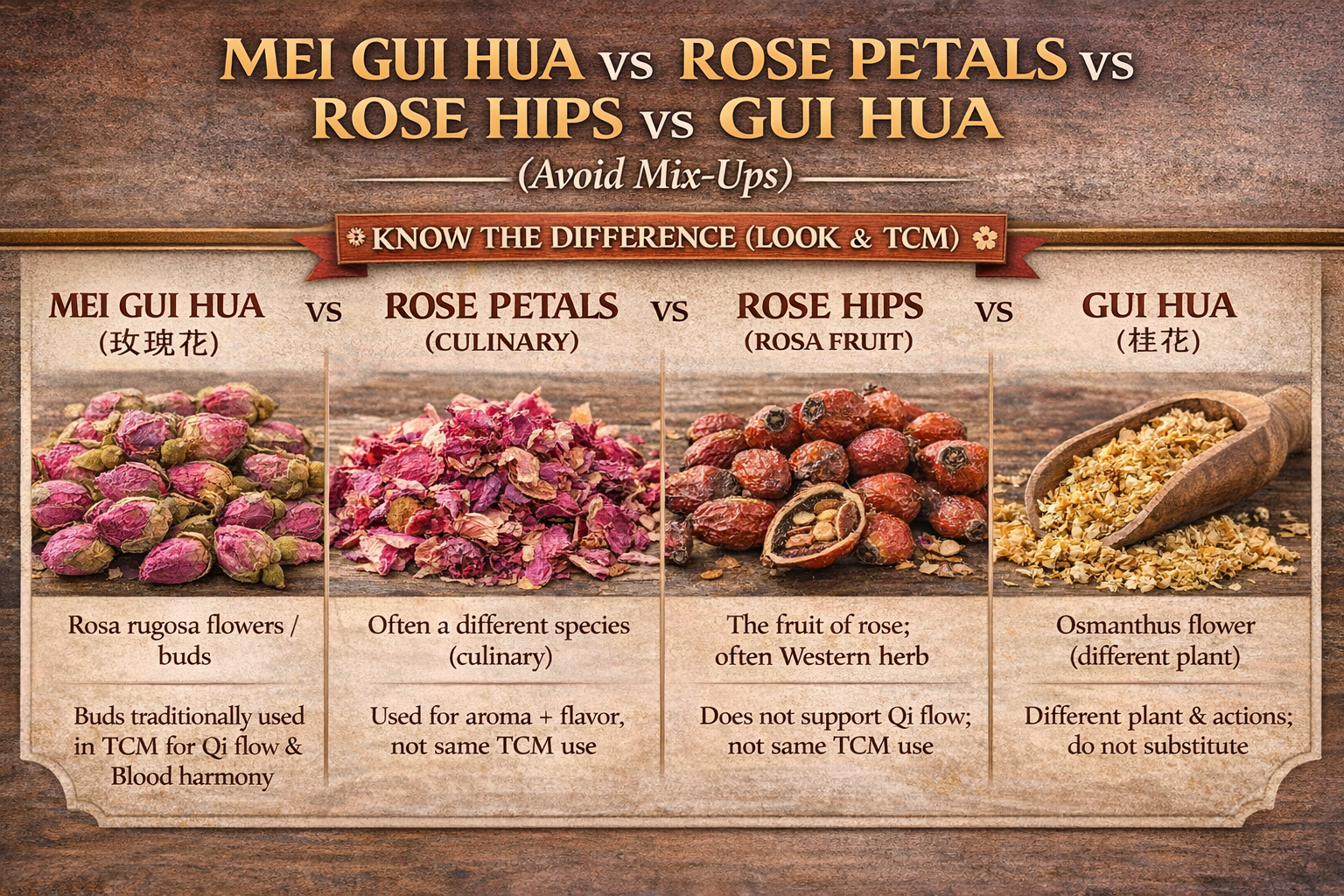
9) Mei Gui Hua vs Rose Petals vs Rose Hips vs Gui Hua (Avoid Mix-Ups)
-
Mei Gui Hua = Rosa rugosa flower/bud used in TCM for Qi movement + Blood harmony patterns.
-
Rose petals (culinary) = often used for flavor/aroma; may be different species and not the same TCM identity.
-
Rose hips = the fruit of rose; used very differently (often vitamin C–focused in Western herbalism).
-
Gui Hua (桂花) = osmanthus flower (different plant), different actions—don’t substitute.
10) FAQs
Does Mei Gui Hua tea have caffeine?
No—Mei Gui Hua is a flower herb and naturally caffeine-free.
What does it taste like?
Soft floral, gently sweet, not bitter when brewed lightly. If it tastes “too strong,” use less herb or steep shorter.
How do I store it?
Keep airtight, cool, dry, away from sunlight and strong kitchen odors (flowers absorb smells easily).
Can I drink it daily?
Many people use it as a gentle daily tea, but frequency should match your constitution and goals. When in doubt, consult a practitioner.
Why does “unsulfured” matter?
Sulfur fumigation can leave residues and alter herb chemistry; unsulfured is a cleaner processing choice for many customers.
11) Shop Mei Gui Hua (Plum Flower) — Bulk 500g
If you want a premium floral herb that does double duty (tea ritual + traditional Qi support), Mei Gui Hua is one of the most “worth keeping stocked” flowers in the Chinese apothecary.
What you’re getting (at a glance):
-
Bulk 500g (1.1 lb) bag
-
Plum Flower brand
-
Origin: China
-
Traditionally described as sweet, slightly bitter, warm; enters Liver/Spleen
12) Research & References
-
Mei Gui Hua properties, channels, and traditional actions (Qi movement, relieve constraint, harmonize Blood).
-
Antioxidant-active constituents reported from Rosa rugosa flowers.
-
Reviews of Rosa genus constituents (flavonoids, tannins, phenolic acids, polysaccharides, etc.).
-
Rose-derived bioactives reviewed for functional/wellness research contexts.
-
Sulfur fumigation overview and monitoring methods; potential chemical changes and residue concerns.
-
Sulfite sensitivity overview (clinical).
-
Source: https://tcmwiki.com/wiki/mei-gui-hua
About Plum Flower Quality Herbs
Plum Flower is an established worldwide manufacturer of high-quality Chinese herbs, and innovative Chinese medicinal herbs and products. Plum Flower uses sulfur-free herbs and laboratory tests its products for contamination and heavy metals, such as mercury, lead, and pesticides.
Main Characteristics (Attributes) of Herbs
- Harvested at the proper level of maturity and correct time of the season to maximize potency.
- Free from Chlorine
- Manufactured without the use of sulphur
- Preservative Free
- Made at GMP internationally certified facilities (Good Manufacturing Practices) Quality control tests are done at the manufacturing site and at third party labs to confirm results
- Aluminum Phosphate free
- Packaged in an airtight sealed bag
- Pin Yin Names and Botanical Names are listed on the bag
- Certificate of Analysis are available upon request
- Conforms to Standards of Chinese Pharmacopeia
- No dyes, colors, or bleaching of the herbs
- We are a authorized direct distributor of Plum Flower Herbs.
- 500 gram bag size which equal anywhere from 4 to 6 cups of herbs
Chinese Traditional herbs should be regarded as a supplementary aspect to modern western healthcare, and not as a replacement. Chinese traditional herbs ( Teas ) emphasize harmony, and balance.