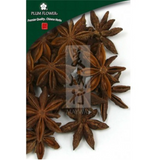


Organic Star Anise Whole Pods (Illicium verum) | You Ji Ba Jiao / Da Hui | 1 lb Nuherbs
Star anise is the spice people buy for deep, comforting “winter flavor.”
How many pods do I use?
Why does it taste too strong sometimes?
Is it safe?
This page answers those questions clearly. You’re getting organic whole star anise pods (Illicium verum)—the edible culinary species—plus practical brewing and cooking instructions, and a straightforward safety section to help you avoid toxic look-alikes that are responsible for most “star anise tea” warnings.
Quick Summary On Star Anise
-
Common name: Star Anise (whole pods)
-
Botanical name: Illicium verum (fruit)
-
TCM / Pin Yin: You Ji Ba Jiao / Da Hui
-
Form: Whole pods (not powder)
-
Size: 1 lb
-
Ingredients: 100% single herb, no additives
-
Origin: China
-
Brand: Nuherbs Organics (Certificate of Analysis Upon Request)
-
Product properties (traditional): Acrid, Warm
-
Critical safety note: Do not confuse with Japanese star anise (toxic look-alike)
-
California Prop 65
1) What is Star Anise?
Star anise is the star-shaped fruit of Illicium verum, widely used as a culinary spice (broths, braises, pho, baking, mulled drinks). Modern reviews describe it as rich in aromatic plant compounds—especially trans-anethole—and summarize research on antioxidant and antimicrobial activity.
2) Why Whole Pods are Better
Whole star anise pods are the most user-friendly form because they:
-
Strain cleanly (no gritty sediment like powders)
-
Give better control over flavor strength
-
Keep their aroma longer when stored properly
-
Look beautiful in gift jars, tea blends, and simmer pots
If you want a licorice-warm flavor without the “overpowering” problem, whole pods are the easiest way to stay in control.
3) The Big Safety Issue: Edible Star Anise vs Toxic Look-Alikes
The problem
Some star anise “teas” have been associated with illness when products were contaminated/adulterated with Japanese star anise (Illicium anisatum), a toxic look-alike. The FDA issued advisories warning consumers not to ingest “star anise teas,” especially for infants and children, in part because of contamination concerns and lack of evidence for infant colic claims.
What this means
-
Buy only products that clearly identify Illicium verum (the edible culinary species).
-
Do not give star anise tea to infants, and use conservative guidance for children.
-
If you are pregnant/nursing or managing medications, follow professional guidance.
4) How to Use Star Anise (Tea + Cooking) with Taste Tips
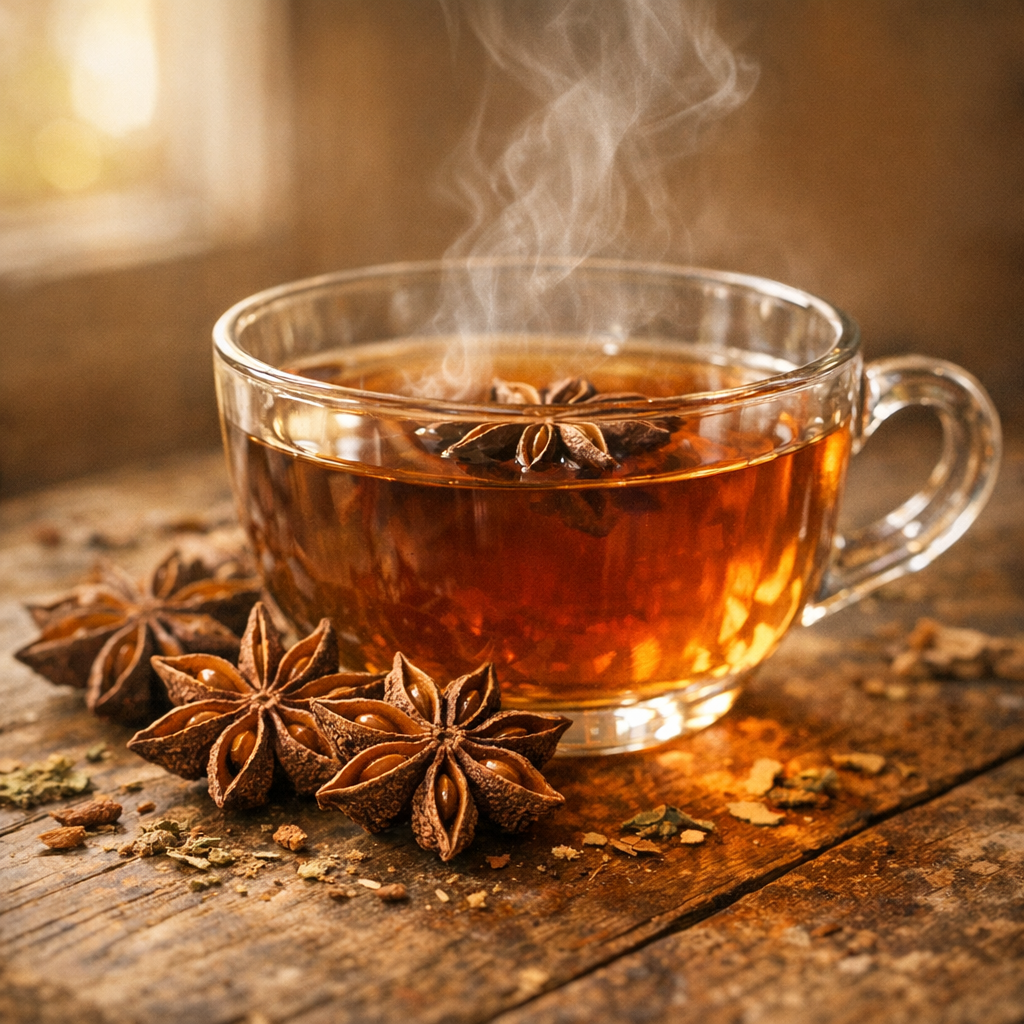
Option A: Tea / Infusion (the simplest)
For 8–12 oz (1 mug):
-
Mild: 1 whole pod
-
Stronger: 2 whole pods
How to brew
-
(Optional) Lightly crack the pod to release aroma faster.
-
Pour boiling water over pod(s).
-
Steep 8–12 minutes.
-
Remove pods and sip warm.
Taste tips
-
If it tastes too strong/perfumy, use fewer pods or steep less time.
-
For a smoother cup, pair with cinnamon or ginger (they “round out” the licorice note).
-
Don’t boil it hard for long periods if you’re making a delicate tea—steeping is usually enough.
Option B: Broths, Pho, and Braises (classic use)
-
Add 1–3 pods to soup, broth, pho, or red-braised dishes.
-
Simmer 20–60 minutes, then remove before serving.
Option C: Winter Blend Ideas
Star anise pairs well with: cinnamon, ginger, fennel, clove, allspice, licorice root.
5) “Is Star Anise Nature’s Tamiflu?”
Star anise is associated with shikimic acid, a chemical used as a starting material in the pharmaceutical synthesis of oseltamivir (Tamiflu)—but star anise tea is not Tamiflu, and brewing pods in hot water does not create an antiviral drug.
Practical takeaway: enjoy star anise as a spice/tea for flavor and comfort, but don’t rely on it as a substitute for medical care.
6) Traditional Use
In Traditional Chinese Medicine references, Ba Jiao Hui Xiang is described as Warm and Pungent, traditionally used in “warming” patterns (traditional framework).
(Traditional-use description; not a disease claim.)
7) What Star Anise Contains
Modern sources describe star anise as containing aromatic constituents such as trans-anethole, alongside a broader profile of phytochemicals that are commonly studied for antioxidant and antimicrobial properties.
8) Whole vs Ground vs Essential Oil
Whole pods (this product)
-
Best for: tea, broths, clean straining, controlled flavor
Ground star anise
-
Best for: baking blends and spice rubs
-
Tradeoff: can be overpowering and harder to strain
Star anise essential oil
-
Not the same as whole spice
-
Much more concentrated (use professional guidance)
9) Storage
-
Store in an airtight container away from heat/light.
-
Whole pods keep aroma longer than powders when stored dry.
10) FAQs
1) Is star anise the same as anise seed?
No. They taste similar, but they’re different plants and different forms.
2) How many pods should I use for tea?
Usually 1 pod for mild, 2 pods for stronger flavor per mug.
3) Why do warnings mention toxicity or seizures?
Warnings are often tied to contamination/adulteration with toxic Japanese star anise in “star anise teas,” especially involving infants.
4) Can I reuse star anise pods?
Yes—often once more (second steep will be lighter).
5) Is star anise tea the same as Tamiflu?
No. Star anise is linked to shikimic acid used in manufacturing, but tea does not convert into oseltamivir.
6) What does it taste like?
Licorice-like, sweet-spice, warming, aromatic.
7) What’s the best culinary use?
Pho/broths/braises—add pods during simmering and remove before serving.
8) How do I keep it from tasting too strong?
Use fewer pods, steep less time, and pair with cinnamon or ginger.
9) Can kids drink star anise tea?
Follow conservative guidance; do not give to infants, and use caution for children.
10) How do I know I’m buying the edible kind?
Look for the botanical name Illicium verum clearly stated
Trust
Most marketplace listings don’t explain the one thing shoppers worry about: identity and safety. We do.
Why buy star anise from a specialist herb supplier instead of a random listing?
-
Clear botanical identity: Illicium verum (edible culinary species)
-
Transparent safety guidance about toxic look-alikes and FDA advisories
-
Whole pods for clean brewing and controlled flavor
-
Single ingredient, no additives
Internal Links
What No One Tells You About Chinese Herbs (7 Common Mistakes + Fixes)
10 Vital Medicinal Herbs That Work (Free Ebook)
Research
Check out our How to Use Bulk Herbs page to see how to use herbs correctly.
About Nuherbs Quality.
Each batch of herbs is dual-lab tested by our in-house lab and an independent third-party lab. Our in-house lab is equipped with instruments such as a high-performance liquid chromatography, moisture determination meter, a Fourier transform infrared spectrometer, atomic absorption spectrophotometer, gas chromatograph, etc.
In addition, the following additional tests are performed:
- Micro bacteria
- Pesticides - over 200 pesticides tested for (Uab 2000 screen).
- Heavy Metals - Lead, Mercury and Arsenic
Why use Chinese Bulk Herbs?
Traditional Chinese Medicine curative herbal formulas have been developed, improved and perfected for over 5000 years.
Traditional Chinese Medicine is an ancient, holistic medical system used all over the world to treat a wide variety of health issues. Traditional Chinese Medicine (TCM) works by helping to balance the body’s functions, thus restoring health.
As soon as the Chinese people began to carve out a civilization in ancient China, it developed a cultural heritage that has continued to the present day. TCM is the oldest and one of the safest, most effective systems one can use to care for their body, it promotes health and helps to sustain longevity.
Chinese herbs have been with mankind for 5,000 years and will be with us in the years ahead – it is using nature’s bountiful gifts to have good health.
References:
-
Illicium verum (Star Anise) and Trans-Anethole as Valuable… (Review, 2022)
Supports: star anise overview; trans-anethole as main aroma compound; broad preclinical activity summaries.
https://pubmed.ncbi.nlm.nih.gov/35163914/ -
Illicium verum L. Essential Oil: GC/MS profile + antibacterial/antibiofilm (2023)
Supports: essential oil composition + antimicrobial activity (lab).
https://pubmed.ncbi.nlm.nih.gov/38067422/ -
Antifungal activity of Illicium verum fruit essential oil (2010)
Supports: essential oil composition (high trans-anethole) + antifungal testing (lab).
https://pubmed.ncbi.nlm.nih.gov/21030909/
B) Safety: “Don’t confuse with Japanese star anise”
-
Neurotoxicities in infants with star anise tea (2004)
Supports: infant neurologic reactions; concern about adulteration with Japanese star anise.
https://pubmed.ncbi.nlm.nih.gov/15492355/ -
[Star anise poisoning in infants] (2003)
Supports: infant poisoning case reports; contamination/adulteration discussed.
https://pubmed.ncbi.nlm.nih.gov/12907070/ -
[Think about star anise intoxication!] (2011)
Supports: summary of reported infant neuro/GI cases; contamination of Illicium verum by Illicium anisatum discussed.
https://pubmed.ncbi.nlm.nih.gov/21652187/ -
Neonate with seizures after consuming star anise tea (2021)
Supports: modern case report; contamination or high-dose neurotoxicity concerns.
https://pubmed.ncbi.nlm.nih.gov/34582506/
C) “Tamiflu / shikimic acid” clarification
-
Production of shikimic acid (Review, 2012)
Supports: shikimic acid is a key intermediate for oseltamivir (Tamiflu); supply historically sourced from Illicium verum.
https://pubmed.ncbi.nlm.nih.gov/22445787/ -
Production and Synthetic Modifications of Shikimic Acid (Review, 2018)
Supports: industrial extraction from star anise and/or fermentation; shikimic acid used as Tamiflu precursor (manufacturing context).
https://pubmed.ncbi.nlm.nih.gov/30350584/ -
Shikimic acid produced from Chinese star anise is a key intermediate… (2014)
Supports: clear statement that shikimic acid (from Illicium verum) is an intermediate for oseltamivir; discusses supply stability (manufacturing context).
https://pubmed.ncbi.nlm.nih.gov/24512078/