
Reishi Mushroom vs Lion's Mane: Which Medicinal Mushroom Is Right For You?
Quick Answer: Choose Reishi if you enjoy traditional herbal history,
earthy mushroom teas, and one of the most respected mushrooms in
Chinese herbal traditions. Choose Lion's Mane
if you want a mild-tasting mushroom that is easy to cook,
beginner-friendly, and versatile enough for everyday use.
If you're exploring medicinal mushrooms for the first time, chances are you've encountered the same two names over and over again.
Reishi Mushroom, sometimes noted as Red Reishi Mushroom, or Black Reishi Mushroom, and Lion's Mane.
Reishi Mushroom is often called the "Mushroom of Immortality."
The Lion's Mane looks like a shaggy white waterfall and has become one of the most talked-about mushrooms in modern wellness circles.
Both have long histories.
Both have passionate fans.
Both appear in mushroom blends, powders, teas, capsules, and extracts.
Yet despite being grouped together, they are completely different mushrooms.
They look different. They taste different. They are used differently.
And most importantly, they appeal to different types of people.
So if you're standing in front of two bags wondering:
"Which one should I buy?"
This guide is for you.
Quick Comparison: Reishi vs Lion's Mane
| Feature | Reishi Mushroom | Lion's Mane Mushroom |
|---|---|---|
| Botanical Name | Ganoderma lucidum | Hericium erinaceus |
| Nickname | Mushroom of Immortality | Pom-Pom Mushroom |
| Flavor | Earthy & Bitter | Mild & Savory |
| Can Be Cooked? | Rarely | Yes |
| Most Common Form | Tea, Powder, Extract | Powder, Extract, Culinary |
| Beginner Friendly | ★★★★☆ | ★★★★★ |
| Traditional History | Exceptional | Strong |
| Most Famous For | Traditional Use | Culinary Appeal |
| Can They Be Used Together? | Yes | Yes |
 If you only read one section, here's the simplest answer:
Choose Reishi if you love herbal traditions.
Choose Lion's Mane if you want the easiest mushroom to start with.
The Story Of These Two Mushrooms
Imagine walking into an ancient herbal shop thousands of years ago.
If you asked what mushroom everyone respected most, there is a good chance someone would point to Reishi.
For centuries, Reishi was considered so valuable that it became surrounded by stories, legends, artwork, and folklore.
People didn't just view Reishi as another mushroom.
They viewed it as something special.
Now imagine walking into a modern health food store.
The mushroom drawing attention today is often Lion's Mane.
Its appearance is unforgettable.
Its flavor is approachable.
And unlike Reishi, it can actually be cooked and enjoyed as food.
That's why these mushrooms attract very different audiences.
What Do They Actually Taste Like?
This is where most people make their decision.
Because no matter how famous a mushroom is, if you dislike the flavor, you probably won't use it regularly.
Reishi Flavor
Let's be honest.
People rarely fall in love with Reishi because of its taste.
Most people describe it as:
- Earthy
- Woody
- Bitter
- Rich
- Strong
Think of Reishi as black coffee.
Not everyone enjoys it immediately.
But many people grow to appreciate it.
Lion's Mane Flavor
Lion's Mane is the exact opposite.
People commonly compare it to:
- Crab
- Lobster
- Seafood
- Mild mushrooms
- Savory foods
Many first-time users are surprised by how enjoyable Lion's Mane tastes.
If flavor alone determined the winner, Lion's Mane would win for most people.
What Does Each Mushroom Look Like?
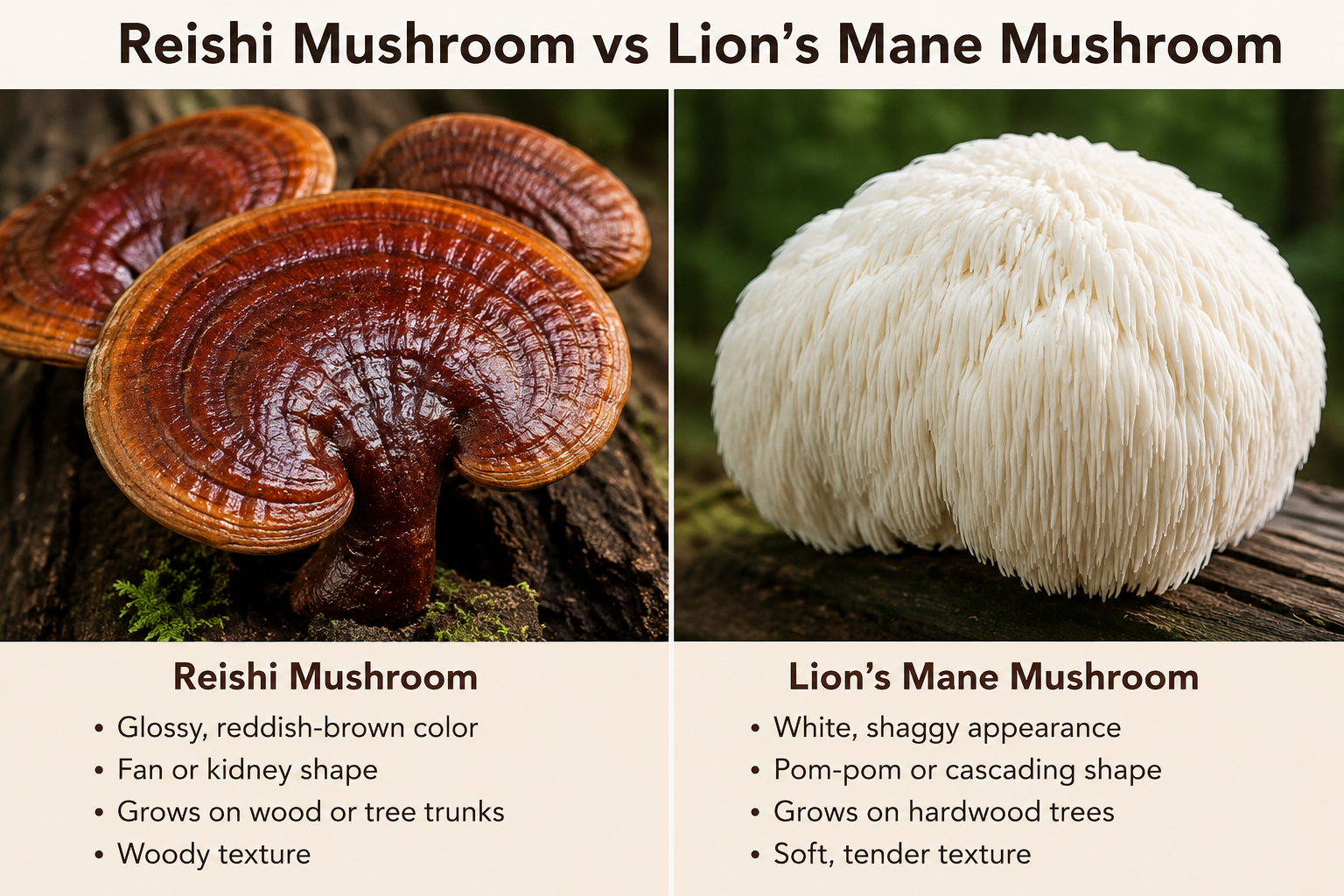
These mushrooms couldn't be more different.
Reishi
Reishi typically grows as a glossy shelf mushroom.
Its reddish-brown surface often looks polished or lacquered.
Many people say it looks more like a piece of artwork than a mushroom.
Lion's Mane
Lion's Mane resembles a white waterfall of soft spines.
Some people compare it to a shaggy pom-pom.
Others think it looks like a sea creature.
Either way, it is one of the most unusual mushrooms you'll ever see.
How Are These Mushrooms Commonly Used?
This is one of the biggest practical differences between the two.
Using Reishi Mushroom
Because Reishi is woody and bitter, it is rarely eaten like a culinary mushroom.
Instead, people commonly use it as:
- Mushroom tea
- Decoctions
- Powders
- Extract powders
- Capsules
- Tinctures
Many people prefer extracts because they provide convenience without needing to brew tea.
Using Lion's Mane Mushroom
Lion's Mane is incredibly versatile.
People commonly enjoy it as:
- A cooked mushroom
- Powdered mushroom
- Smoothie ingredient
- Coffee additive
- Capsules
- Extract powders
Its culinary flexibility is one reason Lion's Mane has become so popular.
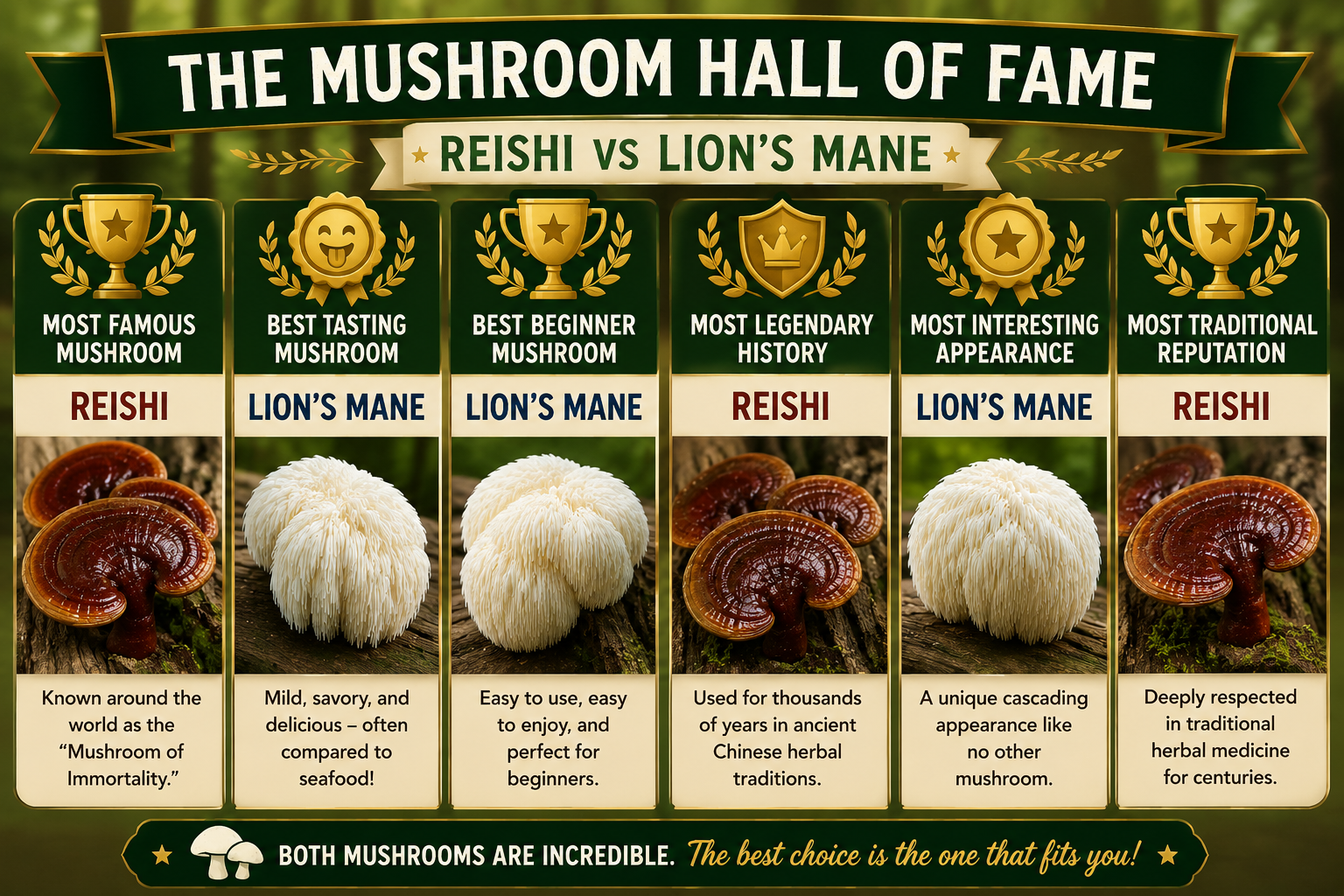
The Mushroom Hall Of Fame
Which Mushroom Fits Your Personality?
Sometimes choosing a mushroom is less about science and more about personal preference.
Choose Reishi If:
- You enjoy herbal history.
- You love traditional remedies.
- You appreciate ancient botanical traditions.
- You don't mind earthy flavors.
- You enjoy tea rituals.
Choose Lion's Mane If:
- You are new to mushrooms.
- You enjoy cooking.
- You want a mild flavor.
- You prefer foods over herbal teas.
- You enjoy trying unique ingredients.
What Surprises Most Customers?
The biggest surprise is usually not the history.
It's the flavor.
People often assume all medicinal mushrooms taste roughly the same.
Then they try Reishi and Lion's Mane.
One tastes like a traditional herbal ingredient.
The other tastes like something that belongs in dinner.
That difference surprises people every time.
If You Like Reishi, You May Also Like...
- Cordyceps Mushroom
- Turkey Tail Mushroom
- Chaga Mushroom
- Astragalus Root
If You Like Lion's Mane, You May Also Like...
- Tremella Mushroom
- Maitake Mushroom
- Shiitake Mushroom
- Cordyceps Mushroom
Can Reishi And Lion's Mane Be Used Together?
Yes.
Many mushroom enthusiasts keep both in their pantry.
Rather than choosing one over the other, they enjoy having both available.
This is one reason many mushroom blends contain both ingredients.
What Does Modern Research Say?
Both Reishi and Lion's Mane continue to attract scientific attention.
Researchers have studied their naturally occurring compounds, traditional uses, and biological activity.
Today they remain among the most researched medicinal mushrooms available.
Research & References
- Wachtel-Galor S, Yuen J, Buswell JA, Benzie IFF. Ganoderma lucidum (Lingzhi or Reishi Mushroom): A Medicinal Mushroom.
- Boh B, Berovic M, Zhang J, Zhi-Bin L. Ganoderma lucidum and its Pharmaceutically Active Compounds.
- Wasser SP. Medicinal Mushroom Science: Current Perspectives.
- Friedman M. Chemistry, Nutrition and Health-Promoting Properties of Hericium erinaceus (Lion's Mane Mushroom).
- Li IC, Lee LY, Tzeng TT, Chen WP. Neurohealth Properties of Hericium erinaceus.
Final Verdict
If you want one of the most respected mushrooms in traditional herbal history, Reishi is difficult to overlook.
If you want a mushroom that is approachable, flavorful, and easy to incorporate into daily life, Lion's Mane is often the better starting point.
The truth is many mushroom enthusiasts eventually stop choosing.
They simply keep both.
One offers tradition.
One offers accessibility.
Together they represent two of the most fascinating mushrooms in the herbal world.
Author: Sarah Johnson, Certified Herbalist
Last Updated: June 10, 2026
Trusted Since 1994
Helping customers discover medicinal mushrooms, Chinese herbs, roots, berries, flowers, and traditional wellness products.
Home → Compare Chinese Herbs → Medicinal Mushroom Comparisons → Reishi vs Lion's Mane