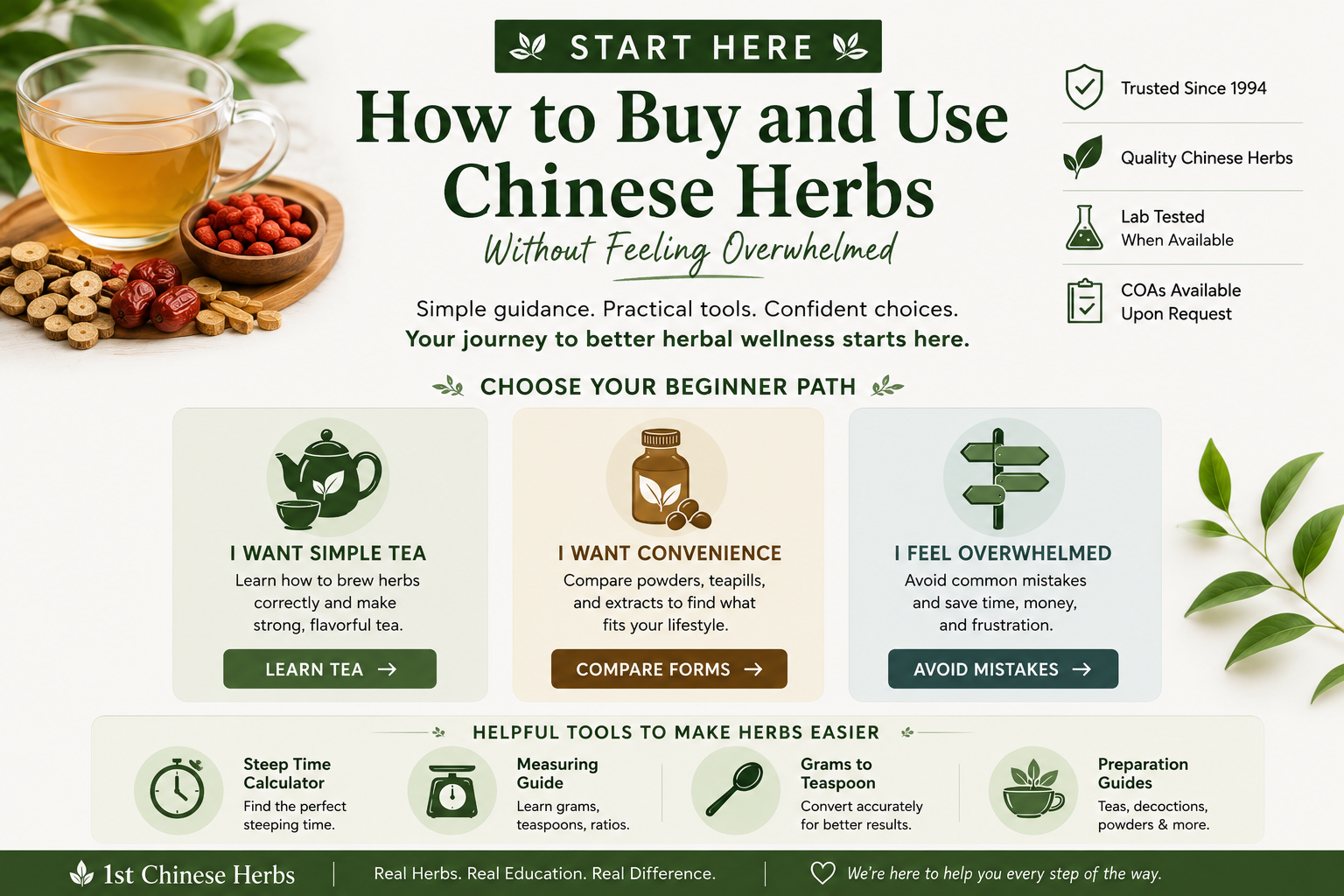
Start Here: How to Buy and Use Chinese Herbs Without Feeling Overwhelmed
A beginner-friendly guide to herbal tea, powders, teapills, measurements, tools, and smart buying decisions.
Most people do not fail with herbs because herbs “do not work.” They usually fail because nobody showed them how to use herbs correctly. Herbs can be confusing, do I step them or boil the herb? Is the root better than the leaves? Or maybe the biggest question is: How much do I take?
In our experience, a person chooses the wrong form. They brew weak tea. They use too little. They try too many things at once. Or they quit before they ever build a steady routine.
 Let's Make This Easy
This page was created to make Chinese herbs easier to understand, easier to use, and easier to buy with confidence.
Think of this as your starting map. If you are new to Chinese herbs, begin here.
Quick Answer: Where Should a Beginner Start?
If you are new to Chinese herbs, start with one goal, one herb form, and one simple routine.
(A goal is normalizing blood pressure, reducing joint inflammation, boosting the immune system, etc.)
For many beginners, the easiest starting points are herbal tea, teapills, or powders. Loose herbs are great if you enjoy brewing tea. Teapills are helpful if you want convenience. Powders are useful when you want something fast and easy to mix.
The biggest mistake is trying to learn everything at once. Start simple, stay consistent, and build from there.
Choose Your Beginner Path
Instead of scrolling through hundreds of products, choose the path that fits your situation best.
I Want Simple Herbal Tea
Best if you enjoy a warm daily ritual and want to learn how to brew herbs correctly.
Traditional Flexible Beginner-friendly
I Want Convenience
Best if you are busy, travel often, or do not want to brew herbs every day.
Easy Portable No brewing
I Feel Overwhelmed
Best if you are not sure what to buy, how to use herbs, or why past herbs did not seem to work.
Start Simple. Avoid Mistakes. Save money.
Most Beginners Start Here
If you are completely new, we usually suggest beginning with one of these simple paths:
- Loose herbs if you want to make teas or decoctions.
- Teapills if you want convenience and simple daily use.
- Powders if you want something quick to mix into warm water, tea, or food.
There is no perfect choice for everyone. The best herb form is the one you will actually use consistently.
Why Some Herbs Feel Powerful and Others Taste Like Dust
This is one of the most common beginner frustrations.
One tea tastes rich and comforting. Another tastes flat, looks dusty, or smells weak.
Usually the difference comes down to:
- herb quality
- freshness
- how much herb was used
- whether it was steeped or simmered correctly
- whether the herb form matched the person’s lifestyle
Small details can completely change the outcome.
What You Need To Know. Simple And Understandable
Herbs are not one-size-fits-all.
A fluffy flower does not prepare the same way as a dense root. A powder does not measure the same way as cut bark. A teapill does not work the same way as a simmered decoction.
That is why beginners often feel confused. The problem is not that herbs are impossible to understand. The problem is that most websites do not explain them in a practical way.
Understand the Main Herb Forms
Before you buy anything, it helps to understand the basic forms.
| Herb Form | Best For | Beginner Level | What to Know |
|---|---|---|---|
| Loose Bulk Herbs | Tea, decoctions, custom blends | Easy to moderate | Flexible and traditional, but requires preparation. |
| Herb Powders | Quick daily routines | Easy | Fast to use, but taste and measurement matter. |
| Teapills | Convenience and travel | Very easy | No brewing required. Follow label directions. |
| Extracts | Concentrated support | Moderate | More concentrated. Use carefully and follow serving guidance. |
| Mushrooms | Daily wellness routines | Easy to moderate | Often used as powders, extracts, teas, or decoctions. |
Tea, Powders, or Teapills: Which Should You Choose?
Choose Tea If...
- You enjoy a warm routine.
- You want flexibility.
- You like blending herbs.
- You do not mind steeping or simmering.
Choose Powders If...
- You want something fast.
- You like mixing herbs into drinks.
- You want less brewing.
- You are comfortable with stronger tastes.
Choose Teapills If...
- You want convenience.
- You travel or stay busy.
- You do not want to prepare tea.
- You prefer traditional formulas in an easy form.
Best Beginner-Friendly Product Starting Points
People often need direction, not more choices. These beginner categories make it easier to get started.
Beginner Tea Herbs
Good for people who want a simple, traditional routine.
- Goji berries
- Red dates
- Chrysanthemum
- Ginger
- Chen Pi
Beginner Teapills
Good for people who want easy, portable herbal support without brewing.
- Easy to use
- No kitchen prep
- Great for busy schedules
- Simple label directions
Beginner Powders
Good for people who want quick routines and easy mixing.
- Mix into warm water
- Add to tea or smoothies
- Fast preparation
- Start with small amounts
What Most Beginners Get Wrong
Most people do not fail with herbs because herbs are useless. They fail because they were never shown how to use them correctly.
Trying Too Many Herbs at Once
Start with one goal and a simple routine. More herbs does not always mean better results.
Using Too Little Herb
A tiny pinch in a large mug often creates weak tea. Measuring matters.
Choosing the Wrong Form
If you dislike brewing tea, teapills or powders may fit your lifestyle better.
Stopping Too Early
Herbs work best when used consistently. Give your routine time before judging it.
Making Weak Tea
Cover your cup, steep long enough, and simmer dense herbs when needed.
Buying Poor-Quality Herbs
Even perfect preparation cannot fix stale, dusty, or low-quality herbs.
Use These Tools Before You Buy
These tools help remove guesswork and make herbs easier to use at home.
Herbal Steep Time Calculator
Find better steeping times based on herb type and form.
Herbal Measuring Guide
Learn grams, teaspoons, tablespoons, water ratios, and herb density.
How Many Grams Are in a Teaspoon?
Understand why fluffy flowers, powders, roots, and extracts measure differently.
Helpful Beginner Learning Pages
Use these step-by-step guide pages as your learning path. They were created to answer the questions beginners ask most. If you do have questions, we are as close as a phone call or email
| Question | Where to Go |
|---|---|
| How do I brew herbs correctly? | The Complete Guide to Herbal Tea |
| How do I use bulk herbs at home? | How to Use Bulk Herbs |
| Which form works best? | Bulk Herbs vs Powders vs Teapills |
| What mistakes should I avoid? | 7 Common Chinese Herb Mistakes |
| How do I measure herbs? | Herbal Measuring Guide |
| What do herbs do? | Herbal Benefits Guide |
Why Botanical, Common, Latin, and Pin Yin Names Matter
Chinese herbs can have several names. One herb may be listed by a common name, botanical name, Latin pharmaceutical name, or Pin Yin name.
This matters because names help reduce confusion and help you identify the correct herb.
Learn about common, botanical, Latin, and Pin Yin names.
What Should You Expect When Starting Herbs?
Herbs are not magic. They are part of a routine. Results depend on the herb, the person, the preparation method, product quality, and consistency.
| Timeline | What Beginners Often Notice |
|---|---|
| Day 1 to 3 | You are learning the taste, timing, and routine. |
| Week 1 | You may notice more consistency in your daily routine and how your body responds. |
| Week 2 to 4 | Many people better understand which form and routine fits them best. |
Why 1st Chinese Herbs Is Different
At 1st Chinese Herbs, we believe herbs should make sense.
You should not have to guess how to brew them, measure them, compare them, or choose between forms. Our goal is to help you understand herbs clearly so you can make confident decisions.
- Trusted since 1994
- Family-owned herbal business
- Bulk herbs, powders, teapills, mushrooms, and extracts
- Herbal education written for real people
- Lab-tested products when available
- COAs available upon request when applicable
- Practical tools, guides, and beginner support
Come Back When You Need Help
This page is designed to be a starting point you can return to.
Use it when you need to:
- compare herb forms
- check steeping times
- measure herbs correctly
- avoid common mistakes
- find beginner-friendly products
- learn what to do next
Our goal is simple: when herbs feel confusing, you know where to come back for answers.
Still Not Sure Where to Start?
That is completely normal. Start with one goal, one form, and one simple routine.
Shop Bulk HerbsShop Teapills
Shop Powders
Use Herbal Tools
Frequently Asked Questions
What is the easiest way to start using Chinese herbs?
The easiest way is to choose one goal and one herb form. Many beginners start with herbal tea, teapills, or powders depending on their lifestyle.
Are teapills easier than bulk herbs?
Teapills are often easier because they do not require brewing. Bulk herbs are more flexible but take more preparation.
Are powders stronger than loose herbs?
Powders can feel stronger by volume because they are dense and concentrated. Measurement matters more with powders.
Why did my herbal tea taste weak?
Common reasons include using too little herb, steeping too briefly, not covering the cup, or using a tea method when a decoction was needed.
How do I know which herb form is best for me?
Choose based on your lifestyle. Tea is best if you enjoy a ritual. Teapills are best for convenience. Powders are best for quick mixing.
Can beginners mix multiple Chinese herbs?
Yes, but simple is better at first. Start with one to three herbs so you can understand how the blend fits your routine.
What should I read first?
Start with the herbal tea guide, herb form comparison, measuring guide, and common mistakes guide.
Disclaimer: This content is for educational purposes only and is not intended to diagnose, treat, cure, or prevent any disease. Always consult a qualified healthcare professional before using herbs, especially if pregnant, nursing, taking medication, managing a medical condition, or preparing herbs for children.