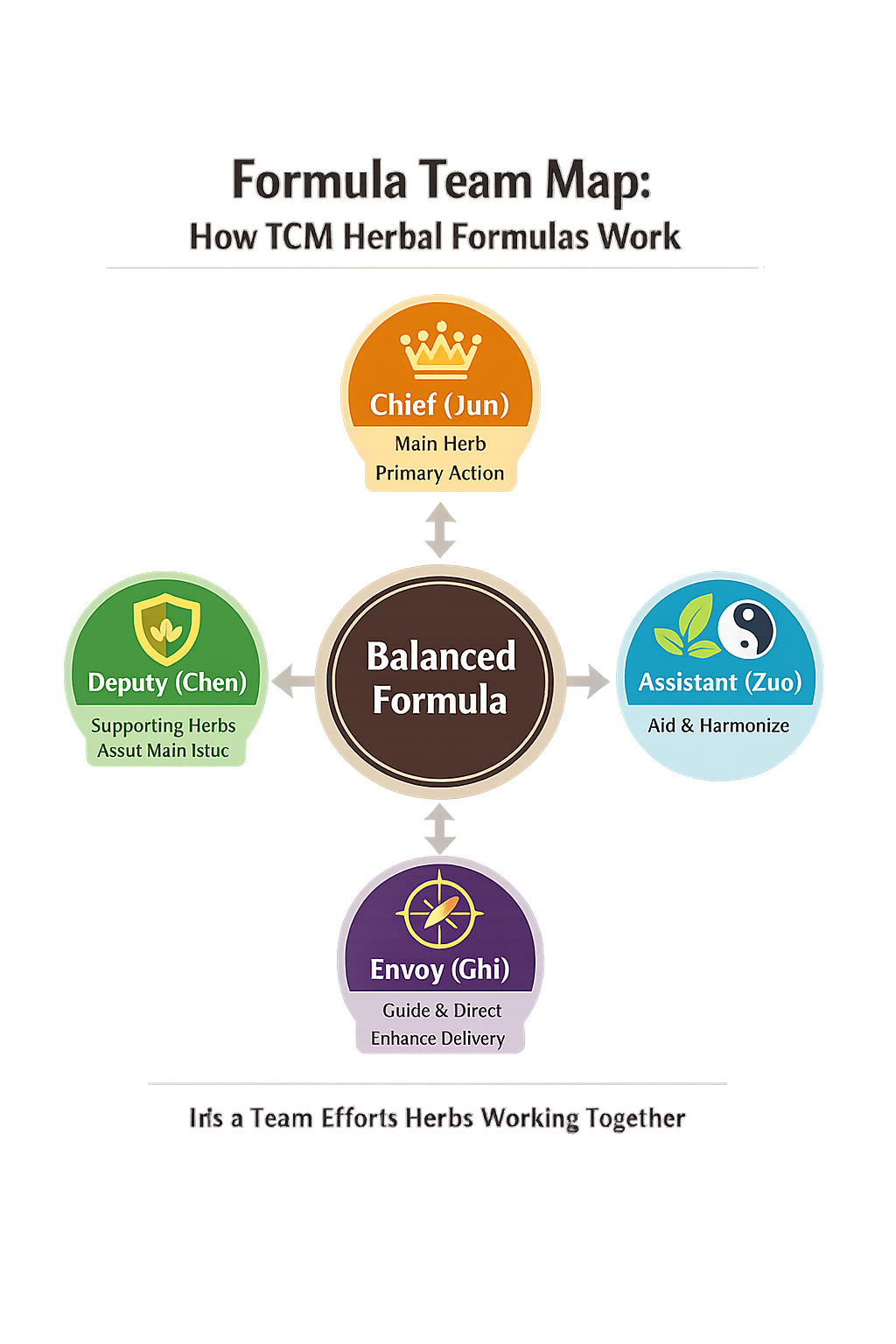
Chinese Herbs • How-To Guide Herbs aren’t magic. They’re tools. And tools work best with a system. Chinese herbalism matters because it isn’t a list of trendy “single ingredients” — it’s a complete framework for choosing herbs by pattern, combining them with purpose, preparing them correctly, and buying them with quality and safety in mind. Choose a goal, pick a format you’ll actually use, and start a simple 7-day routine. Shop Bulk Chinese Herbs → How to Use Bulk Herbs → Want help choosing? Contact us. “Ancient” doesn’t automatically mean effective. What makes Chinese herbs vital is the system. TCM doesn’t treat herbs like a checklist of claims. It treats them as part of a decision framework: No need to feel “I tried an herb and felt nothing” experience—because consistency and correct match matter. One of the biggest reasons Chinese herbs are used successfully is that formulas are built like teams, not random ingredient lists. In traditional formula building: Many herbal articles stop at “What herb for X?” TCM asks: What pattern is driving X? This matters because the same complaint can come from different patterns. You don’t need to be an expert. The goal is to stop shopping like every herb is one-size-fits-all. If you only do one thing right: be consistent for 7 days and write one sentence per day about digestion, sleep, comfort, and energy. Herbs are only as good as their sourcing and handling. A trustworthy seller should clearly state (when true): FDA Disclaimer: This content is for educational purposes. It is not intended to diagnose, treat, cure, or prevent any disease. Not always. Many Chinese herbs are prepared as decoctions for deeper extraction, especially roots and rhizomes. Formulas assign roles (Chief/Deputy/Assistant/Envoy) to improve focus and balance instead of relying on a single ingredient. Choose one goal, pick a format you’ll use consistently, and start a 7-day routine. If you want less guesswork, start with a classic formula. Buying by hype instead of matching pattern, choosing the right format, and being consistent. Research Best PubMed/PMC sources: Zhou X, et al. (2016). Synergistic Effects of Chinese Herbal Medicine. Explains Jun/Chen/Zuo/Shi roles and how formulas are structured. Wu L, et al. (2014). Identifying roles of “Jun-Chen-Zuo-Shi” component herbs… A network pharmacology study explicitly testing Jun-Chen-Zuo-Shi roles. Wu Z, et al. (2023). Visualization of Traditional Chinese Medicine Formulas. Describes Jun-Chen-Zuo-Shi as a compatibility principle for formulas. Good supporting sources: Li S, et al. (2014). Network Pharmacology in Traditional Chinese Medicine. Discusses multicomponent therapeutics and network-target thinking in TCM formulas. Zhang W, et al. (2019). Systems Pharmacology for TCM Drug Discovery. Review on systems pharmacology approaches for complex TCM mixtures. Zhao M, et al. (2019). Systems Pharmacology Dissection… Focuses on multi-components and herb interactions in TCM. Solid sources: Zhou X, et al. (2016). Synergistic Effects of Chinese Herbal Medicine. Strong overview of synergy + formula design. Wang X, et al. (2026). The scientific basis of synergy in traditional Chinese medicine. More recent overview of synergy mechanisms in compound formulas. Useful sources: Guimarães R, et al. (2011). Infusions and decoctions of mixed herbs… Discusses how infusions/decoctions are widely used and often as mixtures. Daswani PG, et al. (2011). Preparation of Decoction of Medicinal Plants: A Self-Help Measure… Discusses decoction as a preferred household extraction method and preparation considerations. Abubakar AR, et al. (2020). Preparation of Medicinal Plants: Basic Extraction and Fractionation Procedures… Broad extraction-method review (useful to support “extraction influences constituents”). High-value sources: Harris ESJ, et al. (2011). Heavy Metal and Pesticide Content in Commonly Consumed Chinese Herbal Medicines. Large sample study; directly supports the need for contamination monitoring/testing. Luo L, et al. (2021). Heavy Metal Contaminations in Herbal Medicines. Broad review; supports why quality control matters and how often issues appear in samples. Liu SH, et al. (2015). Safety Surveillance of Traditional Chinese Medicine. Safety monitoring perspective; useful for “why vigilance matters.” Where to cite: your “Quality isn’t optional” section (and the buyer checklist). Jeong HI, et al. (2022). Monitoring heavy metals/pesticides in herbal decoctions (Korea). Yu IS, et al. (2017). Monitoring heavy metals/pesticides/sulfur dioxide in herbal decoctions (Korea). The Real Reason Chinese Herbs Matter (It’s Not “Because They’re Ancient”)
Quick Summary
Trust
Ready to Start With Chinese Herbs?
1) Why it’s not “because they’re ancient”
2) The formula blueprint: Chief, Deputy, Assistant, Envoy
3) Pattern thinking
Beginner-friendly pattern language
4) Start here: 3 beginner paths that actually work
Path A: “I want something simple I’ll actually do.”
Path B: “I want the most ‘TCM-correct’ approach.”
Path C: “I’m a practitioner / serious student.”
5) Choose your format
Format
Best for
Pros
Considerations
Shop
Cut / Sliced (Bulk)
Decoctions; deeper extraction
Classic preparation; flexible
Requires simmer time
Shop Cut Herbs →
Powder
Convenience + routines
Fast; easy daily use
Start low if digestion is sensitive
Shop Powders →
Granules
Quick tea-style use
Dissolves easily
Quality can vary by manufacturer
Shop Granules →
Teapills / Tablets
Travel + compliance
Simple; pre-formulated
Less customizable
Shop Teapills →
6) How to use bulk herbs at home (simple routines)
Decoction (best for roots, bark, rhizomes)
Infusion (best for flowers and leaves)
Your “7-Day Consistency Rule”
7) Quality, sourcing, and safety
Safety reminders
FAQs
Are Chinese herbs the same as “herbal tea”?
Why do Chinese formulas use multiple herbs?
How do I know what to buy first?
What’s the #1 beginner mistake?
Next Steps
1) “Chinese herbal formulas use roles (Chief/Deputy/Assistant/Envoy), not random blends.”
2) “TCM formulas are multi-component and can act on multiple targets (systems / network pharmacology).”
3) “Synergy is a core concept in Chinese herbal formulas.”
4) “Preparation method matters: decoctions and infusions are common dosage forms and extract different constituents.”
5) “Quality and safety: contaminants (heavy metals/pesticides) can occur in some herbal materials → testing matters.”
6) Optional: “Decoction products and contaminants monitoring”