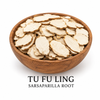


Tu Fu Ling (Smilax Root): Benefits, Tea, Uses, and Why This Quiet Herb Deserves More Attention
Not all health issues feel dramatic. Sometimes it’s more subtle. You just feel… off.
Puffy.
Heavy.
Inflamed.
Swollen.
Achy.
Sluggish.
Your rings feel tighter. Your legs feel heavy. Your joints feel worse when it rains. Your skin feels irritated for no obvious reason.
And maybe the hardest part? You can’t quite explain it. You just know your body doesn’t feel right.
That’s when Tu Fu Ling (Smilax Root) starts making a lot of sense.
And once people understand what this herb traditionally does, they usually have the same reaction:
“Ah… now I get why people use this.”
Because Tu Fu Ling isn’t about stimulation.
It isn’t a flashy herb. It’s a quiet workhorse.
One that has earned deep respect for helping support balance when the body feels heavy, inflamed, and uncomfortable.
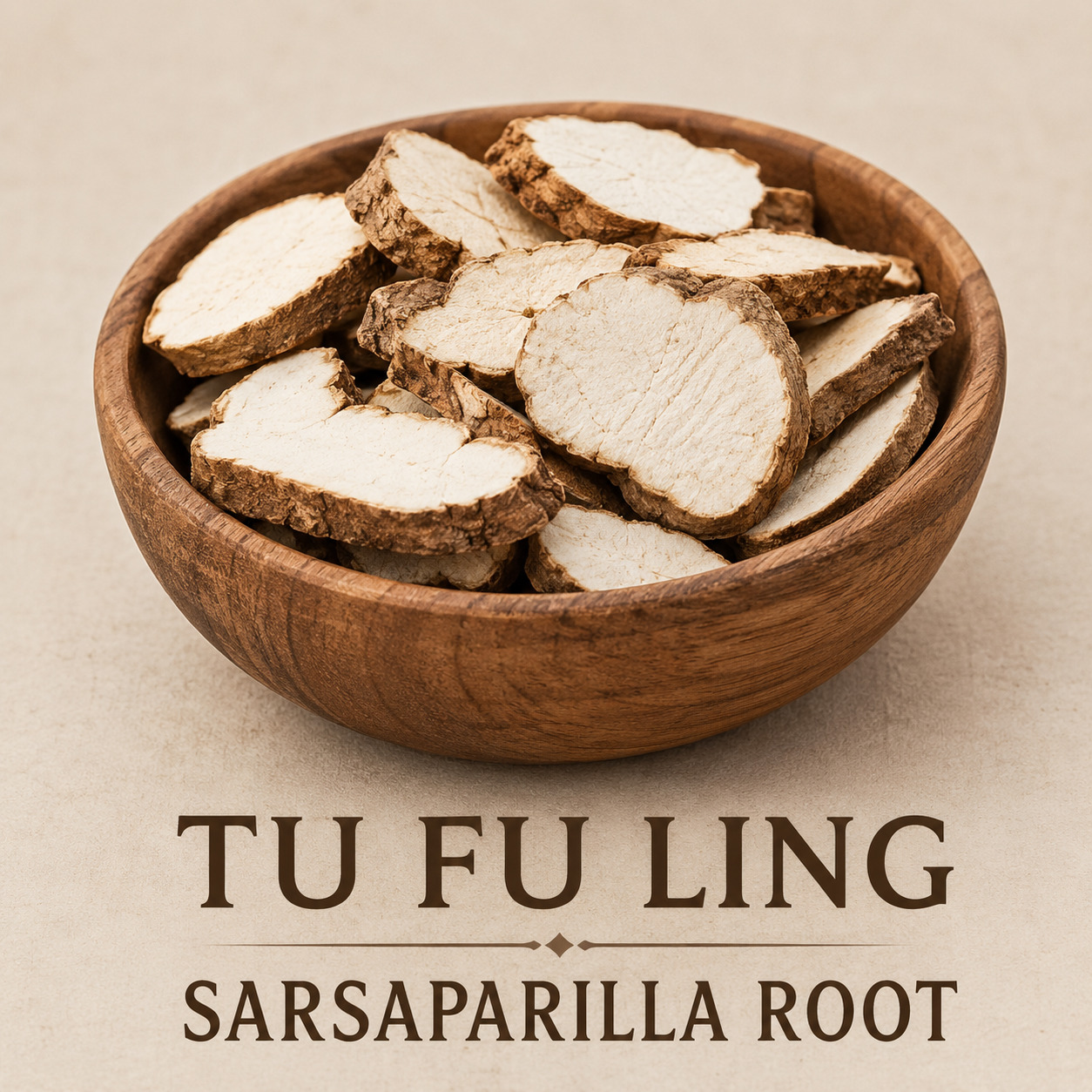 Quick Summary: What Is Tu Fu Ling?
Tu Fu Ling (土茯苓), commonly called Smilax Root or China Root, is a traditional Chinese herb valued for supporting the body when excess dampness and heat create imbalance.
Traditionally, it is used to support:
-
Skin wellness
-
Joint comfort
-
Healthy detox pathways
-
Mobility
-
Dampness support
-
Whole-body balance
It is especially respected when the body feels:
-
Puffy
-
Hot
-
Swollen
-
Heavy
-
Inflamed
-
Congested
What You Need To Know This is where Tu Fu Ling clicks.
Some herbs are used when people feel cold and depleted.
Tu Fu Ling is often used when people feel:
stuck, swollen, irritated, and heavy.
That’s a very different pattern.
What Does Tu Fu Ling Taste Like?
Good news.
Tu Fu Ling is surprisingly easy to drink.
It tastes:
-
Mild
-
Earthy
-
Neutral
-
Slightly woody
Compared to many Chinese herbs, it’s very approachable.
It’s nowhere near as bitter as Huang Qin. And nowhere near as pungent as ginger. That makes it beginner-friendly.
Tu Fu Ling Benefits
1. Supports Skin Wellness
This is one of Tu Fu Ling’s most respected traditional uses.
It is commonly included in formulas for skin support when the skin feels:
-
Warm
-
Reactive
-
Inflamed
-
Irritated
Traditional herbal systems often ask:
What’s happening internally that may be showing up on the skin?
That’s a very different way of thinking.
2. Supports Joint Comfort and Mobility
Many people explore Tu Fu Ling for joint and mobility support.
Especially when discomfort feels worse during:
-
Damp weather
-
Rainy days
-
Cold mornings
-
Humid conditions
Sound familiar?
That pattern matters.
3. Supports Healthy Cleansing Pathways
Your body already has natural detox systems.
Your liver, kidneys, lymphatic system, and digestive system are always working.
Tu Fu Ling is traditionally used to support those natural pathways.
Many people use it during seasonal wellness routines.
4. Supports Dampness and Heavy Sensations
This is one of the biggest reasons herbalists love Tu Fu Ling.
In traditional herbal thinking, dampness may show up as:
-
Brain fog
-
Puffiness
-
Sluggishness
-
Water retention
-
Heavy legs
-
Feeling weighed down
Some people don’t feel sick.
They just don’t feel good.
Heavy.
Puffy.
Slow.
Off.
That’s exactly where Tu Fu Ling becomes interesting.
Who Might Consider Tu Fu Ling?
Tu Fu Ling may be worth exploring if you:
-
Feel puffy or swollen often
-
Notice stiffness in damp weather
-
Feel heavy or sluggish
-
Want skin wellness support
-
Want gentle cleansing support
-
Want support for mobility and comfort
Who Should Use Caution or Avoid Tu Fu Ling?
Use caution if you:
-
Are pregnant or nursing
-
Have major medical conditions
-
Take prescription medications
-
Have kidney concerns
-
Are under practitioner supervision
Always check with a qualified healthcare practitioner before use.
Tu Fu Ling vs Other Herbs
This is where things get interesting.
Tu Fu Ling vs Fu Ling
| Feature | Tu Fu Ling | Fu Ling |
|---|---|---|
| Best Known For | Damp heat + skin + joints | Water balance + digestion |
| Energy | Neutral/slightly cooling | Neutral |
| Best For | Heat + swelling | Bloating + dampness |
| Taste | Mild earthy | Mild bland |
Easy Explanation
-
Tu Fu Ling = heavier, hotter, more inflamed patterns
-
Fu Ling = digestion, fluids, and water balance
Tu Fu Ling vs Yu Xing Cao
| Feature | Tu Fu Ling | Yu Xing Cao |
|---|---|---|
| Focus | Damp heat support | Heat + toxicity support |
| Taste | Mild earthy | Strong fishy |
| Best For | Skin, joints | Strong clearing support |
Big difference in taste.
Yu Xing Cao is much harder for beginners.
Tu Fu Ling (Smilax glabra) vs Western Sarsaparilla (Smilax ornata)
This is a surprisingly useful comparison.
| Feature |
Tu Fu Ling Smilax glabra |
Sarsaparilla Smilax ornata |
|---|---|---|
| Tradition | Chinese herbal use | Western herbal use |
| Best Known For | Damp heat support | Root tonic support |
| Flavor | Mild earthy | Slightly sweet root |
Many customers think:
“Tu Fu Ling and Sarsaparilla are the same thing.”
Not exactly.
They are related, but not identical.
- Tu Fu Ling = Chinese herbal medicine use (TCM)
- Western Sarsaparilla = Western / South American herbal traditions
Both belong to the Smilax family, but they’re used a bit differently.
Important: Tu Fu Ling is often called Chinese Sarsaparilla, but it is not identical to the Western Sarsaparilla varieties commonly sold in herbal products. While both belong to the Smilax family, they have different traditional uses and origins.
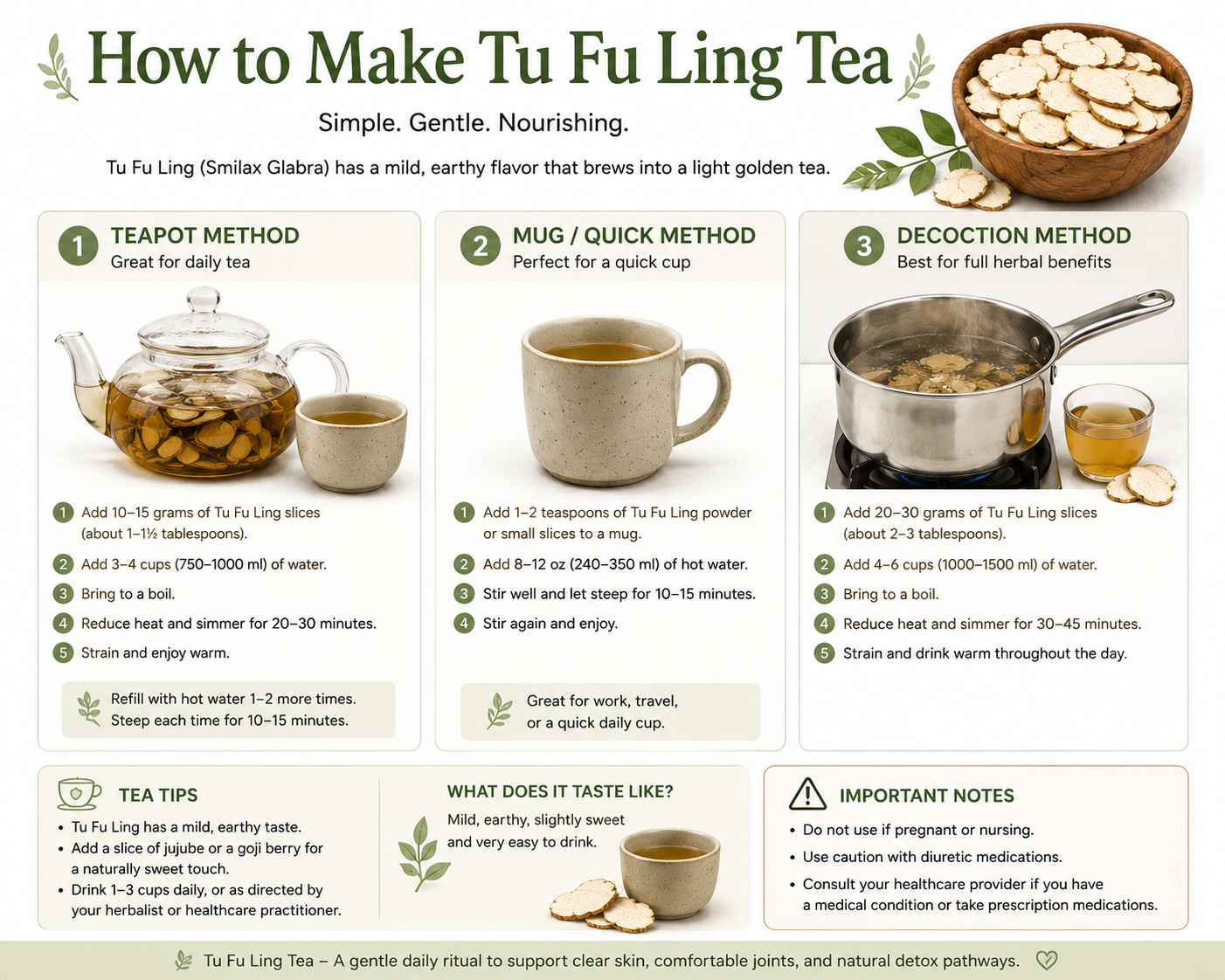
How to Make Tu Fu Ling Tea
You’ll need:
-
10–15 grams Tu Fu Ling
-
3–4 cups water
Instructions:
-
Rinse herbs
-
Add to pot
-
Bring to boil
-
Reduce heat
-
Simmer 30–40 minutes
-
Strain and drink warm
Drink 1–2 cups daily.
What Herbs Pair Well With Tu Fu Ling?
Some traditional pairings include:
For Skin Support
-
Tu Fu Ling + Jin Yin Hua
-
Tu Fu Ling + Lian Qiao
For Joint Support
-
Tu Fu Ling + Du Huo
-
Tu Fu Ling + Xu Duan
For Dampness Support
-
Tu Fu Ling + Yi Yi Ren
-
Tu Fu Ling + Fu Ling
5 Things That May Surprise You About Tu Fu Ling
1. It’s much milder tasting than most people expect
Great for beginners.
2. It’s often used for skin and joints together
That surprises many people.
3. Damp weather matters
Rain and humidity patterns matter in herbal systems.
4. It combines beautifully with other herbs
Very versatile.
5. It’s one of the quiet workhorse herbs
No hype.
Just respected results.
Tu Fu Ling (Smilax Glabra): Traditional Benefits, Uses, and Product Details
Tu Fu Ling, also known as Sarsaparilla Root or Smilax Glabra, is a traditional Chinese herb valued for clearing heat, removing toxicity, excreting dampness, supporting healthy skin, easing joint movement, and promoting normal urination.
This is one of those herbs that makes people say, “Oh… that explains why I feel puffy, heavy, irritated, and uncomfortable.”
Let's Make This Easy
Tu Fu Ling is often used when the body feels like it is holding on to too much: too much heat, too much dampness, too much heaviness, and too much inflammation.
It is not a flashy herb. It is a quiet, dependable herb traditionally used when the body needs help feeling clearer, lighter, and more comfortable.
Quick Product Snapshot
| Common Name | Sarsaparilla Root |
|---|---|
| Pin Yin Name | Tu Fu Ling |
| Botanical Name | Smilax Glabra |
| Other Names | Smilax, Glabrous Greenbrier Rhizome, Chinese Smilax Rhizome |
| Channels / Meridians | Stomach and Kidney |
| Properties | Sweet, bland, cool, and non-toxic |
| Form | Sliced Non Uniform Pieces |
| Package Size | 500 grams / 1.1 pounds |
| Origin | China |
| Brand | Plum Flower |
| Other Ingredients | None |
Traditional Benefits of Tu Fu Ling
- Supports natural cleansing: Traditionally used to help the body remove toxins and clear unwanted buildup.
- Supports liver wellness: Used in TCM to clear heat and dampness.
- Promotes clear, healthy skin: Traditionally used for skin concerns such as eczema, psoriasis, acne, boils, and abscesses.
- Supports joint comfort: Traditionally used to ease stiffness, inflammation, and difficult movement.
- Promotes normal urination: Traditionally used to help the body excrete dampness.
- Supports immune resilience: Used in traditional formulas to support the body’s natural defenses.
Why Tu Fu Ling Works: TCM and Modern Perspective
From a Traditional Chinese Medicine perspective, Tu Fu Ling helps clear heat, remove toxicity, excrete dampness, clear the skin, ease joint movement, and promote normal urination.
From a modern research perspective, Smilax species naturally contain compounds such as flavonoids, saponins, astilbin, quercetin, β-sitosterol, and β-sitosterol palmitate. These naturally occurring components are being studied for their antioxidant and inflammatory-response properties.
- Helps clear dampness and heat from the body
- Supports skin and joint comfort
- Supports digestive and metabolic cleansing pathways
- Traditionally enters the Stomach and Kidney channels
- Traditionally used when heat, dampness, and toxicity affect the skin
Tu Fu Ling Naturally Occurring Components
- β-sitosterol palmitate
- β-sitosterol
- Astilbin
- Quercetin
Important Manufacturer Note
Special Note From The Manufacturer: While meeting Plum Flower Premium Grade Herb standards, post-import verification testing found that this product’s sulfite levels exceeded the manufacturer’s standard for unsulfured herbs.
Who May Benefit From Tu Fu Ling?
- People who feel puffy, heavy, or sluggish
- People looking for traditional skin support
- People wanting joint and mobility support
- People interested in dampness-clearing herbs
- People looking for a mild, cooling herb traditionally used for heat and toxicity
Who Should Use Caution or Avoid Tu Fu Ling?
- Do not use if pregnant or nursing.
- Use caution if taking prescription medications.
- Not recommended with diuretic medications, as it may increase urination.
- Use caution with Yin deficiency patterns, as Tu Fu Ling may have drying properties.
- Consult a healthcare provider before use if you have kidney disease, liver disease, chronic illness, or are taking medication.
California Prop 65 Notice
This product carries a California Prop 65 warning. Please review product labeling before use.
Why Buy Tu Fu Ling From 1st Chinese Herbs?
- Clearly labeled: Includes the correct botanical name, Smilax Glabra.
- Trusted brand: Plum Flower Premium Grade Herbs.
- Quality tested: Lab-tested for quality and safety.
- COA available: Certificate of Analysis available upon request.
- Trusted since 1994: Helping customers choose quality herbs with confidence.
Final Thought
Tu Fu Ling is not the loudest herb in the cabinet.
But when the body feels hot, damp, swollen, irritated, heavy, or uncomfortable, this quiet root starts to make a lot of sense.
Sometimes the best herbs are not the flashy ones.
Sometimes they are the dependable ones that help the body feel clearer, lighter, and more balanced.
That is the beauty of Tu Fu Ling.
These statements have not been evaluated by the Food and Drug Administration. This product is not intended to diagnose, treat, cure, or prevent any disease.
Frequently Asked Questions
Is Tu Fu Ling bitter?
No. It is mild and earthy.
Can beginners use Tu Fu Ling?
Yes. Many beginners find it approachable.
Is Tu Fu Ling warming or cooling?
Generally neutral to slightly cooling.
Can I drink Tu Fu Ling daily?
Many people drink it regularly, but usage depends on individual needs.
Is Tu Fu Ling good for tea?
Yes. Decoction is the most common method.
PubMed Research on Smilax Root
Modern research is exploring compounds in Smilax species for their potential roles in:
-
Antioxidant activity
-
Inflammatory response support
-
Skin wellness
-
Cellular protection
Research is still developing, but interest continues to grow.
Final Thoughts
Tu Fu Ling isn’t trendy.
It doesn’t get the attention of ginseng.
It doesn’t sound exciting.
But experienced herbalists know something important.
Some of the best herbs aren’t flashy.
They’re dependable.
Tu Fu Ling is one of those herbs.
Especially when the body feels:
-
Heavy
-
Puffy
-
Inflamed
-
Sluggish
-
Uncomfortable
Sometimes helping the body feel lighter, clearer, and more balanced is exactly what’s needed.
And that’s where Tu Fu Ling quietly shines.
References:
https://www.americandragon.com/Individualherbsupdate/TuFuLing.html
https://pubmed.ncbi.nlm.nih.gov/11038973/
https://www.lac.com/en/tu-fu-ling-%28smilacis-glabrae-rhizoma%29/tu-fu-ling.html
https://tcmwiki.com/wiki/tu-fu-ling
https://www.sacredlotus.com/go/chinese-herbs/substance/tu-fu-ling-smilax-glabrous-greenbrier-rhizome