
WHY YOU CAN’T SLEEP (AND THE CHINESE HERBS THAT MAY HELP YOU FINALLY REST)
If this sounds familiar…
You’re tired all day…
But the moment you lie down—your mind turns on.
You replay conversations.
You think about tomorrow.
You feel wired when you should feel calm.
And the frustrating part?
You know you need sleep
But your body won’t cooperate
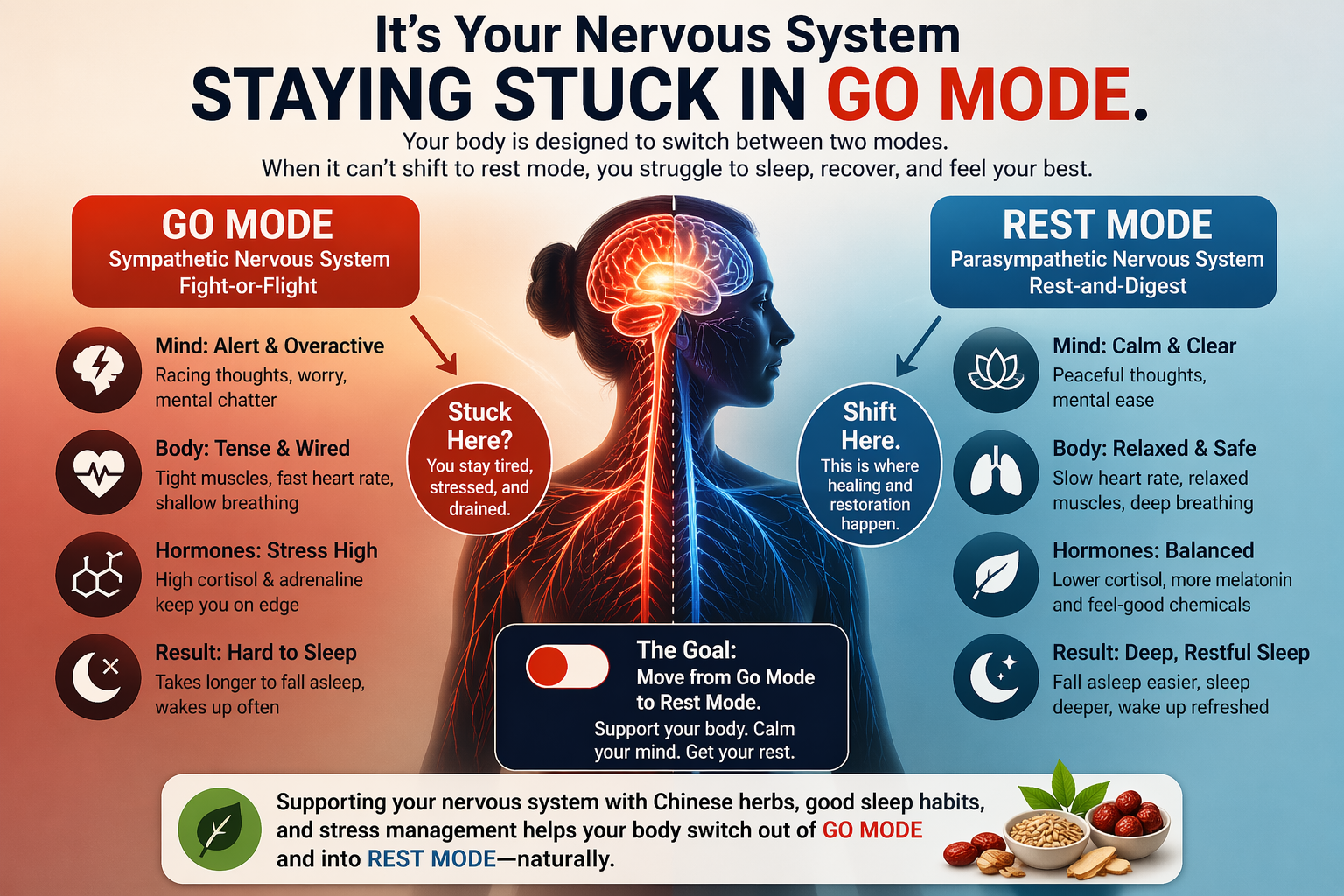 Here’s what’s actually happening
This isn’t just “bad sleep.”
It’s your nervous system staying stuck in go mode.
Your body is supposed to shift at night:
- From alert → calm
- From stress → recovery
- From thinking → resting
But if that switch doesn’t happen… You stay “on” when you should be “off”
How Chinese herbs approach sleep differently
Most sleep aids try to knock you out.
Chinese herbs focus on something smarter:
Helping your body naturally settle down
Instead of forcing sleep, they help:
- Quiet the mind
- Ease tension
- Support deeper rest
THE MOST COMMON CHINESE HERBS FOR SLEEP
Suan Zao Ren (Ziziphus Seed)
Best for: Trouble falling asleep + light sleep
- Helps calm the mind
- Supports deeper, more restful sleep
- Often used when you wake up during the night
Think of this as your “core sleep herb”
Bai Zi Ren
Best for: Restlessness + overactive mind
- Helps settle nervous energy
- Supports emotional calm
- Often used for interrupted sleep
Great if your mind won’t stop thinking
He Huan Pi (Albizia Bark)
Best for: Stress, frustration, emotional tension
- Helps you unwind mentally
- Supports a lighter, calmer mood
- Often used when stress keeps you up
This is your “let it go” herb
Fu Ling
Best for: Stress + digestion-related sleep issues
- Supports calmness
- Helps when your stomach feels off at night
- Often used in formulas for balance
Good when your body feels unsettled
Yuan Zhi
Best for: Racing thoughts
- Helps clear mental chatter
- Supports focus and calm
- Often used when your brain won’t “shut off”
Ideal for overthinkers
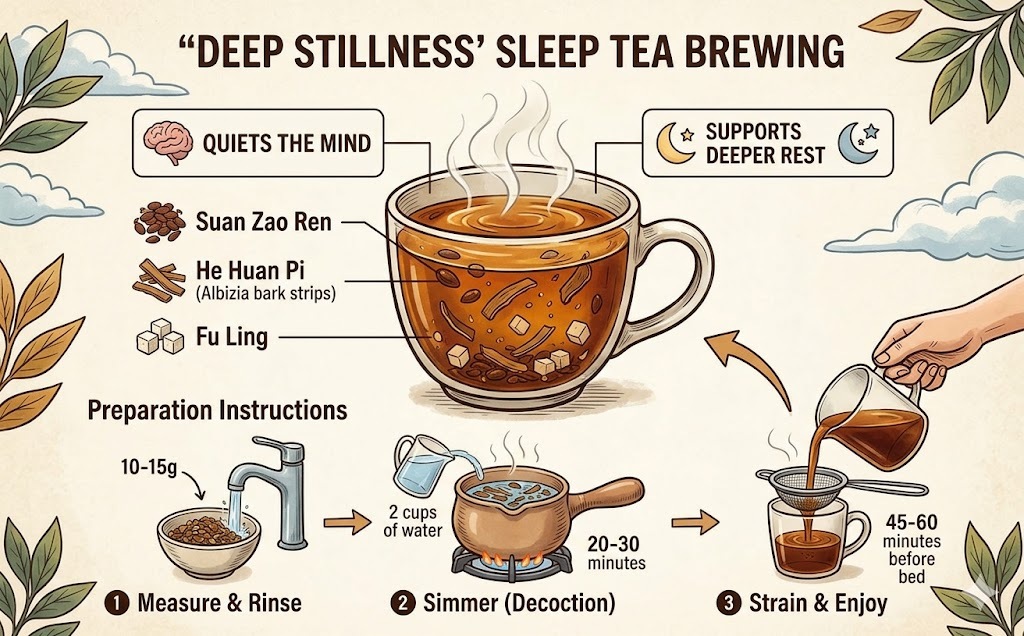
The "Deep Stillness" Sleep Tea
This recipe uses a ratio approach, allowing you to scale it based on whether you are making a single cup or a larger batch of bulk herbs.
Ingredients:
-
3 parts Suan Zao Ren (Ziziphus Seed): The primary herb for nourishing the heart and calming the mind. It is especially helpful if you find yourself waking up throughout the night.
-
2 parts He Huan Pi (Albizia Bark): Known as the "collective happiness bark," this helps move stuck emotional energy and eases the "wired but tired" feeling.
-
1 part Fu Ling (Poria): Added to settle the digestion and ground the formula, ensuring your body feels stable enough to rest.
-
Optional: A few slices of fresh ginger or a pinch of dried orange peel to improve flavor and digestion.
Preparation Instructions
Since these are mostly roots, seeds, and barks (rather than delicate leaves), they require a decoction rather than a simple steep to extract their active properties.
-
Measure: For a single potent serving, use about 10–15 grams of the total herbal blend.
-
Rinse: Quickly rinse the herbs under cold water to remove any dust.
-
Simmer: Place the herbs in a small ceramic or glass pot (avoid metal if possible) with 2 cups of water. Bring to a boil, then reduce heat and simmer for 20–30 minutes until the liquid is reduced by about half.
-
Strain: Pour the tea through a fine-mesh strainer into your favorite mug.
-
Enjoy: Drink this warm about 45–60 minutes before bed.
Tips for Best Results
-
Crush the Seeds: If your
Suan Zao Ren -
Consistency: Chinese herbs often have a cumulative effect. While you may feel more relaxed after one cup, the best results for sleep usually appear after 3–5 nights of consistent use.
-
Mind the Temperature: Sip the tea while it is warm. In TCM, cold liquids at night can shock the digestive system and interfere with the body's natural transition to sleep.
WHICH HERB IS RIGHT FOR YOU?
| If your problem is… | Start here |
|---|---|
| Can’t fall asleep | Suan Zao Ren |
| Wake up at night | Bai Zi Ren |
| Stress keeps you up | He Huan Pi |
| Digestion affects sleep | Fu Ling |
| Racing thoughts | Yuan Zhi |
WHY SLEEP DOESN’T FIX ITSELF
If this keeps happening night after night, it can lead to:
- Constant fatigue
- Brain fog
- Irritability
- Low energy
- Poor focus
Sleep affects everything—your mood, your energy, your health
WHAT ACTUALLY WORKS (THIS IS KEY)
The biggest mistake people make:
Trying random things every night
The better approach:
Support your body consistently
A SIMPLE SLEEP ROUTINE THAT MAKES SENSE
Evening (1–2 hours before bed):
- Start calming your system
- Reduce stimulation
Before bed:
- Use calming herbs like Suan Zao Ren or He Huan Pi
Consistency:
- This is what makes the biggest difference
Herbs work best when your body learns what to expect
WHAT MOST PEOPLE DON’T REALIZE
You don’t need:
- Strong sedatives
- Harsh sleep aids
- Something that knocks you out
You need your body to feel safe enough to rest
That’s the real shift.
COMMON QUESTIONS
Why can’t I sleep even when I’m tired?
Because your nervous system is still active.
What works fastest?
Herbs that calm the mind, like He Huan Pi or Yuan Zhi.
What works long-term?
Suan Zao Ren is often used for ongoing sleep support.
Can I combine herbs?
Yes—and that’s often where the best results happen.
FINAL THOUGHT
If sleep has been a struggle, it’s not because you’re doing something wrong.
Your body just hasn’t been supported the right way yet.
Once your system starts to calm down…
Sleep doesn’t feel forced anymore.
It happens naturally.
References
Suan Zao Ren (Ziziphus Seed)
- Supports improved sleep quality and insomnia patterns
→ Suanzaoren treatment for insomnia and sleep quality - Review of herbal medicine for sleep regulation and insomnia
→ Herbal medicine for insomnia and sleep disorders
Fu Ling (Poria cocos)
- Studied for improving sleep quality and relaxation
→ Poria cocos extract and sleep quality study - Supports gut-brain axis and emotional balance
→ Poria cocos and gut-brain interaction research - Evaluated for suboptimal sleep improvement
→ Poria cocos clinical sleep study
Herbal Combinations (Real-World Use)
- Combination of herbs improves sleep quality and balance
→ Ziziphus and Poria combination sleep study - Traditional Chinese medicine approaches to insomnia
→ Chinese herbal medicine patterns for insomnia
Broad Herbal Sleep Research
- Review of medicinal herbs that support sleep pathways
→ Medicinal herbs with sleep-promoting effects review
⚠️ These studies include traditional use, laboratory, and clinical research and are provided for educational purposes only.