
Wu Wei Zi vs Suan Zao Ren: Which Traditional Chinese Herb Should You Choose?
If you are exploring traditional Chinese herbs for relaxation, evening wellness, or simply expanding your herbal pantry, chances are you have encountered both Wu Wei Zi and Suan Zao Ren.
Let's Make This Easy
 At first glance, they seem surprisingly similar.
Both appear in traditional Chinese herbal formulas.
Both have been used for centuries.
Both are associated with calmness, balance, and traditional wellness practices.
Yet despite appearing together in many conversations about Chinese herbs, they are completely different plants with very different personalities.
One is a tart berry famous for having all five traditional flavors.
The other is a mild seed that has become one of the most recognized herbs associated with evening wellness traditions.
So which one belongs in your herbal cabinet?
The Quick Answer
If you enjoy tart fruit teas, berry flavors, and learning about some of the most fascinating herbs in Chinese herbalism, start with Wu Wei Zi.
If you prefer gentle flavors, relaxing evening teas, and a beginner-friendly herbal experience, start with Suan Zao Ren.
That is the short answer.
Now let's look at why.
Meet The Herbs
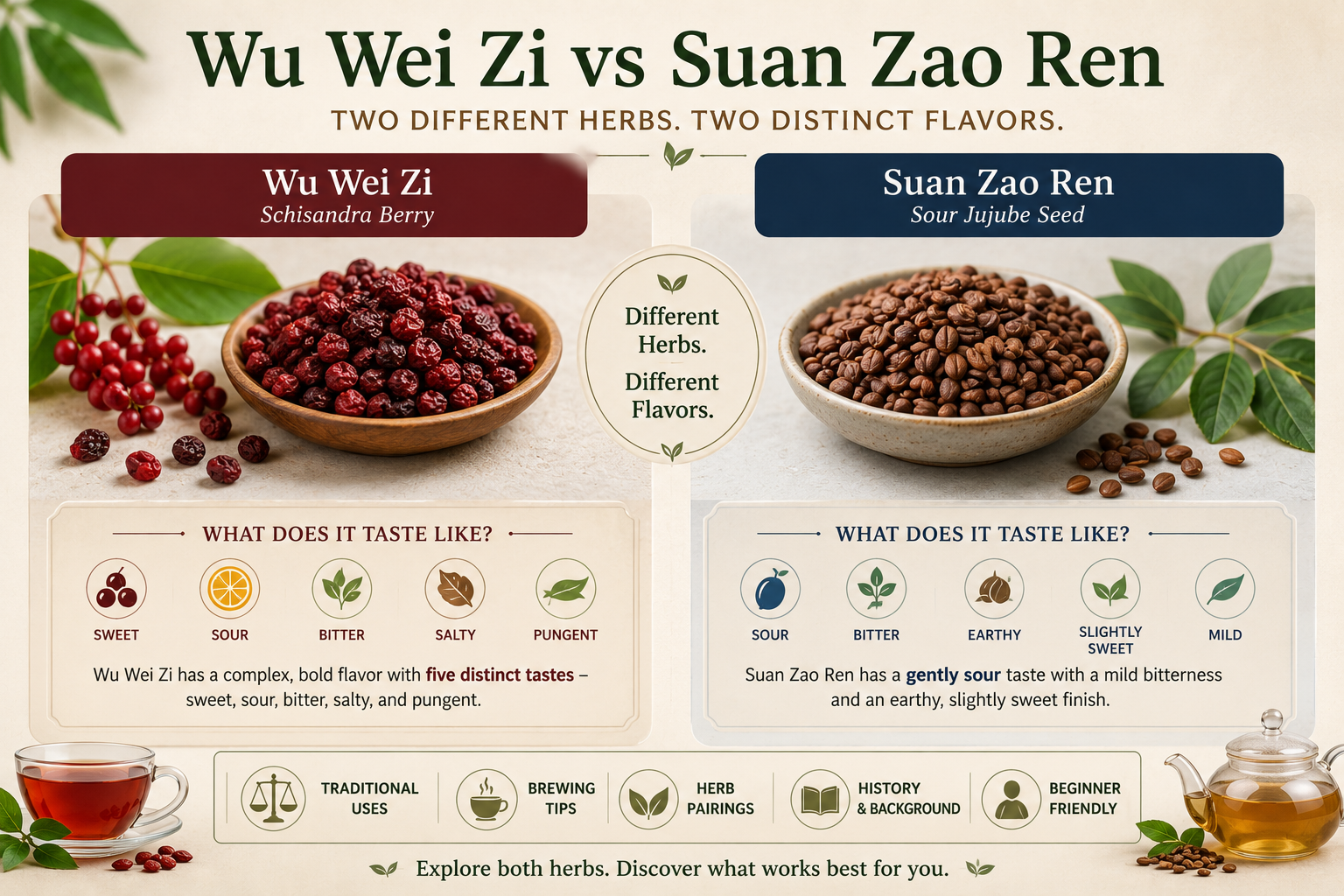
Wu Wei Zi: The Five Flavor Berry
Wu Wei Zi is often translated as Five Flavor Berry.
According to traditional Chinese herbal theory, it contains all five primary flavors:
- Sweet
- Sour
- Bitter
- Pungent
- Salty
Whether or not your taste buds identify all five, there is no question that Wu Wei Zi has one of the most unique flavor profiles in the herbal world.
The bright red berries have been used for centuries and are frequently included in traditional formulas associated with vitality, endurance, resilience, and overall wellness.
It is one of those herbs that people often remember after trying it once.
Usually because of the flavor.
Suan Zao Ren: The Seed Behind A Classic Tradition
Suan Zao Ren comes from the Sour Jujube tree.
Unlike Wu Wei Zi, which immediately grabs attention with its unusual taste, Suan Zao Ren is much quieter.
Its flavor is mild.
Its aroma is subtle.
Its appearance is not particularly exciting.
Yet it remains one of the most respected and widely used seeds in traditional Chinese herbalism.
Many people discover Suan Zao Ren while looking for traditional herbs associated with evening routines, calmness, and relaxation.
It has earned a reputation as one of the gentlest introductions to Chinese herbal teas.
Which One Tastes Better?
This is probably the question people care about most.
After all, the best herb in the world is useless if you hate drinking it.
Wu Wei Zi Flavor
Wu Wei Zi is bold.
Most people immediately notice the sourness.
Some compare it to cranberry.
Others compare it to tart cherry.
A few describe it as a berry that cannot decide what flavor it wants to be.
It is memorable.
And not everyone falls in love with it immediately.
Suan Zao Ren Flavor
Suan Zao Ren sits on the opposite end of the spectrum.
The flavor is mild, slightly nutty, and much softer than Wu Wei Zi.
It does not demand attention.
It simply creates an easy-drinking tea that most people find approachable.
If you enjoy subtle flavors, Suan Zao Ren will probably win.
If you enjoy fruit teas and tart flavors, Wu Wei Zi is likely your herb.
How Are These Herbs Traditionally Used?
This is where many comparison articles become confusing.
Both herbs are often discussed alongside wellness, relaxation, and traditional balance.
However, they traditionally fill different roles.
Wu Wei Zi is commonly found in traditional formulas associated with vitality, endurance, adaptation, and long-term wellness strategies.
Suan Zao Ren is more commonly associated with relaxation, calmness, evening routines, and traditional sleep-support formulas.
This is why many herbalists do not see them as competing herbs.
They often see them as complementary herbs.
Can They Be Used Together?
Absolutely.
In fact, many traditional formulas combine multiple herbs that serve different purposes.
Because Wu Wei Zi and Suan Zao Ren bring different characteristics to a formula, they often appear alongside one another rather than replacing one another.
Think of them as members of the same team rather than rivals.
Which Herb Is Easier For Beginners?
If someone walked into our store and said:
"I have never tried Chinese herbs before. Which one should I start with?"
We would usually recommend Suan Zao Ren.
The flavor is easier.
The tea is straightforward.
The purpose is easier for beginners to understand.
Wu Wei Zi is fascinating, but its tartness can surprise people who expect a typical herbal tea experience.
Suan Zao Ren is often the safer first step.
How Are They Commonly Prepared?
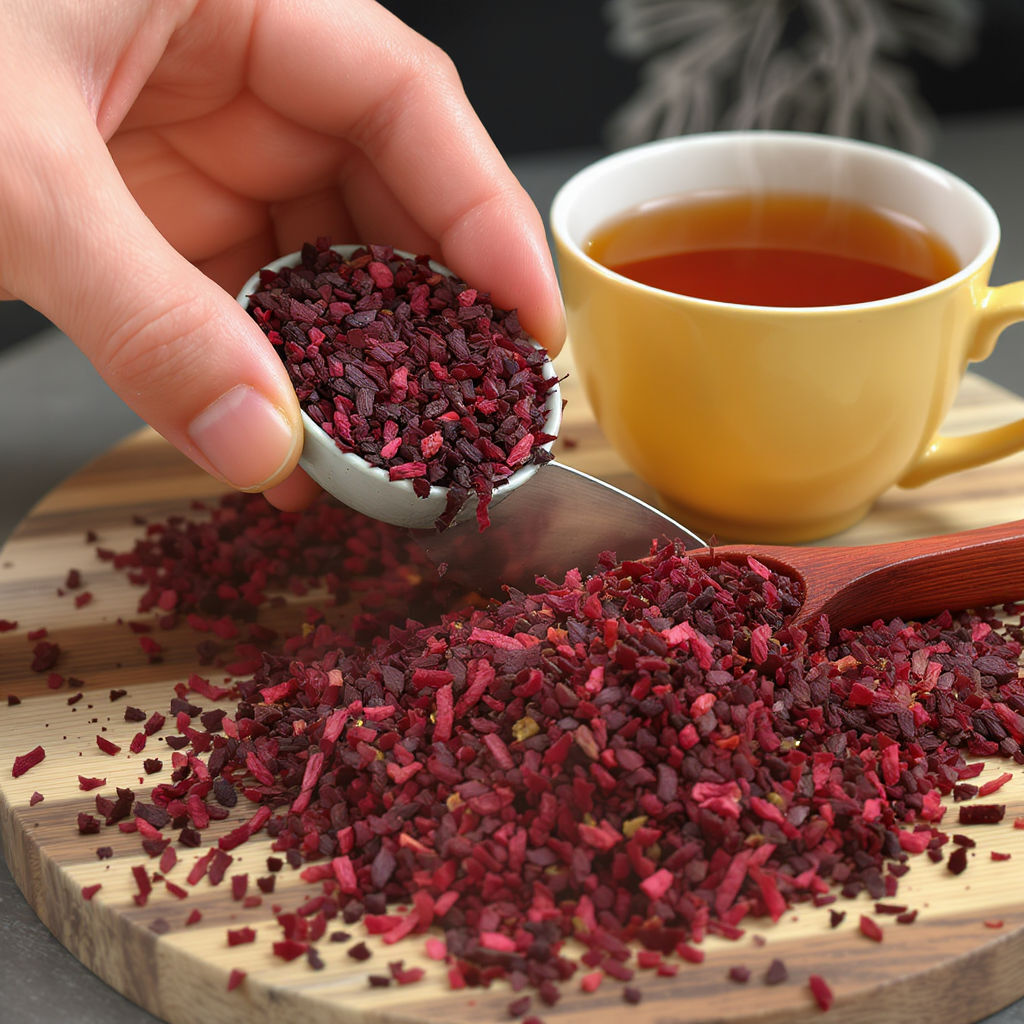 Both herbs are traditionally prepared as decoctions or teas.
Simple Wu Wei Zi Tea
- 1 tablespoon Wu Wei Zi berries
- 2 cups water
Simmer for approximately 15 to 20 minutes.
The resulting tea is tart, fruity, and bright.
Simple Suan Zao Ren Tea
- 1 tablespoon crushed Suan Zao Ren
- 2 cups water
Simmer for approximately 20 to 30 minutes.
The resulting tea is much gentler and softer.
What Herbs Are Commonly Paired With Them?
Looking at herb pairings often helps people understand how herbs are traditionally viewed.
Wu Wei Zi Is Often Paired With:
- Goji Berry
- Astragalus Root
- Reishi Mushroom
- Jiao Gu Lan
- American Ginseng
Suan Zao Ren Is Often Paired With:
- Bai Zi Ren
- Fu Ling
- He Huan Pi
- Long Yan Rou
- Wu Wei Zi
What Most Customers Really Want To Know
| Question | Winner |
|---|---|
| Easiest Herb For Beginners | Suan Zao Ren |
| Most Interesting Flavor | Wu Wei Zi |
| Best Fruit Tea Experience | Wu Wei Zi |
| Mildest Tea | Suan Zao Ren |
| Most Unique Herb | Wu Wei Zi |
| Easiest Daily Tea | Suan Zao Ren |
So Which One Should You Buy First?
If you love tart berries, unusual flavors, and discovering herbs with fascinating histories, choose Wu Wei Zi.
If you prefer gentle teas, evening rituals, and beginner-friendly herbs, choose Suan Zao Ren.
Neither choice is wrong.
They simply offer different experiences.
And that is exactly why both herbs have remained popular for centuries.
Many herbal enthusiasts eventually end up keeping both in their herbal pantry.
One for its bold personality.
The other for its quiet reliability.
Sometimes the best way to understand the difference is to experience both for yourself.
Related Comparisons:
- Goji Berry vs Red Dates
- Reishi vs Cordyceps
- Ginseng vs Astragalus
- Bai Zi Ren vs Suan Zao Ren
- Jiao Gu Lan vs Green Tea
Trusted Since 1994
Helping customers explore traditional Chinese herbs, roots, berries, flowers, mushrooms, and botanical wellness products.
Author: 1st Chinese Herbs Research Team
Last Updated June 2026
Research & References
The following scientific publications provide additional information regarding Wu Wei Zi (Schisandra chinensis) and Suan Zao Ren (Ziziphus spinosa seed). These studies are provided for educational purposes and do not constitute medical claims for this product.
- Panossian A, Wikman G. Effects of Adaptogens on the Central Nervous System and the Molecular Mechanisms Associated with Their Stress-Protective Activity. PubMed Central. https://pmc.ncbi.nlm.nih.gov/articles/PMC3991026/
- Panossian A, et al. Stimulating Effect of Adaptogens: An Overview with Particular Reference to Their Efficacy Following Single Dose Administration. PubMed. https://pubmed.ncbi.nlm.nih.gov/16261511/
- Nowak A, et al. Potential of Schisandra chinensis in Human Health and Nutrition. PubMed Central. https://pmc.ncbi.nlm.nih.gov/articles/PMC6412213/
- Shergis JL, et al. Ziziphus spinosa Seeds for Insomnia: A Review of Chemistry and Pharmacology. PubMed. https://pubmed.ncbi.nlm.nih.gov/28899507/
- Yang M, et al. The Herbal Medicine Suanzaoren (Ziziphi Spinosae Semen) for Sleep Quality Improvements: A Systematic Review and Meta-Analysis. PubMed Central. https://pmc.ncbi.nlm.nih.gov/articles/PMC10084578/
- Yeung WF, et al. Chinese Herbal Medicine for Insomnia: A Systematic Review. PubMed. https://pubmed.ncbi.nlm.nih.gov/22440393/
- Ruan W, et al. Sour Jujube (Ziziphus jujuba var. spinosa): Traditional Uses, Chemistry, and Research Review. PubMed Central. https://pmc.ncbi.nlm.nih.gov/articles/PMC10930723/
Note: Traditional Chinese herbal use and modern scientific research are not always equivalent. The information presented in this article is intended for educational purposes only.