
Yan Hu Suo vs Du Zhong: Which Chinese Herb Is Better for Movement, Mobility, and Everyday Comfort?
If you’ve been exploring Chinese herbs for movement, comfort, mobility, or aging well, you’ve probably seen two names come up again and again:
At first glance, they seem similar.
Both are respected in Traditional Chinese Herbalism.
Both are associated with movement and physical comfort.
Both are popular among customers looking to stay active.
But here’s what most people don’t realize.
These herbs are completely different.
In fact, they solve two very different problems.
That is exactly why choosing the right one matters.
 The Big Difference Nobody Explains
Here’s the simplest way to understand them:
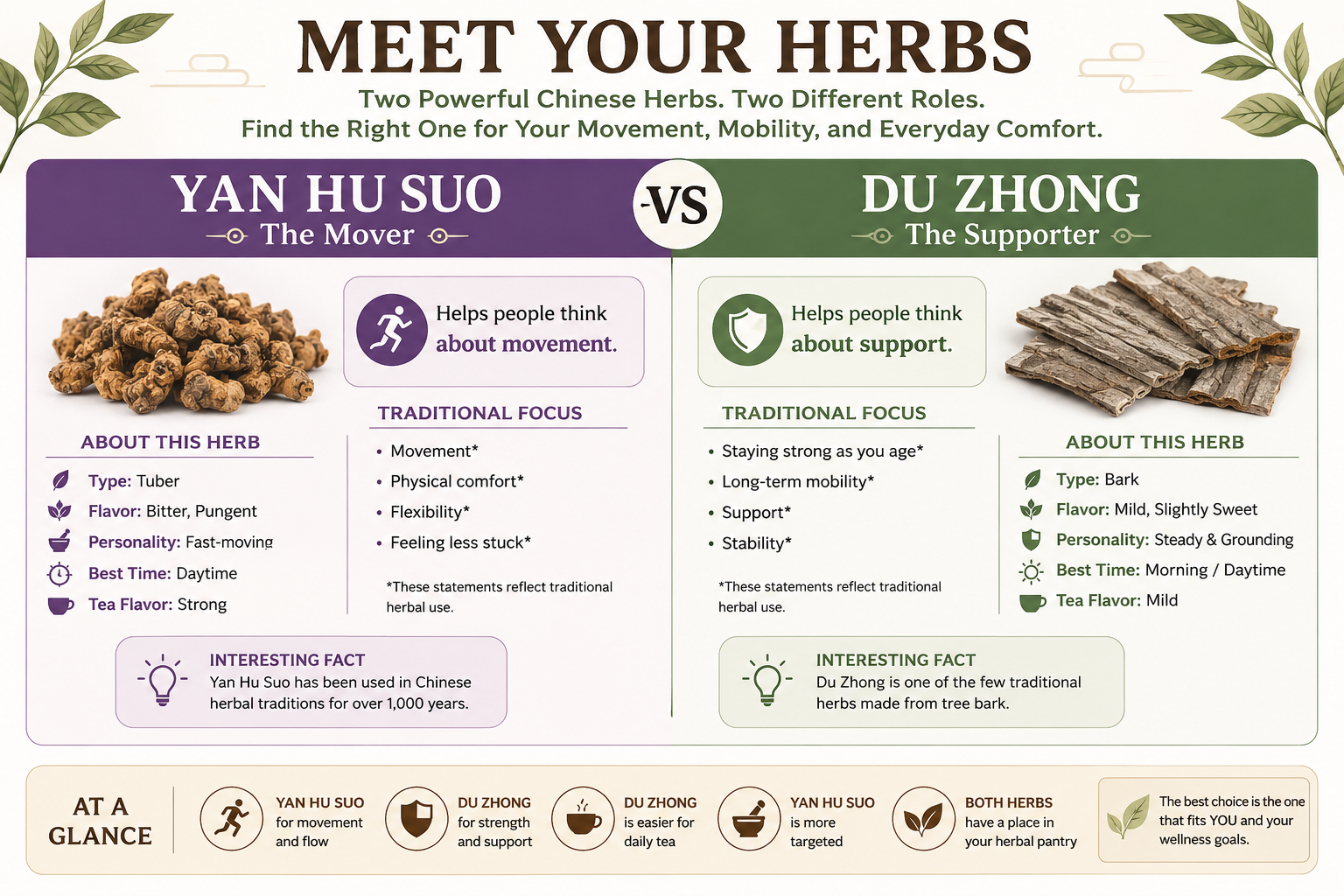
Yan Hu Suo helps people think about movement.
Du Zhong helps people think about support.
That one idea explains almost everything.
Yan Hu Suo is the herb people often explore when they feel:
Stiff. Tight. Achy. Stuck.
Du Zhong is the herb people often explore when they feel:
Weaker. Less stable. Worn down.
Less mobile than they used to be.
This is usually the “aha” moment. Where you go Yes! That is me.
Because most people instantly recognize themselves in one group.
Quick Comparison Chart
| Feature | Yan Hu Suo | Du Zhong |
|---|---|---|
| Common Name | Corydalis | Eucommia Bark |
| Herb Type | Tuber | Bark |
| Flavor | Bitter, pungent | Mild, slightly sweet |
| Personality | The Mover | The Supporter |
| Best For | Tightness & stiffness | Long-term support |
| Beginner Friendly | Moderate | Excellent |
| Daily Use | More targeted | Better for daily use |
| Tea Flavor | Strong | Mild |
| Best Time | Daytime | Morning/daytime |
Meet The Herbs
Yan Hu Suo — The Mover
If this herb were a person, it would be the one saying:
“Get up. Move. Let’s go.”
Yan Hu Suo is fast-moving in personality.
People who gravitate toward it are usually focused on:
-
movement
-
physical comfort
-
flexibility
-
feeling less stuck
Interesting fact:
Yan Hu Suo has been used in Chinese herbal traditions for over 1,000 years.
That kind of longevity says something.
Du Zhong — The Supporter
If Du Zhong were a person, it would be the calm, reliable one saying:
“Let’s build strength that lasts.”
Du Zhong feels steady.
Grounding.
Supportive.
People usually explore Du Zhong when thinking about:
-
staying active as they age
-
long-term mobility
-
support
-
stability
Interesting fact:
Du Zhong is one of the few traditional herbs made from tree bark.
That alone makes it unique.
Which Herb Sounds More Like You?
Choose Yan Hu Suo if you say:
-
“I feel stiff getting up.”
-
“I feel tight.”
-
“Movement feels harder.”
-
“I feel stuck.”
Choose Du Zhong if you say:
-
“I feel older than I used to.”
-
“I want to stay strong.”
-
“I want better long-term support.”
-
“I want to stay active.”
How To Use Each Herb
| Herb | Best Forms | How People Use It |
|---|---|---|
| Yan Hu Suo | Powder, capsules, granules | Usually targeted herbal use |
| Du Zhong | Tea, bark, decoction | Daily wellness routines |
How to Use Yan Hu Suo
-
Capsules
-
Powder
-
Granules
-
Extract
Usually not the first herb beginners brew as tea.
Flavor is strong.
How to Use Du Zhong
-
Tea
-
Decoction
-
Soup
-
Herbal formulas
Simple tea:
-
1 tbsp Du Zhong
-
2–3 cups water
-
Simmer 30–45 minutes
Which Tastes Better?
Du Zhong wins.
Yan Hu Suo is:
-
bitter
-
pungent
-
strong
Du Zhong is:
-
mild
-
earthy
-
slightly sweet
For daily drinking, Du Zhong is easier.
Which Herb Is Better For Beginners?
Why?
-
Easier to use
-
Better flavor
-
Easier tea
-
Better daily herb
Yan Hu Suo is more targeted.
When To Avoid These Herbs
| Herb | Use Caution If |
|---|---|
| Yan Hu Suo | Pregnancy, blood thinners, surgery, pain medications |
| Du Zhong | Pregnancy, blood pressure meds, chronic conditions |
Always consult your practitioner if:
-
pregnant
-
nursing
-
taking medications
-
managing chronic conditions
Final Comments
Choose Yan Hu Suo if your biggest concern is feeling stiff, tight, or stuck.
Choose Du Zhong if your goal is staying strong, supported, and active long term.
That’s the real difference.
Yan Hu Suo is about movement.
Du Zhong is about foundation.
One helps you think about getting moving.
The other helps you think about staying strong enough to keep moving.
And for many experienced herbal users?
The best answer isn’t one or the other.
It’s understanding where each herb fits in your herbal pantry.
Author
Sarah Johnson
Certified Herbalist | Founder, 1st Chinese Herbs
Trusted Since 1994
1st Chinese Herbs has spent more than 30 years helping customers understand traditional Chinese herbs, mushrooms, roots, berries, and botanical wellness products. They specialize in translating complex herbal information into practical, easy-to-understand guidance that helps customers choose the right herbs with confidence.
Our focus is simple: helping people buy better herbs, use them wisely, and feel confident in what they choose.
Medical Disclaimer:
This article is for educational purposes only and is not intended to diagnose, treat, cure, or prevent any disease. Always consult your healthcare provider before making changes to your diet, supplements, or wellness routine.
Last Updated: June 23, 2026
PubMed Research
Yan Hu Suo (Corydalis)
-
Analgesic alkaloids from Corydalis yanhusuo
Research highlights tetrahydropalmatine and other active compounds found in Yan Hu Suo that have been widely studied in traditional herbal medicine for movement and physical comfort.
View PubMed Study -
Corydalis yanhusuo and pain-related research review
This review examines traditional uses, phytochemistry, and major bioactive compounds of Yan Hu Suo.
View PubMed Review -
Pharmacological effects of Corydalis species
A review of Corydalis compounds and their applications in herbal medicine.
View PubMed Study
Du Zhong (Eucommia Bark)
-
Eucommia ulmoides Oliver: A systematic review
Comprehensive review covering traditional use, phytochemistry, and modern research on Du Zhong (Eucommia Bark).
View PubMed Review -
Traditional uses and bioactive compounds of Eucommia ulmoides
Research discusses lignans, iridoids, and flavonoids found in Du Zhong and their traditional applications.
View PubMed Study -
Eucommia ulmoides in traditional herbal medicine
A review of the plant’s traditional use and biological properties.
View PubMed Review