



Angelica Dahurica Root (Bai Zhi) — Organic Cut Form (1 lb)
Bai Zhi (Angelica dahurica root) is a classic herb in Traditional Chinese Medicine (TCM) used for pattern-based support related to the head, face, and nasal passages, especially when symptoms match traditional “wind” patterns.* It is also traditionally used in certain skin-focused strategies where dispersing and drying actions are appropriate.*
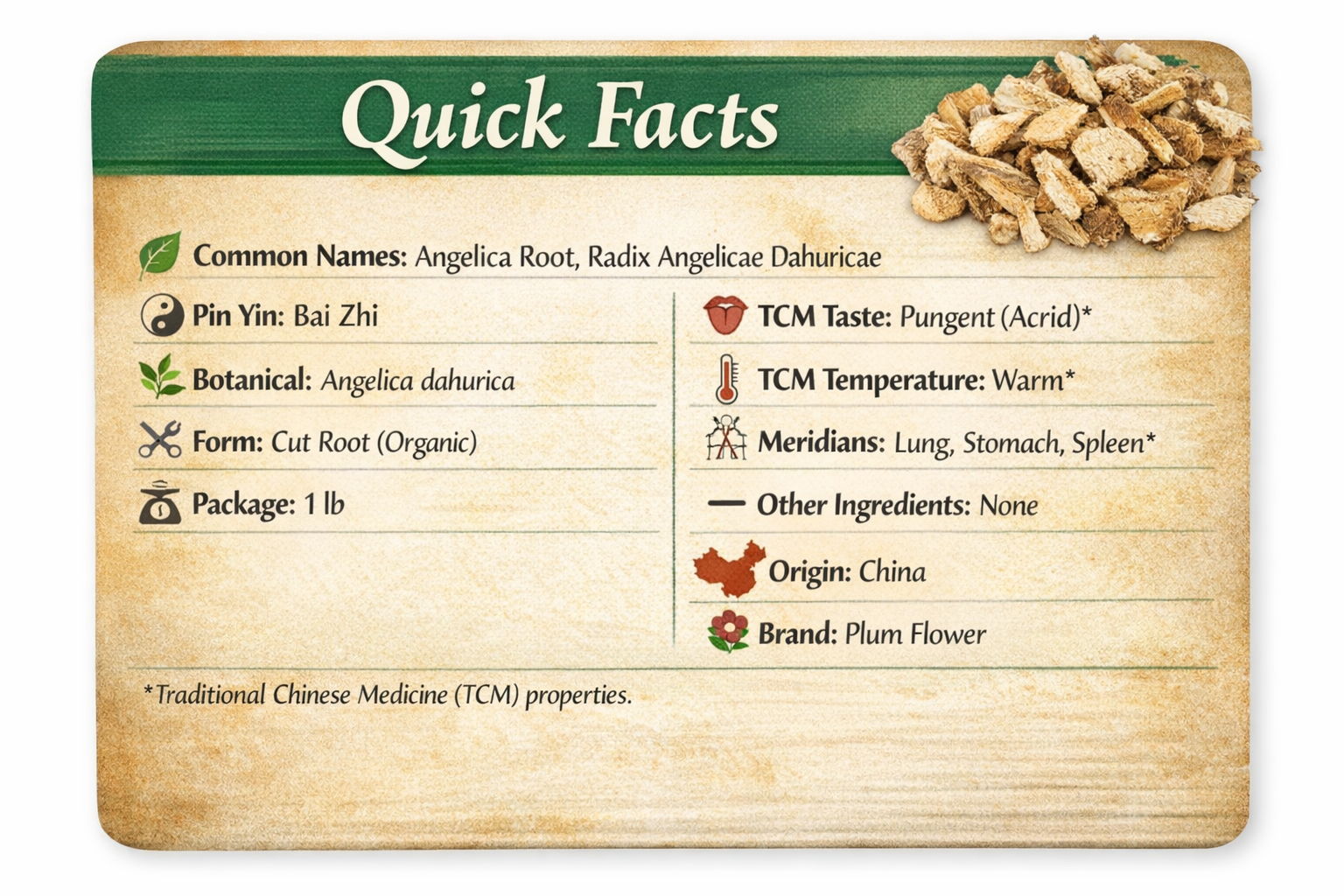
Quick Facts
- Common names: Angelica Root, Radix Angelicae Dahuricae
- Pin Yin: Bai Zhi
- Botanical: Angelica dahurica
- Form: Cut Root (Organic)
- Package: 1 lb
- TCM taste: Pungent (acrid)*
- TCM temperature: Warm*
- Meridians: Lung, Stomach, Spleen*
- Other ingredients: None
- Origin: China
- Brand: Plum Flower
*Traditional Chinese Medicine (TCM) properties.
First: Make Sure You’re Buying the Right “Angelica”
This is the most common online confusion: Bai Zhi is not the same herb as Dang Gui. They share the word “Angelica” in English, but they are used very differently in TCM.*
- Bai Zhi (Angelica dahurica): traditionally used for head/face wind patterns, nasal comfort, and certain skin strategies.*
- Dang Gui (Angelica sinensis): traditionally used more for blood nourishment and women’s pattern support.*
If you’re shopping for a head/face + nasal focused herb, you almost always mean Bai Zhi.
What Bai Zhi Is Used for in TCM (Pattern-Based)
In TCM language, Bai Zhi is described as an aromatic, dispersing root that helps “expel wind” and support normal flow in the head/face region.* This is why it appears so often in traditional strategies for nasal congestion discomfort and forehead-focused head tension patterns.*
Traditional functions commonly associated with Bai Zhi*
- Supports head and face comfort in wind patterns (especially when the forehead/nose feel “blocked”).*
- Aromatic support for nasal passages in traditional wind-cold / wind-damp presentations.*
- Supports normal swelling response in certain traditional external-use strategies.*
- Dries dampness (selective use) when dampness is part of the pattern and warmth/drying is appropriate.*
When People Choose Bai Zhi *
These are traditional pattern clues, not a diagnosis. If symptoms are severe, persistent, or unusual, get medical evaluation.
- Discomfort or pressure sensation is focused in the forehead/face.*
- The nose feels blocked, with a “stuffy head” feeling that matches wind-pattern language.*
- You want an herb that is aromatic and dispersing rather than heavy and sedating.*
Bai Zhi may not be a fit for everyone, especially if there are strong signs of dryness or “yin deficiency heat” pattern language.*
Bai Zhi Compared to Similar Herbs (Quick Decision Guide)
| Goal shoppers often have | Why Bai Zhi is considered (TCM logic)* | Common pairing ideas* |
|---|---|---|
| Nasal congestion comfort | Aromatic, dispersing support for head/face wind patterns* | Cang Er Zi, Xin Yi, Ju Hua* |
| Forehead-focused head tension | Traditionally discussed for head/face region patterns* | Chuan Xiong* |
| Wind-damp heaviness/achy feeling | Used in strategies where damp + wind pattern cues are present* | Qiang Huo, Fang Feng* |
| Skin comfort strategies | Traditional external-use history in swelling/discomfort patterns* | Practitioner-guided combinations* |
*Traditional pattern language. Not medical claims.
How to Use Bai Zhi (Cut Root)
Beginner Decoction Method (Most Common)
- Quick rinse the cut root.
- Add to a pot with 3–4 cups of water.
- Bring to a gentle boil, then simmer 20–30 minutes.
- Strain and use as directed by a qualified practitioner.
Traditional amounts vary widely depending on the formula and the person. If you take prescription medications, are pregnant/nursing, or manage a chronic condition, consult a qualified professional before use.
Topical Use (Traditional Practice Note)*
Bai Zhi appears in traditional external-use strategies where dispersing and drying actions are desired.* If you use it topically, patch test first and avoid eyes, mucous membranes, and broken skin unless guided by a professional.
Storage
Store sealed, cool, and dry. Aromatic roots keep their character longer in an airtight container away from heat and moisture.
Taste & Smell
Bai Zhi is strongly aromatic—rooty, fragrant, and noticeably pungent. In tea it can taste acrid/warming, with a slightly bitter edge for some people. If you’re sensitive to strong herbs, it’s often best used in a balanced formula rather than alone.*
What’s Inside (Naturally Occurring Components)
Constituent lists are provided for educational purposes and do not imply medical outcomes.
Commonly referenced components include coumarins and related compounds such as: Byak-angelicin, Byak-angelicol, Oxypeucedanin, Phellopterin, and other coumarin/furocoumarin constituents, plus plant sterols (e.g., stigmasterol) and volatile aromatic compounds.
Why Buy Bai Zhi from 1st Chinese Herbs?
- Organic cut root (easy for decoction)
- Single-ingredient (no fillers or additives)
- Plum Flower brand with quality and manufacturing controls
- Helpful support if you have questions about preparation and storage
Frequently Bought Together (Head/Face & Nasal Pairings)*
- Cang Er Zi and Xin Yi (classic head/face nasal pairing ideas)*
- Ju Hua (often used in head/eye comfort strategies depending on pattern)*
- Chuan Xiong (commonly paired for head pattern support)*
- Qiang Huo or Fang Feng (wind-damp pattern strategies)*
- Xi Xin (special safety considerations; use only under professional direction)*
Learn methods: How to Use Bulk Herbs
Cautions & Who Should Avoid Bai Zhi
- Do not use if pregnant or nursing unless directed by a qualified professional.
- TCM caution: Often cautioned in “yin deficiency with heat / blood heat” pattern language due to its warm/drying nature.*
- Use caution if you are prone to significant dryness unless guided by a practitioner.
- Medication check: If you take prescription medications or have medical conditions, consult a clinician/pharmacist.
- Sun sensitivity note: Some plants containing furocoumarins may increase sun sensitivity in some people. If you notice unusual sensitivity, discontinue and consult a professional.
California Prop 65 notices may appear on botanical products sold in California. If you have questions about testing standards or sourcing, contact us.
Disclaimer: These statements have not been evaluated by the Food and Drug Administration. This product is not intended to diagnose, treat, cure, or prevent any disease.
FAQ
Is Bai Zhi the same as Dang Gui?
No. Bai Zhi is Angelica dahurica. Dang Gui is Angelica sinensis. They are different herbs with different traditional uses.
Is Bai Zhi best for frontal headaches?
Bai Zhi is commonly discussed in TCM for patterns affecting the forehead/face area.* Pattern match matters, and head discomfort can have many causes.
Can I use Bai Zhi by itself?
It can be used alone, but it’s often used in formulas for better balance and a clearer pattern match.*
How long do I simmer Bai Zhi?
20–30 minutes is a common decoction simmer time. Some practitioners adjust timing depending on the full formula.
How do I know if my Bai Zhi is fresh?
Freshness often shows up as a strong aroma and a clean, non-musty smell. Store sealed, cool, and dry to preserve quality.
Can I grind the cut root into powder?
Some people do, but dosing and suitability vary. Practitioner guidance is recommended.
Related Links
- How to Use Bulk Herbs
- Common Mistakes (and how to fix them)
- Contact Us
- Free Ebook: 10 Vital Medicinal Herbs That Work
About Our Content
About Our Content We create product education to help customers shop confidently and use bulk herbs responsibly. Our content focuses on traditional herbal pattern language, preparation methods, and quality considerations.
Experience: Bulk herb retail + customer education
Expertise: TCM pattern-based explanations (not medical diagnosis)
Authoritativeness: Clear sourcing/manufacturing notes and references
Trust: Safety-first language, transparent product specs, and contact support
Disclaimer: These statements have not been evaluated by the Food and Drug Administration. This product is not intended to diagnose, treat, cure, or prevent any disease.
Traditional Chinese Herbs
Chinese Traditional herbs should be regarded as an added feature to modern western healthcare, and not as a replacement. Chinese traditional herbs (Teas) emphasize harmony, and balance.
Reference:
alternativehealing.org
https://www.americandragon.com/Individualherbsupdate/BaiZhi.html
https://www.ncbi.nlm.nih.gov/pmc/articles/PMC9283917/
https://en.wikipedia.org/wiki/Angelica_dahurica