


Bai Zi Ren (Platycladi Semen): Calm the Shen, Moisten Dryness, Storage & Research
Bai Zi Ren (also called Biota Seed or Platycladi Semen) is an oil-rich seed used in Traditional Chinese Medicine (TCM) for its classic role in calming the Shen (the mind/spirit in TCM language) and gently addressing dryness patterns. T
Quick Answer: Why Bai Zi Ren Matters in TCM
In TCM, Bai Zi Ren is important because it is traditionally used to nourish the Heart, calm the Shen, and moisten the intestines. This matters most when restlessness and “dryness-type” patterns show up together (traditional framework language).
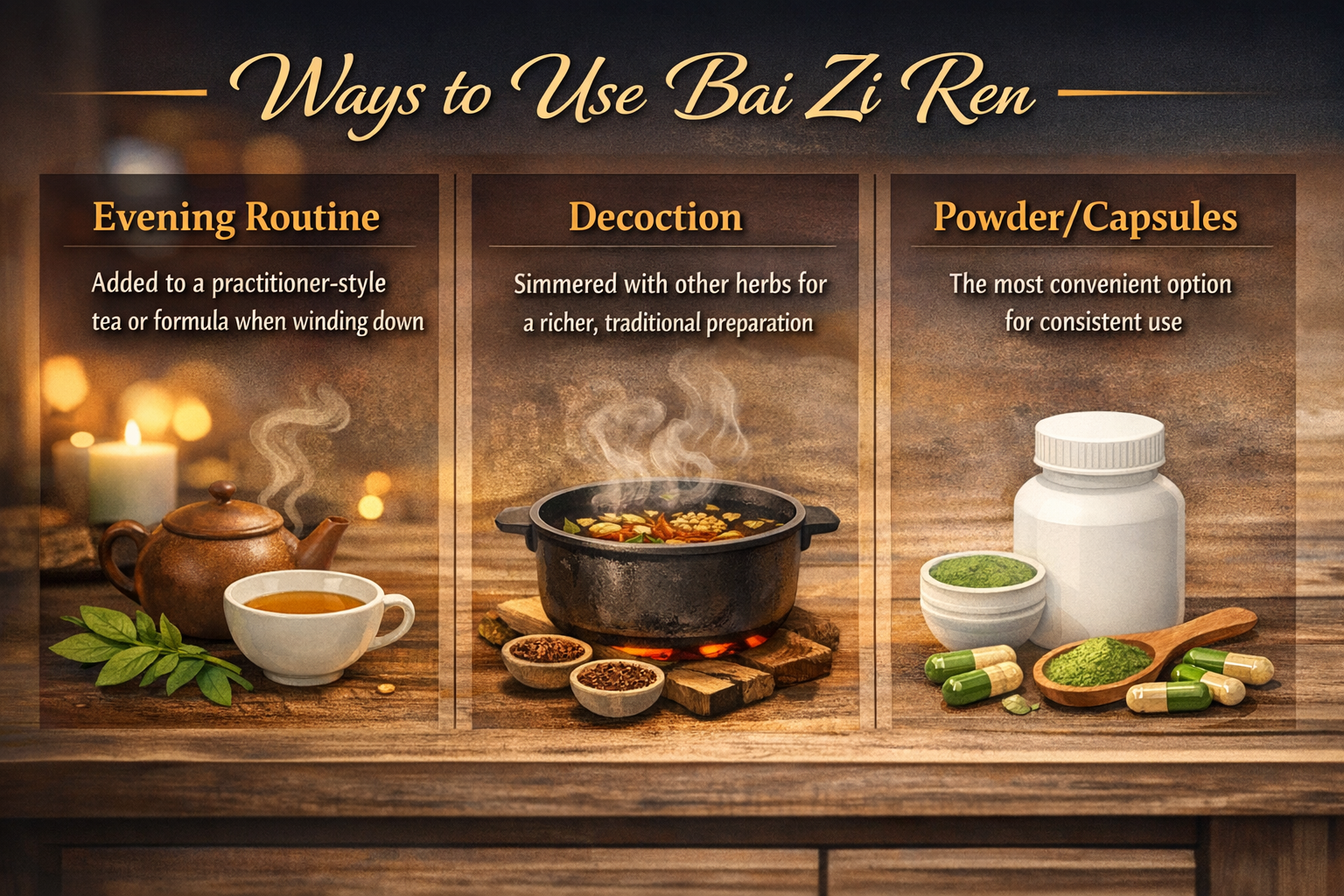
How Customers Use Bai Zi Ren
- Evening routine: added to a practitioner-style tea or formula when winding down
- Decoction: simmered with other herbs for a richer, traditional preparation
- Powder/capsules: the most convenient option for consistent use
- Dryness support: used in formulas when “dry-type” irregularity is part of the picture (traditional language)
Tip: Bai Zi Ren is oil-rich—quality storage matters more than people expect (see Storage section below).
Quick Facts
What Is Bai Zi Ren?
Bai Zi Ren refers to the dried seed used in Chinese herbal practice commonly labeled as Platycladi Semen. It appears in traditional herb texts as a calming and nourishing seed that also supports dryness patterns (traditional framework language).
Plain-English summary: It’s often chosen when someone wants a more “nourishing calm” approach rather than something that feels harsh, stimulating, or overly drying. And because it’s naturally oil-rich, it also has a classic role in formulas used when dryness is part of the picture.
What Is the Importance of Bai Zi Ren in TCM?
1) It’s a classic “Calm the Shen” herb (traditional framework)
In TCM language, the “Shen” is associated with the mind/spirit. When the Shen feels unsettled, people may describe difficulty relaxing, feeling mentally “wired,” or having an overactive mind at night. Bai Zi Ren is traditionally categorized among herbs that calm the Shen while also nourishing—a combination that makes it a staple in many classic calming formulas.
2) It supports dryness patterns—especially when calm + moisture are both needed
Bai Zi Ren’s naturally oil-rich nature makes it well known in traditional practice for its role in moistening the intestines (traditional phrase). This becomes relevant when dryness shows up alongside restlessness—one of the reasons it’s considered especially “useful” compared to single-purpose calming herbs.
3) It’s a practical seed that fits modern routines
People don’t always have time for long cooking. Bai Zi Ren is commonly used in modern formats (granules/capsules) while still fitting traditional strategy. A high-trust page explains this clearly: you can respect tradition and make it doable.
What Matters
1) Quality and storage: oil-rich seeds can degrade faster
Because Bai Zi Ren is oil-rich, it is more sensitive to heat, humidity, and long storage than many dry roots or barks. Research has documented that Platycladi Semen can be susceptible to fungal contamination and potential aflatoxin issues under unsuitable storage conditions. This doesn’t mean “panic”—it means store it correctly and buy from sources that take quality seriously.
2) Confusion around names and plant labeling
You’ll see multiple labels in commerce (Biota/Platycladus terminology). A trustworthy page explains that naming conventions can vary across supply chains, and the important point is the correct part used (seed) and proper handling.
Comparison Mini-Grid: Bai Zi Ren vs Suan Zao Ren vs Yuan Zhi
| Herb | Traditional “Job” (TCM Language) | Best Fit (Plain English) | What Customers Notice | Common Cautions |
|---|---|---|---|---|
| Bai Zi Ren (Platycladi Semen) |
Calms the Shen; nourishes Heart; moistens intestines | When you want “nourishing calm” + dryness support (traditional framework) | Often chosen as a gentle evening-support seed; oil-rich feel | Avoid with loose stools / heavy phlegm patterns; storage quality matters |
| Suan Zao Ren (Ziziphi Spinosae Semen) |
Nourishes Heart; calms Shen; supports sleep rhythm (traditional) | Most famous “sleep-support seed” in classic TCM strategy | Commonly used as the “go-to” seed in calming formulas | May not fit very “damp/heavy” digestion patterns without modification |
| Yuan Zhi (Polygala Root) |
Transforms phlegm; opens the orifices; calms Shen (traditional) | When the mind feels “foggy” or cluttered and phlegm is part of the picture (traditional) | Often used in formulas supporting clarity + calm | Can irritate sensitive stomachs; use clinician guidance |
How to Use Bai Zi Ren
Bai Zi Ren is used in multiple formats. The best option depends on your schedule, your digestion sensitivity, and whether you’re following a practitioner’s plan. We do not publish medical dosing; follow professional guidance for personalized use.
Option 1: Tea-style steep (lighter, ritual-friendly)
- Use as directed by a practitioner or product label.
- This approach is typically milder than simmering.
- Best for customers who want an easy evening routine.
Option 2: Decoction (traditional simmer)
- Simmer with other herbs in a formula per practitioner instructions.
- Often used when the goal is a deeper, more traditional preparation.
- Strain and consume as directed.
Option 3: Capsules / powder / granules (most convenient)
- Best for consistent use without cooking.
- Helpful for travel, work schedules, and customers who want repeatable routine.
Storage & Freshness: The Most Important Tip for Bai Zi Ren
Bai Zi Ren is oil-rich. That’s part of why it’s valued traditionally—but it also means storage matters. Research has discussed susceptibility to fungal contamination and aflatoxin risk in Platycladi Semen under inappropriate humidity/temperature conditions. The practical takeaway is simple: keep it dry, cool, and sealed.
Best storage practices
- Airtight container (keep moisture out).
- Cool, dark place away from heat sources.
- Avoid humidity (don’t store next to stove, dishwasher, or in steamy bathrooms).
- Long-term storage: refrigeration can help preserve freshness in humid climates.
- Check aroma: if it smells rancid or “off,” don’t use it.
Cautions & Interactions
Use professional guidance if you take medications (especially sedatives, psychiatric medications, blood pressure medications, or multiple prescriptions).
- Pregnant or nursing: avoid unless directed by a qualified clinician.
- Loose stools / diarrhea: traditionally avoided when stools are already loose.
- “Phlegm-heavy” patterns (traditional): some practitioners avoid or modify use in heavy phlegm/damp presentations.
- Allergies: discontinue if allergic symptoms occur.
- Quality and storage matter: oil-rich seeds should be stored properly to reduce spoilage risk.
Note: “Traditional incompatibilities” (e.g., with Ju Hua) are discussed in some traditional sources. When in doubt, follow practitioner guidance rather than DIY combining.
FAQs
Is Bai Zi Ren the same as arborvitae seed?
Yes—Bai Zi Ren is commonly translated as arborvitae seed / biota seed / Platycladi Semen. Naming can vary across suppliers; what matters is correct herb ID and the seed part.
What does Bai Zi Ren taste like?
Many people describe it as mild and seed-like. Taste can vary by processing and freshness. Oil-rich seeds stored poorly may develop an “off” odor or taste—store airtight and dry.
What is Bai Zi Ren used for in TCM?
Traditionally it is used to calm the Shen, nourish the Heart, and moisten dryness patterns (traditional language). It is often included in formulas rather than used alone.
Bai Zi Ren vs Suan Zao Ren—what’s the difference?
Both are famous calming seeds in TCM strategy, but they are not identical. Suan Zao Ren is often the most commonly discussed “sleep-support seed,” while Bai Zi Ren is especially known for calming plus moistening dryness patterns.
How should I store Bai Zi Ren?
Airtight, cool, dry, away from humidity and heat. Because it is oil-rich, long storage in warm/humid conditions can reduce quality. Refrigeration can help for long-term storage.
Who should avoid Bai Zi Ren?
Common cautions include pregnancy/nursing without supervision, active loose stools/diarrhea, and situations where a clinician advises against calming herbs due to medication interactions.
About the Author
Sarah Johnson is part of the family team behind 1st Chinese Herbs (trusted since 1994). consumer-first herbal education that clearly separates traditional use (TCM framework) from modern research. We prioritize primary sources (PubMed/PMC when possible), practical “how to use” guidance, and quality/storage education customers rarely get elsewhere.
Last updated: January 16, 2026
Our Quality Promise
- We partner with suppliers that follow current Good Manufacturing Practices (cGMP).
- We prioritize ethically sourced herbs and transparent handling practices.
- We focus on customer safety education (storage, cautions, realistic expectations).
Reference:
PubMed
The studies below are provided for educational purposes only. Many studies evaluate extracts, isolated compounds, or preclinical models. They should not be interpreted as proof that a retail product will produce specific outcomes.
Platycladi Semen anxiolytic mechanisms (metabolomics + network pharmacology): PubMed: 37201666
Platycladus orientalis seed extract and neurotransmitter-related pathways (preclinical): PubMed: 35489661
Microbiome + potential aflatoxin contamination concerns in Platycladi Semen (storage relevance): PubMed: 33193220 | PMC full text
Fungal contamination research in Platycladi Semen (quality-control relevance): PubMed: 33645054
Broader aflatoxin contamination context in herbal materials (includes Platycladi Semen): PMC full text
Related seed commonly compared by customers (Suan Zao Ren) – evidence review: PubMed: 37014010 | PMC full text
"The Effect of Biota Orientalis Extract on Anxiety and Sleep": This study explores how extracts from Bai Zi Ren can help alleviate anxiety and improve sleep quality among participants.
"Bioactive Compounds in Bai Zi Ren and Their Implications for Health": This research article analyzes the bioactive components found in Bai Zi Ren and discusses their potential health benefits, including sedative effects.
"Evaluation of Heart-Healthy Benefits of Biota Seed": This research investigates how Bai Zi Ren may contribute to heart health through its effects on blood pressure and cholesterol levels.
"Clinical Evaluation of Bai Zi Ren on Insomnia Patients: A Randomized Controlled Trial": A clinical trial assessing the effectiveness of Bai Zi Ren in treating insomnia compared to a placebo, providing insights into its safety and efficacy in a controlled environment.
"Traditional Uses and Modern Research on Bai Zi Ren": This review covers the various traditional applications of Bai Zi Ren alongside modern scientific findings that validate its use in herbal medicine.