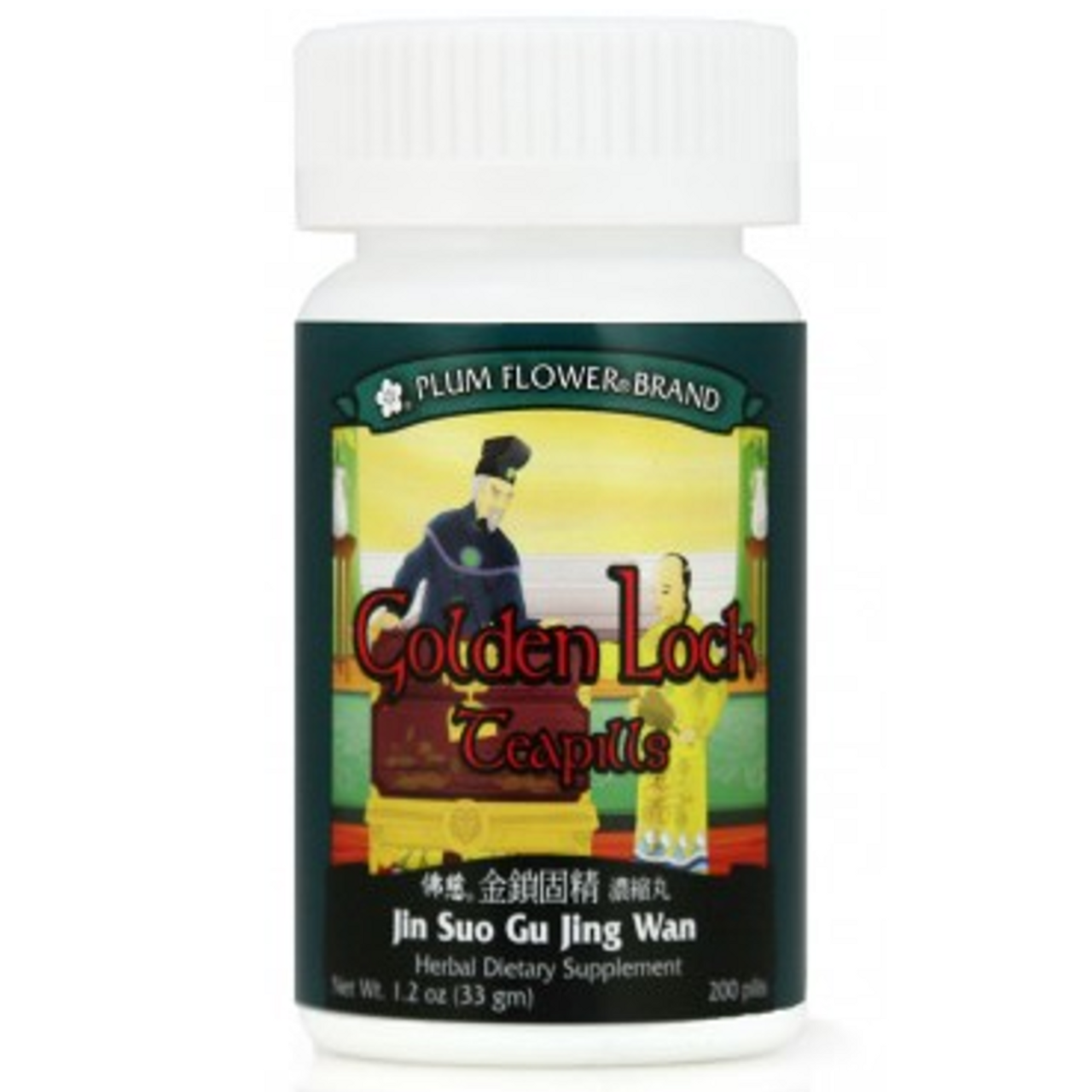


Golden Lock Teapills – Jin Suo Gu Jing Wan – Plum Flower – 200 Pills
Traditional Chinese Herbal Formula | Jin Suo Gu Jing Wan (金鎖固精丸)
Golden Lock Teapills, traditionally known as Jin Suo Gu Jing Wan, are a six-ingredient Chinese herbal formula traditionally used within TCM when the Kidney's ability to secure and contain Jing (Essence) is considered insufficient.
The name “Golden Lock” describes the traditional strategy of the formula: strengthening and stabilizing while helping the body hold onto what TCM describes as valuable Essence and fluids.
Unlike a general Kidney-tonic formula, Jin Suo Gu Jing Wan has a more specific traditional purpose. It combines nourishing and supporting ingredients with strongly astringent ingredients traditionally used to secure, stabilize, and prevent unwanted leakage.
What Are Golden Lock Teapills?
Golden Lock Teapills are the Plum Flower version of Jin Suo Gu Jing Wan, a traditional Chinese herbal formula.
In Traditional Chinese Medicine, the Kidneys are associated with storing Jing, often translated into English as Essence.
Jing is a TCM concept and should not be confused with a specific hormone, nutrient, or substance recognized by modern medicine.
When the Kidney's traditional function of storing and securing is considered weak, a TCM practitioner may describe the pattern as Kidney Qi not firm or an inability to secure Essence.
Jin Suo Gu Jing Wan was traditionally formulated around that concept.
Rather than simply adding stronger tonic herbs, Golden Lock combines herbs and mineral ingredients with astringent and stabilizing properties. This gives the formula its characteristic “locking” or securing strategy.
Why Is It Called “Golden Lock”?
The name actually tells you quite a bit about the formula.
Jin (金) means gold or metal.
Suo (鎖) means lock.
Gu (固) means to secure, consolidate, or stabilize.
Jing (精) means Essence.
Wan (丸) means pill.
So Jin Suo Gu Jing Wan is commonly translated as Golden Lock Pill to Secure the Essence or Metal Lock Pill to Stabilize the Essence.
The “lock” is not literal. It is a traditional metaphor describing the formula's astringent and securing strategy.
What Does “Jing” or “Essence” Mean in TCM?
This is an important distinction because the word Essence can be confusing when translated into English.
Within Traditional Chinese Medicine, Jing is a foundational concept associated with the Kidneys, development, maturation, reproduction, and constitutional reserves.
It is part of the theoretical framework of TCM rather than a substance that can be measured through a standard laboratory test.
Therefore, when traditional sources say that Golden Lock “secures Jing” or “secures Essence,” they are describing the formula according to traditional Chinese medical theory, not claiming that the product changes a particular hormone or laboratory value.
Golden Lock Teapills Product Details
Brand: Plum Flower®
Chinese Name: 金鎖固精丸
Pin Yin: Jin Suo Gu Jing Wan
English Name: Golden Lock Teapills
Form: Traditional Chinese teapills
Bottle Size: 200 pills
Suggested Use: 8 pills, 3 times daily, or as directed by your healthcare practitioner
Origin: China
What Are the Ingredients in Golden Lock Teapills?
Plum Flower Golden Lock contains six principal ingredients:
| Pin Yin | Ingredient | Botanical / Material Name | Traditional Role in the Formula |
|---|---|---|---|
| Lian Zi | Lotus Seed | Nelumbo nucifera seed | Traditionally associated with strengthening the Spleen and Kidney while helping secure Essence. |
| Qian Shi (Fu) | Euryale / Fox Nut Seed | Euryale ferox seed, bran-fried | Traditionally used to support the Spleen and Kidney and provide an astringent, stabilizing action. |
| Lian Xu | Lotus Stamen | Nelumbo nucifera stamen | Traditionally valued for its astringent quality and its role in securing Essence. |
| Sha Yuan Zi (Yan) | Flatstem Milkvetch Seed | Astragalus complanatus seed, salt-fried | Traditionally associated with supporting the Kidney and securing Essence. |
| Mu Li (Duan) | Oyster Shell | Ostrea gigas shell, toasted | A mineral ingredient traditionally used for its heavy, anchoring and astringent properties. |
| Long Gu (Duan) | Long Gu Mineral | Os draconis mineral, toasted | Traditionally used as an anchoring and astringent ingredient in Chinese herbal formulas. |
Other Ingredients
Maltose, hydrated magnesium silicate, activated carbon, and China wax.
Allergen Information
Contains wheat.
The Qian Shi (Euryale ferox) used in this formula is processed with wheat bran.
How Do the Six Ingredients Work Together Traditionally?
Golden Lock Teapills combine ingredients traditionally associated with supporting, consolidating, astringing, anchoring, and securing. Each ingredient has a different role within the overall TCM strategy of Jin Suo Gu Jing Wan.
| Ingredient | Traditional Role | How It Fits the Formula |
|---|---|---|
| Sha Yuan Zi – Flatstem Milkvetch Seed | Support & Secure | Traditionally associated with supporting the Kidney while helping secure Jing (Essence). It gives the formula a supportive component rather than relying on astringent ingredients alone. |
| Lian Zi – Lotus Seed | Strengthen & Stabilize | Traditionally associated with strengthening the Spleen and Kidney while helping secure Essence. It contributes both supportive and astringent qualities. |
| Qian Shi – Euryale Seed | Reinforce & Consolidate | Traditionally used to support the Spleen and Kidney while helping consolidate and secure. Its combination of nourishing and astringent qualities complements Lian Zi. |
| Lian Xu – Lotus Stamen | Astringe & Secure | Traditionally valued for its astringent qualities and its role in securing Essence. Although it comes from the same lotus plant as Lian Zi, the stamen is considered a separate herbal material in Chinese herbalism. |
| Mu Li – Toasted Oyster Shell | Anchor & Astringe | Traditionally used for its heavy, anchoring and astringent qualities. It adds a mineral component to the formula's securing strategy. |
| Long Gu – Toasted Os Draconis Mineral | Anchor & Stabilize | Traditionally used as a heavy, anchoring and astringent ingredient. It works alongside Mu Li to reinforce the formula's stabilizing character. |
The Formula Strategy
Rather than having six ingredients performing the same job, Jin Suo Gu Jing Wan combines several complementary traditional actions:
Support → Strengthen → Consolidate → Astringe → Anchor → Secure
This helps explain the name Golden Lock. The traditional formula is designed around supporting the underlying system while simultaneously helping stabilize and secure Jing (Essence) according to TCM theory.
Lotus Seed vs. Lotus Stamen: Why Does Golden Lock Contain Both?
Golden Lock contains two ingredients from Nelumbo nucifera, the sacred lotus:
Lian Zi is the seed.
Lian Xu is the stamen of the flower.
They are not duplicate ingredients.
Traditional Chinese herbalism distinguishes different parts of the same plant because each may have different properties and applications.
In Jin Suo Gu Jing Wan, lotus seed contributes both supportive and astringent qualities, while lotus stamen is particularly associated with the formula's securing strategy.
What Is Qian Shi?
Qian Shi is the seed of Euryale ferox, sometimes called fox nut, Euryale seed, or gorgon fruit seed.
It has been used as both a food and traditional herbal ingredient in Asia for centuries.
In Chinese herbalism, Qian Shi is traditionally associated with the Spleen and Kidney and is valued for its combination of nourishing and astringent characteristics.
The Qian Shi in this particular Plum Flower formula is bran-fried, which is why customers with wheat allergies or sensitivities should pay attention to the allergen statement.
What Are Mu Li and Long Gu?
These two ingredients frequently cause confusion because they are not botanical herbs.
Mu Li – Oyster Shell
Mu Li is oyster shell. Plum Flower uses toasted Ostrea gigas shell in Golden Lock.
In TCM, processed oyster shell is traditionally classified as a heavy mineral substance with anchoring and astringent properties.
Long Gu – Traditional Mineral Ingredient
Long Gu literally translates as “dragon bone,” but the name comes from traditional Chinese materia medica terminology.
The Plum Flower ingredient specification identifies it as Os draconis mineral.
It is traditionally used in formulas for its heavy, anchoring and astringent qualities.
Neither ingredient is included simply as a source of dietary minerals. Their inclusion reflects the traditional formulation principles behind Jin Suo Gu Jing Wan.
Golden Lock Is Not Simply a General Kidney Tonic
This distinction matters when comparing Chinese formulas.
Many traditional formulas involve the Kidney system, but that does not make them interchangeable.
Golden Lock is specifically constructed around the TCM strategy of:
Stabilizing → Astringing → Securing
rather than simply:
Tonifying → Nourishing → Replenishing
That difference is one reason it is important to choose Chinese formulas according to their traditional pattern and formulation rather than purchasing every product containing the word “Kidney” as though they serve the same purpose.
How Do You Take Golden Lock Teapills?
The manufacturer's standard dosage is:
8 teapills, 3 times per day, or as directed by your healthcare practitioner.
Each bottle contains 200 teapills.
At the standard label dosage of 24 pills per day, one bottle contains approximately 8 days of use.
Teapills are swallowed with water. They do not need to be brewed or prepared as tea.
If you have a sensitive stomach, discuss the most appropriate way to take herbal products with your healthcare practitioner.
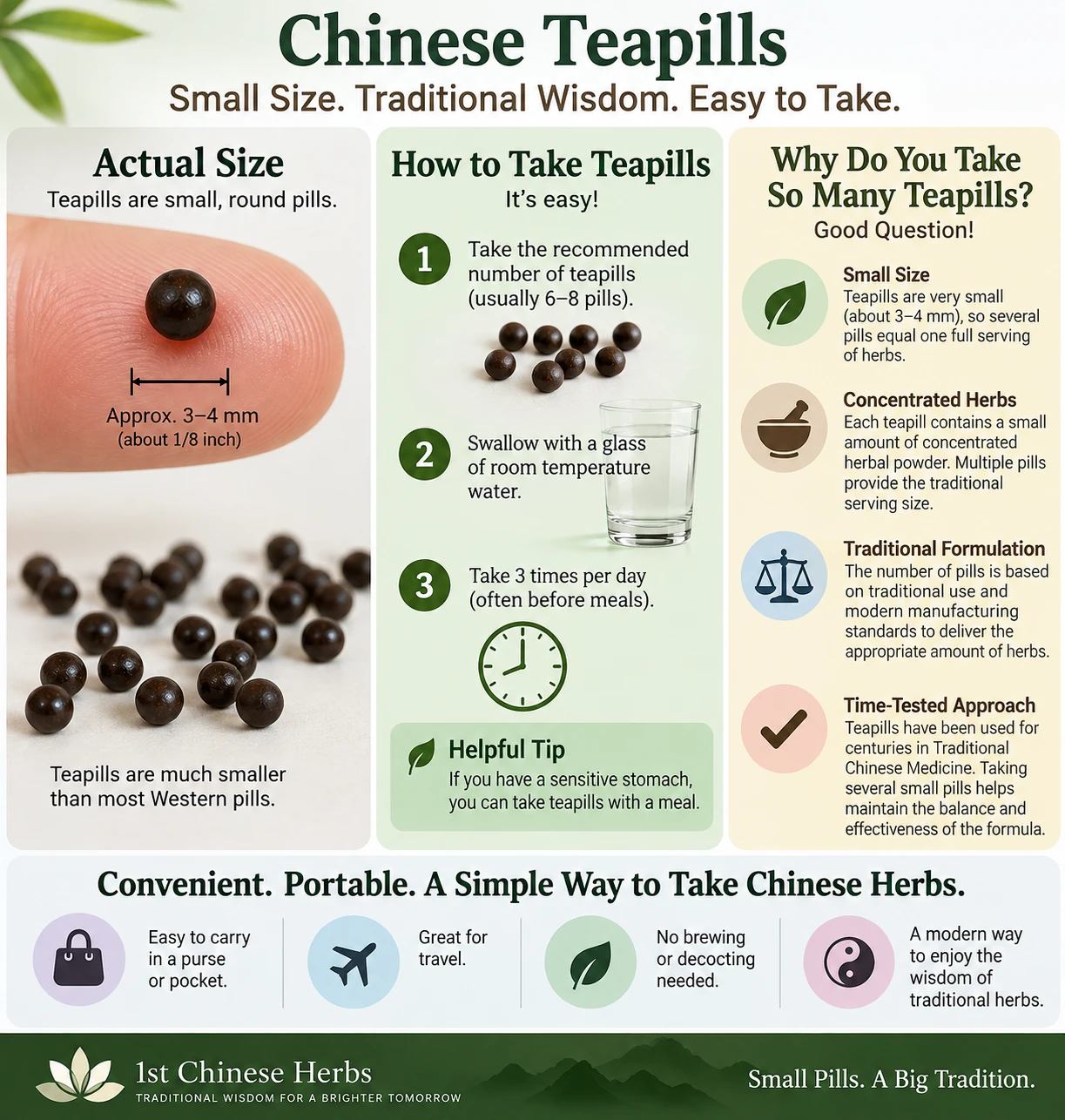 Why Are They Called Teapills?
The term can be confusing because teapills are not tea bags and are not brewed in a cup.
Teapills are small prepared pills containing a traditional Chinese herbal formula. They offer a convenient alternative to preparing a traditional raw-herb decoction.
Golden Lock Teapills can therefore be taken directly according to the bottle directions without simmering herbs for an extended period.
Who Should Be Careful With Golden Lock Teapills?
Do not use if pregnant or nursing.
This product contains wheat because one ingredient is processed with wheat bran.
Consult your physician, pharmacist, qualified herbalist, or other healthcare professional before using this product if you:
-
Take prescription medications
-
Have a medical condition
-
Are preparing for surgery
-
Have a known wheat allergy or sensitivity
-
Are uncertain whether Jin Suo Gu Jing Wan matches your traditional TCM pattern
Traditional formulas containing strongly astringent ingredients are not automatically appropriate simply because someone recognizes one symptom associated with their historical use. A qualified practitioner can help determine whether the traditional pattern matches the formula.
Modern Research on Ingredients in Golden Lock
Modern scientific research and Traditional Chinese Medicine use different frameworks.
The following PubMed research is provided so customers can learn more about botanical ingredients found in this formula.
Lotus – Nelumbo nucifera
A comprehensive scientific review discusses the traditional uses, chemical constituents, nutritional properties, and pharmacological research involving different parts of Nelumbo nucifera.
PubMed PMID: 30633540
https://pubmed.ncbi.nlm.nih.gov/30633540/
Another updated review examines the chemical composition, nutritional value, and pharmacological research involving Nelumbo nucifera.
PubMed PMID: 38327030
https://pubmed.ncbi.nlm.nih.gov/38327030/
Qian Shi – Euryale ferox
A review examines the ethnopharmacology, traditional use, phytochemistry, and modern pharmacological research involving Euryale ferox.
PubMed PMID: 37298878
https://pubmed.ncbi.nlm.nih.gov/37298878/
Another scientific review examines the nutritional and pharmaceutical characteristics of Euryale ferox seed.
PubMed PMID: 36183158
https://pubmed.ncbi.nlm.nih.gov/36183158/
Research note: These references concern individual botanical ingredients. They should not be interpreted as clinical evidence that the finished Jin Suo Gu Jing Wan formula diagnoses, treats, cures, or prevents a disease.
Frequently Asked Questions About Golden Lock Teapills
What is the Chinese name for Golden Lock Teapills?
The traditional Chinese name is 金鎖固精丸, transliterated as Jin Suo Gu Jing Wan.
What does Jin Suo Gu Jing Wan mean?
It is commonly translated as Golden Lock Pill to Secure the Essence or Metal Lock Pill to Stabilize the Essence. The name describes the traditional TCM strategy of consolidating and securing Jing.
What is Jing?
Jing, commonly translated as Essence, is a concept within Traditional Chinese Medicine associated with the Kidney system, constitutional reserves, development, maturation and reproduction. It is a traditional theoretical concept rather than a substance measured by a conventional laboratory test.
How many ingredients are in Golden Lock Teapills?
There are six principal ingredients: Lian Zi, Qian Shi, Lian Xu, Sha Yuan Zi, Mu Li and Long Gu.
Why does Golden Lock contain two lotus ingredients?
Lian Zi is lotus seed, while Lian Xu is lotus stamen. Traditional Chinese herbalism treats different plant parts as distinct herbal materials with different traditional applications.
Does Golden Lock contain oyster shell?
Yes. The Plum Flower formula contains toasted Ostrea gigas shell, traditionally known as Mu Li.
Does Golden Lock contain wheat?
Yes. Qian Shi is processed with wheat bran, so the manufacturer identifies wheat as an allergen.
Are Golden Lock Teapills brewed like tea?
No. Teapills are swallowed with water according to the product directions. They do not require brewing.
Can Golden Lock Teapills be taken during pregnancy?
No. The product caution states do not use during pregnancy or while nursing.
Why Buy Golden Lock Teapills From 1st Chinese Herbs?
At 1st Chinese Herbs, we believe a traditional Chinese formula deserves more explanation than a product name and ingredient list.
We have specialized in Chinese and Western herbs since 1994. Our goal is to help customers understand what they are purchasing by providing botanical identification, traditional TCM information, ingredient details, safety information, and educational research resources.
Trusted Since 1994
Lab-Tested Herbal Products
Ships From Washington State
Free U.S. Shipping on Qualifying Orders
Questions about Golden Lock Teapills? Contact us before ordering. Understanding the traditional purpose and ingredients of a formula is an important part of choosing Chinese herbal products.
California Proposition 65 Information
California Proposition 65 Warning: Consuming this product can expose you to chemicals, including lead, which are known to the State of California to cause cancer and birth defects or other reproductive harm.
Official California Proposition 65 Website:
https://www.p65warnings.ca.gov/
Learn More About Proposition 65 and Herbal Products at 1st Chinese Herbs:
https://1stchineseherbs.com/understanding-prop-65-california/
The presence of a Proposition 65 warning does not necessarily mean that a product violates federal safety standards. Proposition 65 warning requirements are specific to California and are based on exposure thresholds established under California law.
Important Disclaimer
The information on this page is provided for educational purposes and describes the historical and traditional use of this formula within Traditional Chinese Medicine.
Terms such as Kidney, Jing, Essence, securing, stabilizing, and astringing are used according to traditional Chinese medical theory and should not be interpreted as modern medical diagnoses or physiological claims.
Research involving individual herbs, botanical constituents, laboratory models, or other preparations does not establish the effectiveness of this finished herbal formula.
These statements have not been evaluated by the Food and Drug Administration. This product is not intended to diagnose, treat, cure, or prevent any disease.
Consult a qualified healthcare professional before using dietary supplements, particularly if you take prescription medications, have a medical condition, are preparing for surgery, or have questions about whether this traditional formula is appropriate for you.