
Hawthorn Berry vs Dan Shen: Why Herbalists Keep Both In The Pantry
One Teaches You How To Enjoy Herbs. The Other Teaches You Why Herbalists Love Them. Different Herbs. Different Jobs. Better Understanding.
 Have you ever noticed that some herbs seem to show up in the same conversations even though they're completely different?
That's exactly what happens with Hawthorn Berry and Dan Shen.
If you've spent any time reading about Chinese herbs, you've probably seen both names.
Sooner or later most people ask:
"Are these herbs used for the same thing?"
It's a fair question.
They're both famous.
They're both respected.
They're both common in discussions about traditional Chinese herbs.
Yet comparing Hawthorn Berry and Dan Shen is a little like comparing apples and oak trees.
One is a fruit. One is a root.
One became famous partly because people enjoyed it.
The other became famous because generations of herbalists respected it.
And understanding that difference may teach you one of the most important lessons in Chinese herbalism.
The Pantry Mystery
Imagine opening two jars.
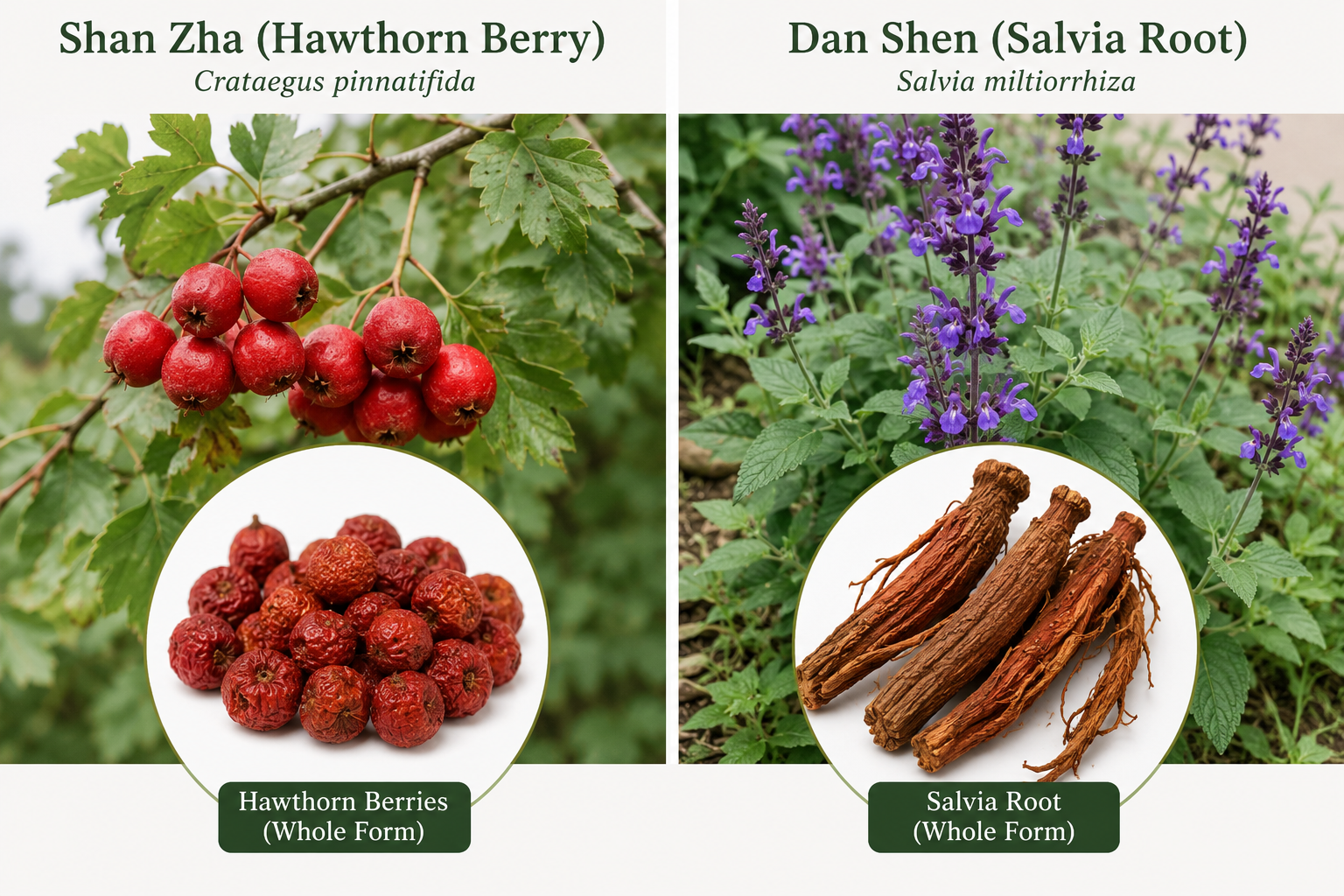
The first contains bright red Hawthorn berries.
The second contains slices of dark red Dan Shen root.
Without knowing anything else, which one would you try first?
Most people immediately point to the Hawthorn.
Why? Because fruit feels familiar. Fruit feels safe. Fruit feels approachable.
Dan Shen looks like what it is. A traditional herbal root.
That simple observation explains a lot about why people experience these herbs differently.
Quick Answer
If you're standing in your kitchen wondering which herb is which:
Hawthorn Berry (Shan Zha)
Think:
Fruit
Tea
Flavor
Enjoyment
Dan Shen
Think:
Root
Tradition
Decoctions
Herbal Study
One often attracts beginners.
The other often attracts people who want to understand traditional herbalism more deeply.
The Kitchen vs The Apothecary
What You Need To Know
Hawthorn Started In The Kitchen
People have used Hawthorn in:
-
Teas
-
Candies
-
Snacks
-
Preserves
-
Traditional foods
-
Fruit preparations
Its story begins with something people already understand. Food.
Dan Shen Started In The Apothecary
Dan Shen's story is different.
Its history is rooted in traditional herbal practice, herbal literature, and classical Chinese herbology.
Its reputation wasn't built because people thought:
"This tastes amazing."
Its reputation was built because herbalists kept returning to it generation after generation.
That's a completely different path to fame.
Side-By-Side Comparison Chart
| Question | Hawthorn Berry | Dan Shen |
|---|---|---|
| Fruit Or Root? | Fruit | Root |
| Beginner Friendly? | ⭐⭐⭐⭐⭐ | ⭐⭐⭐ |
| Pleasant Flavor? | ⭐⭐⭐⭐⭐ | ⭐⭐ |
| Traditional Herbal Reputation? | ⭐⭐⭐ | ⭐⭐⭐⭐⭐ |
| Most Familiar To Beginners? | Yes | No |
| Easy To Enjoy? | Yes | Acquired Taste |
| Tea Drinker Favorite? | ⭐⭐⭐⭐⭐ | ⭐⭐ |
| Herbalist Favorite? | ⭐⭐⭐ | ⭐⭐⭐⭐⭐ |
| Common Form | Berry | Root |
| First Impression | Friendly | Serious |
What Do They Taste Like?
Let's answer the question everyone really wants to know, as if it isn't going to taste good, I am not drinking it.
Hawthorn Berry
Most people describe Hawthorn as:
-
Tart
-
Fruity
-
Slightly sweet
-
Bright
-
Pleasant
Some compare it to:
-
Crabapple
-
Rose hips
-
Tart apple tea
Dan Shen
Most people describe Dan Shen as:
-
Earthy
-
Root-like
-
Herbal
-
Traditional
-
Slightly bitter
Nobody has ever mistaken Dan Shen for fruit punch. And honestly, Dan Shen isn't trying to be fruit punch.
That's part of its charm.
If These Herbs Were People
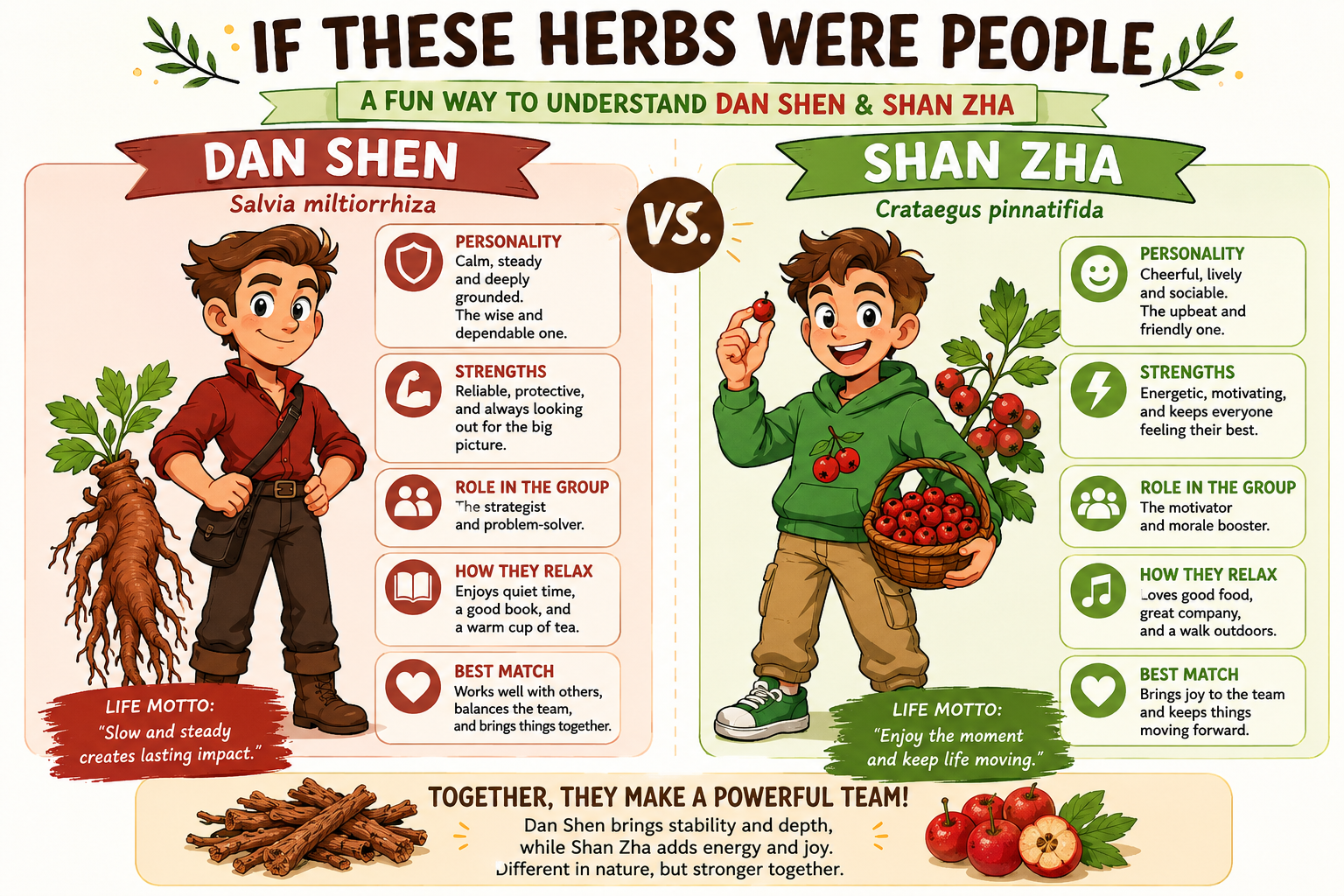
Hawthorn Berry
The friend who brings homemade pie. Friendly. Warm. Easy to like. The person everyone remembers.
Dan Shen
The professor who has spent forty years studying one subject. Deep. Respected. Not flashy. But when they speak, people listen.
The important lesson? Neither is better.
They're simply famous for different reasons.
The Five Biggest Lessons These Herbs Teach
Lesson #1
Not Every Herb Needs To Taste Amazing
Some herbs became famous because people enjoyed them.
Others became famous because they earned respect.
Lesson #2
Fruit And Root Are Different Experiences
You don't approach them the same way.
You don't expect them to taste the same.
You don't use them the same.
Lesson #3
Most Beginners Start With Flavor
That's why many people fall in love with Hawthorn first.
Lesson #4
Most Herbalists Eventually Learn To Appreciate Roots
That's where Dan Shen enters the conversation.
Lesson #5
The Best Herb Isn't The Most Famous Herb
It's the herb that fits what you're trying to learn, explore, or enjoy.
Why Herbalists Keep Both
Let's make sense of all of this and keep it simple.
Most people assume herbalists are always looking for the single best herb.
They're not. Experienced herbalists understand something different.
Different herbs bring different strengths. Hawthorn teaches us how approachable herbs can be.
Dan Shen teaches us how deep herbal traditions can be. One helps people fall in love with herbs.
The other helps people understand why herbalists fell in love with herbs. That's why both remain important.
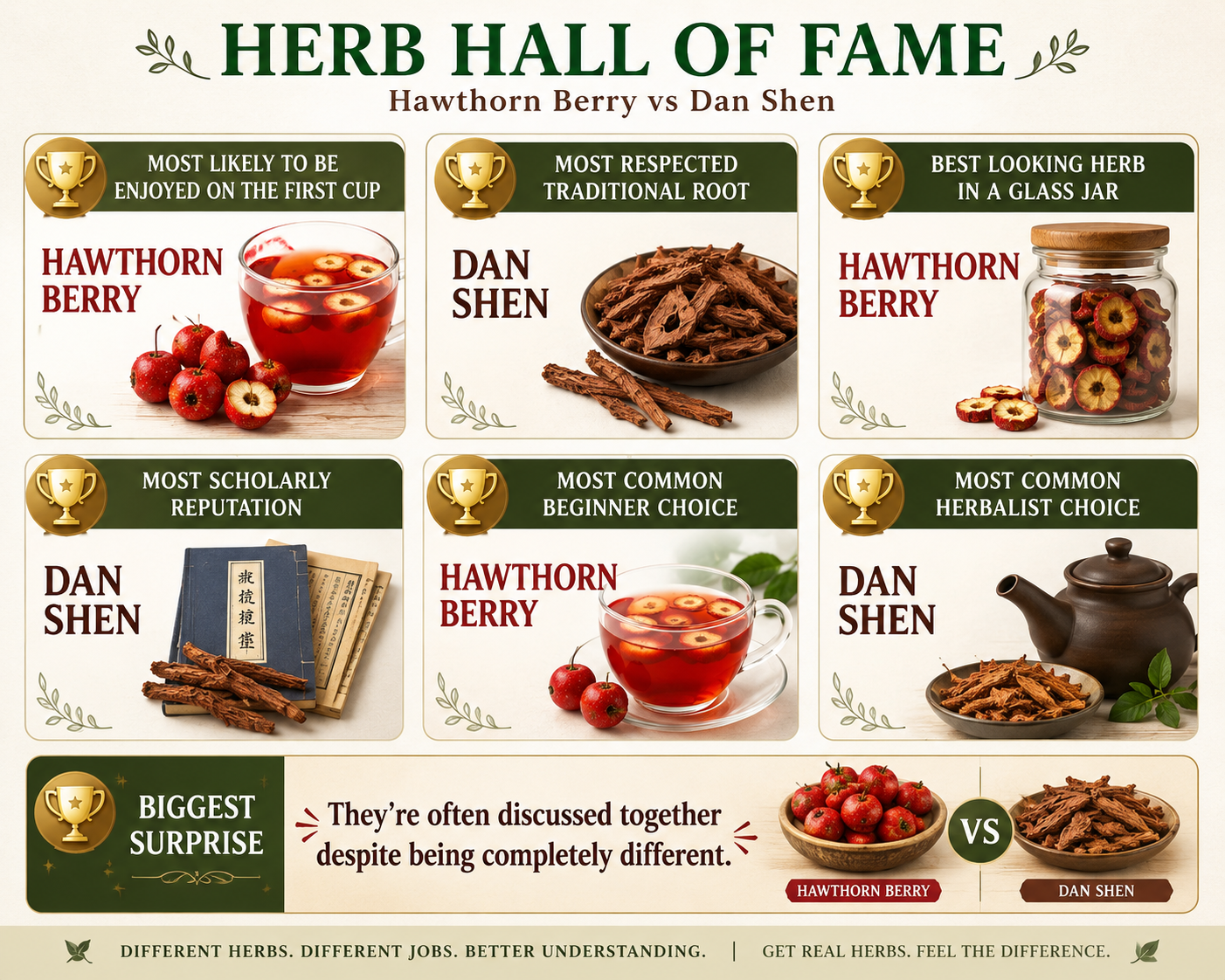
Herb Hall Of Fame
What Customers Usually Ask
Which One Tastes Better?
Most people would say Hawthorn.
Which One Is Easier For Beginners?
Hawthorn.
Which One Has The Longer Traditional Herbal Reputation?
Dan Shen.
Which One Should I Try First?
If you're exploring flavor, start with Hawthorn.
If you're exploring traditional Chinese herbology, start with Dan Shen.
Do Experienced Herbalists Keep Both?
Very often, yes.
Because they appreciate different qualities in each herb.
Final Takeaway
Most comparison articles end by declaring a winner.
This isn't one of those articles. Because Hawthorn Berry and Dan Shen aren't competing.
They're teaching. Hawthorn teaches us that herbs can be approachable.
Dan Shen teaches us that herbs can carry centuries of wisdom. One begins with fruit. One begins with roots. One opens the door. One invites you deeper inside.
And together they remind us of one of the most important truths in herbalism:
Different herbs don't need to do the same job to be equally valuable.
Final Thoughts: Why Compare Dan Shen and Shan Zha?
At first glance, Dan Shen and Shan Zha may seem like an unusual pair. One is a deep red root. The other is a bright red berry. They come from completely different plants and have distinct flavors, appearances, and traditional roles.
Yet that's exactly why comparing them is so valuable.
By looking at these two herbs side by side, we gain a better understanding of how diverse the world of Chinese herbs truly is. Dan Shen represents the rich tradition of root-based botanicals, while Shan Zha highlights the important role fruits and berries have played in herbal practices for centuries.
Comparisons like this help move us beyond simply asking, "What does this herb do?" and encourage us to ask deeper questions:
-
Where does this herb come from?
-
How has it traditionally been prepared?
-
What makes it unique?
-
How does it differ from other herbs I may already know?
Whether you're just beginning your herbal journey or have been exploring herbs for years, understanding these differences helps you become a more informed and confident herbal enthusiast.
And perhaps that's the real lesson from Dan Shen and Shan Zha: two herbs can share a place in traditional herbal history while still having completely different stories to tell.
About The Author
Author: 1st Chinese Herbs Research Team
Last Updated: June 15, 2026
The 1st Chinese Herbs Research Team has spent decades researching traditional Chinese herbs, roots, berries, flowers, mushrooms, and botanical ingredients. Our mission is to make herbal education practical, memorable, and useful for beginners and experienced herbal enthusiasts alike.
Trusted Since 1994
Get Real Herbs. Feel The Difference.
References
Zhou L, Zuo Z, Chow MSS.
Danshen: An Overview of Its Chemistry, Pharmacology, Pharmacokinetics, and Clinical Use
PMID: 16291709
Citation:
Zhou L, Zuo Z, Chow MSS. Danshen: An Overview of Its Chemistry, Pharmacology, Pharmacokinetics, and Clinical Use. J Clin Pharmacol. 2005. PMID: 16291709.
2. Cardiovascular Review
Ren J, Fu L, Nile SH, et al.
Salvia miltiorrhiza in Treating Cardiovascular Diseases
PMID: 31338034
Citation:
Ren J, Fu L, Nile SH, et al. Salvia miltiorrhiza in Treating Cardiovascular Diseases: A Review on Its Pharmacological and Clinical Applications. Front Pharmacol. 2019. PMID: 31338034.
3. Modern Pharmacology Review
Chen W, et al.
Danshen (Salvia miltiorrhiza Bunge): A Prospective Healing Sage for Cardiovascular Diseases
PMID: 28828985
Citation:
Chen W, Liu L, Luo Y, et al. Danshen (Salvia miltiorrhiza Bunge): A Prospective Healing Sage for Cardiovascular Diseases. Curr Pharm Des. 2017. PMID: 28828985.
4. Salvianolic Acids Review
Du G, Song Y, Zhang T, et al.
A Review of Salvianolic Acids
PMID: 32089230
Citation:
Du G, Song Y, Zhang T, et al. A Review of Salvianolic Acids. Molecules. 2020. PMID: 32089230.
Shan Zha (Crataegus pinnatifida) PubMed References
Dehghani S, et al.
The Effects of Crataegus pinnatifida (Chinese Hawthorn) on Metabolic Syndrome
PMID: 31217924
Citation:
Dehghani S, et al. The Effects of Crataegus pinnatifida (Chinese Hawthorn) on Metabolic Syndrome: A Review. Nutrients. 2019. PMID: 31217924.
2. Hawthorn Research Overview
This review discusses bioactive compounds including flavonoids, triterpenes, and organic acids traditionally associated with Shan Zha and reviews research related to lipid metabolism, cardiovascular health, and antioxidant activity.
3. Modern Hawthorn Review
Chemical Composition, Biological Activities, and Quality Control of Hawthorn
Frontiers in Pharmacology (2023).
Citation:
Guo W, et al. Chemical Composition, Biological Activities, and Quality Control of Hawthorn. Front Pharmacol. 2023.