Huai Hua (槐花) is the flower of Sophora japonica (also commonly listed as Styphnolobium japonicum), traditionally used in Traditional Chinese Medicine (TCM) for patterns associated with Blood Heat—especially when that “heat” shows up as bleeding (commonly described in TCM contexts as hemorrhoidal bleeding, nosebleeds, or blood in stool). Modern research has focused heavily on Huai Hua’s naturally occurring flavonoids, including rutin and quercetin, which are widely studied for antioxidant and vascular-support properties.
Quick Summary Of Japanese Sophor Flower
Huai Hua is best known for:
-
TCM action: cooling Blood Heat + supporting hemostasis (traditional “stop bleeding” use)
-
Key compounds: flavonoids such as rutin and quercetin
-
Common forms: dried flower or bud (Huai Hua / Huai Hua Mi), powders, extracts, and formulas
-
Best for: people looking for traditional TCM support for heat-related bleeding patterns (under practitioner guidance)
-
Safety note: use extra caution if you’re pregnant/nursing or using blood-thinning medications; consult your clinician/practitioner first
What is Huai Hua?
Huai Hua refers to the flower of the Japanese pagoda tree. You may also see:
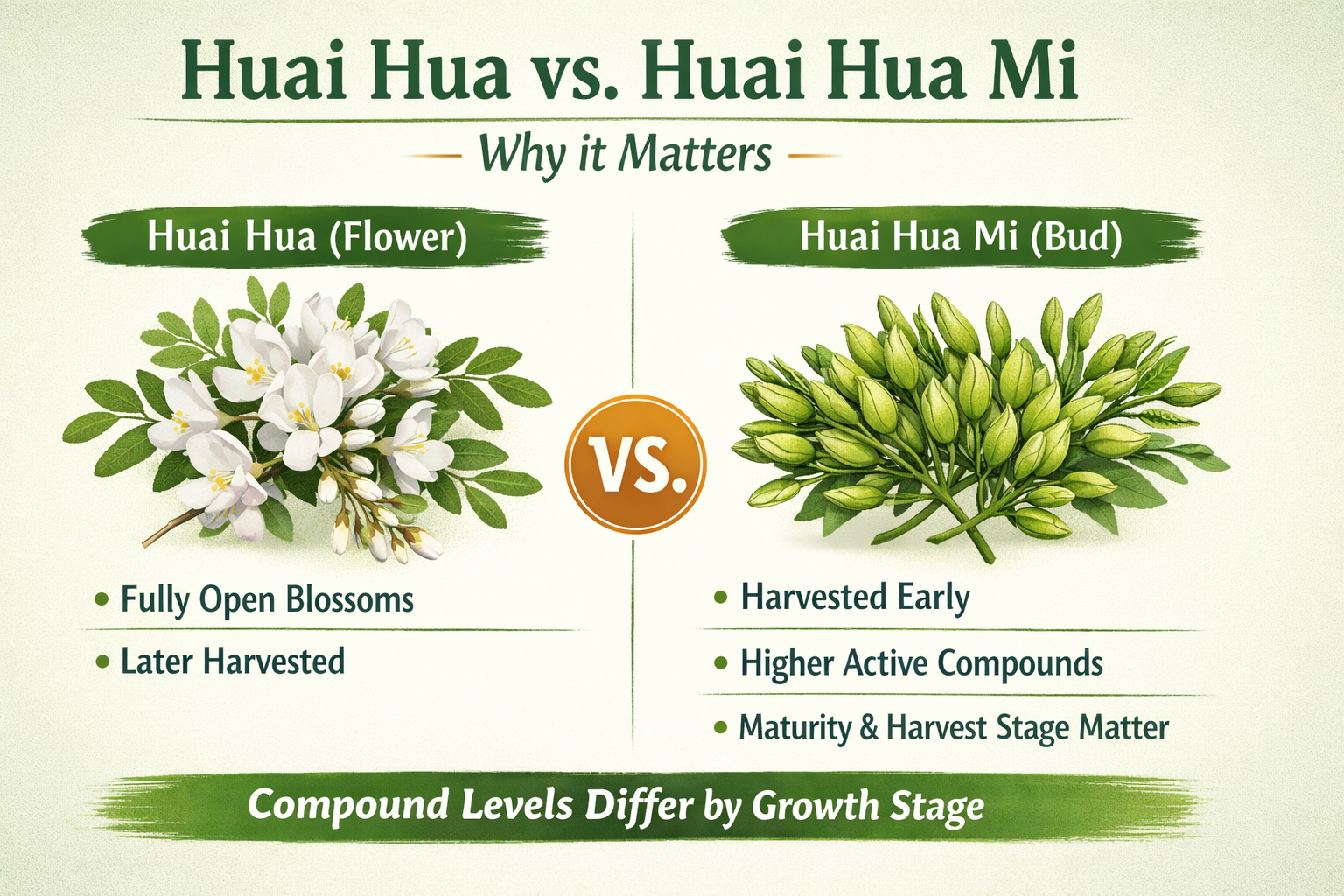
Huai Hua vs. Huai Hua Mi (Why it matters)
If you’re buying bulk herbs, the form matters for recipe, brewing method, and consistency.
Traditional TCM Functions (“why it’s used”)
In TCM language, Huai Hua is commonly described as:
-
Cooling the blood (used when heat affects the blood level)
-
Supporting hemostasis (traditional use for bleeding patterns, often in the lower burner)
-
Clearing Liver Fire (used when Liver heat signs are present in the pattern)
Important: TCM actions describe traditional pattern logic—not a diagnosis or a promise to treat disease.
Key Compounds in Huai Hua
Huai Hua is especially known as a rich source of flavonoids—most notably:
Potential Benefits
Below are education-focused benefits that align with how this herb is discussed in both traditional and modern literature.
1) Antioxidant support
Huai Hua flavonoids are widely studied for their antioxidant activity, which matters because oxidative stress is one contributor to normal aging and cellular wear-and-tear.
2) Traditional support for vascular integrity
Rutin and related compounds are commonly studied for their relationship to vascular function and capillary integrity (one reason Huai Hua is widely discussed in “bleeding pattern” traditions).
3) Traditional use in hemorrhoid-focused formulas
A randomized, double-blind, placebo-controlled trial evaluated a Sophora flower formula (containing Huai Hua among other herbs) for symptomatic hemorrhoids—useful context, but not proof that Huai Hua alone produces the same effect.
4) Skin and topical interest
Flavonoids from Sophora flower/bud are studied in lab contexts for properties relevant to skin oxidative stress and related pathways. This is still an emerging area and should be framed as exploratory.
5) Microbial balance research
Some studies evaluate antibacterial/antioxidant activity in Sophora flower/bud preparations (often related to processing methods like roasting). Consider this early-stage rather than a clinical claim.
How to Use Huai Hua
Common forms
-
Whole flowers or buds (traditional brewing)
-
Powder (capsules or blending)
-
Extract powder (concentrated; not the same as whole herb tea)
Brewing (simple guidance)
Infusion (steep) is common for flowers/buds:
Decoction (simmer) may be used when combined with denser herbs (roots/bark) in formulas.
If you want, I can format this section to match your Herbal Steep Time Calculator so it interlinks naturally.
Pairing logic
Huai Hua is rarely used alone in classical practice. It’s commonly paired with other herbs depending on the pattern (for example, other “cool blood / stop bleeding” herbs). This is best guided by a trained practitioner.
Safety, Interactions, and Who Should Be Careful
Huai Hua is widely used traditionally, but “natural” still deserves respect.
Use extra caution and get professional guidance if you:
-
are pregnant or nursing
-
take anticoagulants / antiplatelet meds (blood thinners)
-
have a bleeding disorder or are preparing for surgery
A safety review of S. japonicum flower/bud as dietary supplement ingredients reported no serious adverse events in reviewed studies, while still noting potential interaction considerations around flavonoids like rutin/quercetin.
Quality matters
Look for:
-
Species identification (correct botanical name and plant part: flower vs bud)
-
Contaminant testing (heavy metals, pesticides, microbial)
-
Good Manufacturing Practices (GMP)
-
COA availability (Certificate of Analysis on request)
This aligns with how pharmacopeia-listed botanicals are commonly handled in quality standards.
Product Information
Herbal Information for Huai Hua (Sophora flower/bud) – Whole Form
-
Common names: Sophora Flower Bud, Pagoda Tree Flower Bud
-
Botanical name: Sophora japonica (also seen as Styphnolobium japonicum)
-
Pin Yin: Huai Hua / Huai Hua Mi / Huai Jiao
-
Properties (TCM): Bitter, Cool; Channels: Liver, Large Intestine
-
Ingredients: 100% single herb (no additives)
-
Cautions: avoid during pregnancy/nursing unless advised by a qualified professional
FAQs
What is Huai Hua used for in TCM?
Traditionally, it is used to cool Blood Heat, support hemostasis (“stop bleeding”), and clear Liver Fire in pattern-based herbal practice.
What’s the difference between Huai Hua and Huai Hua Mi?
Huai Hua is the flower, while Huai Hua Mi (Huaimi) is the flower bud harvested earlier. Maturity stage can affect compound profiles and quality.
Does Huai Hua contain rutin and quercetin?
Yes—research frequently highlights Sophora flower/bud as a notable source of these flavonoids.
Is Huai Hua safe?
A safety review of S. japonicum flower/bud as dietary supplement ingredients reported no serious adverse events in reviewed studies, but people on medications—especially blood thinners—should consult a clinician/practitioner due to potential interaction considerations.
How do you brew Huai Hua as a tea?
Most people prepare it as an infusion (steep 10–15 minutes). If combining with dense herbs, a decoction method may be used for the whole formula.
Helpful Links
About Plum Flower Quality Herbs