Mi Meng Hua Traditional Eye and Liver Support

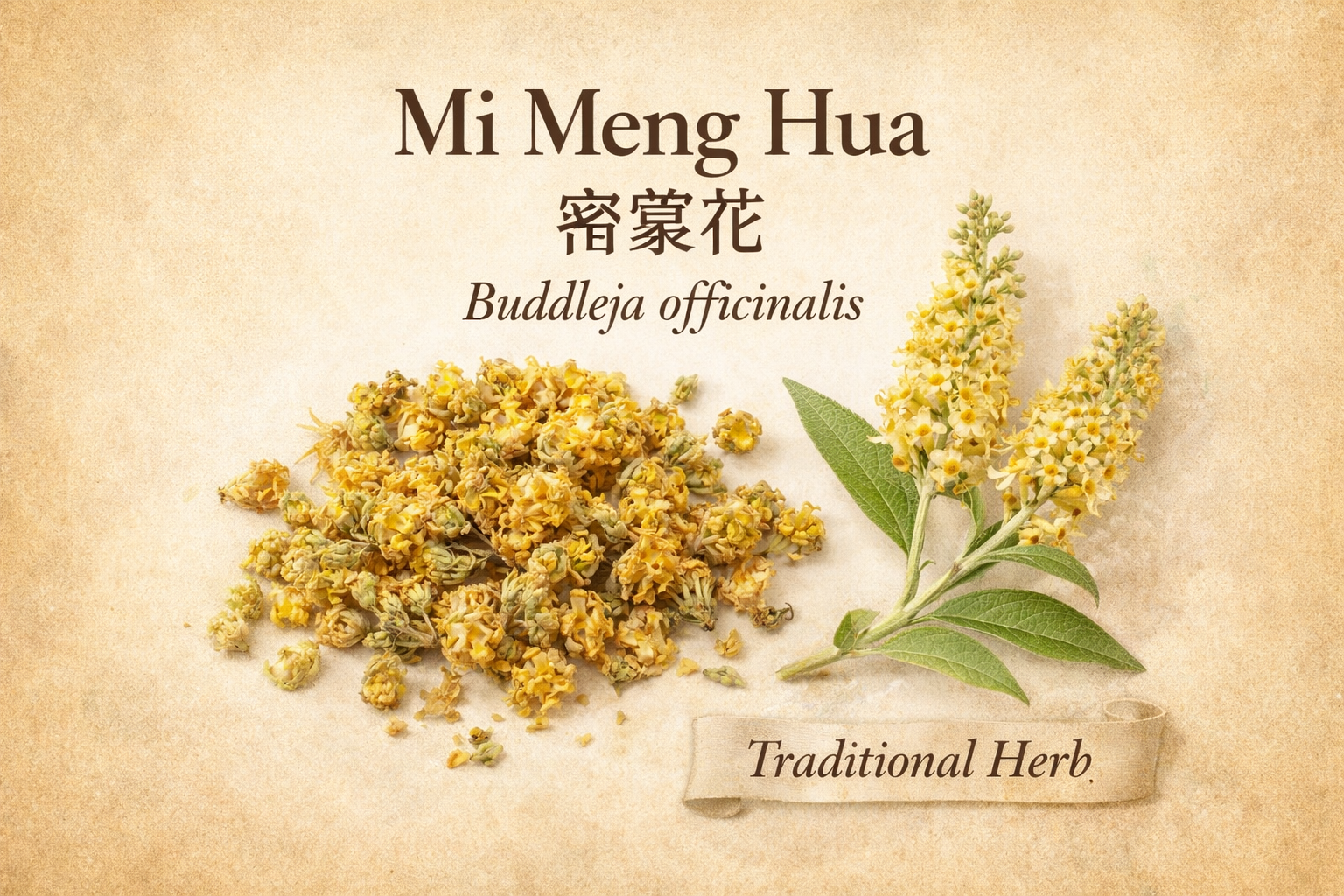
Mi Meng Hua (密蒙花) — Buddleja Flower for Traditional Eye Comfort & Liver Heat Support

If your eyes feel tired, dry, or irritated after long days of screen time, reading, or seasonal shifts, Mi Meng Hua is one of the classic Chinese herbs traditionally chosen to support eye comfort and visual clarity—especially when discomfort is linked to “Liver heat” patterns in Traditional Chinese Medicine (TCM).

Mi Meng Hua is a traditional Chinese eye-support herb derived from Buddleja officinalis. It is commonly used to promote eye comfort and clarity in Liver heat patterns and is often prepared as a tea or blended with other eye-nourishing herbs.

At 1st Chinese Herbs (Trusted Since 1994), we provide identity-verified, sulfur-free, quality-screened Mi Meng Hua for customers who want a clean, professional, practitioner-grade herb that fits naturally into a simple tea routine or a traditional formula approach.
Trusted Since 1994 Quality-Screened Identity-Focused Sourcing Sulfur-Free Customer Education First
Mi Meng Hua (Buddleja Flower) →  See Below for all forms of Mi Meng Hua

What Is Mi Meng Hua?

Mi Meng Hua (密蒙花) is the dried flower (often the flower buds) of Buddleja officinalis. In Traditional Chinese Medicine, it is best known for being traditionally used to clear Liver heat and benefit the eyes.

In TCM theory, the Liver “opens to the eyes.” When internal heat rises or balance is strained, the eyes may feel uncomfortable. Mi Meng Hua is often selected as a gentle, targeted eye-support herb—especially when used as part of a balanced blend.

Quick Facts

Common Name Mi Meng Hua / Buddleja Flower
Botanical Name Buddleja officinalis
TCM Category Clears heat & benefits the eyes (traditional classification)
Meridians Liver
Taste / Temperature Sweet, Cool (traditional description)
Form Bulk cut flower / buds

Why Mi Meng Hua Works (TCM + Modern Research)

Traditional Chinese Medicine Perspective

In TCM, the eyes are closely connected to Liver function. When “Liver heat” rises—or when balance is strained—the eyes may feel dry, red, irritated, or visually fatigued. Mi Meng Hua is traditionally used to clear Liver heat and support the eyes, often as part of a formula rather than alone.

Modern Research Perspective 

Research on Buddleja officinalis has explored its flavonoids and related compounds, with studies suggesting antioxidant and anti-inflammatory activity in laboratory settings. (See references in the Research section below.)

Important: Traditional use and early research are not the same as medical treatment. This page focuses on traditional wellness support and general research context—no disease claims.

Understanding Mi Meng Hua

Is Mi Meng Hua good for dry eyes?

Mi Meng Hua is traditionally used to support eye comfort and moisture balance when dryness is linked to heat patterns (TCM language). Many people choose it when their eyes feel strained from screens, reading, or dry environments—especially when paired with complementary herbs.

Mi Meng Hua vs Chrysanthemum (Ju Hua): what’s the difference?

Both herbs are used traditionally for the eyes. Mi Meng Hua is often chosen when eye symptoms are the main focus, while Ju Hua is commonly used when eye discomfort appears alongside seasonal “wind-heat” patterns, head tension, or heat-related discomfort. They are frequently combined.

How long does Mi Meng Hua take to work?

Chinese herbs are typically used as consistent routines, not quick stimulants. Many people evaluate results over days to weeks, depending on constitution, pattern fit, and whether the herb is used alone or in a blended formula.

Can I use Mi Meng Hua daily?

Mi Meng Hua is traditionally considered gentle, but daily use should still match your individual pattern. If you run cold, have digestive weakness, or are unsure whether “heat” applies, consider professional guidance or pair with balancing herbs.

how to brew mi meng huaHow to Use Mi Meng Hua (Practical, Simple, Repeatable)
1) Easy Tea Method (Most Popular)

  1. Amount: 3–9 grams of Mi Meng Hua
  2. Simmer: 10–15 minutes (gentle simmer)
  3. Strain & sip: 1–2 cups/day as desired

2) Best Pairings 

  • Mi Meng Hua + Ju Hua (Chrysanthemum): Traditional comfort blend for heat-type eye irritation
  • Mi Meng Hua + Gou Qi Zi (Goji Berry): Adds nourishment support for eyes that feel dry from long-term strain
  • Mi Meng Hua + Bai Ji Li: Traditional option when eye tension/pressure patterns are present (TCM language)
Want the easiest starter blend?
Start with Mi Meng Hua + Ju Hua. If dryness feels more “depleted,” add Gou Qi Zi.
Shop Mi Meng Hua → Or View The Other Herbs  Ju Hua · Gou Qi Zi

Comparison Chart: Mi Meng Hua vs Common Eye-Support Herbs

This chart helps customers choose the right herb (or combination) based on traditional pattern fit. It also increases trust because it shows guidance, not hype.

Herb Best For (Traditional Use) Pattern Fit (TCM) Taste/Temp When to Choose Best Pairings
Mi Meng Hua
Buddleja Flower
Eye comfort & visual clarity support Liver heat affecting eyes Sweet, Cool When eyes are the main focus and you want a gentle, targeted herb Ju Hua, Gou Qi Zi, Bai Ji Li
Ju Hua
Chrysanthemum
Eye comfort + seasonal heat patterns Wind-heat; Liver heat with head tension Sweet/Bitter, Slightly Cold When eye discomfort comes with heat signs or seasonal flare-ups Mi Meng Hua, Gou Teng, Bo He
Gou Qi Zi
Goji Berry
Nourishing support for eyes Liver/Kidney Blood or Yin deficiency Sweet, Neutral When dryness feels more “depleted” and long-term support is desired Mi Meng Hua, Ju Hua, Dang Gui
Bai Ji Li
Tribulus Fruit
Eye tension/pressure patterns Liver constraint; rising yang Bitter/Acrid, Neutral When eye discomfort feels tense or pressure-like (TCM language) Mi Meng Hua, Ju Hua, Chai Hu

Why Buying Quality Mi Meng Hua Matters

Flower herbs are especially sensitive to misidentification and poor handling. Low-quality material may contain excess stems, degraded buds, or inconsistent plant matter. When customers buy for eye-support routines, clean handling and correct identity are non-negotiable.

  • Identity-focused sourcing: correct herb, correct plant part
  • Sulfur-free: clean handling and storage standards
  • Quality-screened: packed with consistency in mind
  • Trusted Since 1994: long-term customer relationships built on reliability
Professional tip: If you’re new to bulk herbs, start with small amounts and keep notes. You’ll build a routine that’s repeatable—so you can confidently reorder and refine.

About This Page 

This page was written and reviewed by the team at 1st Chinese Herbs, a trusted supplier of Chinese herbs since 1994. We work with practitioners, herbal educators, and informed consumers nationwide, focusing on education-first content and quality-screened sourcing.

Our goal is to help you choose herbs responsibly by explaining traditional pattern language, practical use methods, and what research suggests about key constituents— while staying fully DSHEA-compliant.

FAQ: Mi Meng Hua (Buddleja Flower)

Does Mi Meng Hua contain caffeine?

No. Mi Meng Hua is naturally caffeine-free.

What does Mi Meng Hua tea taste like?

Mild and floral. Many people find it easier to drink than bitter roots, especially when blended.

Can I combine Mi Meng Hua with eye supplements or eye drops?

Many people combine traditional herbs with modern routines, but if you have a medical condition, use prescription eye drops, or take medications, consult a qualified healthcare professional.

Who should be cautious with Mi Meng Hua?

If you run cold, have significant digestive weakness, are pregnant/nursing, or are unsure whether your pattern involves heat, seek professional guidance. Stop use if you experience discomfort.

What is the best beginner combination?

A classic starting point is Mi Meng Hua + Ju Hua. If dryness feels more “depleted,” add Gou Qi Zi.

Research & References (PubMed)

Below are research references related to Buddleja officinalis and its constituents. These studies provide context for antioxidant / inflammatory pathways and dry-eye model exploration. They are shared for educational purposes.

  • In vitro profiling for dry eye disease context: “Pharmacological in vitro profiling of Buddleja officinalis extracts…” (PubMed)
  • Anti-inflammatory + antioxidant activity of constituents: “Anti-inflammatory and antioxidant activities of chemical constituents from the flower buds of Buddleja officinalis.” (PubMed)
  • Review article (botany, ethnopharmacology, phytochemistry, ophthalmic potential):Buddleja officinalis Maxim.: A review…” (PubMed)
  • Dry eye rabbit model (lacrimal gland morphology/apoptosis): “The Effect of Buddleja officinalis Maxim Eye Drops…” (PubMed / PMC)
  • Retinal protective glycosides in a light-damage model (use as general context): “Glycosides from Buddleja officinalis with protective effects…” (PubMed)

DSHEA note: Research references are included for education and context. This product is not intended to diagnose, treat, cure, or prevent any disease.

Ready to build your Mi Meng Hua routine?

Choose a quality herb you can trust, then keep it simple: consistent tea, smart pairings, and the right pattern fit. That’s how customers get results they can feel and come back for—without hype.

Shop Mi Meng Hua (Buddleja Flower) →
Educational Disclaimer: Information on this page is provided for educational purposes only and reflects traditional use. These statements have not been evaluated by the FDA. This product is not intended to diagnose, treat, cure, or prevent any disease. If you are pregnant, nursing, have a medical condition, or take medications, consult a qualified healthcare professional before use.

There are no products listed under this category.

Recommended For You View all

New
Sale
brewing white tea brewing white tea
+ Add to Cart The item has been added

Starwest Botanicals

Organic White Tea Bags

White Tea Bags vs. Green Tea: Why They’re Different White tea and green tea come from the same plant—Camellia sinensis—but they’re made differently. That difference in processing is why white tea...

Was: $18.99
Now: $10.00
+ Add to Cart The item has been added