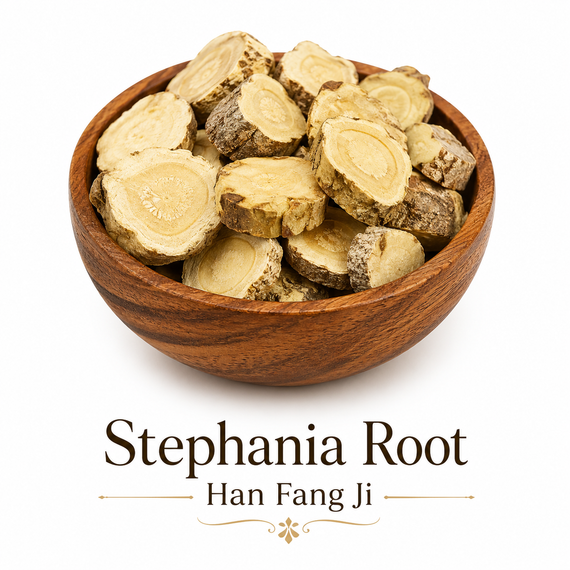


Stephania Root Powder — Han Fang Ji — 100% Stephania tetrandra
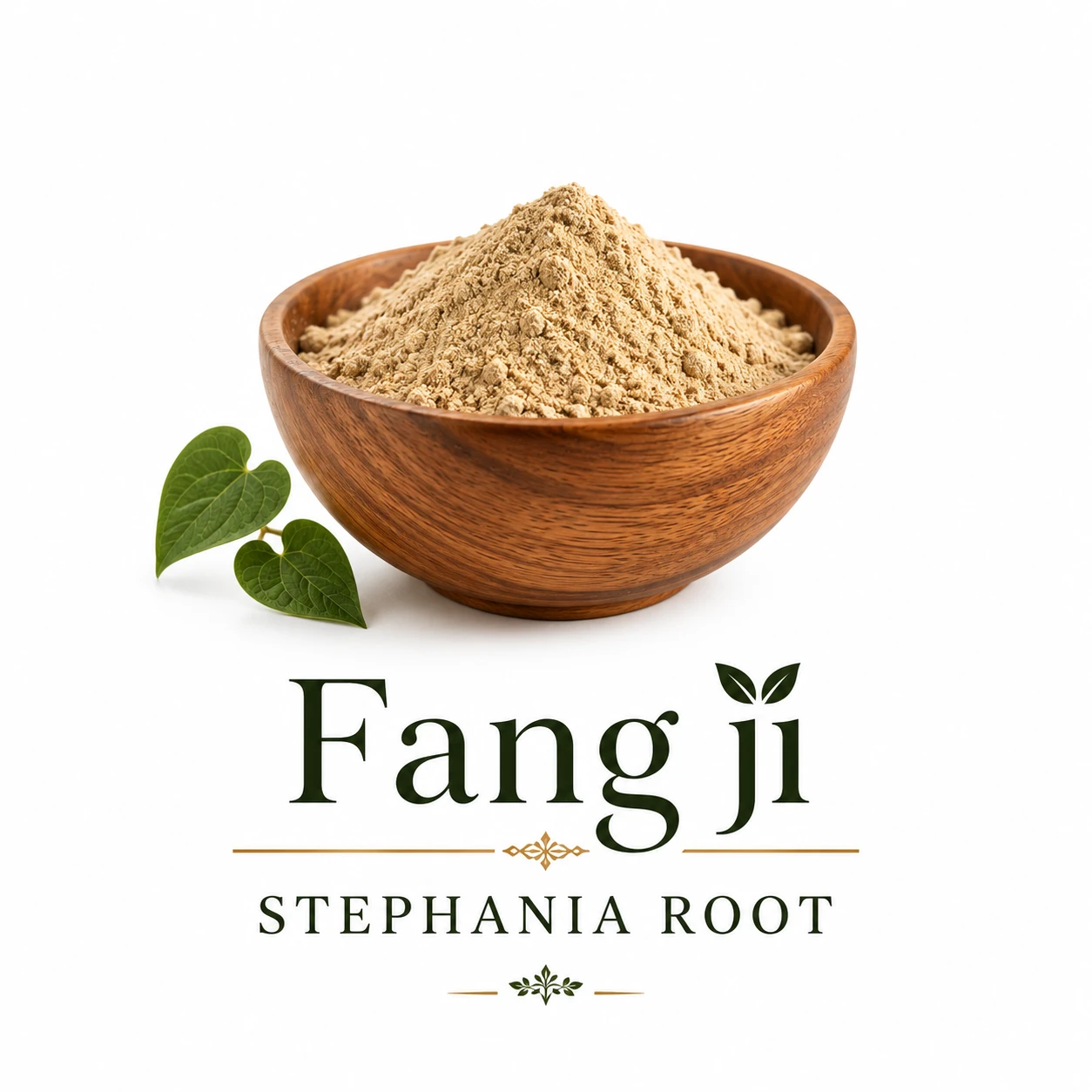 Looking for authentic Han Fang Ji in convenient powder form? This Plum Flower product contains 100% Stephania tetrandra root powder with no other ingredients added.
Han Fang Ji has a long history of use within Traditional Chinese Herbalism. Because the general name “Fang Ji” has historically been associated with more than one botanical species, correct botanical identification is especially important when purchasing this herb.
Stephania tetrandra
Convenient whole-herb form
16 oz / approximately 454 g
Stephania Root Powder at a Glance
Use the botanical name—not simply the common name “Fang Ji”—when comparing products. Here is exactly what this product contains.
| Common Name | Stephania Root |
| Pin Yin Name | Han Fang Ji / Fang Ji |
| Botanical Name | Stephania tetrandra |
| Plant Part | Root |
| Form | Fine Powder |
| Package Size | 1 lb |
| Ingredients | Stephania tetrandra root powder |
| Other Ingredients | None |
| Brand | Plum Flower |
| Origin | China |
What Is Stephania Root (Han Fang Ji)?
Han Fang Ji is a traditional Chinese herbal material derived from the root of Stephania tetrandra, a plant in the Menispermaceae family.
The dried root has been used historically within Chinese herbal practice and is traditionally classified as a bitter, acrid and cold herb.
This product has been finely ground into powder. Unlike an extract, whole-root powder contains the physical botanical material itself and therefore does not completely dissolve in water.
For shoppers, the most important first step is confirming the botanical name: Stephania tetrandra.
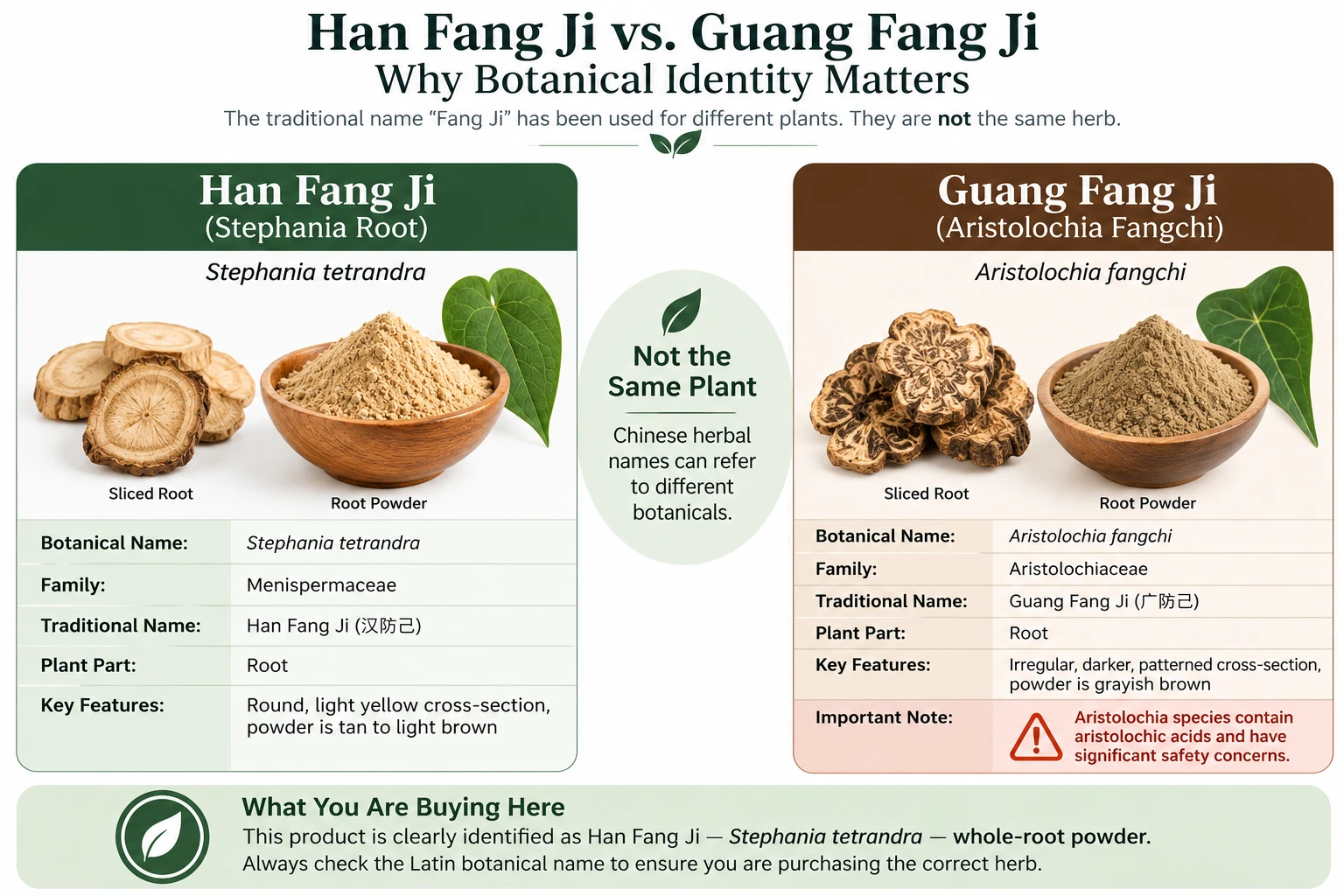
Han Fang Ji vs. Guang Fang Ji: Why Botanical Identity Matters
This is one of the most important things to understand when purchasing a product described as “Fang Ji.” Similar traditional names do not necessarily mean the herbs are botanically equivalent.
| Identification | Han Fang Ji | Guang Fang Ji |
|---|---|---|
| Botanical | Stephania tetrandra | Aristolochia fangchi |
| Same Plant? | No | No |
| Aristolochia Species? | No | Yes |
| This Product? | YES — Stephania tetrandra | NO |
What Should Quality Stephania Root Powder Look Like?
Natural botanical powders vary somewhat from harvest to harvest. A quality Stephania root powder should retain the natural characteristics of ground root material.
Natural tan, beige, light brown or muted root tones.
Fine ground botanical powder with natural variation.
Characteristic dry root and herbal aroma.
Dry, properly stored and free of obvious moisture damage.
Signs That Deserve Attention
- Musty or mold-like odor
- Visible moisture or wet clumping
- Evidence of contamination
- Unusual foreign material
- Packaging damaged by moisture
Normal differences in shade or grind between botanical batches do not by themselves indicate poor quality.
Stephania Powder vs. Sliced Root: Which Form Should I Buy?
| Feature | Powder — This Product | Sliced / Cut Root |
|---|---|---|
| Form | Finely ground root | Visible dried root pieces |
| Convenience | Ready to measure or encapsulate according to appropriate directions | Often selected for traditional decoction-style preparations |
| Visual Identification | Root structure no longer visible after grinding | Physical root pieces remain visible |
| Extract? | No | No |
Neither form is automatically “better.” Choose the form specified by your practitioner, formula or intended traditional preparation.
Stephania Root in Traditional Chinese Herbalism
Bitter & Acrid
Cold
Spleen, Bladder & Kidney
Within the traditional Chinese herbal framework, Han Fang Ji has historically been associated with wind-damp patterns, heat, urination and swelling.
These descriptions belong to the traditional Chinese herbal system and should be understood within that historical framework rather than interpreted as modern medical diagnoses or treatment claims.
Traditional terminology describes historical herbal practice and is provided for educational purposes.
What Does Modern Research Study in Stephania tetrandra?
Modern research on Stephania tetrandra has examined its phytochemistry and naturally occurring bisbenzylisoquinoline alkaloids.
Two compounds frequently discussed in scientific literature are:
- Tetrandrine
- Fangchinoline
Researchers have investigated these isolated compounds in laboratory, animal and other experimental settings. Such research is useful for understanding the chemistry of the plant, but results involving isolated compounds should not automatically be attributed to ordinary whole-root powder.
This product is whole Stephania tetrandra root powder. It is not purified tetrandrine, purified fangchinoline, or a standardized pharmaceutical preparation.
Why Species Identification Is Especially Important With Fang Ji
Common names are convenient, but they are not always precise enough for botanical products. Historically, multiple plants have been associated with names containing “Fang Ji.”
This makes the Latin botanical name particularly useful. When comparing products, look for:
- Botanical name: Stephania tetrandra
- Plant part: Root
- Traditional name: Han Fang Ji
- Manufacturer identification: Clearly stated on the product
A product identified only as “Fang Ji” without a botanical species gives the shopper less information than one clearly identified as Stephania tetrandra.
How Is Stephania Root Powder Used?
Powdered Stephania root provides a convenient alternative to sliced root because the botanical material has already been finely ground.
Depending on the directions being followed, whole-herb powders may be incorporated into traditional preparations or placed into empty capsules.

How to Store Stephania Root Powder
Botanical powders are particularly sensitive to moisture because their finely ground surface area is exposed to the surrounding environment.
- Keep the package tightly sealed.
- Store in a cool, dry location.
- Keep away from excessive heat and direct sunlight.
- Avoid introducing moisture into the package.
- Use a clean, dry utensil when measuring powder.
Discard botanical material showing obvious evidence of moisture damage, mold or spoilage.
Important Stephania Root Safety Information
Do not use during pregnancy or breastfeeding.
Stephania may interact with medications or may not be appropriate for certain individuals. Consult a qualified healthcare professional before use if you take prescription medications, have a medical condition, or intend to use Stephania for a specific health concern.
Botanical identification is especially important. This product is identified as Stephania tetrandra. Do not substitute products identified as Aristolochia fangchi or other Aristolochia species.
Seek professional guidance for individualized amounts, combinations and duration of use.
Stephania Root / Han Fang Ji Frequently Asked Questions
What is Han Fang Ji?
Han Fang Ji is a traditional Chinese herbal name associated with Stephania tetrandra root.
What is the botanical name of this product?
The botanical name is Stephania tetrandra.
Is Fang Ji always Stephania tetrandra?
No. The general name Fang Ji has historically been associated with more than one botanical material. This is why shoppers should verify the Latin botanical name rather than relying on the common name alone.
Is Han Fang Ji the same as Guang Fang Ji?
No. Han Fang Ji is associated with Stephania tetrandra, while Guang Fang Ji has been associated with Aristolochia fangchi. They are different plants and should not be considered interchangeable.
Does this product contain Aristolochia fangchi?
No. This product is identified as Stephania tetrandra root powder.
Is this Stephania powder an extract?
No. This is finely ground root powder, not a concentrated extract.
What size is the package?
This package contains 1 pound / 16 ounces / approximately 454 grams of Stephania root powder.
Are there other ingredients?
No other ingredients are listed.
What should Stephania root powder look like?
Natural Stephania root powder may have tan, beige, light brown or muted root-like tones. Botanical color and texture can naturally vary between harvests and batches.
Why doesn't whole-root powder completely dissolve in water?
Whole-root powder contains finely ground plant material rather than only water-soluble compounds. Some suspended material or sediment is therefore normal.
How should Stephania powder be stored?
Keep it tightly sealed in a cool, dry location away from moisture, excessive heat and direct sunlight.
Is Stephania tetrandra the same as tetrandrine?
No. Stephania tetrandra is the botanical plant. Tetrandrine is one naturally occurring alkaloid studied from the plant. This product is whole-root powder, not isolated tetrandrine.
Looking for Clearly Identified Han Fang Ji?
This Plum Flower product provides 100% Stephania tetrandra root in fine powder form, packaged as a full 1-pound quantity with no other ingredients listed.
For an herb where common-name confusion matters, clearly stated botanical identity gives shoppers an important piece of information before purchasing.
Stephania tetrandra • Han Fang Ji • Root Powder • Plum Flower • 1 lb • No Other Ingredients
The information on this page is provided for educational purposes, including historical and traditional herbal-use information. These statements have not been evaluated by the Food and Drug Administration. This product is not intended to diagnose, treat, cure, or prevent any disease.
References:
https://www.ncbi.nlm.nih.gov/pmc/articles/PMC7180683/
https://en.wikipedia.org/wiki/Stephania_tetrandra
https://pubmed.ncbi.nlm.nih.gov/36809961/
"Herbal Antibiotics: Natural Alternatives for Treating Drug-Resistant Bacteria" by Stephen Harrod Buhner
Healing Lyme: Natural Healing And Prevention of Lyme Borreliosis And Its Co-infections" by Stephen Harrod Buhner
Lyme Disease: Why an Antibiotic Treatment Is Not Enough - The Truth about Chronic Lyme" by Dr. Alan B. MacDonald
Lyme Disease and Modern Chinese Medicine: The TCM Approach to Lyme Disease and Its Many Coinfections" by QingCai Zhang
Beyond Lyme Disease: Healing the Underlying Causes of Chronic Illness in People with Borreliosis and Co-Infections" by Connie Strasheim
2 Reviews
-
Excellent herb for arthritis pain
Stephania Tetrandra is an excellent herb to use for arthritis pain in both humans and animals. This herb can be used long term for hip dysplysia, arthritis or pain from Lyme disease and will combat spirochete bacteria. Some side effects may occur in individuals such as constipation which can be corrected with effervescent Vitamin C. Some weight loss may occur in animals and people when used long term. Excellent for pain in dogs and horses -used in Veterinary medicine in TCM (Traditional Chinese Medicine). I have used this herb extensively for pain, it also has heart & kidney protective properties,. Considered a Calcium Channel Blocker.
-
Excellent Herb for Pain & more
Stephania Tetrandra has shown immediate improvement in Pain for Lyme Arthritis & other causes of Arthritis, Canine pain (hip dysplysia & immune system disfunction) and a canine heart condition. Also in humans-Myasthenia Gravis has responded favorably-either because it causes other medications used to be more effective and/or is probably killing spirochetes that originally caused the disease. I can not recommend it enough for many unknown causes of pain or fatigue or for Bacterial Infections such as Lyme.