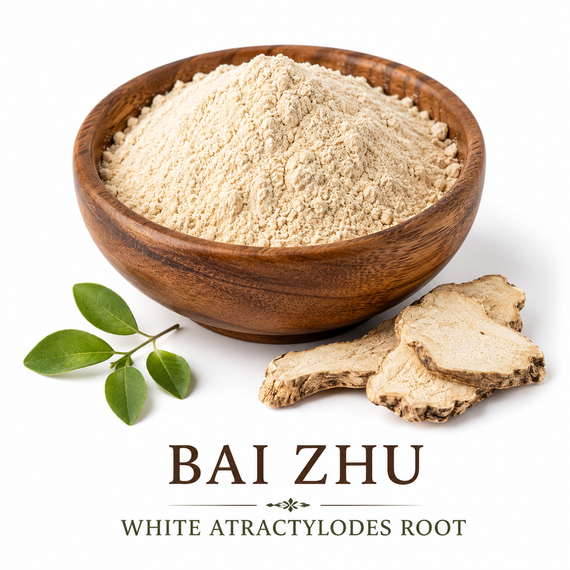


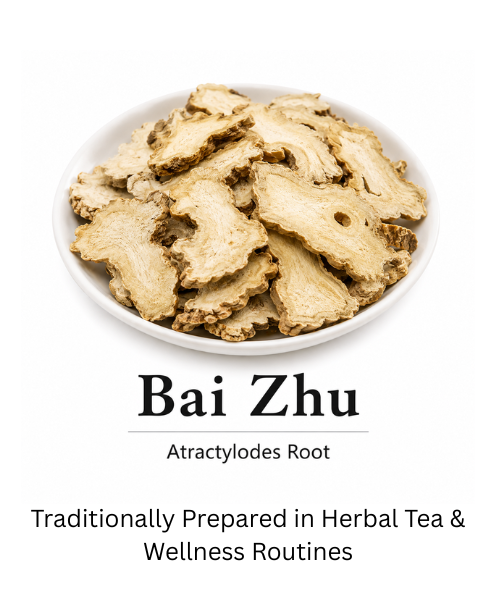
White Atractylodes Root (Bai Zhu) • Bulk Cut Herb Guide • Traditional-Use Education
Bai Zhu (白术) — White Atractylodes Root for Spleen Qi, Digestion, Dampness & Resilient Energy
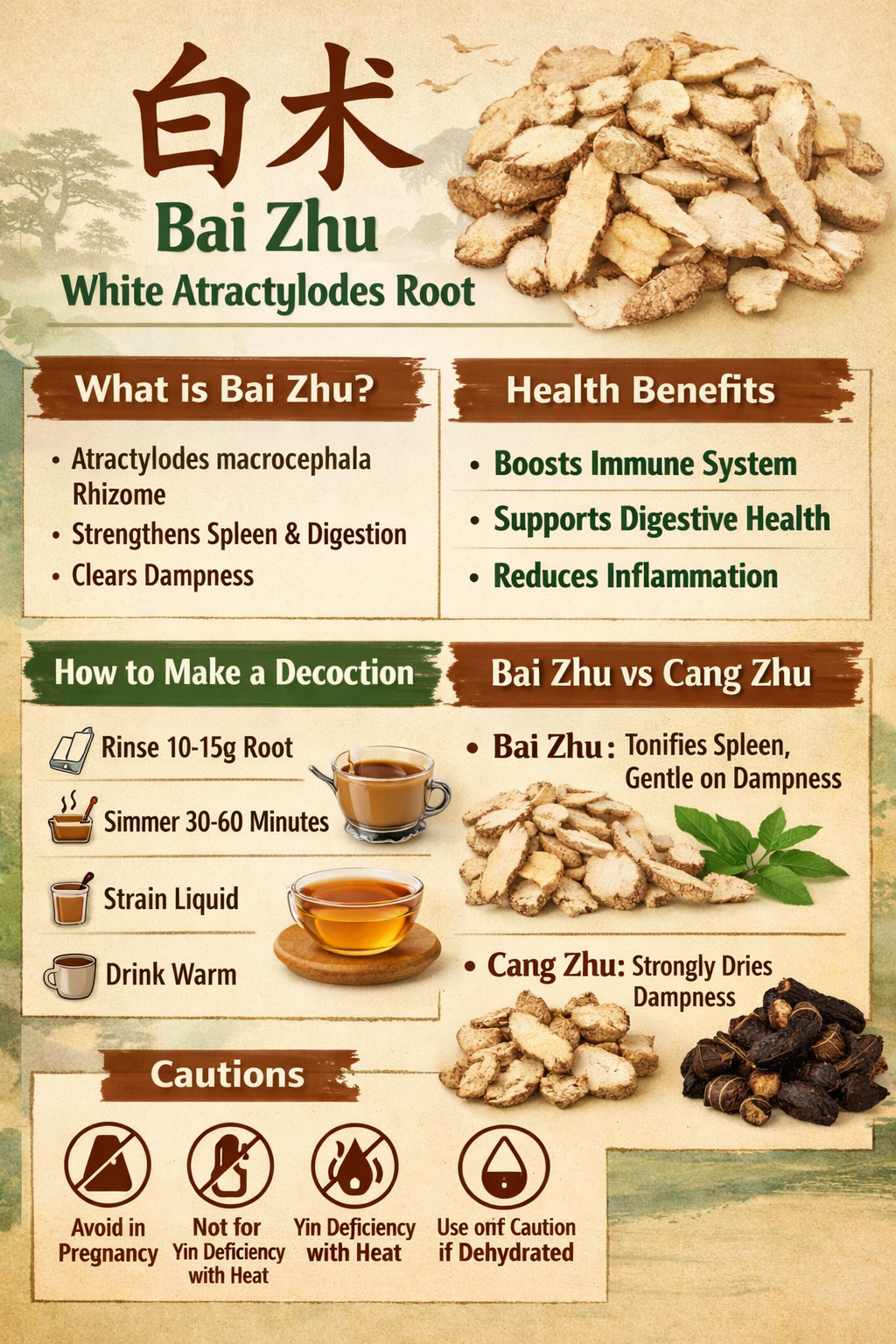
Bai Zhu (White Atractylodes Root; Atractylodes macrocephala) is a foundational herb in Traditional Chinese Medicine (TCM) used to tonify Spleen Qi, support digestion, and gently resolve dampness. This page explains what Bai Zhu is, how it’s traditionally used, how to make a decoction, who it’s for, how it differs from Cang Zhu (Black Atractylodes), and what cautions matter most.
Why this guide is written differently (and why that matters)
- Species-authenticated: We specify the exact botanical and do not treat “Atractylodes” as one interchangeable herb.
- Traditional-use + modern research: We explain classical TCM logic and cite research without making disease claims.
- Customer-first clarity: You’ll see who should use Bai Zhu, who shouldn’t, and how to prepare it safely.
Quick Facts On Bai Zhu
Common names: Atractylodes Root, White Atractylodes Root, Rhizoma Atractylodis Macrocephalae
Botanical name: Atractylodes macrocephala
Pin Yin: Bai Zhu
Channels: Spleen, Stomach, Liver
Properties: Bitter, sweet, warm, slightly acrid
Form: Cut / Sliced (sizes vary)
Other ingredients: None (nothing added)
Brand: Plum Flower (species-authenticated)
Origin: China
Package size: 500g (1.1 lb)
What Is Bai Zhu (White Atractylodes Root)?
Bai Zhu is the dried rhizome (root-like stem) of Atractylodes macrocephala, a classic Qi-tonifying herb in Traditional Chinese Medicine. In TCM, Bai Zhu is best known for tonifying Spleen Qi, supporting digestion, and drying dampness gently.
In plain language: Bai Zhu is often chosen when someone feels “run down” with digestive weakness—think low appetite, loose stools, bloating that improves with warmth, or a tendency toward heaviness and fluid retention.
Bai Zhu’s Long History in TCM (Why It’s Trusted)
Bai Zhu has been used for over a thousand years and is referenced in early Chinese materia medica texts including the Shen Nong Ben Cao Jing (Divine Farmer’s Materia Medica), one of the oldest pharmacopoeias in China. Historically, Bai Zhu was valued for its role in strengthening digestion, eliminating dampness, supporting vitality, and (under expert guidance) calming the fetus in pregnancy.
Many competitors mention “Spleen support” but skip the reason Bai Zhu matters: in TCM, the Spleen is the engine that turns food and fluids into usable energy (Qi). When that engine is weak, everything downstream suffers.
Traditional Uses + Research-Supported Benefits
Bai Zhu is traditionally used to: tonify Spleen Qi, augment Qi, dry dampness, support fluid metabolism, and help stop spontaneous sweating. Some individuals may experience occasional diarrhea if the herb is not a fit for their constitution.
1) Digestive strength (Spleen & Stomach support)
In TCM, Bai Zhu is a go-to herb for digestive weakness patterns such as loose stools, poor appetite, and bloating. Modern research on Atractylodes macrocephala and related formulas has explored its role in gastrointestinal comfort and resilience.
2) Immune system support (Defensive Qi / Wei Qi)
Traditionally, a strong Spleen helps build “Defensive Qi.” Research on Atractylodes macrocephala and its polysaccharides has examined immune-modulating activity and immune signaling pathways.
3) Anti-inflammatory + antioxidant activity (whole-herb chemistry)
Constituents such as atractylenolides and other sesquiterpenoids have been studied for antioxidant and anti-inflammatory properties. This supports why Bai Zhu is traditionally used in patterns involving dampness and stagnation.
Research is ongoing and varies by extract, processing, and formula context. We avoid exaggeration. Bai Zhu is best understood as a traditional pattern-based herb—especially effective when it matches the person’s constitution and symptoms.
Who Should Use Bai Zhu?
Bai Zhu is most commonly chosen for Spleen Qi deficiency patterns—especially when dampness is present. People often look for Bai Zhu when they want steady, foundational support for digestion, energy, and resilience.
- Low appetite, bloating after meals
- Loose stools / “weak digestion” patterns
- Fatigue that improves when digestion improves
- Heaviness, mild fluid retention, dampness tendency
- Frequent seasonal vulnerability (Defensive Qi support)
- Yin deficiency with heat signs (night sweats, thirst, red tongue)
- Pronounced dryness or dehydration
- Situations requiring strong damp-drying (often Cang Zhu instead)
- Pregnancy/nursing without professional guidance
How to Use White Atractylodes Root (Bai Zhu)
Bai Zhu is traditionally used in formulas, but it can also be prepared as a simple decoction. Decoction is often preferred because it extracts active compounds into water for traditional use.
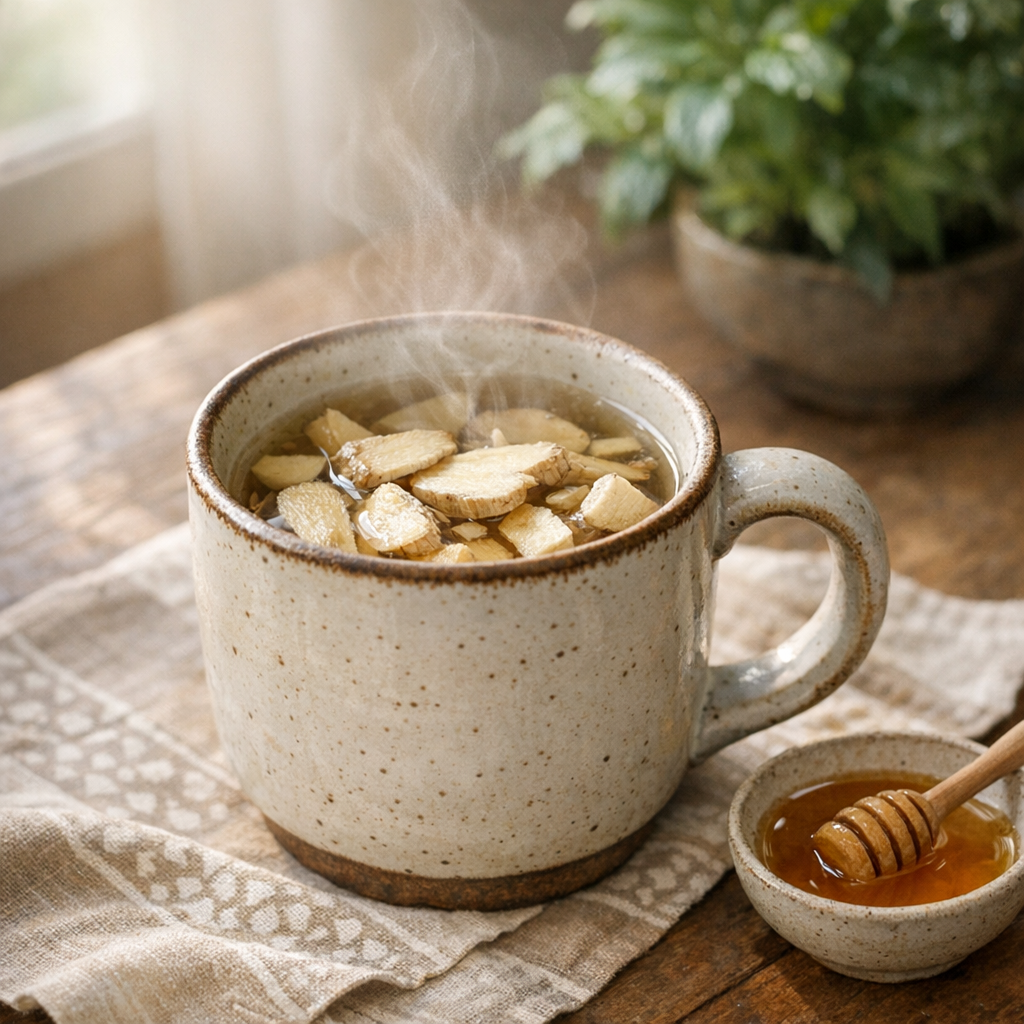 How to Make a Bai Zhu Decoction (Step-by-Step)
Ingredients:
- 10–15 grams dried Bai Zhu (cut/sliced)
- 500 ml water
Instructions:
- Rinse: Quickly rinse the Bai Zhu under cool water to remove dust.
- Boil: Add herb + water to a pot and bring to a gentle boil.
- Simmer: Reduce heat and simmer 30–60 minutes (longer simmer = stronger tea).
- Strain: Strain out the slices.
- Drink warm: Split into 2 servings (morning and evening).
Tip: If you’re new to Bai Zhu, start with the shorter simmer time and a smaller amount first, then adjust.
How long can you use Bai Zhu?
Traditional use depends on the pattern and whether Bai Zhu is used alone or in a formula. For ongoing support, most people do best with practitioner guidance to ensure it matches their constitution.
Bai Zhu vs Cang Zhu (White vs Black Atractylodes) — Avoid Mix-Ups
Bai Zhu and Cang Zhu are not interchangeable. They address different patterns and have different intensity. Choosing the wrong one can reduce results or worsen dryness and weakness.
| Bai Zhu (Atractylodes macrocephala) | Cang Zhu (Atractylodes lancea) |
|---|---|
| Main focus: Tonifies Spleen Qi | Main focus: Strongly dries dampness / turbidity |
| Best for deficiency + damp tendency | Best for excess damp obstruction |
| Supportive, foundational, steady | Aromatic, more drying, more forceful |
| Often used for loose stools + fatigue patterns | Often used for heaviness, thick greasy coating patterns |
Practical rule: If the root issue is weakness, Bai Zhu builds. If the issue is heavy excess dampness, Cang Zhu clears.
Naturally Occurring Components in White Atractylodes Root
Bai Zhu contains a range of naturally occurring constituents studied in the context of botanical chemistry, including: humulene, β-elemol, α-curcumene, atractylone, 3β-acetoxyatractylone, palmitic acid, atractylenolides, and amino acids. Processing and preparation can influence the final chemical profile.
Cautions, Contraindications & Possible Side Effects
- Pregnant or nursing (unless directed by a qualified professional)
- Dehydrated
- Yin deficiency with heat signs (night sweats, thirst, red tongue)
Possible side effects:
- Occasional diarrhea or digestive changes (often a sign it’s not the right match or dose)
- Dryness if used inappropriately in heat/dry constitutions
California Prop 65: This product carries a Prop 65 notice for California customers.
Frequently Asked Questions
What is Bai Zhu used for in TCM?
Traditionally, Bai Zhu tonifies Spleen Qi, augments Qi, dries dampness, supports fluid metabolism, and helps stop spontaneous sweating. It’s commonly chosen when digestive weakness and fatigue appear together.
How do I make Bai Zhu tea?
Use a decoction: simmer 10–15g of cut Bai Zhu in 500ml water for 30–60 minutes, strain, and drink warm (split into 2 servings).
Can I substitute Cang Zhu for Bai Zhu?
Generally no. Bai Zhu builds deficient Spleen Qi; Cang Zhu is more forcefully drying for excess damp patterns. They may look similar in English, but they act differently in practice.
Who should avoid Bai Zhu?
Avoid if pregnant/nursing without guidance, dehydrated, or experiencing Yin deficiency with heat signs such as night sweats, thirst, and a red tongue.
Product Information: White Atractylodes Root (Bai Zhu) — Cut Form
Common Name: White Atractylodes Root
Botanical Name: Atractylodes macrocephala
Pin Yin: Bai Zhu
Form: Cut / Sliced (sizes vary)
Other Ingredients: None
Package Size: 500g (1.1 lb)
Origin: China
Brand: Plum Flower (species-authenticated herbs)
Start with a simple decoction and let your digestion guide the pace. If you’re building a classic Spleen Qi support plan, Bai Zhu is one of the best foundational herbs to begin with.
References (PubMed / PMC)
Below are research and review resources on Atractylodes macrocephala constituents and biological activity. These references support the discussion of immune signaling, anti-inflammatory/antioxidant activity, and GI research context.
- Bailly C (2021) — Review of atractylenolides and antioxidant/anti-inflammatory properties (PubMed)
- Jeong D et al. (2019) — Anti-inflammatory compounds from A. macrocephala; cytokine/NF-κB findings (PMC)
- Jeong D et al. (2019) — PubMed record for anti-inflammatory compounds; IL-1β/IL-6/TNF-α, NF-κB (PubMed)
- Kwak TK et al. (2018) — Oral administration and immune-related findings (PMC)
- Bai W et al. (2023) — Meta-analysis of Atractylodes macrocephala–Paeonia lactiflora class formulas for IBS (PMC)
- Liu C et al. (2022) — Review on Atractylodes polysaccharides and immune-related effects (PMC)
- Li L et al. (2023) — Anti-inflammatory and antioxidant effects of selected constituents in cell models (PMC)
About Plum Flower Quality Herb Cut Bulk Herbs
Plum Flower is an established worldwide manufacturer of high-quality Chinese herbs, and innovative Chinese medicinal herbs and products. Plum Flower uses sulfur-free herbs and laboratory tests its products for contamination and heavy metals, such as mercury, lead, and pesticides.
Main Characteristics (Attributes) of Herbs
- Harvested at the proper level of maturity and correct time of the season to maximize potency.
- Free from Chlorine
- Manufactured without the use of sulphur
- Preservative Free
- Made at GMP internationally certified facilities (Good Manufacturing Practices) Quality control tests are done at the manufacturing site and at third party labs to confirm results
- Aluminum Phosphate free
- Packaged in an airtight sealed bag
- Pin Yin Names and Botanical Names are listed on the bag
- Certificate of Analysis are available upon request
- Conforms to Standards of Chinese Pharmacopeia
- No dyes, colors, or bleaching of the herbs
- We are an authorized direct distributor of Plum Flower Herbs.
- 500 gram bag size which equal anywhere from 4 to 6 cups of herbs
Chinese Traditional herbs should be regarded as a supplementary aspect to modern western healthcare, and not as a replacement. Chinese traditional herbs ( Teas ) emphasize harmony, and balance.
Why use Chinese Bulk Herbs?
Traditional Chinese Medicine curative herbal formulas have been developed, improved and perfected for over 5000 years.
Traditional Chinese Medicine is an ancient, holistic medical system used all over the world to treat a wide variety of health issues. Traditional Chinese Medicine (TCM) works by helping to balance the bodies’ functions thus restoring health.
As soon as the Chinese people began to carve out a civilization in ancient China it developed a cultural heritage that has continued to the present day. TCM is the oldest and one of the safest, effective systems one can use to care for their body, it promotes health and helps to sustain longevity.
Chinese herbs have been with mankind for 5,000 years and will be with us in the years ahead – it is using nature’s bountiful gifts to have good health.
White Atractylodes Root • Traditional Chinese Herbal Education • Species-Authenticated Herb Guide
Bai Zhu (白术) — White Atractylodes Root for Digestion, Spleen Qi, Dampness & Steady Energy
Bai Zhu (White Atractylodes Root; Atractylodes macrocephala) is one of the most important digestive-support herbs in Traditional Chinese Medicine. Traditionally used to tonify Spleen Qi, gently dry dampness, and support digestive resilience, Bai Zhu has been valued for centuries in herbal formulas focused on strength, nourishment, and balance.
Updated: May 21, 2026 • Reviewed by: Sarah Aries • Educational Traditional-Use Content
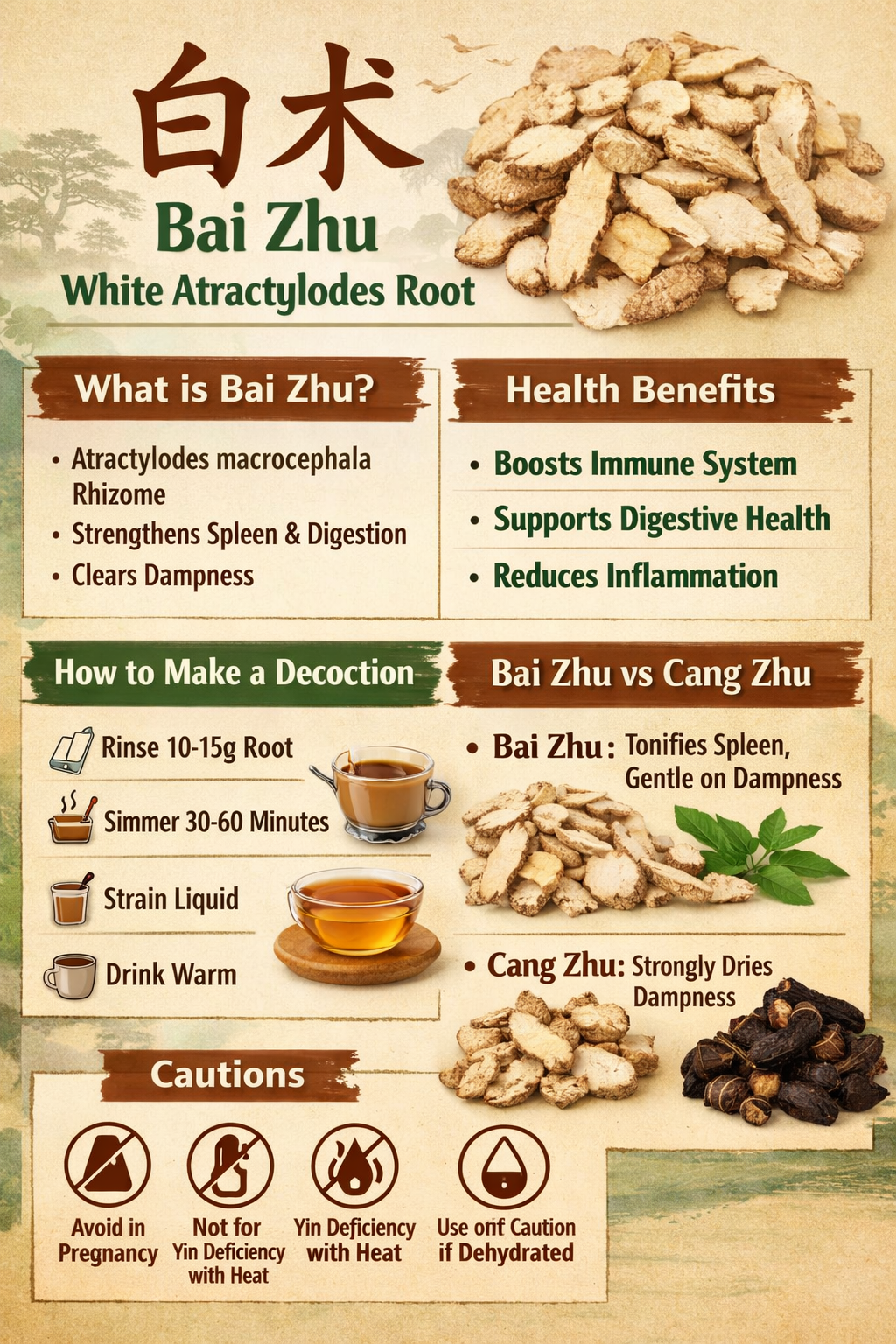
Quick Answer
Bai Zhu is the dried rhizome of Atractylodes macrocephala, traditionally used in Chinese herbal medicine to strengthen Spleen Qi, support digestion, help manage dampness patterns, and promote balanced energy. It is commonly prepared as a decoction and frequently included in classic TCM formulas focused on digestive weakness and fatigue.
What Is Bai Zhu?
Bai Zhu is the dried rhizome of Atractylodes macrocephala, a foundational herb in Traditional Chinese Medicine used primarily to strengthen digestive function and support Spleen Qi.
In TCM theory, the Spleen is responsible for transforming food and fluids into usable energy. When the Spleen becomes weak, people may experience bloating, fatigue, poor appetite, loose stools, heaviness, or dampness accumulation.
Bai Zhu is traditionally used to help strengthen that digestive “engine” while gently drying excess dampness without being as harsh as stronger drying herbs.
Bai Zhu's Long History in Traditional Chinese Medicine
Bai Zhu has been used for over a thousand years and appears in early Chinese herbal texts including the Shen Nong Ben Cao Jing, one of the oldest Chinese materia medica references.
Historically, Bai Zhu became known as one of the primary herbs for digestive weakness, fluid metabolism imbalance, fatigue linked to poor nourishment, and constitutional dampness patterns.
Bai Zhu is not just a “digestion herb.” In TCM, digestion is viewed as the center of energy production. That is why Bai Zhu appears in so many classic formulas designed to support long-term resilience and recovery.
Traditional Benefits of Bai Zhu
1. Digestive Support
Bai Zhu is traditionally used when digestion feels weak, sluggish, or inconsistent. In TCM, it is commonly associated with poor appetite, loose stools, bloating, and digestive fatigue.
2. Spleen Qi Support
One of Bai Zhu’s primary traditional roles is strengthening Spleen Qi. In TCM, strong Spleen Qi supports energy, nourishment, fluid transformation, and resilience.
3. Dampness Support
Bai Zhu is traditionally used to gently dry dampness patterns linked to heaviness, sluggishness, fluid retention tendencies, and digestive imbalance.
4. Energy & Vitality Support
Many classic TCM formulas use Bai Zhu as part of broader Qi-support strategies because digestive strength is closely tied to energy production in Chinese medicine.
5. Defensive Qi (Wei Qi) Support
Traditional theory suggests strong digestion helps support Defensive Qi, which is associated with the body’s outer protective systems.
6. Traditional Fluid Balance Support
Bai Zhu is often discussed in TCM in relation to fluid transformation and transportation within the body.
7. Research Interest in Atractylodes Compounds
Modern botanical research has explored naturally occurring compounds such as atractylenolides, polysaccharides, sesquiterpenoids, and antioxidant constituents found in Atractylodes macrocephala.
Traditional herbs work best when matched appropriately to the individual and constitution. This page is educational and not intended to diagnose, treat, cure, or prevent disease.
Who Traditionally Uses Bai Zhu?
Traditionally Considered a Better Fit
- Low appetite
- Digestive weakness
- Loose stools
- Fatigue linked to digestion
- Dampness tendencies
- Heaviness after meals
- Weak constitutional patterns
Usually Not a Traditional Match
- Pronounced dryness
- Yin deficiency heat patterns
- Strong dehydration
- High internal heat signs
- Pregnancy without professional guidance
How To Make a Bai Zhu Decoction
Bai Zhu is commonly prepared as a decoction because simmering helps extract many of the herb’s traditional constituents into water.
Simple Bai Zhu Tea Recipe
| Step | Instructions |
|---|---|
| Amount | Use 10–15 grams dried Bai Zhu. |
| Water | Add approximately 500 ml water. |
| Boil | Bring to a gentle boil. |
| Simmer | Simmer 30–60 minutes. |
| Drink | Strain and drink warm. |
Brewing Tip
Longer simmering generally creates a stronger decoction. If you are new to Bai Zhu, start with a lighter brew and shorter simmer time first.
Bai Zhu vs Cang Zhu (White vs Black Atractylodes)
| Bai Zhu | Cang Zhu |
|---|---|
| Tonifies Spleen Qi | Strongly dries dampness |
| Gentler and more supportive | More aromatic and forceful |
| Often used for weakness patterns | Often used for excess damp patterns |
| Better for digestive fatigue | Better for heavy damp obstruction |
Although their English names sound similar, Bai Zhu and Cang Zhu are traditionally used very differently in Chinese medicine.
Naturally Occurring Components in Bai Zhu
Bai Zhu contains naturally occurring compounds studied in botanical research including:
- Atractylenolides
- Polysaccharides
- Sesquiterpenoids
- Humulene
- β-elemol
- Atractylone
- Antioxidant plant compounds
Cautions & Safety
- Pregnant or nursing
- Experiencing dehydration
- Showing Yin deficiency heat signs
- Using medications
- Managing a medical condition
Some people may experience digestive changes if Bai Zhu is not appropriate for their constitution or preparation strength.
Frequently Asked Questions
What is Bai Zhu traditionally used for?
Bai Zhu is traditionally used in TCM for digestive weakness, Spleen Qi support, dampness patterns, and foundational energy support.
How do you make Bai Zhu tea?
Simmer 10–15 grams of Bai Zhu in approximately 500 ml water for 30–60 minutes, then strain and drink warm.
Is Bai Zhu the same as Cang Zhu?
No. Bai Zhu and Cang Zhu are different herbs traditionally used for different TCM patterns.
What does Bai Zhu taste like?
Bai Zhu is traditionally described as bitter, sweet, warm, and slightly acrid.
Scientific References
Related Links
Educational Disclaimer
This page is for educational purposes only and is not intended to diagnose, treat, cure, or prevent disease. Traditional herbal information reflects historical and Traditional Chinese Medicine usage.
1 Review
-
Excellent
Excellent, as always