

Discover the Health Benefits of Bai Zhu (White Atractylodes) for Digestion and Immune Support
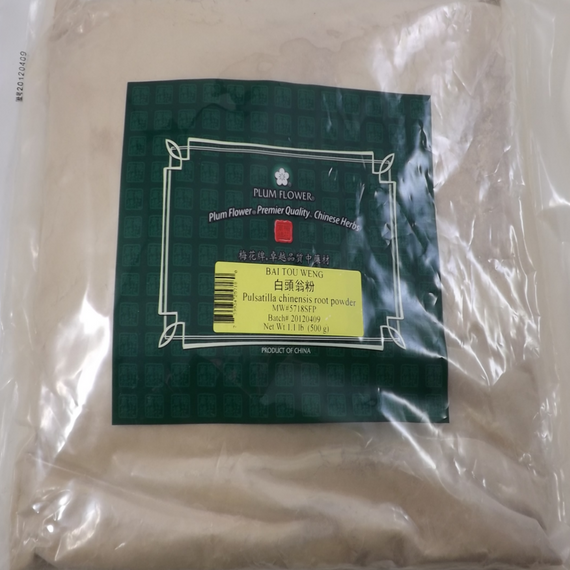
White Atractylodes Root (Bai Zhu) Powder – Plum Flower, 1 lb
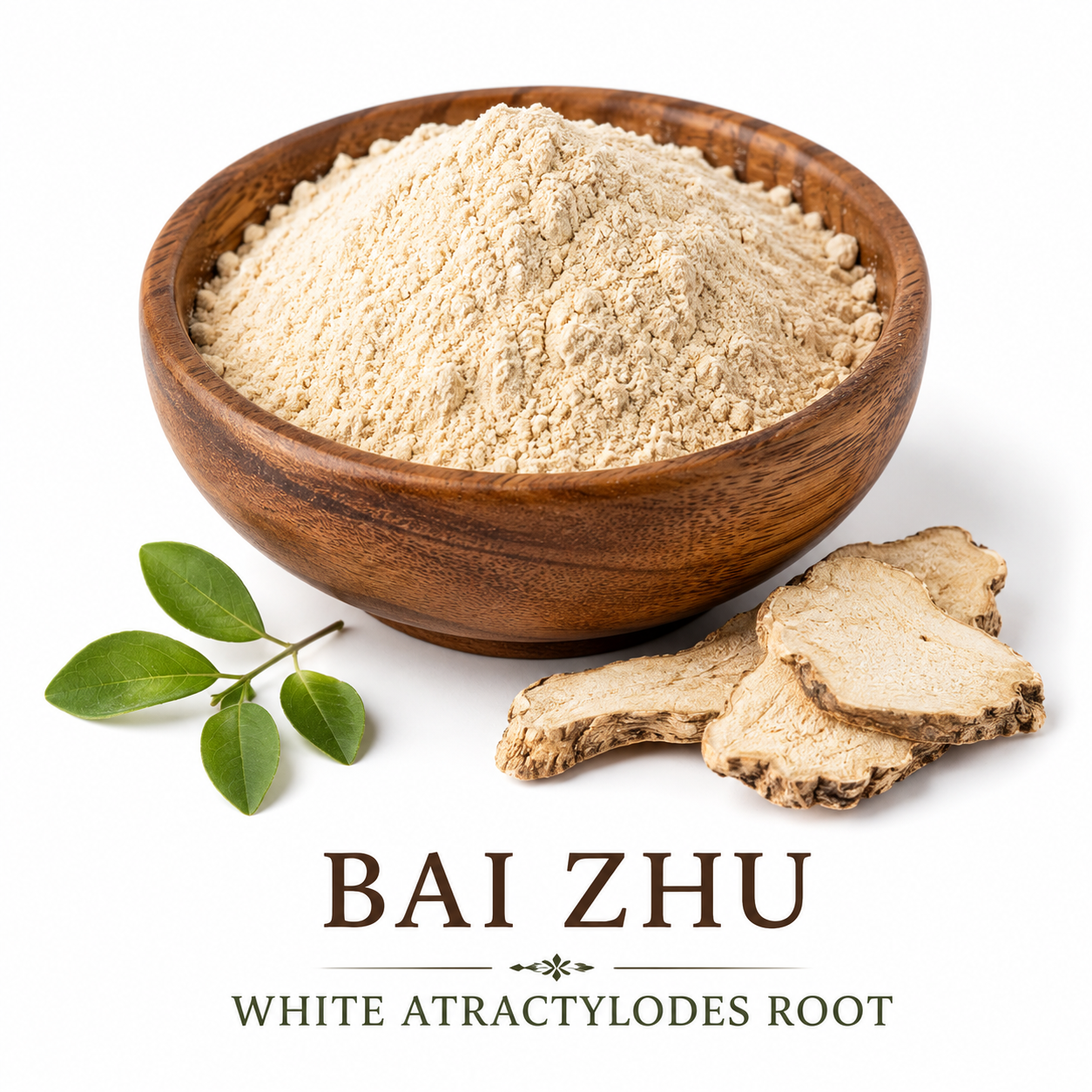 Convenient powdered Bai Zhu (Atractylodes macrocephala) for traditional Chinese herbal preparations.
Bai Zhu, commonly called White Atractylodes Root, is an important herb in Traditional Chinese Medicine traditionally associated with strengthening Spleen Qi and addressing patterns involving Dampness. This Plum Flower product provides Bai Zhu already ground into powder, eliminating the need to cut or grind the dried rhizome yourself.
If your formula or practitioner calls for Bai Zhu powder, this page will help you confirm the herb, understand its traditional characteristics, decide whether powder is the right form, recognize normal quality, and compare Bai Zhu with similar Chinese herbs before you purchase.
All About Bai Zhu At A Glance
| Common Name | White Atractylodes Root |
|---|---|
| Pinyin Name | Bai Zhu |
| Botanical Name | Atractylodes macrocephala |
| Plant Part | Rhizome |
| Traditional Flavor | Bitter and sweet |
| Traditional Nature | Warm |
| Traditional Meridians | Spleen and Stomach |
| Form | Powder |
| Brand | Plum Flower |
| Package Size | 500 Grams (1.1 pound) |
What Is Bai Zhu?
Bai Zhu is the dried rhizome of Atractylodes macrocephala, a plant in the Asteraceae family. Although commonly called White Atractylodes Root in English herbal commerce, the part traditionally used is technically an underground rhizome.
Bai Zhu has a long history in Chinese herbal practice and appears in many classical formulas. Traditional practitioners evaluate it by its warm nature, bitter-sweet flavor, Spleen and Stomach meridian associations, and the role it plays alongside other herbs in a formula.
Why Do Customers Traditionally Choose Bai Zhu?
In Traditional Chinese Medicine, Bai Zhu is best known as an herb that tonifies Spleen Qi and traditionally helps transform Dampness. It has historically been included in formulas when a practitioner identifies patterns associated with weak Spleen Qi, accumulation of Dampness, or difficulty properly transforming food and fluids within the traditional system.
Classical herbal literature also describes Bai Zhu in formulas related to spontaneous sweating from Qi deficiency and traditional support during pregnancy when professionally selected.
Is This Bai Zhu Powder the Right Product for You?
This product may be a good fit when you are looking for:
- Bai Zhu specifically, rather than another Atractylodes species.
- Atractylodes macrocephala in powdered form.
- A Chinese herb powder for a traditional formula.
- A convenient form that requires no grinding.
- 500 grams (1.1 pounds) Plum Flower package.
If your formula specifically calls for whole or sliced Bai Zhu, powder may not be the form you need. Match the product form to your practitioner or preparation instructions.
Why Choose Plum Flower Bai Zhu Powder?
Powder is about convenience. The herb has already been milled, which makes it easier to incorporate into preparations that specifically require powdered Bai Zhu.
- Correct herb: Bai Zhu / Atractylodes macrocephala.
- Powder form: No cutting or home grinding required.
- Bulk quantity: 500 grams package.
- Established brand: Plum Flower Chinese herbal product.
- Versatile: Appropriate when powdered Bai Zhu is specified for the preparation.
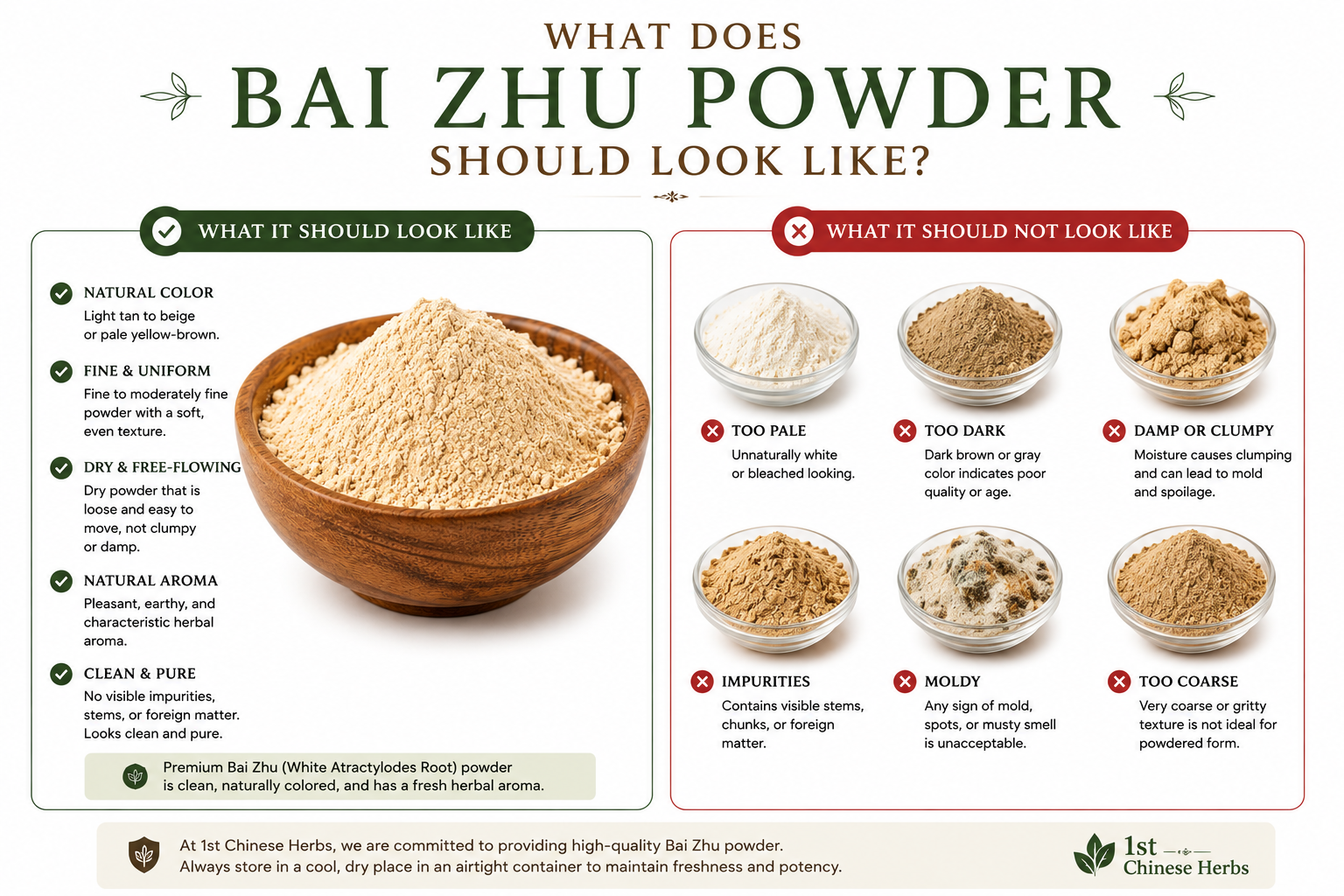
What Does Quality Bai Zhu Powder Look Like?
Because Bai Zhu has already been ground, you cannot inspect the original rhizome slices. That makes color, aroma, texture, cleanliness, and trusted sourcing especially important.
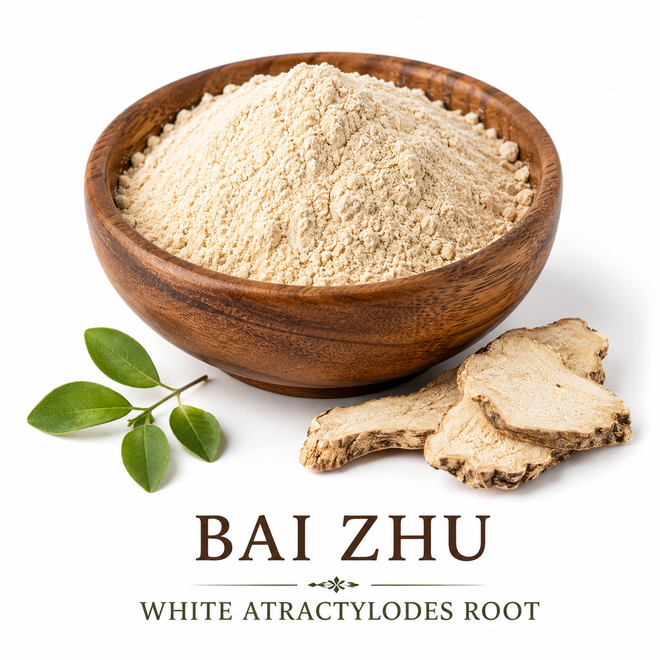
- Natural light tan to beige or pale yellow-brown color.
- Fine to moderately fine herbal powder.
- Dry and free-flowing rather than damp or sticky.
- Distinct natural herbal aroma.
- No visible mold, insects, or unusual foreign material.
Agricultural products naturally vary slightly in color and aroma from batch to batch. A small amount of variation is expected.
Bai Zhu Powder vs. Cut or Whole Bai Zhu
| Form | Best Suited For | Main Difference |
|---|---|---|
| Powder | Preparations specifically calling for powdered herbs. | Convenient and requires no grinding. |
| Cut / Sliced | Traditional water decoctions and formula preparation. | Allows visual inspection of the rhizome pieces. |
| Extract Granules | Customers or practitioners specifically using concentrated extracts. | More processed and not equivalent gram-for-gram to raw powder. |
What Does Bai Zhu Taste Like?
Bai Zhu is traditionally described as bitter and sweet. Powder may have an earthy, root-like, mildly aromatic flavor with a noticeable bitter finish. When combined with other herbs, its flavor becomes part of the overall formula rather than dominating the preparation.
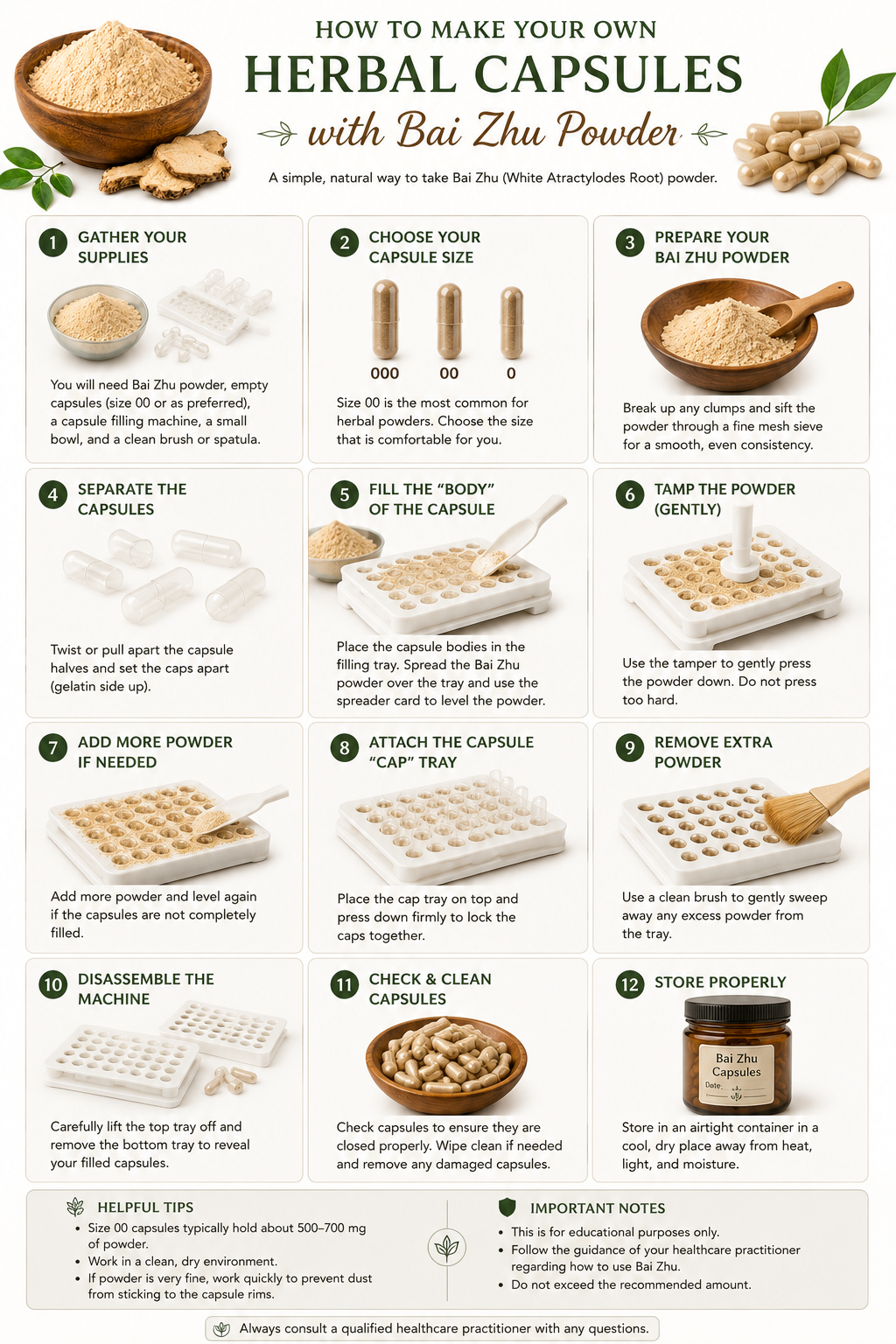 How Is Bai Zhu Powder Used?
Bai Zhu powder may be incorporated into traditional herbal preparations when powdered herbs are specifically called for. Because it is already finely ground, it behaves differently from sliced rhizome in water and generally does not require the same long decoction process used for hard roots and bark.
Follow the preparation instructions for your specific formula or the directions of a qualified practitioner. Do not assume raw powder, sliced Bai Zhu, and concentrated extract granules can be substituted for one another in equal amounts.
Bai Zhu Compared With Similar Chinese Herbs
| Herb | Traditional Focus | Key Difference |
|---|---|---|
| Bai Zhu White Atractylodes |
Traditionally tonifies Spleen Qi and addresses Dampness. | Warm, bitter-sweet herb strongly associated with Spleen Qi. |
| Dang Shen Codonopsis |
Traditionally tonifies Qi, especially Spleen and Lung Qi. | Often selected for broader Qi nourishment rather than Bai Zhu's stronger traditional Dampness focus. |
| Huang Qi Astragalus |
Traditionally tonifies Qi and supports the exterior. | Has different traditional actions and formula roles than Bai Zhu. |
| Shan Yao Chinese Yam |
Traditionally tonifies Spleen, Lung, and Kidney systems. | Generally described as more neutral and nourishing in traditional character. |
These herbs frequently appear together because they contribute different traditional functions. They should not automatically be substituted for one another.
What Does Modern Research Examine?
Modern research on Atractylodes macrocephala has examined naturally occurring compounds including atractylenolides, polysaccharides, volatile constituents, and other plant compounds. Researchers have investigated their chemical and biological properties in laboratory, animal, and extract studies.
Those studies do not establish that ordinary Bai Zhu powder can diagnose, prevent, treat, or cure disease in people.
Frequently Asked Questions About Bai Zhu Powder
Is Bai Zhu the same as White Atractylodes Root?
Yes. White Atractylodes Root is a common English market name for Bai Zhu. Botanically, the traditional plant part is the rhizome of Atractylodes macrocephala.
Is this raw powder or an extract?
This product is sold as Plum Flower Bai Zhu powder. It should not be confused with concentrated extract granules, which are produced differently.
Why buy powder instead of sliced Bai Zhu?
Powder eliminates the need to grind the herb and may be more convenient when a preparation specifically calls for powdered Bai Zhu. Sliced Bai Zhu is generally preferred for traditional decoctions.
What color should Bai Zhu powder be?
Natural Bai Zhu powder is generally light tan, beige, or pale yellow-brown. Minor batch-to-batch color differences are normal in botanical products.
What should Bai Zhu powder smell like?
It should have a recognizable natural herbal and root-like aroma. A musty, moldy, or strongly sour smell would not be expected.
Is Bai Zhu the same as Cang Zhu?
No. Bai Zhu and Cang Zhu are different Atractylodes herbs with different botanical identities and traditional characteristics. They should not automatically be substituted for one another.
Is Bai Zhu the same as Chinese Yam?
No. Bai Zhu is Atractylodes macrocephala. Chinese Yam, known as Shan Yao, is a different herb with different traditional properties and uses.
How should Bai Zhu powder be stored?
Keep it tightly sealed in a cool, dry, dark place. Powder has more exposed surface area than whole herbs, so protecting it from moisture, heat, air, and strong odors is particularly important.
How do I know whether powder is the correct form?
Check your formula or practitioner instructions. If they specifically call for powdered Bai Zhu, this form may be appropriate. If the instructions call for sliced raw herb or concentrated extract granules, choose that form instead.
Bai Zhu Safety and Cautions
Use Bai Zhu according to the guidance appropriate for your herbal formula. Traditional references advise that Bai Zhu may not be appropriate for every pattern or constitution.
If you are pregnant or nursing, take prescription medication, have a significant medical condition, or use multiple herbs and supplements, consult a qualified healthcare professional before use.
Continue Learning
References
- "Bai Zhu (Atractylodes Macrocephala)." Chinese Herbs Healing. Web. 23 Sept. 2015. <http://www.chineseherbshealing.com/bai-zhu-atractylodes-macrocephala/>.
- Liu H, Zhu Y, Zhang T, Zhao Z, Zhao Y, Cheng P, Li H, Gao H, Su X. Anti-tumor effects of atractylenolide I isolated from Atractylodes macrocephala in human lung carcinoma cell lines. Molecules. 2013 Oct 29;18(11):13357-68. doi: 10.3390/molecules181113357. PubMed PMID: 24172243.
- Song HP, Li RL, Zhou C, Cai X, Huang HY. Atractylodes macrocephala Koidz stimulates intestinal epithelial cell migration through a polyamine dependent mechanism. J Ethnopharmacol. 2015 Jan 15;159:23-35. doi: 10.1016/j.jep.2014.10.059. Epub 2014 Nov 12. PubMed PMID: 25446597.
- https://herbpathy.com/Uses-and-Benefits-of-Bai-Zhu-Cid3939
- https://www.americandragon.com/Individualherbsupdate/BaiZhu.html
- (1) https://www.ncbi.nlm.nih.gov/pmc/articles/PMC5796224/
- (2) https://www.ncbi.nlm.nih.gov/pmc/articles/PMC6017956/
- https://en.wikibooks.org/wiki/Traditional_Chinese_Medicine/Usage_Of_Single_Herbs
- http://www.shen-nong.com/eng/herbal/baizhu.html