


Cherokee Rose Fruit – Jin Ying Zi – Whole – Nuherbs Lab Tested – 1 lb
Jin Ying Zi is the dried mature fruit of Rosa laevigata, commonly known as Cherokee rose. It has a long history of use in Chinese herbal traditions and is categorized in Traditional Chinese Medicine (TCM) among herbs traditionally described as stabilizing and binding.
This product contains whole (halves) dried Jin Ying Zi fruit, rather than powder, extract, granules, capsules, or a finished herbal formula. Whole-herb form gives herbalists and experienced customers flexibility when preparing traditional decoctions or using the herb as directed by a qualified practitioner.
Jin Ying Zi Product Details
Botanical Name: Rosa laevigata Michx.
Pharmaceutical Name: Rosae Laevigatae Fructus
Pin Yin: Jin Ying Zi (Jīn Yīng Zǐ)
Chinese Name: 金樱子
Common Name: Cherokee Rose Fruit
Plant Part: Mature fruit
Form: Whole dried fruit (halves)
Package Size: 1 lb
Origin: China
Brand: Nuherbs Lab Tested
Other Ingredients: None
What Is Jin Ying Zi?
Jin Ying Zi is the Chinese herbal name for the mature fruit of Rosa laevigata, a member of the rose family (Rosaceae).
The plant produces distinctive oval to pear-shaped fruits. Once mature, the fruits are harvested, dried, and prepared for use as Chinese herbal material.
The pharmaceutical name Rosae Laevigatae Fructus specifically refers to the fruit. This is important because the root and other portions of Rosa laevigata have also appeared in traditional herbal literature, but they are different herbal materials.
This product is the fruit.
Quick Guide to Jin Ying Zi
| Herbal Information | Details |
|---|---|
| Common Name | Cherokee Rose Fruit |
| Pin Yin | Jin Ying Zi |
| Chinese | 金樱子 |
| Botanical Name | Rosa laevigata Michx. |
| Pharmaceutical Name | Rosae Laevigatae Fructus |
| Family | Rosaceae |
| Plant Part | Mature fruit |
| Form | Whole dried fruit (halves) |
| Traditional Taste | Sour, sweet and astringent |
| Traditional Temperature | Neutral |
| Traditional Channels | Kidney, Bladder and Large Intestine |
| Package Size | 1 lb |
| Origin | China |
| Other Ingredients | None |
| Brand | Nuherbs Lab Tested |
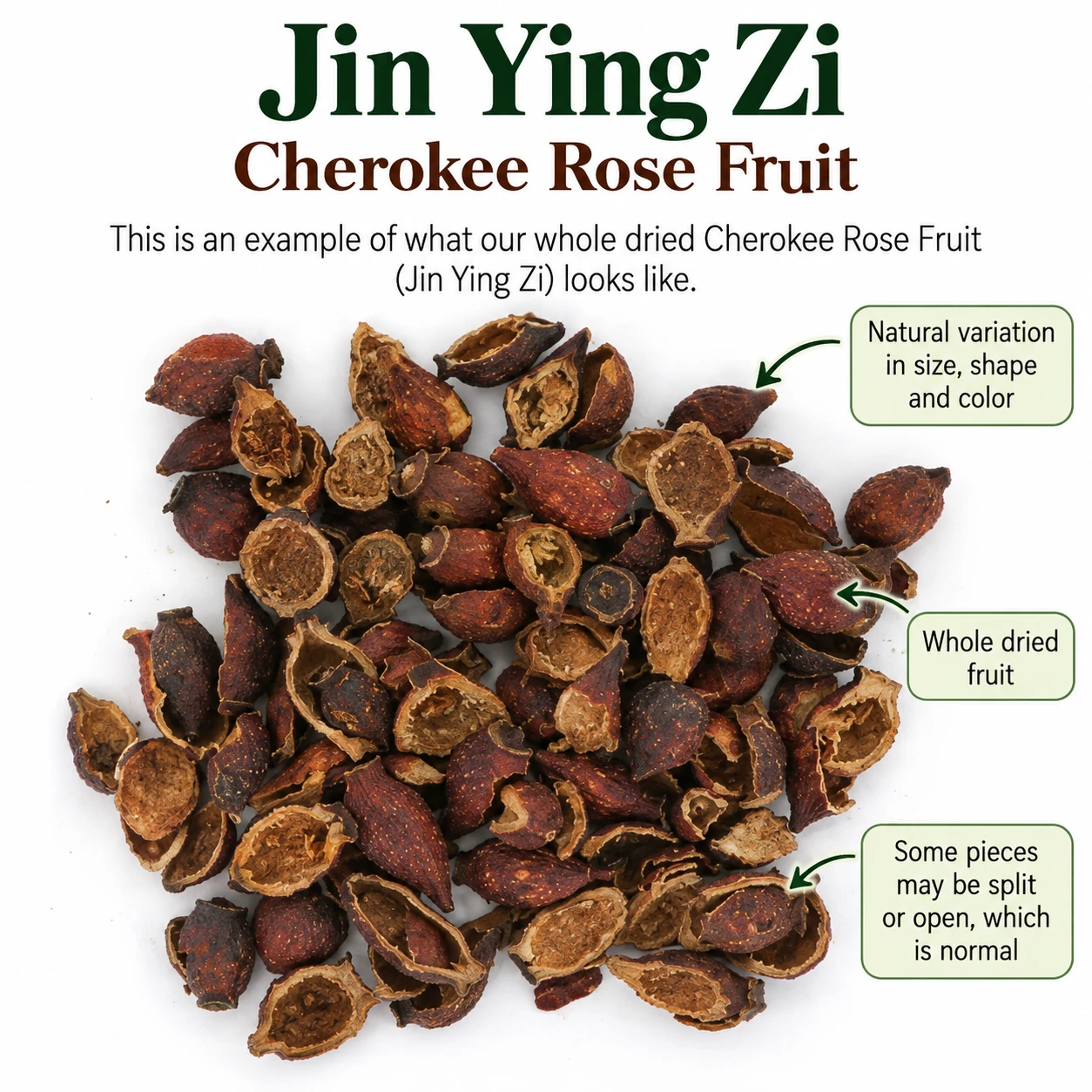
What Does Whole (Halves) Jin Ying Zi Look Like?
Whole Jin Ying Zi does not resemble the soft rose hips commonly seen in herbal tea blends.
The dried fruit is generally firm and oval or pear-shaped. Natural variation in size, shape and color should be expected because this is minimally processed botanical material rather than a manufactured tablet or capsule.
Traditional descriptions of the dried herb describe the fruit as reddish-yellow to reddish-brown with a firm texture.
Because this is a natural whole herb, individual pieces will not be identical.
What Does Jin Ying Zi Taste Like?
Jin Ying Zi is traditionally described as:
Sour • Sweet • Astringent • Neutral
“Astringent” describes the dry, puckering sensation produced by certain plant compounds, particularly tannins.
It does not mean that something has been artificially added to the herb.
Jin Ying Zi in Traditional Chinese Herbalism
In Traditional Chinese Medicine, Jin Ying Zi is classified among herbs traditionally described as stabilizing and binding.
Traditional materia medica describes Jin Ying Zi as sour, sweet and astringent in taste and neutral in temperature, with traditional associations with the:
-
Kidney channel
-
Bladder channel
-
Large Intestine channel
Within the historical TCM framework, Jin Ying Zi has traditionally been incorporated into formulas when an herbalist's strategy calls for astringing, securing or consolidating.
These descriptions represent traditional Chinese herbal theory. Terms such as Kidney, Bladder, Essence, securing and astringing have specific meanings within the TCM system and should not be interpreted as claims that this product treats diseases of the modern anatomical kidneys, bladder or intestines.
What Does “Stabilizing and Binding” Mean in TCM?
This phrase can be confusing if you are new to Chinese herbs.
In TCM theory, herbs in the stabilizing and binding category are characterized by their traditional astringent or consolidating qualities.
Think of the category as describing the traditional strategy of the herb, rather than a modern medical diagnosis.
Jin Ying Zi is therefore quite different from herbs traditionally categorized as warming tonics, cooling herbs, Qi tonics or Blood-moving herbs.
The category helps trained herbalists understand how the herb historically fits into a larger formula.
Is Jin Ying Zi a Single Herb or a Formula?
Jin Ying Zi is a single herb.
The package contains Rosa laevigata fruit rather than a multi-herb Chinese formula.
Traditional practitioners may use Jin Ying Zi by itself in certain preparations or combine it with other herbs according to an individualized formula.
Do not assume that adding additional herbs will make a preparation better or stronger. Chinese herbal formulas are traditionally constructed according to the individual pattern and intended herbal strategy.
Whole Jin Ying Zi vs. Powder vs. Extract
These forms should not be considered interchangeable simply because they come from the same plant.
| Form | What It Is | Common Reason for Choosing It |
|---|---|---|
| Whole Jin Ying Zi | Dried fruit with minimal processing | Traditional preparation and visual identification of the herb |
| Jin Ying Zi Powder | Dried herb ground into powder | Convenient when a finely ground form is preferred |
| Jin Ying Zi Extract | Concentrated preparation | Smaller quantity of concentrated herbal material |
| Jin Ying Zi Formula | Jin Ying Zi combined with other herbs | Used when following a specific traditional formula |
This listing is for whole (halves) dried Jin Ying Zi fruit.
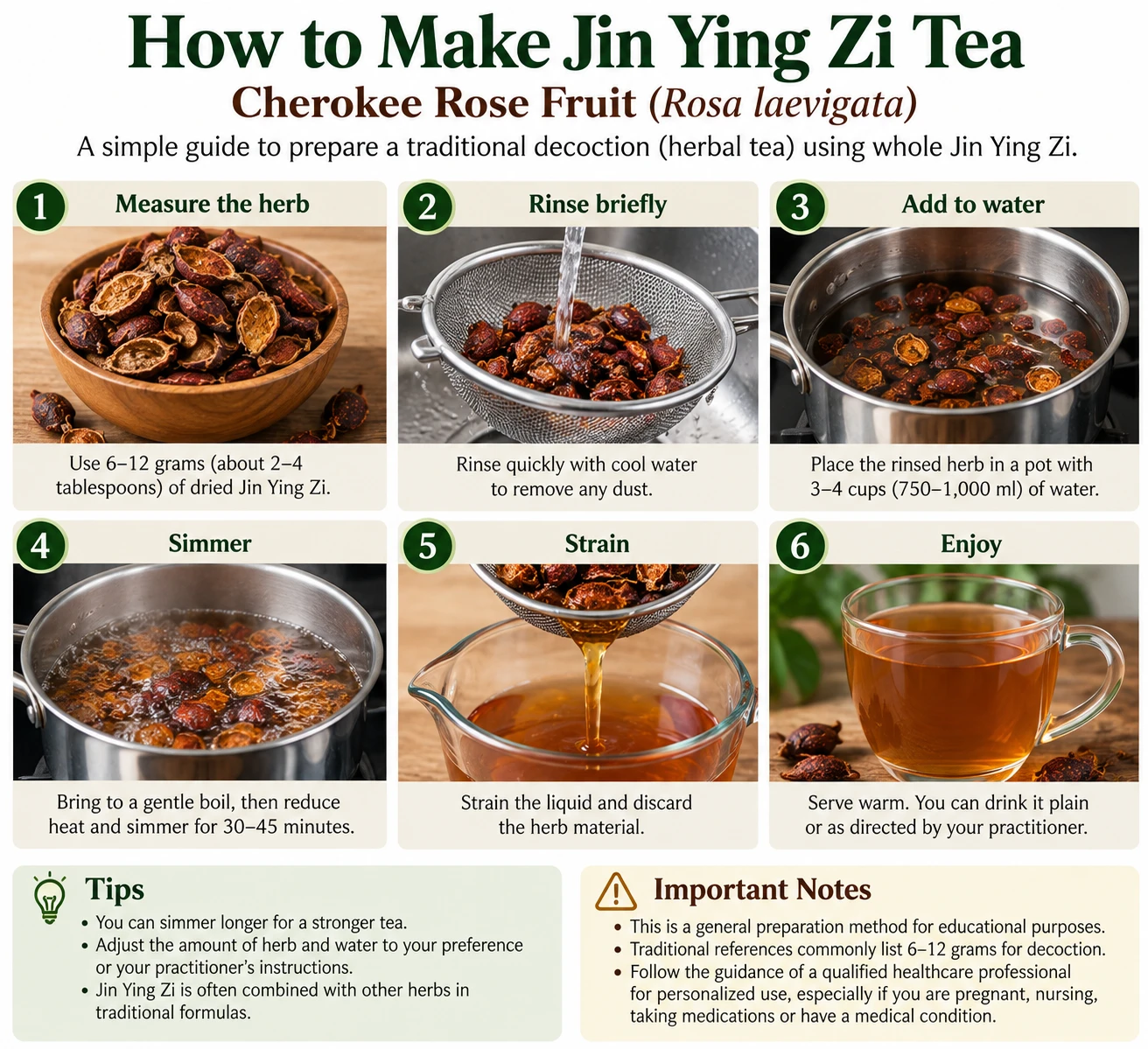
How Is Whole Jin Ying Zi Traditionally Prepared?
One traditional method for preparing Chinese bulk herbs is a decoction.
A decoction is made by simmering herbal material in water for a period of time and then straining the liquid.
Traditional references commonly describe Jin Ying Zi as an herb used in decoctions. Historical materia medica references commonly list amounts around 6–12 grams, but this information is provided for educational context and is not individualized dosing advice.
The appropriate amount, preparation method and combination with other herbs can vary according to the individual, formula and practitioner's instructions.
If you are using Jin Ying Zi therapeutically, follow the directions of a qualified healthcare professional or licensed practitioner knowledgeable in Chinese herbal medicine.
Do I Eat the Whole Dried Fruit?
Whole Chinese medicinal herbs are not necessarily intended to be eaten directly from the package like ordinary dried fruit.
Jin Ying Zi is traditionally prepared and processed for herbal use, frequently as part of a decoction or formula.
The fruit naturally contains internal structures, including seeds and fine hairs. Processing methods can differ depending upon the herbal preparation.
If you are unfamiliar with preparing Jin Ying Zi, consult a qualified herbal professional before use rather than treating the contents as a ready-to-eat snack.
Can Jin Ying Zi Be Made Into Tea?
People often use the word “tea” broadly when discussing Chinese herbs, but decoction is the more accurate term for many traditional preparations.
A typical herbal tea is steeped.
A decoction generally involves gently simmering tougher herbal materials in water for a longer period.
Because preparation depends upon the intended use and formula, follow the directions provided by your practitioner rather than assuming that every bulk herb should be prepared in the same way.
Can Jin Ying Zi Be Combined With Other Chinese Herbs?
Yes. Traditional Chinese herbal practice frequently combines individual herbs into formulas.
However, the combination should have a reason within the formula rather than simply combining several herbs because they appear to have similar descriptions.
Jin Ying Zi's traditional role is associated with an astringent, stabilizing strategy. A trained practitioner may combine it with other herbs depending upon the overall traditional pattern and formula.
Naturally Occurring Compounds in Rosa laevigata
Modern researchers have identified numerous naturally occurring compounds in Rosa laevigata.
Published research and reviews have reported groups of constituents including:
-
Triterpenoids
-
Flavonoids
-
Tannins and other polyphenols
-
Polysaccharides
-
Organic acids
-
Other naturally occurring plant compounds
The chemical composition of a botanical can vary with growing conditions, harvest, processing and the portion of the plant studied.
Importantly, identifying a chemical constituent in an herb does not establish that consuming the whole herb will produce a particular medical effect.
What Does Modern Research Say About Rosa laevigata?
Modern research has investigated Rosa laevigata fruit and its naturally occurring constituents.
Researchers have studied the plant's phytochemistry as well as extracts, flavonoids, polysaccharides and other isolated fractions.
Much of this research is preclinical, meaning it has been conducted in laboratory systems or animals. Research involving an isolated extract or compound should not be interpreted as proof that whole Jin Ying Zi produces the same effect in people.
The research is useful for understanding the plant's chemistry and identifying areas for further study, but it does not replace human clinical evidence or individualized healthcare advice.
PubMed Research & Further Reading
A Review on the Phytochemical and Pharmacological Properties of Rosa laevigata: A Medicinal and Edible Plant
PMID: 33952852
https://pubmed.ncbi.nlm.nih.gov/33952852/
This review summarizes published information about the phytochemistry of Rosa laevigata, including triterpenoids, flavonoids, tannins, lignans and polysaccharides.
Traditional Uses, Phytochemical, Pharmacology, Quality Control and Modern Applications of Two Important Chinese Medicines from Rosa laevigata Michx.: A Review
PMID: 36278229
https://pubmed.ncbi.nlm.nih.gov/36278229/
This review discusses the fruit and root of Rosa laevigata as separate traditional herbal materials and reviews their botanical characteristics, chemistry, traditional history and modern research.
Physicochemical, Biological Properties, and Flavour Profile of Rosa roxburghii Tratt, Pyracantha fortuneana, and Rosa laevigata Michx Fruits: A Comprehensive Review
PMID: 34339923
https://pubmed.ncbi.nlm.nih.gov/34339923/
This review examines the chemical and physical characteristics of Rosa laevigata fruit along with two other traditionally used fruits.
Structural Characterization and In Vitro Anti-Inflammatory Activity of Polysaccharides Isolated from the Fruits of Rosa laevigata
PMID: 38396810
https://pubmed.ncbi.nlm.nih.gov/38396810/
This laboratory study investigated polysaccharides isolated from Rosa laevigata fruit. Laboratory findings involving isolated compounds should not be interpreted as demonstrating the effects of consuming whole Jin Ying Zi in humans.
Research Note
Research involving isolated compounds, concentrated extracts, cells, animals or other preparations of Rosa laevigata is provided for botanical education only. These studies do not establish that this whole-herb product can diagnose, treat, cure or prevent disease.
Is Jin Ying Zi the Same as an Ordinary Rose Hip?
Not necessarily.
“Rose hip” is a broad term for the fruit of plants belonging to the genus Rosa. Different rose species produce different fruits.
Jin Ying Zi specifically refers to the dried mature fruit of:
Rosa laevigata Michx.
When purchasing Chinese herbs, identify the botanical species rather than relying only on a common name such as “rose hip.”
Why Buy Whole Jin Ying Zi?
Customers may choose whole herbs because they want:
-
A traditional bulk-herb form
-
Minimal processing
-
The ability to visually examine the botanical material
-
Flexibility when preparing decoctions or traditional formulas
-
A single herb without additional ingredients
Whole herbs are not automatically stronger or better than powders or extracts. They are simply a different form suited to different preparation preferences.
Lab-Tested Jin Ying Zi from Nuherbs
Botanical identity and quality matter when purchasing bulk herbs.
This Jin Ying Zi is supplied under the Nuherbs Lab Tested line.
Nuherbs uses quality-control and laboratory testing procedures for its herbal materials. Testing programs may include botanical identity and appropriate screening for contaminants such as microorganisms, pesticide residues and heavy metals depending upon the herb and batch.
A Certificate of Analysis (COA) may be available upon request for applicable lots.
Testing does not mean that an herb is appropriate for every person. Quality testing and individual suitability are separate considerations.
How Should I Store Whole Jin Ying Zi?
Keep the herb:
-
Tightly sealed
-
Cool
-
Dry
-
Away from direct sunlight
-
Away from excessive heat and moisture
Always use clean, dry utensils when removing herbs from the package.
For long-term herbal storage, moisture is one of the most important things to avoid.
Safety & Important Precautions
Chinese herbs can have significant physiological activity and may not be appropriate for everyone.
Do not use during pregnancy or while nursing unless specifically directed by a qualified healthcare professional.
Consult a qualified healthcare professional before using Jin Ying Zi if you:
-
Take prescription or over-the-counter medications
-
Have a medical condition
-
Are preparing for surgery
-
Are giving herbs to a child
-
Are uncertain whether an astringent herb is appropriate for you
-
Are already using other herbs or dietary supplements
Traditional Chinese herbal references also describe circumstances in which strongly astringent herbs may be inappropriate. A qualified practitioner can determine whether Jin Ying Zi fits the individual's traditional pattern.
Do not use this product as a substitute for medical evaluation or treatment.
Frequently Asked Questions About Jin Ying Zi
What is Jin Ying Zi?
Jin Ying Zi is the Pin Yin name for the dried mature fruit of Rosa laevigata Michx., commonly called Cherokee rose. Its pharmaceutical name is Rosae Laevigatae Fructus.
What part of the plant am I buying?
This product contains the fruit of Rosa laevigata.
Is this whole Jin Ying Zi?
Yes. This listing is for whole dried herbal material rather than powder, capsules, granules or concentrated extract.
Does anything else come mixed with the herb?
No. There are no added ingredients.
Where does Jin Ying Zi come from?
This product is sourced from China.
What does Jin Ying Zi taste like?
Traditional herbal references describe Jin Ying Zi as sour, sweet and astringent.
Is Jin Ying Zi warming or cooling?
In Traditional Chinese Medicine, Jin Ying Zi is traditionally classified as neutral.
Which TCM channels are associated with Jin Ying Zi?
Traditional references associate Jin Ying Zi with the Kidney, Bladder and Large Intestine channels.
These are TCM classifications and should not be interpreted as modern anatomical or medical claims.
Is Jin Ying Zi a rose hip?
It is the fruit of a rose species, but Jin Ying Zi specifically refers to Rosa laevigata. The general term “rose hip” can refer to fruits from many different Rosa species.
Is Cherokee Rose Fruit the same as Jin Ying Zi?
Yes, when Cherokee Rose Fruit refers specifically to Rosa laevigata fruit.
Is this the root of Rosa laevigata?
No. Jin Ying Zi is the fruit. Rosa laevigata root is a separate herbal material and should not be confused with the fruit.
Is Jin Ying Zi a formula?
No. Jin Ying Zi is an individual Chinese herb. Traditional formulas may combine it with other herbs.
How is whole Jin Ying Zi traditionally used?
One traditional preparation method is decoction, in which herbal material is simmered in water and strained. Preparation and amount should be determined according to the specific formula or instructions from a qualified practitioner.
How much Jin Ying Zi is traditionally used?
Traditional references commonly list approximately 6–12 grams for decoction. This is historical and educational information, not individualized dosing advice. Follow the directions of your qualified healthcare practitioner.
Can I eat the whole dried fruits directly?
This product is sold as bulk herbal material, not as a ready-to-eat dried-fruit snack. Whole fruits contain internal structures that may require appropriate processing. Use according to knowledgeable herbal guidance.
Is Jin Ying Zi the same as Jin Ying Zi extract powder?
No. Whole herb and concentrated extract are different forms and should not automatically be substituted for one another by weight.
Is Jin Ying Zi lab tested?
This product is from the Nuherbs Lab Tested line. Quality-control testing is used to evaluate herbal identity and appropriate quality and contaminant parameters.
Does Jin Ying Zi contain additives?
No additional ingredients are listed for this product.
How should I store it?
Keep Jin Ying Zi tightly sealed in a cool, dry place away from direct sunlight and moisture.
Learn How to Use Bulk Chinese Herbs
New to whole Chinese herbs?
Visit our How to Use Bulk Herbs guide to learn about common preparation methods including herbal teas, decoctions, powders, capsules, tinctures, poultices and other traditional preparations:
https://1stchineseherbs.com/how-to-use-bulk-herbs/
Why Buy Jin Ying Zi from 1st Chinese Herbs?
Serving herbal customers since 1994.
At 1st Chinese Herbs, we believe buying an unfamiliar herb should not require guessing what is in the bag or how the different herbal forms compare.
We provide botanical identification, plant-part information, traditional herbal context, preparation education and access to quality information so customers can make informed purchasing decisions.
-
Serving customers since 1994
-
Ships from Washington State
-
Lab-tested herbal products
-
Botanical and Pin Yin identification
-
Educational information for bulk-herb users
-
COA information available upon request when applicable
-
Customer service available before and after ordering
California Proposition 65
For information about California Proposition 65, visit:
Official California Proposition 65 website:
https://www.p65warnings.ca.gov/
1st Chinese Herbs – Understanding Proposition 65:
https://1stchineseherbs.com/understanding-prop-65-california/
Important Disclaimer
The traditional information on this page is provided for historical and educational purposes and describes concepts used within Traditional Chinese Medicine. Traditional uses are not equivalent to scientifically established medical benefits.
Research discussed on this page may involve isolated constituents, extracts, laboratory studies or animal models and should not be interpreted as proof that this whole-herb product produces the same effects in humans.
Consult a qualified healthcare professional before using herbs or dietary supplements, particularly if you are pregnant, nursing, taking medications, have a medical condition, or are preparing for surgery.
These statements have not been evaluated by the Food and Drug Administration. This product is not intended to diagnose, treat, cure, or prevent any disease.