

Huai Niu Xi (Achyranthes Root) Cut Pieces — Nuherbs Lab Tested (1 lb)
Botanical identity: Achyranthes bidentata (root)
Traditional name: Huai Niu Xi (怀牛膝)
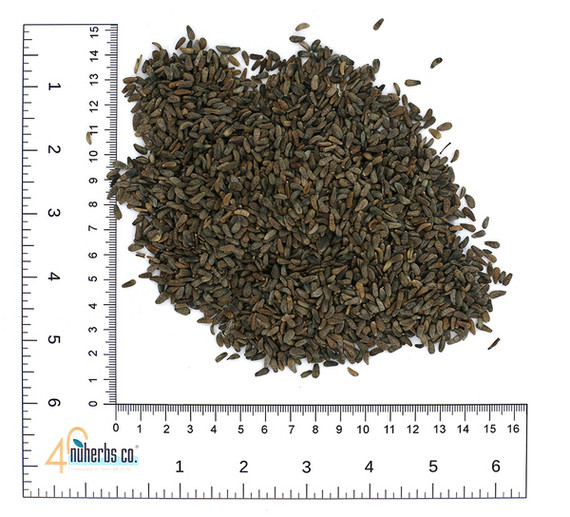
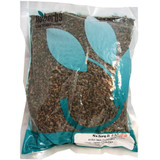
Form: Cut Pieces | Net weight: 1 lb | Origin: China
GMP: Yes | COA: Available upon request
Huai Niu Xi is a classic Chinese root used in Traditional Chinese Medicine (TCM) when the goal is to support lower-body patterns—especially those commonly discussed in TCM language around the knees, hips, and low back—and to complement formula strategies that emphasize healthy circulation and “guiding” effects downward. Because the name “Niu Xi” can refer to more than one species in commerce, the most important buying decision is simple: verify the botanical identity. This page gives you the key details consumers search for—what Huai Niu Xi is, how it differs from other “Niu Xi” products, how to prepare cut root pieces at home, quality and storage best practices, and the cautions that matter—so you can shop confidently and use it responsibly.
Quick Summary Of Huai Niu Xi
Huai Niu Xi = Achyranthes bidentata root. In TCM, it is traditionally used in formulas that:
-
Focus on lower-body support (knees/hips/low back in traditional pattern language)
-
Support healthy circulation patterns described as “moving blood” and working with “stasis” patterns
-
Play a classic formula role often described as “guiding downward”
When buying, prioritize:
-
Correct species (botanical name listed)
-
Clean, uniform cut pieces (low dust, fresh aroma, no mustiness)
-
Clear prep guidance (roots extract best with simmering)
-
Caution-fit (pregnancy, blood-thinning meds, bleeding conditions)
What Is Huai Niu Xi?
Huai Niu Xi is the root of Achyranthes bidentata. It is widely used in Chinese herbal practice and is most commonly purchased as part of a formula approach rather than as a stand-alone herb. In traditional usage, it is often associated with the Liver and Kidney channels (TCM framework) and chosen for strategies that emphasize lower-body focus and circulation-pattern support.
Huai Niu Xi vs. Chuan Niu Xi
Many consumers search this because “Niu Xi” is a name umbrella. Species differences can affect traditional emphasis and formula matching. If your formula specifies Huai Niu Xi, you should purchase the product labeled Achyranthes bidentata.
| Feature | Huai Niu Xi (怀牛膝) | Chuan Niu Xi (川牛膝) |
|---|---|---|
| Common botanical identity in commerce | Achyranthes bidentata (root) | Often Cyathula officinalis (root) |
| What it’s typically used for (traditional emphasis) | Lower-body focus; classic “guides downward” role in formulas; circulation-pattern language | Often discussed as more strongly “blood-invigorating” in some traditions (varies by lineage) |
| Best for | Formulas that specify Huai Niu Xi; buyers who want A. bidentata | Formulas that specify Chuan Niu Xi or practitioner preference |
| Shopping takeaway | Buy only when the botanical name is listed | Same |
If your formula says Huai Niu Xi, choose Achyranthes bidentata—clearly labeled and quality screened—so you are not guessing.
Traditional Profile
-
TCM category (commonly listed): Invigorate Blood & Dispel Blood Stasis
-
Channels (commonly listed): Liver, Kidney
-
Taste / temperature (commonly listed): Bitter, sour, neutral
Note: Traditional categories describe how the herb is used within TCM patterns and formula design.
Choose Your Use Case
1) I’m making a decoction (traditional simmer)
Choose this if you bought cut pieces (like this product). Roots are typically prepared by simmering, not quick steeping.
2) I’m using powders/granules/extracts
These use different directions than raw cut herbs. Follow the label instructions for the specific product (extract ratios vary).
3) I’m following a formula
Confirm whether your source specifies Huai vs Chuan Niu Xi and match the botanical identity.
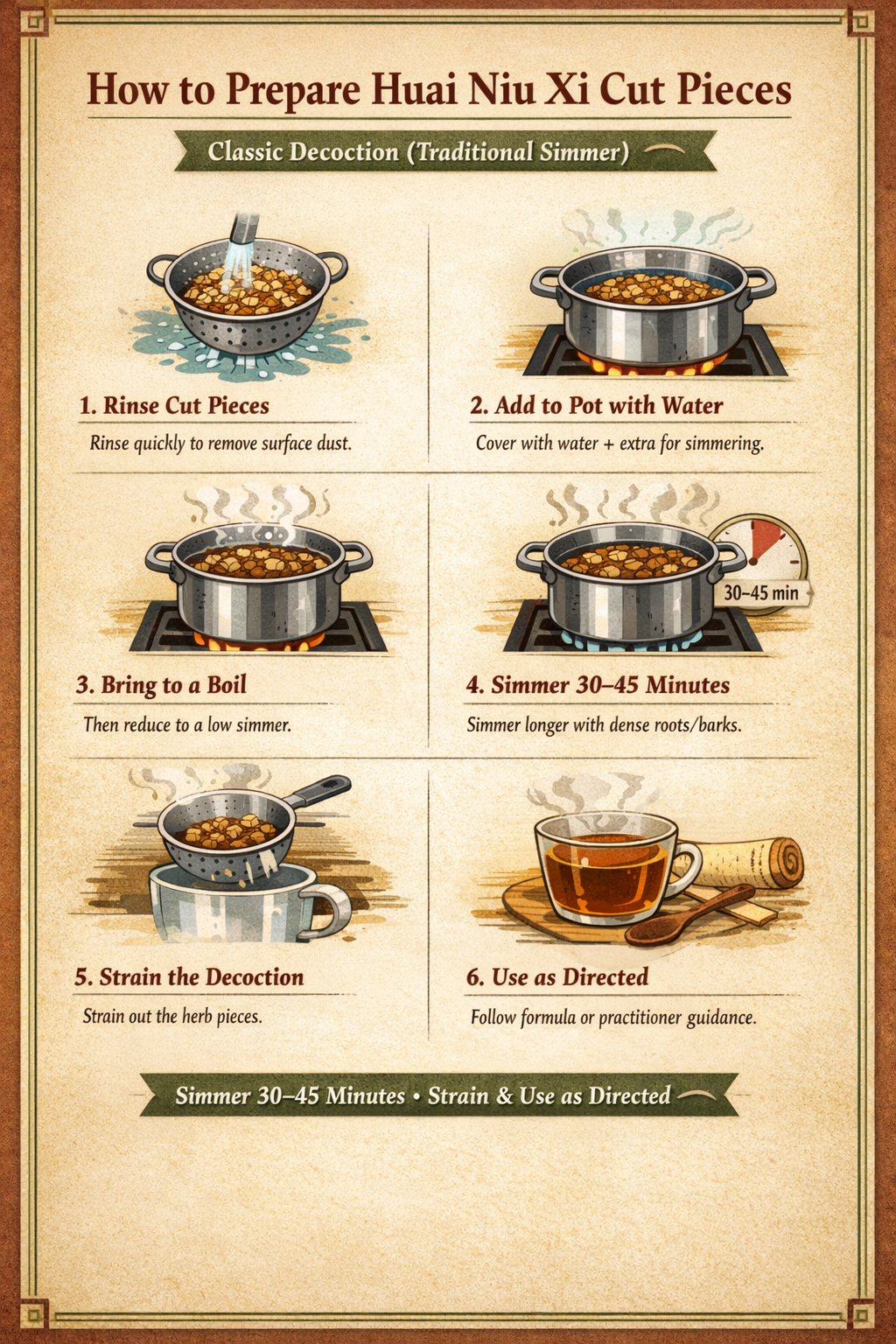
How to Prepare Huai Niu Xi Cut Pieces (Step-by-step)
Option A: Classic decoction (most traditional for cut root)
-
Rinse quickly to remove surface dust.
-
Add cut pieces to a pot and cover with water (add extra water for simmering).
-
Bring to a gentle boil, then reduce to a low simmer.
-
Simmer 30–45 minutes.
-
If combined with dense roots/barks, many people simmer longer.
-
-
Strain and use according to your formula instructions or qualified guidance.
Option B: “Tea-style” simmer (simpler method)
A quick steep is usually weak for roots. If you want a simpler approach, do a gentle simmer rather than a brief tea steep.
Typical Use Amounts
Traditional references often list root amounts around 6–15 g/day in decoction for adults, depending on the formula and practitioner approach. Because individuals differ, it is best used with formula guidance (practitioner, classical recipe, or professional instruction).
What Huai Niu Xi Is Commonly Combined With
These are traditional pairing ideas, not medical claims:
-
Lower-body formula strategies: often combined with herbs traditionally used for “sinews and bones” support (for example, Du Zhong, Xu Duan).
-
Circulation-pattern strategies: often combined with other blood-invigorating herbs depending on pattern-fit and formula design.
Batch Quality You Can Verify
We treat Huai Niu Xi like a food-grade botanical—because quality determines usability.
Identity & cleanliness
-
Botanical identity: Achyranthes bidentata (root)
-
Single herb: no additives, fillers, dyes, or preservatives
-
Cut pieces: selected for consistent use in decoctions
Testing & documentation
-
Lab tested (Nuherbs)
-
GMP: Yes
-
COA available upon request
Storage & packing
-
Stored cool, dry, and away from light
-
Packed in sealed packaging for freshness
-
Labeled clearly with herb name + botanical identity
Lab-Tested • GMP • Family-Owned Since 1994 • Packed for Freshness
Quality Checklist
Look for:
-
Botanical name clearly listed: Achyranthes bidentata
-
Cut pieces that are mostly uniform (not powdery)
-
Clean aroma (not musty)
-
Sealed storage and humidity protection
-
Testing/traceability statements you can verify (COA available)
Cautions, Contraindications & Interactions
Because Huai Niu Xi is traditionally described as a blood-moving herb, use caution if you:
-
are pregnant or nursing (traditional caution)
-
have a bleeding disorder
-
take anticoagulant or antiplatelet medications (seek clinician guidance)
If you have complex conditions or take multiple medications, consult a qualified clinician or licensed herbal professional before use.
Disclaimer: This information is for education and traditional use context only. It is not intended to diagnose, treat, cure, or prevent any disease.
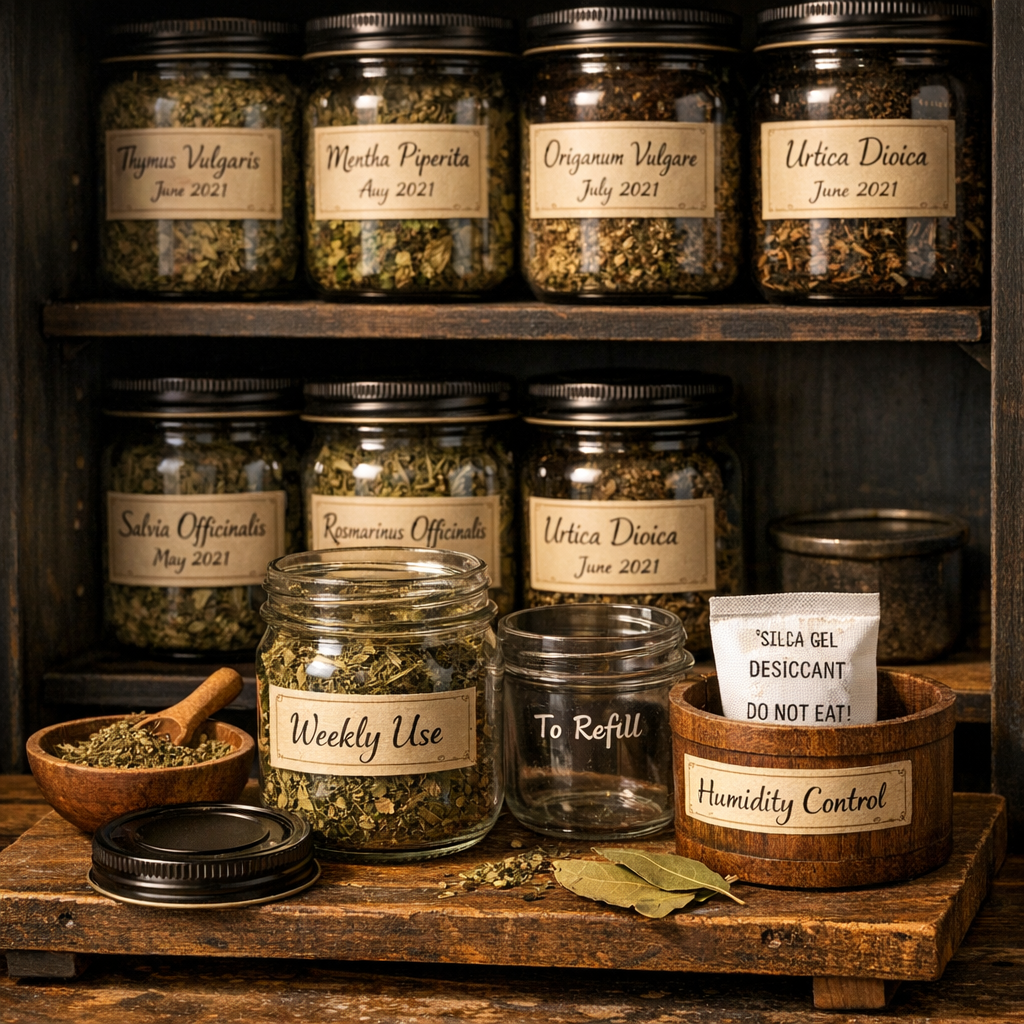
Storage: How to Keep Huai Niu Xi Fresh
-
Store airtight, away from heat, light, and humidity
-
Keep a small working jar for 2–6 weeks of use
-
Keep bulk sealed to reduce repeated air exposure
FAQs
Is Huai Niu Xi the same as “Niu Xi”?
Not always. “Niu Xi” can refer to multiple species in commerce. Huai Niu Xi typically refers to Achyranthes bidentata—verify the botanical name.
How long should I simmer Huai Niu Xi?
Most people simmer root herbs 30–45 minutes (often longer when combined with other dense roots/barks).
Why do people say it “guides downward”?
That is traditional formula language describing how it is commonly used for lower-body focus within TCM strategies.
Can I steep it like tea?
A quick steep is usually weak for roots. A gentle simmer is typically preferred.
What does it taste like?
It is commonly described as bitter/sour in traditional references.
Product Specs
-
Herb: Huai Niu Xi (怀牛膝)
-
Botanical name: Achyranthes bidentata (root)
-
Form: Cut Pieces
-
Packet size: 1 lb
-
Origin: China
-
GMP: Yes
-
COA: Available upon request
Shop Huai Niu Xi
If you want true Huai Niu Xi (Achyranthes bidentata), clearly labeled and packaged for freshness, this lab-tested cut root makes an excellent staple for traditional lower-body formula strategies and decoction preparation.
Check out our How to Use Bulk Herbs page to see how to use herbs correctly.
Traditional Chinese Herbs
Chinese Traditional herbs should be regarded as an added feature to modern western healthcare, and not as a replacement. Chinese traditional herbs (Teas) emphasize harmony, and balance.
Reference:
http://alternativehealing.org/niu_xi.htm
https://www.ncbi.nlm.nih.gov/pmc/articles/PMC4235941/#:~:text=bidentata%20is%20recommended%20to%20reinforce,(Meng%20and%20Li%202001).
https://herbpathy.com/Uses-and-Benefits-of-Achyranthes-Bidentata-Cid2573
https://www.sciencedirect.com/science/article/pii/S1002007109000185#:~:text=Achyranthes%20bidentata%20Blume%20(Chinese%20name,theory%20of%20traditional%20Chinese%20medicine.