
Raw Rehmannia vs Prepared Rehmannia: Sheng Di Huang vs Shu Di Huang Explained
One herb cools and clears.
The other deeply nourishes and restores.
What surprises most people is this:
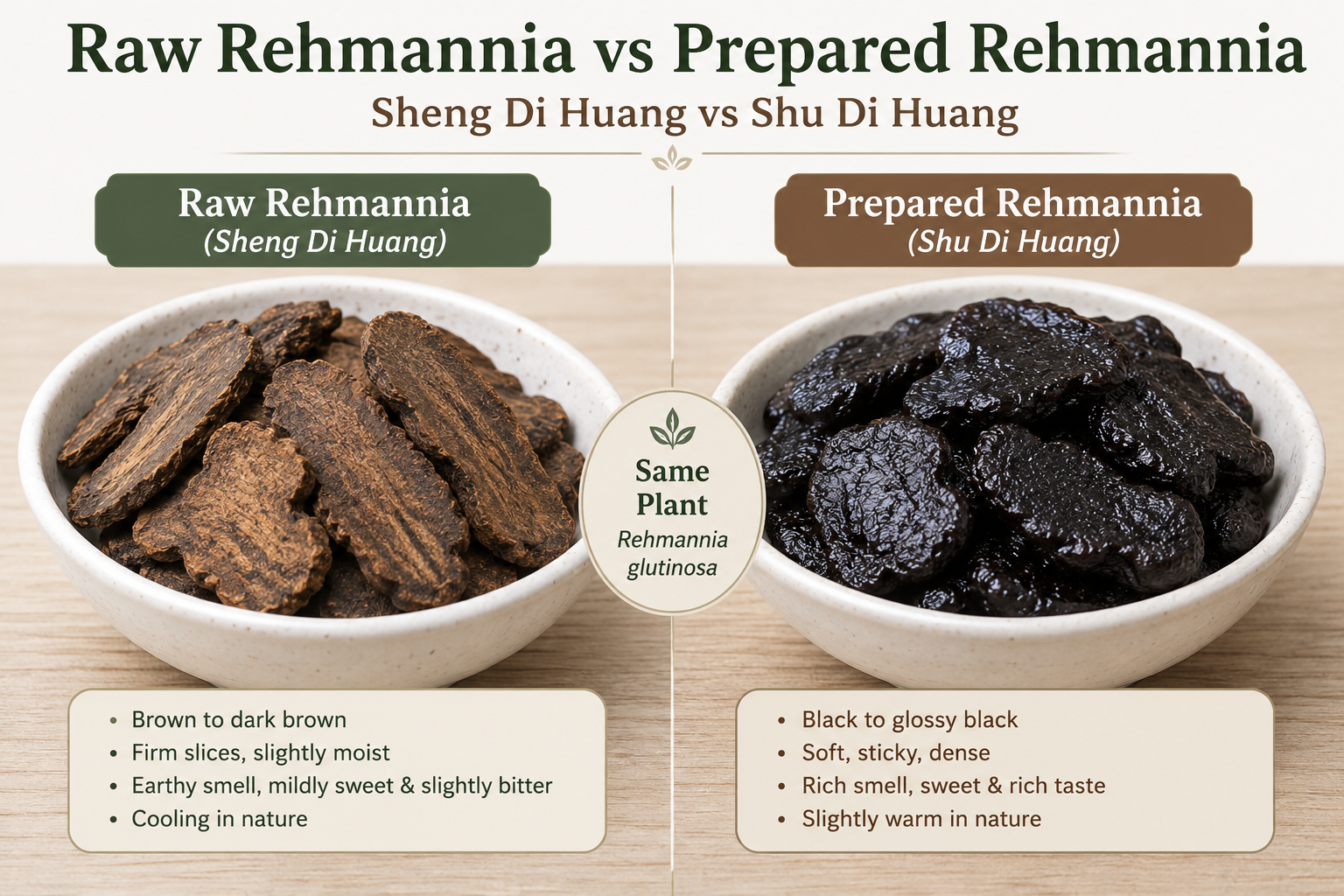
Raw Rehmannia (Sheng Di Huang) and Prepared Rehmannia (Shu Di Huang) come from the exact same root.
Yet after processing, they behave almost like two completely different herbs.
That is why choosing the wrong one can leave people confused—or disappointed.
At 1st Chinese Herbs, one of the most common questions we hear is:
“What is the difference between Sheng Di Huang and Shu Di Huang?”
Let’s make this easy.
Quick Summary
- Raw Rehmannia (Sheng Di Huang): Cooling, moistening, and traditionally used for heat and dryness.
- Prepared Rehmannia (Shu Di Huang): Rich, warming, deeply nourishing, and restorative.
- Same Plant: Both come from Rehmannia glutinosa.
- Main Difference: Processing completely changes how the herb behaves.
See the Difference
| Feature | Raw Rehmannia (Sheng Di Huang) | Prepared Rehmannia (Shu Di Huang) |
|---|---|---|
| Color | Brown to dark brown | Black to glossy black |
| Texture | Firm, sliced root | Soft, sticky, dense |
| Smell | Earthy and fresh | Sweet and rich |
| Taste | Mildly sweet, earthy, slightly bitter | Sweet, thick, rich, molasses-like |
| Nature | Cold | Slightly warm |
How Are They Made?
Both herbs begin with the same root: Rehmannia glutinosa.
Raw Rehmannia (Sheng Di Huang)
This is the fresh or dried root in its natural form.
Minimal processing keeps its cooling nature intact.
Prepared Rehmannia (Shu Di Huang)
Prepared Rehmannia starts as raw rehmannia.
The root is steamed repeatedly—traditionally with rice wine.
This process darkens the herb and transforms it into a richer, sweeter, heavier tonic herb.
This processing is what creates the dramatic difference.
What They Have in Common
- Same botanical source
- Root herb
- Common in traditional Chinese formulas
- Used to support nourishment and balance
What Makes Them Different?
This is where things become important.
Raw Rehmannia focuses more on cooling and moistening.
Prepared Rehmannia focuses more on deep nourishment and restoration.
A simple way to think about it:
Raw Rehmannia is like aloe vera.
Cooling, soothing, and moistening.
Prepared Rehmannia is like slow-cooked bone broth.
Deeply nourishing, rich, and restorative.
What Does Raw Rehmannia Do?
Raw Rehmannia is traditionally valued when cooling support is desired.
- Heat patterns
- Dryness
- Thirst
- Fluid depletion
- Yin deficiency with heat
What Does Prepared Rehmannia Do?
Prepared Rehmannia is traditionally valued for deep nourishment.
- Fatigue
- Recovery support
- Long-term deficiency patterns
- Blood nourishment
- Yin support
What Do They Taste Like?
Raw Rehmannia: Earthy, mildly sweet, slightly bitter, with a cooling feel.
Prepared Rehmannia: Rich, sweet, sticky, dense—almost like herbal molasses, black dates, or prune paste.
Who Usually Chooses Which?
People often choose Raw Rehmannia if they:
- Run hot
- Feel dry
- Want cooling herbs
- Prefer lighter herbs
People often choose Prepared Rehmannia if they:
- Feel depleted
- Need recovery support
- Want deep tonic herbs
- Prefer nourishing formulas
Common Mistakes
Mistake #1: Assuming they are interchangeable.
They are not.
Mistake #2: Choosing based only on appearance.
Always choose based on traditional function.
Classic Herbal Formulas
Raw Rehmannia Commonly Appears In:
- Qing Ying Tang
- Xi Jiao Di Huang Tang
Prepared Rehmannia Commonly Appears In:
- Liu Wei Di Huang Wan
- Zuo Gui Wan
From Our Herbalist
After working with herbs for decades, one of the biggest areas of confusion we see is Sheng Di Huang vs Shu Di Huang.
Many customers assume they are basically the same herb.
They are not.
Understanding this difference makes choosing the right herb much easier.
Which One Is Better?
Neither herb is better.
The right choice depends on your wellness goals.
- Choose Raw Rehmannia for cooling and moistening support.
- Choose Prepared Rehmannia for deeper nourishment and restoration.
Frequently Asked Questions
Is Raw Rehmannia the same as Prepared Rehmannia?
No. They come from the same plant, but processing changes the herb significantly.
Why is Prepared Rehmannia black?
Repeated steaming darkens the root and changes its properties.
Why is Shu Di Huang sticky?
Processing concentrates the root’s rich sugars and compounds.
Can both be used together?
Yes, they may appear together in formulas depending on traditional formulation goals.
Final Thoughts
Raw Rehmannia and Prepared Rehmannia may come from the same root, but they serve very different purposes.
Understanding these differences helps you choose the herb that best matches your needs.
Research on Rehmannia Root
Modern research has studied Rehmannia glutinosa for its natural plant compounds, including polysaccharides, catalpol, iridoid glycosides, and phenylethanoid glycosides.
A 2023 review on Rehmannia polysaccharides discussed their structure, extraction methods, and biological activity. Another review on Rehmanniae Radix described traditional uses and modern pharmacological research, including antioxidant, anti-inflammatory, immune-related, and metabolic areas of study. Research also shows that steaming and processing can change Rehmannia’s chemical profile, which helps explain why Raw Rehmannia and Prepared Rehmannia are treated differently in traditional herbal practice.
- Rehmannia glutinosa polysaccharides review – PubMed
- Pharmacological research on Rehmanniae Radix – PubMed
- Historical and pharmacological studies on Rehmannia root processing – PubMed
- Catalpol in Rehmannia glutinosa – PubMed
Research is ongoing. These studies do not mean Rehmannia is intended to diagnose, treat, cure, or prevent disease.
Research on Rehmannia Root
Modern research has studied Rehmannia glutinosa for its natural plant compounds, including polysaccharides, catalpol, iridoid glycosides, and phenylethanoid glycosides.
A 2023 review on Rehmannia polysaccharides discussed their structure, extraction methods, and biological activity. Another review on Rehmanniae Radix described traditional uses and modern pharmacological research, including antioxidant, anti-inflammatory, immune-related, and metabolic areas of study. Research also shows that steaming and processing can change Rehmannia’s chemical profile, which helps explain why Raw Rehmannia and Prepared Rehmannia are treated differently in traditional herbal practice.
- Rehmannia glutinosa polysaccharides review – PubMed
- Pharmacological research on Rehmanniae Radix – PubMed
- Historical and pharmacological studies on Rehmannia root processing – PubMed
- Catalpol in Rehmannia glutinosa – PubMed
Research is ongoing. These studies do not mean Rehmannia is intended to diagnose, treat, cure, or prevent disease.
Related Herb Comparisons
- Raw Rehmannia vs Prepared Rehmannia
- Chinese Herbs for Beginners
- Compare Chinese Herbs Side-by-Side
- Which Chinese Herbs Pair Well Together?