

Soothe Liver Teapills – Shu Gan Wan
Traditional Liver Qi & Digestive Harmony Formula | Plum Flower | 200 Teapills
Does tension seem to settle in your stomach? Do you feel bloated, uncomfortable or digestive upset when you're stressed or wound up?
Soothe Liver Teapills, traditionally known as Shu Gan Wan (舒肝丸), is an 18-herb Traditional Chinese Medicine formula traditionally used to soothe Liver Qi, regulate Qi and harmonize the Stomach.
This makes Shu Gan Wan particularly interesting when the traditional pattern involves Liver Qi stagnation affecting digestion rather than simple digestive weakness alone.
The formula combines well-known Chinese herbs including Xiang Fu (Cyperus), Bai Shao (White Peony), Chai Hu (Bupleurum), Chen Pi (Tangerine Peel), Hou Po (Magnolia Bark), Yan Hu Suo (Corydalis), Fo Shou (Finger Citron) and others.
Soothe Liver comes in conveniently prepared teapills, eliminating the need to measure and decoct 18 individual herbs.
What Is Shu Gan Wan?
Shu Gan Wan translates approximately as “Liver-Soothing Pill.”
In Traditional Chinese Medicine, the Liver is associated with maintaining the smooth movement of Qi throughout the body.
When that movement becomes constrained, TCM describes the pattern as Liver Qi stagnation.
Shu Gan Wan is traditionally associated with:
-
Soothing the Liver
-
Regulating and moving Qi
-
Relieving Qi stagnation
-
Harmonizing the Stomach
-
Supporting comfortable digestion
These are Traditional Chinese Medicine functions rather than claims about treating anatomical liver disease.
What Does Liver Qi Stagnation Mean?
Liver Qi stagnation is a TCM pattern, not a diagnosis of liver disease.
In traditional theory, emotional tension and stress may interfere with the smooth movement of Qi. When this pattern affects the digestive system, a person may experience a combination of tension and digestive discomfort.
Traditional pattern descriptions can include:
-
Abdominal fullness or bloating
-
Digestive discomfort associated with tension
-
Belching
-
Reduced appetite
-
Occasional nausea
-
A sensation of fullness after eating
-
Irritability or emotional tension accompanying digestive discomfort
The distinguishing feature is often the relationship between constraint or tension and digestion.
Persistent or unexplained digestive symptoms should be medically evaluated rather than assumed to represent Liver Qi stagnation.
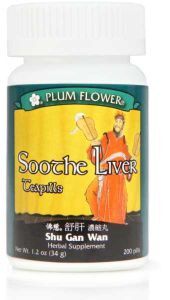
Product Details at a Glance
Product Name: Soothe Liver Teapills
Pin Yin Name: Shu Gan Wan
Chinese Name: 舒肝丸
Also Known As: Shu Kan Wan, Comfort Liver Pills
Brand: Plum Flower
Form: Small prepared teapills
Bottle Size: 200 teapills
Formula Size: 18 herbs
Traditional TCM Focus: Liver Qi stagnation affecting the Stomach and digestion
Traditional Functions: Soothes Liver Qi, regulates Qi and harmonizes the Stomach
Label Directions: 8 teapills, 3 times daily
Approximate Supply: About 8 days at label directions
Preparation Required: None — swallow with water
Allergen Information: Contains wheat
Origin: China
What's in Soothe Liver Teapills?
Shu Gan Wan is a more complex formula than many teapills, combining 18 traditional herbs.
| Pin Yin | Botanical Ingredient | Traditional Role |
|---|---|---|
| Xiang Fu (cu) | Cyperus rotundus rhizome, vinegar-fried | Traditionally regulates Liver Qi |
| Bai Shao (jiu) | Paeonia lactiflora root, wine-fried | Traditionally nourishes Blood and softens the Liver |
| Chai Hu | Bupleurum chinense root | Traditionally courses and soothes Liver Qi |
| Zhi Ke (fu) | Citrus aurantium fruit, bran-fried | Traditionally regulates Qi and reduces fullness |
| Qing Pi | Citrus reticulata immature peel | Traditionally moves constrained Liver Qi |
| Chen Pi | Citrus reticulata peel | Traditionally regulates Qi and harmonizes digestion |
| Sha Ren | Amomum longiligulare fruit | Traditionally moves Qi and harmonizes the middle |
| Hou Po | Magnolia officinalis bark | Traditionally moves Qi and addresses fullness |
| Yan Hu Suo | Corydalis yanhusuo rhizome | Traditionally moves Qi and Blood |
| Mu Dan Pi | Paeonia suffruticosa root-bark | Traditionally clears constrained Heat and moves Blood |
| Xiang Yuan | Citrus medica ripe fruit | Traditionally regulates Qi and harmonizes the middle |
| Gan Cao | Glycyrrhiza uralensis root | Traditionally harmonizes the formula |
| Mu Xiang | Aucklandia lappa root | Traditionally moves Qi and supports digestion |
| Pian Jiang Huang | Curcuma wenyujin rhizome | Traditionally moves Qi and Blood |
| Fo Shou | Citrus medica fruit | Traditionally soothes Liver Qi and harmonizes the Stomach |
| Tu Chen Xiang | Aquilaria sinensis wood | Traditionally regulates and directs Qi |
| Bai Dou Kou | Amomum kravanh fruit | Traditionally moves Qi and harmonizes the middle |
| Tan Xiang | Santalum album wood | Traditionally moves Qi and harmonizes the middle |
Other Ingredients
Maltose, hydrated magnesium silicate and China wax.
Contains wheat because one ingredient is processed with wheat bran.
Always check the current bottle label before use because manufacturers may update ingredients or processing methods.
Why Does Shu Gan Wan Contain So Many Herbs?
Shu Gan Wan isn't simply an 18-herb “liver supplement.”
Its complexity reflects the traditional pattern it was designed around.
Some herbs primarily move constrained Liver Qi.
Others harmonize the Stomach and digestive system.
Still others traditionally move Blood, address fullness or harmonize the formula.
This creates a formula aimed at the traditional relationship between emotional constraint, Qi stagnation and digestive discomfort.
Key Herbs to Know
Xiang Fu — Cyperus
A central Qi-regulating herb traditionally associated with soothing constrained Liver Qi.
Chai Hu — Bupleurum
One of the best-known herbs in Chinese medicine for traditionally coursing and regulating Liver Qi.
Bai Shao — White Peony
Traditionally nourishes Blood while helping soften and regulate the Liver.
Chen Pi — Tangerine Peel
Traditionally regulates Qi and supports the digestive middle.
Hou Po — Magnolia Bark
Traditionally moves Qi and addresses sensations of fullness.
Fo Shou — Finger Citron
Traditionally associated with regulating Liver Qi while harmonizing the Stomach.
Together, these herbs help explain why Shu Gan Wan is traditionally selected when Liver Qi constraint and digestive disharmony occur together.
Is Soothe Liver the Formula You're Looking For?
Shu Gan Wan is worth investigating when you're specifically looking for a traditional formula associated with Liver Qi stagnation affecting digestion.
Someone researching this formula might recognize descriptions such as:
“Stress or tension seems to settle in my stomach.”
“I feel bloated or full when I'm tense.”
“My digestion seems worse when I'm stressed.”
“I've been told to look for a formula that soothes Liver Qi and harmonizes the Stomach.”
“I'm specifically looking for Shu Gan Wan or Soothe Liver Teapills.”
The important point is the overall traditional pattern, not simply the presence of one symptom.
TCM “Liver” vs. Your Physical Liver
This distinction is extremely important.
In Western medicine, the liver is a physical organ with functions involving metabolism, bile production, nutrient processing and detoxification.
Traditional Chinese Medicine uses the term Liver much more broadly as part of a traditional functional system associated with the smooth flow of Qi, Blood and emotional regulation.
Therefore:
“Soothes the Liver” does NOT mean “treats liver disease.”
“Moves Liver Qi” does NOT mean “detoxifies your physical liver.”
“Liver Qi stagnation” does NOT mean your liver is physically congested.
If you have liver disease, abnormal liver tests, persistent abdominal pain or another diagnosed medical condition, consult an appropriate healthcare professional.
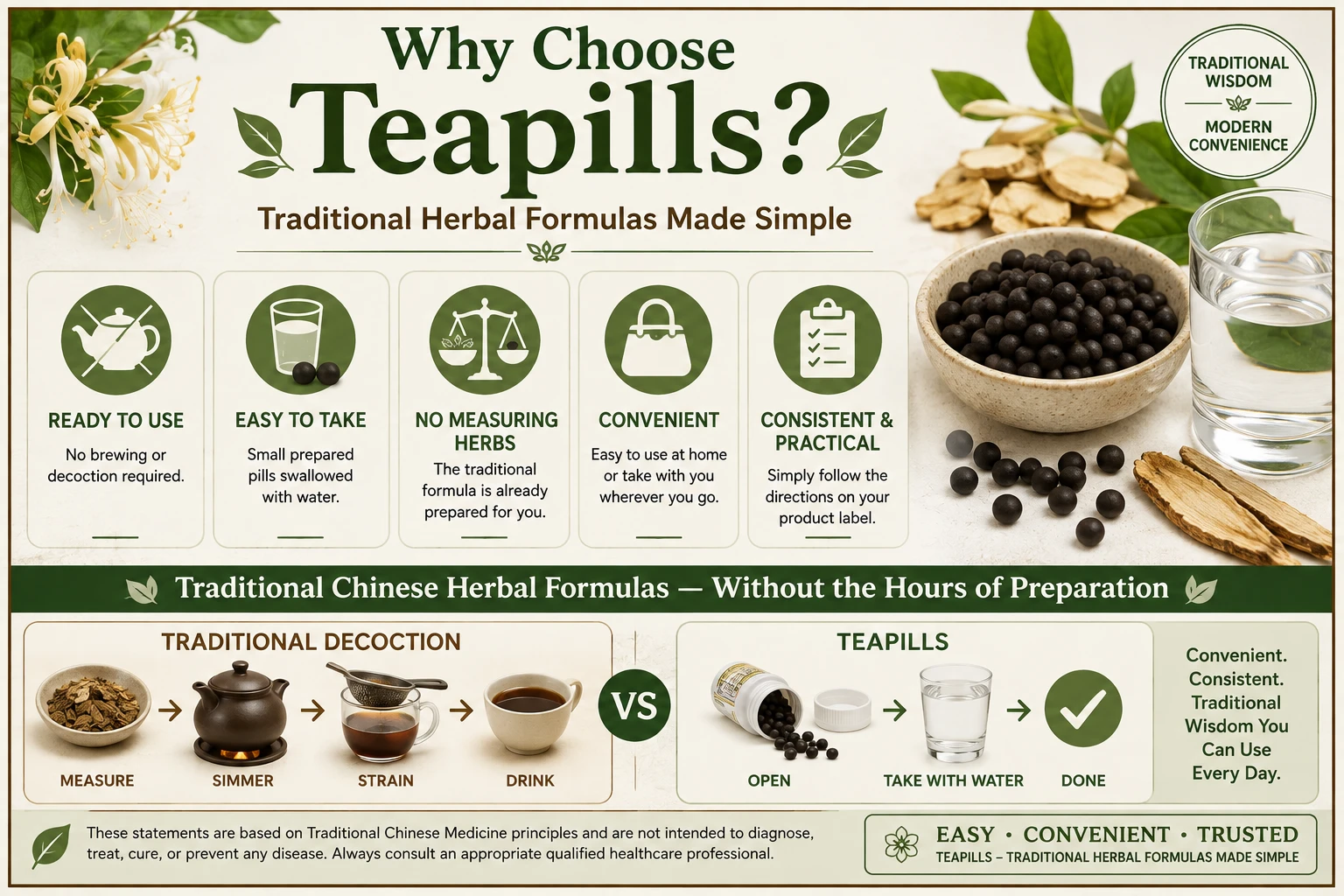
Why Teapills & How Do I Use Them?
A traditional formula containing 18 herbs would otherwise require obtaining, measuring and preparing numerous individual ingredients.
Soothe Liver Teapills provide the complete formula in a convenient prepared form.
There is no daily measuring, simmering or straining, and no 18-herb decoction to prepare.
Label Directions
Take 8 teapills, 3 times per day.
Swallow with water according to the product directions.
At 24 teapills per day, one 200-count bottle provides approximately 8 days of use.
Follow the product label unless your qualified healthcare professional or Traditional Chinese Medicine practitioner has provided different instructions.
Shu Gan Wan vs. Chai Hu Shu Gan Wan
These names look very similar, but shoppers should not assume they are identical.
| Shu Gan Wan | Chai Hu Shu Gan Wan | |
|---|---|---|
| English Product | Soothe Liver | Bupleurum Shu Gan |
| Formula Style | Complex 18-herb formula | Simpler 7-herb formula |
| Shared Focus | Liver Qi regulation | Liver Qi regulation |
| Key Distinction | Broad combination of Qi-regulating and digestive herbs | Chai Hu-centered traditional formula |
| Same Formula? | No | No |
Always purchase the formula specified by your practitioner or the particular formula you intended to buy rather than choosing based only on similar names.
Modern Research on Shu Gan Wan Herbs
Many of the individual herbs in Shu Gan Wan have been investigated in modern phytochemical and pharmacological research.
This research should be distinguished from the traditional use of the complete Shu Gan Wan formula. Research on an individual plant or plant constituent does not establish that Soothe Liver Teapills prevent, treat or cure a medical condition.
Explore the Research
- PubMed – Cyperus rotundus Research
- PubMed – Bupleurum chinense Research
- PubMed – Paeonia lactiflora Research
- PubMed – Magnolia officinalis Research
- PubMed – Citrus reticulata Research
- PubMed – Corydalis yanhusuo Research
Frequently Asked Questions
What are Soothe Liver Teapills?
Soothe Liver is the English product name for Shu Gan Wan, a traditional Chinese herbal formula associated with soothing Liver Qi, regulating Qi and harmonizing the Stomach.
What is Shu Gan Wan traditionally used for?
In Traditional Chinese Medicine, Shu Gan Wan is traditionally associated with Liver Qi stagnation and disharmony between the Liver and Stomach, particularly when digestive discomfort accompanies tension or constraint.
Does Soothe Liver detoxify the liver?
That is not how this product should be understood.
The word Liver in the formula's traditional functions refers to the TCM Liver system. “Soothing the Liver” and “regulating Liver Qi” should not be interpreted as detoxifying or treating the anatomical liver.
Is Shu Gan Wan for liver disease?
No. Shu Gan Wan is a Traditional Chinese Medicine formula associated with a TCM pattern. It should not be considered a treatment for hepatitis, fatty liver disease or another diagnosed liver condition.
How many herbs are in Shu Gan Wan?
This Plum Flower formula contains 18 traditional herbal ingredients.
What are the main herbs in Soothe Liver?
Important herbs include Xiang Fu (Cyperus), Bai Shao (White Peony), Chai Hu (Bupleurum), Chen Pi (Tangerine Peel), Hou Po (Magnolia Bark), Yan Hu Suo (Corydalis) and Fo Shou (Finger Citron), along with additional herbs.
Is Shu Gan Wan the same as Chai Hu Shu Gan Wan?
No. They have related traditional purposes and similar names, but Shu Gan Wan and Chai Hu Shu Gan Wan are different formulas with different ingredient combinations.
Does Soothe Liver contain wheat?
Yes. The current manufacturer's information indicates that the product contains wheat because Zhi Ke is processed with wheat bran.
How many teapills are in the bottle?
Each bottle contains 200 teapills.
How do I take Soothe Liver Teapills?
The manufacturer directions are 8 teapills, 3 times per day. Swallow with water unless your qualified healthcare practitioner provides different instructions.
How long does one bottle last?
At the label directions of 24 teapills per day, a 200-count bottle provides approximately 8 days.
Do I need to brew Shu Gan Wan as tea?
No. The formula is already prepared as teapills. There is no need to measure 18 individual herbs or prepare a decoction.
Safety Information
Contraindicated during pregnancy.
Contains wheat because an ingredient is processed with wheat bran.
Do not use if you are allergic or sensitive to any ingredient.
Because Shu Gan Wan contains numerous herbs, consult your physician, pharmacist or other qualified healthcare professional before use if you take prescription medications or have a medical condition.
Keep out of reach of children.
Do not exceed the labeled directions unless instructed by an appropriate healthcare professional.
Persistent, severe or unexplained digestive symptoms should be medically evaluated rather than assumed to represent Liver Qi stagnation.
Soothe Liver – An 18-Herb Traditional Qi-Regulating Formula
For customers specifically looking for Shu Gan Wan, Soothe Liver combines 18 traditional herbs in a prepared formula traditionally associated with soothing Liver Qi, regulating Qi and harmonizing the Stomach.
Instead of obtaining and preparing 18 individual herbs, the complete traditional formula is provided in convenient teapill form.
No individual herbs to measure. No decoction to prepare. Just the traditional formula in prepared teapills.
Traditional Use & FDA Disclaimer
Information describing Chinese herbal functions and patterns is based on principles of Traditional Chinese Medicine and is provided for educational purposes.
These statements have not been evaluated by the Food and Drug Administration. This product is not intended to diagnose, treat, cure or prevent any disease.
Consult an appropriate qualified healthcare professional regarding medical conditions, medications, pregnancy, nursing or persistent symptoms.