
One of the most confusing things about Chinese herbs is looking at a formula label and wondering why it contains 9, 12, or even 15 herbs when you only wanted help understanding one wellness concern. Then the language makes it worse. One herb is “warming.” Another is “cooling.” One “moves qi.” Another “harmonizes.” Suddenly, you are reading words that sound less like wellness and more like wizard school electives. Here is the simple version: Chinese herbal formulas are usually not random piles of herbs. They are built more like teams. Some herbs lead. Some support. Some soften harshness. Some help digestion. Some guide the formula. Once you understand the roles, formulas stop looking confusing and start making sense. Educational Notice: This page explains traditional Chinese herbal concepts for educational purposes only. It is not medical advice and is not intended to diagnose, treat, cure, or prevent disease. Always speak with a qualified healthcare provider if you are pregnant, nursing, taking medication, or managing a medical condition. Most people expect herbs to work like supplements: one herb, one purpose. Traditional Chinese herbal systems usually do not think that way. A formula may include one herb for the main purpose, another to support digestion, another to balance temperature, another to reduce harshness, and another to guide the formula’s traditional direction. That is why a formula may look complicated at first glance. It is not always because “more is better.” It is often because balance matters. A Chinese herbal formula is a lot like a kitchen, a basketball team, or a family business. Everyone has a job. Traditional role: Harmonizer. Gan Cao, or Licorice Root, is often used to help formulas feel more balanced. It may soften stronger herbs, support flavor, and help the formula feel less harsh. Real-life example: Imagine soup that tastes too salty, sharp, and aggressive. Gan Cao is the ingredient trying to calm everybody down. Traditional role: Warming assistant and harmonizer. Fresh Ginger is often used when a formula needs warmth, digestive support, or a gentler introduction to the stomach. Real-life example: Think of ginger like adding warmth to a cold kitchen. It helps the whole recipe feel more comfortable and less shocking. Traditional role: Qi mover and digestive helper. Chen Pi, or aged Tangerine Peel, is traditionally used when things feel stuck, heavy, or sluggish after food. Real-life example: After a heavy meal, Chen Pi is like the person directing traffic so everything starts moving again. Traditional role: Dampness support. Fu Ling is traditionally used when heaviness, sluggishness, or fluid-related patterns are part of the picture. Real-life example: If the body feels like a damp basement after too much stress, rich food, and poor sleep, Fu Ling is the herb traditionally helping clear the soggy feeling. Look at traditional tonic herbs like Huang Qi, Ren Shen, Dang Gui, and Bai Zhu. Qi-moving herbs like Chai Hu and Chen Pi are often discussed in those traditional patterns. Cooling herbs like Huang Qin, Ju Hua, and Zhi Mu may be part of traditional conversations. Fu Ling, Chen Pi, Bai Zhu, and prepared Ban Xia are commonly discussed in dampness-related formulas. Most people do not quit herbs because they are lazy. They quit because they are confused. Chinese formulas are not just lists of ingredients. They are strategies. A formula may combine warming and cooling herbs. It may pair moving herbs with nourishing herbs. It may include gentle digestive support so stronger herbs do not feel so harsh. That is why understanding herbal roles matters. It helps you stop guessing and start choosing herbs with more confidence. Start with real herbs, simple preparation guides, and traditional explanations that make sense. Get Real Herbs. Feel the Difference. Trusted Since 1994 | Lab-Tested Herbs | COA Available Upon Request | Fast Shipping from Washington StateTraditional Herbal Roles Explained: 20 Chinese Herbs and Why They Are Used Together
Finally Understand Why Chinese Formulas Use Multiple Herbs — Without Feeling Like You Need a Degree in Herbalism
Why Chinese Herbal Formulas Feel So Complicated
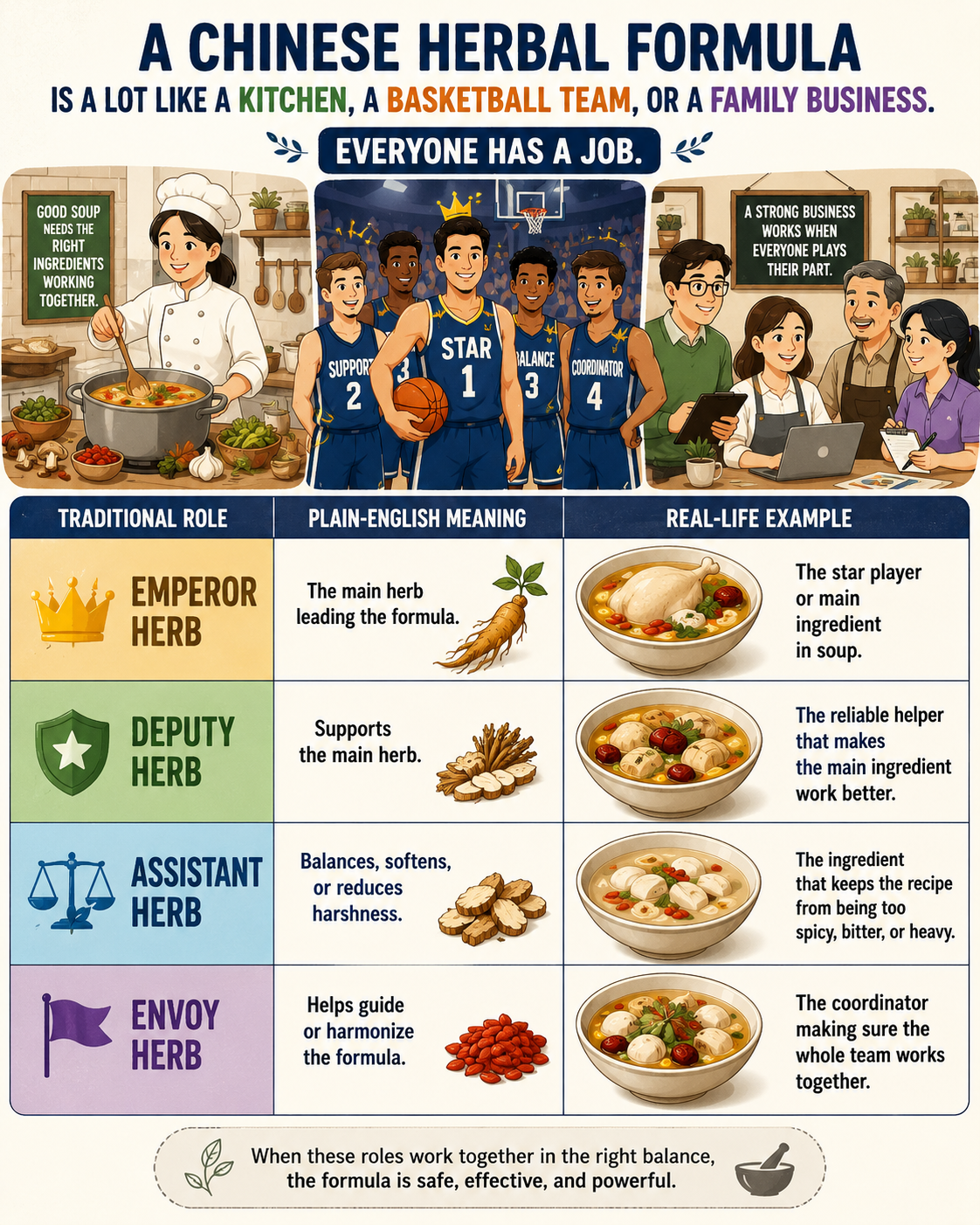
Think of a Formula Like a Team, Not a Single Superstar
Traditional Role
Plain-English Meaning
Real-Life Example
Emperor Herb
The main herb leading the formula.
The star player or main ingredient in soup.
Deputy Herb
Supports the main herb.
The reliable helper that makes the main ingredient work better.
Assistant Herb
Balances, softens, or reduces harshness.
The ingredient that keeps the recipe from being too spicy, bitter, or heavy.
Envoy Herb
Helps guide or harmonize the formula.
The coordinator making sure the whole team works together.
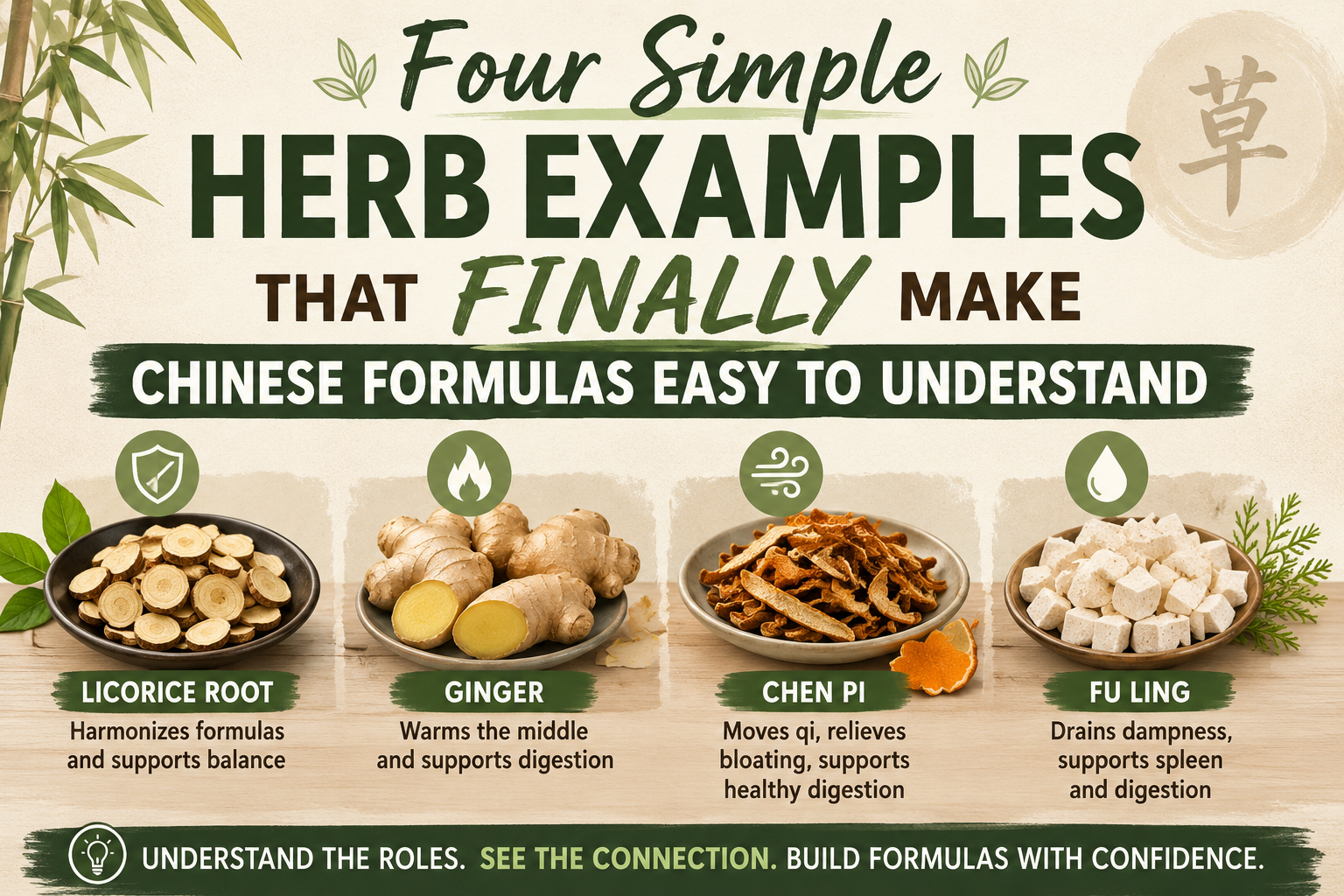
Four Simple Herb Examples That Finally Make Chinese Formulas Easy To Understand
Gan Cao: The Peacekeeper
Sheng Jiang: The Warm Welcome
Chen Pi: The Traffic Director
Fu Ling: The Drain-the-Swamp Herb
20 Common Chinese Herbs and Their Traditional Roles
Herb
Simple Role
What It Means in Real Life
Huang Qi
The builder
Traditionally used in tonic formulas when resilience and everyday vitality are the focus.
Dang Gui
The nourisher
Traditionally used in formulas focused on Blood nourishment and women’s wellness routines.
Bai Zhu
The digestive support herb
Often used when formulas need Spleen Qi and digestion support.
Gan Cao
The peacekeeper
Helps harmonize and soften formulas.
Sheng Jiang
The warm welcome
Adds warmth and helps formulas feel gentler on digestion.
Chen Pi
The traffic director
Traditionally helps move stuck Qi, especially around digestion.
Fu Ling
The dampness helper
Traditionally used when heaviness or dampness patterns are part of the formula.
Chai Hu
The mover
Often used when tension, constraint, or stuck feelings are traditionally discussed.
Huang Qin
The cooling herb
Used in formulas when heat-clearing is part of the traditional strategy.
Bo He
The surface refresher
Light, aromatic, and often used in cooling, surface-level formulas.
Dan Shen
The circulation herb
Traditionally used in formulas focused on movement and circulation support.
Gou Teng
The calming hook
Traditionally used when tension and upward-rising patterns are discussed.
Ju Hua
The cooling flower
Light, floral, and often used in teas for cooling traditional patterns.
Shan Zha
The food mover
Traditionally used when heavy meals and food stagnation are part of the picture.
Ban Xia
The phlegm transformer
Used in prepared form in formulas focused on phlegm and dampness patterns.
Wu Wei Zi
The gatherer
Traditionally used when formulas need an astringing, holding, or conserving quality.
Rou Gui
The warming spark
Brings warming energy into formulas where cold-type patterns are traditionally discussed.
Bai Shao
The softener
Traditionally used to nourish and soften tension in formulas.
Zhi Mu
The cooling moistener
Used when heat and dryness are traditionally part of the formula strategy.
Ren Shen
The core tonic
Traditionally used as a major Qi tonic in formulas focused on deep rebuilding.
Which Herbal Role Sounds Most Like Your Situation?
Feeling exhausted?
Feeling stuck or tense?
Feeling hot or irritated?
Feeling heavy or sluggish?
Why People Quit Chinese Herbs Too Quickly
What You Need To Know
Helpful Herbal Guides
Ready to Stop Guessing?