Why Do Herbal People Own So Many Tiny Spoons?
The surprisingly chaotic beginner’s guide to measuring herbs without feeling like you accidentally joined a wizard school.
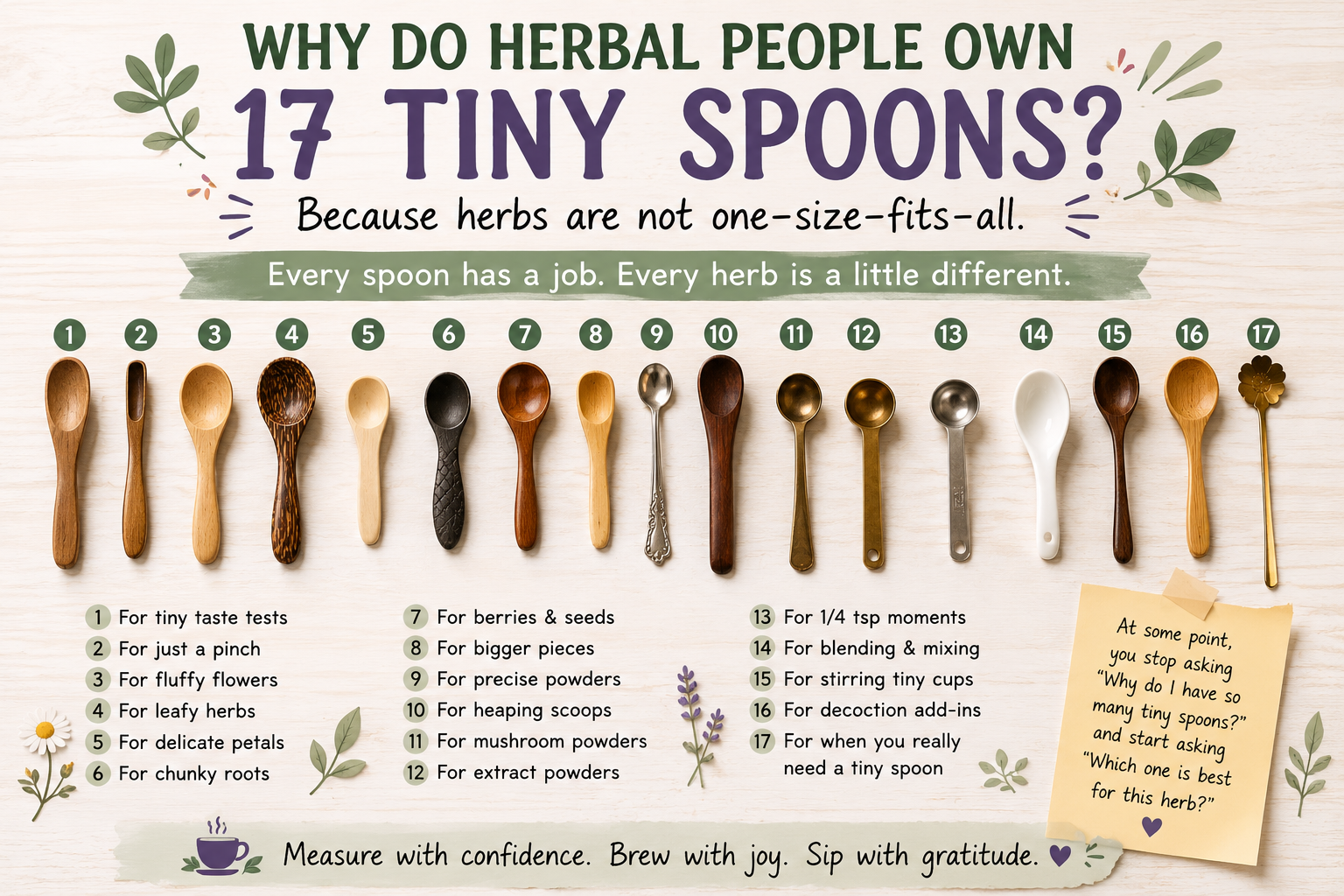
At some point, almost every herbal person mysteriously develops a drawer full of tiny spoons.
Nobody knows exactly when this happens.
One day you are a normal person buying toothpaste and paper towels. The next day you own three bamboo scoops, two brass measuring spoons, a miniature wooden shovel, and one tiny spoon that looks like it was designed for feeding soup to squirrels.
Meanwhile your family is standing in the kitchen asking, “Why do we suddenly own seventeen tiny spoons?”
Honestly? Because herbs are confusing at first. Especially measuring them.
Quick Answer
Herbal people own so many tiny spoons because measuring herbs is not as simple as it looks.
A teaspoon measures space, not weight. Fluffy flowers, dense powders, cut roots, mushrooms, and extracts all measure differently. That means one teaspoon of chamomile is very different from one teaspoon of extract powder.
Tiny spoons help with consistency, better flavor, stronger tea, and fewer “why does this taste like warm sadness?” moments.
The Internet Makes Herbal Measuring Sound Way Too Complicated
You start searching, “How much herb should I use?”
Then the internet throws you into:
- grams
- milligrams
- teaspoons
- tablespoons
- extraction ratios
- decoction math
- density conversions
- people measuring mushroom powder with jewelry scales
Five minutes later you are sitting at the kitchen table wondering, “Am I making tea… or preparing for a NASA launch?”
Relax. You are not failing. Most beginners feel this way.
The Sneaky Part Nobody Explains: Teaspoons Measure Volume, Not Weight
This is the piece that causes so much confusion.
A teaspoon measures how much space something takes up. It does not tell you how heavy that herb is.
In Simple Terms
A teaspoon of fluffy flowers may weigh very little.
A teaspoon of dense extract powder may weigh much more.
Both can fill the same spoon, but they are not the same amount by weight.
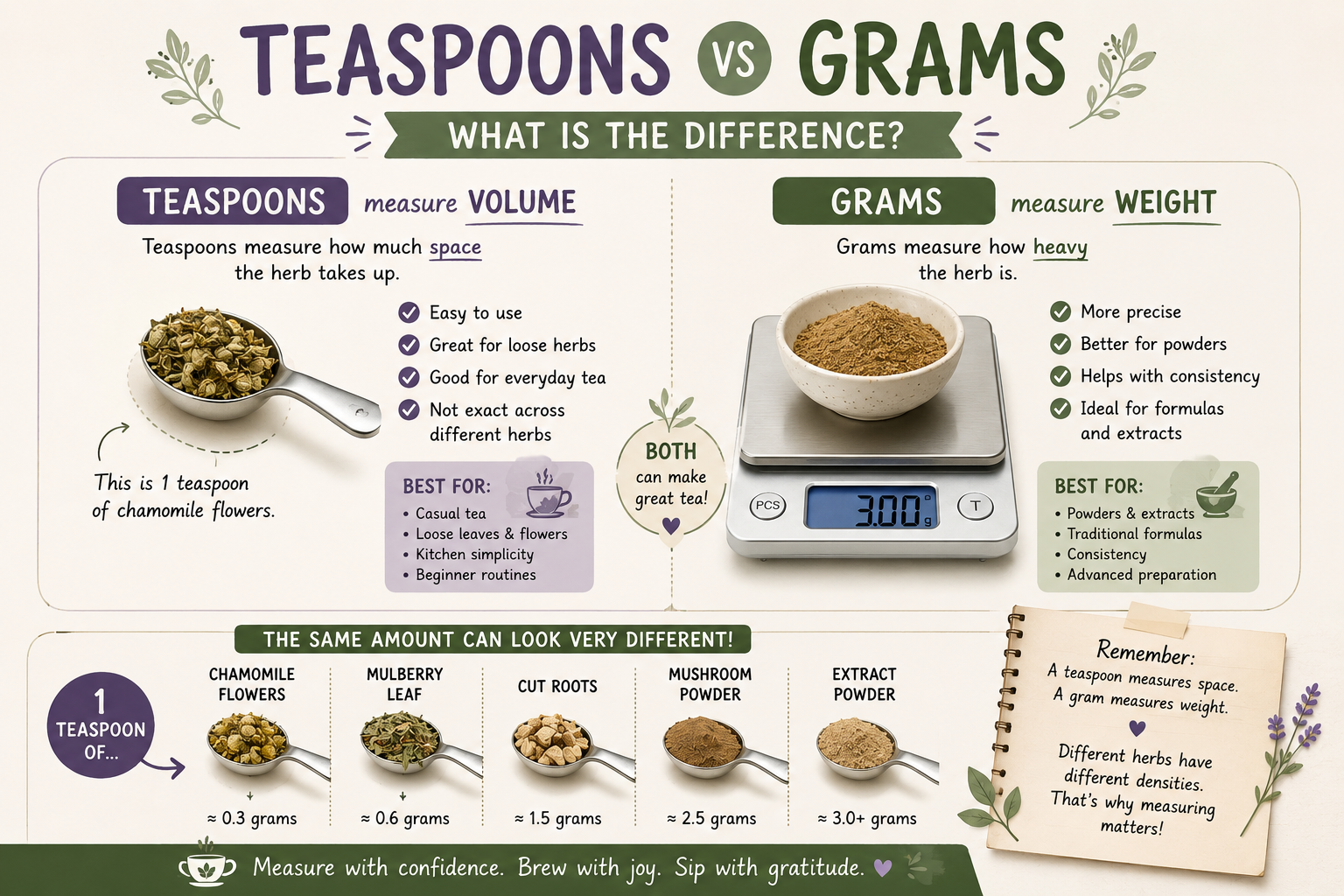
Teaspoons vs Grams: What Is the Difference?
| Measurement | What It Measures | Best For | Beginner Note |
|---|---|---|---|
| Teaspoon | Volume, or how much space the herb takes up. | Simple tea routines and casual kitchen use. | Easy, but not exact for every herb. |
| Gram | Weight, or how heavy the herb is. | More precise formulas, powders, extracts, and decoctions. | More accurate, but can feel intimidating at first. |
| Tablespoon | Volume, larger than a teaspoon. | Larger tea blends or batch brewing. | Helpful for loose herbs, but density still matters. |
| Label serving size | Manufacturer’s suggested serving amount. | Powders, extracts, teapills, and packaged products. | Always follow the product label when available. |
Herbal Density Is the Real Trickster
Imagine filling a pillowcase with feathers.
Now imagine filling that same pillowcase with sand.
Same space. Very different weight.
Herbs work the same way.
| Herb Type | Texture | How It Measures | Beginner Reaction |
|---|---|---|---|
| Chamomile Flowers | Light and fluffy | Fills a spoon quickly but weighs very little. | “This spoon looks gigantic.” |
| Mulberry Leaf | Light and airy | Loose and fluffy unless crushed. | “Did I even add enough?” |
| Cut Roots | Chunky and uneven | Does not sit evenly in a spoon. | “Do I pack this down?” |
| Mushroom Powder | Dense and earthy | Packs into the spoon more heavily. | “This escalated quickly.” |
| Extract Powder | Very compact | Small spoonfuls may be concentrated. | “Surely this cannot be correct.” |
Oh Good… It’s Not Just Me: The Giant Mug Problem
This one deserves its own emotional support group.
You use one tiny teaspoon of herbs inside a mug large enough to bathe a raccoon.
Then you take a sip and think, “Why does this tea taste like somebody whispered the word tea into hot water from another room?”
Usually, that is a water-to-herb ratio problem.
The herbs are trying their absolute best. They are just swimming in a lake.
Mug Size vs Herb Amount Chart
| Mug Size | What Usually Happens | Simple Fix |
|---|---|---|
| 8 oz mug | Standard small cup. | A small measured amount may be enough. |
| 12 oz mug | Common modern mug size. | You may need slightly more herb than an 8 oz cup. |
| 16 oz mug | Large mug. | Increase herb amount or steep longer. |
| 20+ oz mug | Soup bowl pretending to be a mug. | Definitely adjust herb amount or water ratio. |
Oh Good… I Did That Too: The Packed Spoon Disaster
One person lightly scoops powder.
Another person packs it down like they are repairing potholes in a driveway.
Technically, both used “one teaspoon.”
Realistically, those are very different amounts.
This is why herbal measuring is not always perfectly exact. And honestly? That is okay. Herbs are often more forgiving than beginners think.
Loose Herbs vs Powders vs Teapills: Measuring Comparison
| Herb Form | What It Is Like | Measuring Style | Beginner Difficulty |
|---|---|---|---|
| Loose Tea Herbs | Fluffy, leafy, or floral. | Scoop loosely. Do not pack down hard. | Easy |
| Cut Roots | Chunky, uneven pieces. | Approximate scoop or weigh for accuracy. | Moderate |
| Powders | Dense and compact. | Use a level spoon or follow label directions. | Moderate |
| Extract Powders | Concentrated and compact. | Start smaller and follow product label. | Moderate to advanced |
| Teapills | Already formed and pre-measured. | Follow label directions. | Easy |
Why Powders Feel So Different
Powders are usually denser, heavier, and more compact than loose herbs.
Especially extract powders.
This is why one teaspoon of extract powder may feel much stronger than one teaspoon of fluffy flowers.
Nothing is wrong. Density is just being sneaky again.
The “I Bought a Scale and Immediately Regretted It” Phase
Many beginners panic after buying a digital scale.
Suddenly they are staring at decimal points, gram conversions, and extraction ratios while holding mushroom powder and thinking, “I was just trying to make tea.”
You do not need laboratory precision for every cup of tea.
For beginners, consistency matters more than perfection.
When Should You Use a Spoon vs a Scale?
| Situation | Use a Spoon | Use a Gram Scale |
|---|---|---|
| Making a casual cup of tea | Yes | Optional |
| Using fluffy flowers or leaves | Yes | Optional |
| Using concentrated extract powder | Sometimes | Recommended |
| Following a traditional formula | Sometimes | Recommended |
| Trying to repeat the same result every time | Helpful | Best |
| Using teapills | No | No, follow label directions. |
Common Herbal Measuring Mistakes
| Mistake | What Happens | Better Approach |
|---|---|---|
| Packing powders tightly into the spoon | You may use more than intended. | Use a level spoon or label serving size. |
| Using one teaspoon in a giant mug | Tea tastes weak or watery. | Adjust herb amount to water amount. |
| Assuming all teaspoons weigh the same | Confusing results between herbs. | Remember density changes everything. |
| Measuring chunky roots like powder | Uneven scoops and inconsistent tea. | Use approximate amounts or weigh if needed. |
| Trying to be perfect immediately | Overwhelm and frustration. | Start simple and adjust gradually. |
Beginner-Friendly Herbs That Are Easier to Measure
| Herb | Texture | Flavor | Beginner Friendly? |
|---|---|---|---|
| Goji Berry | Small berries | Slightly sweet | Yes |
| Chrysanthemum | Light flowers | Floral and mild | Yes |
| Jujube Dates | Whole or sliced fruit | Mildly sweet | Yes |
| Mulberry Leaf | Cut leaf | Soft and earthy | Yes |
| Ginger Slices | Sliced root | Warm and spicy | Yes |
Helpful Beginner Measuring Tips
Start Simple
You do not need seventeen brewing systems. Start with one mug, one spoon, one tea, and one routine.
Taste as You Learn
Some people like lighter tea. Others prefer stronger earthy flavor. Your taste buds matter too.
Write Down What Worked
This helps when you finally make the perfect cup and immediately forget what you did.
Helpful Beginner Guides & Tools
These guides make measuring, steeping, and choosing herb forms much easier.
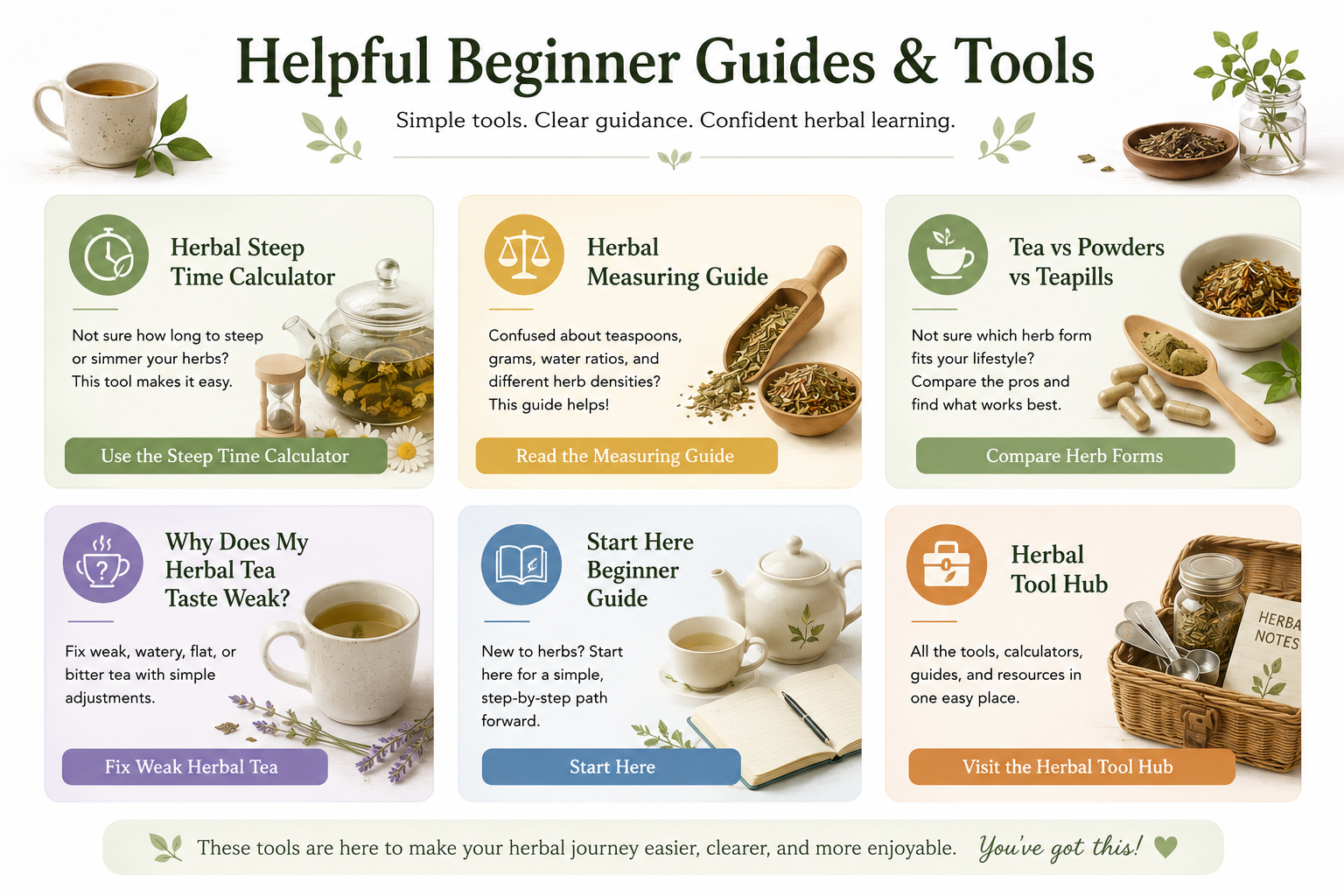
Start Here Beginner Guide
A simple guide for buying and using Chinese herbs without feeling overwhelmed.
Herbal Measuring Guide
Learn teaspoons, grams, water ratios, herb density, and preparation basics.
Herbal Steep Time Calculator
Use this tool to help decide how long to steep or simmer herbs.
Why Does My Herbal Tea Taste Weak?
Find out why tea tastes watery, bitter, flat, or disappointing.
Tea vs Powders vs Teapills
Compare the different herb forms and choose what fits your lifestyle.
Herbal Tool Hub
Find beginner-friendly tools, calculators, and guides in one place.
Trusted Since 1994
At 1st Chinese Herbs, we believe herbs should feel approachable, understandable, practical, and realistic.
Our goal is to help beginners avoid confusion, enjoy the process, understand preparation, and build confidence slowly.
- Family-owned herbal business
- Beginner-friendly herbal education
- Bulk herbs, powders, teapills, mushrooms, and extracts
- Lab-tested products when available
- COAs available upon request when applicable
- Focus on freshness, preparation, and practical herbal learning
No chemistry degree. No 47 tiny spoons required immediately.
Still Confused About Measuring Herbs?
That is normal. Start simple. Learn one method. Adjust slowly.
The goal is not perfect measuring. The goal is making herbs easier to use consistently.
Use the Measuring GuideTry the Steep Time Calculator
Shop Bulk Herbs
Final Thoughts
So why do herbal people own so many tiny spoons?
Because eventually everybody realizes measuring changes everything.
Flavor changes. Strength changes. Ratios matter. Density matters.
And at some point one tiny spoon somehow turns into an entire drawer of mysterious miniature utensils.
That is apparently just part of becoming an herbal person now.
Welcome to the tiny spoon club.
Educational Disclaimer: This information is for educational purposes only and is not intended to diagnose, treat, cure, or prevent any disease. Always consult a qualified healthcare professional before using herbs, especially if pregnant, nursing, taking medication, managing a health condition, or preparing herbs for children.