
How Much Bulk Herb Equals One Teaspoon? (Powder vs Cut Herb + Why a Scale Matters)
Posted by 1st Chinese Herbal Review Team on Mar 5th 2026
How Much Bulk Herb Equals One Teaspoon? (Powder vs Cut Herb + Why a Scale Matters)
If you’ve ever tried to follow an herbal suggestion and thought,
“Okay… but how many teaspoons is that?”—you’re not alone.
Let's get this cleared up once and for all.
A teaspoon measures volume, not weight.
And because herbs come in different forms (powder vs cut/sifted vs fluffy leaf vs dense root chips), 1 teaspoon can mean wildly different doses.
This guide gives you reliable teaspoon ranges, explains why 1 tsp powder ≠ 1 tsp cut herb, and shows the simple method that makes herbal routines more consistent: measuring by grams on a small scale.
Educational information only. For individual guidance, especially with medications,pregnancy/nursing, or health conditions, consult a qualified professional.
Quick Answer: How Much Bulk Herb Equals 1 Teaspoon?
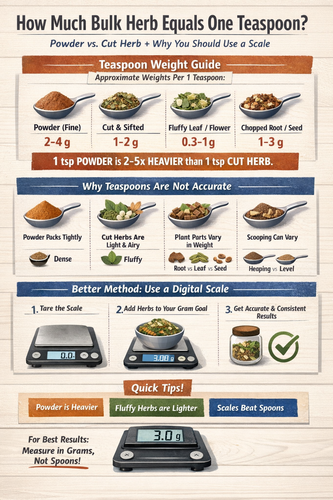
Typical weight ranges by form (most common)
These are general estimates—useful when you must use spoons, but not a substitute for weighing.
| Herb Form | Typical weight per 1 tsp | Why it varies |
|---|---|---|
| Powder (fine) | 2–4 g | packs tightly, less air space |
| Powder (coarse) | 1.5–3 g | looser particles, more air |
| Cut & sifted | 1–2 g | mixed pieces with moderate air space |
| Fluffy leaf/flower | 0.3–1 g | lots of air space, very light |
| Dense chopped root/bark/seed | 1–3+ g | heavier plant parts, compact pieces |
Key point:
1 teaspoon of powder can be 2–5× heavier than 1 teaspoon of a fluffy cut herb. That difference can change how strong your tea feels and how long your bag lasts.
Why 1 Teaspoon Powder Is Different Than 1 Teaspoon Cut Herb
1) Powder packs tighter than cut herb
Powders settle and fill gaps. Cut herbs (especially leaf and flower) contain lots of air between pieces. Same spoon size, very different amount of plant material.
2) Plant parts have different densities
A teaspoon of leaf is usually light. A teaspoon of root chips is heavier. A teaspoon of seeds can be heavier still.
3) Grind size changes the dose
Even within “powder,” a fine grind weighs more per spoon than a coarse grind because it compacts more.
4) Humidity and storage change weight
Herbs can absorb moisture from the environment. That changes weight and sometimes affects aroma and quality.
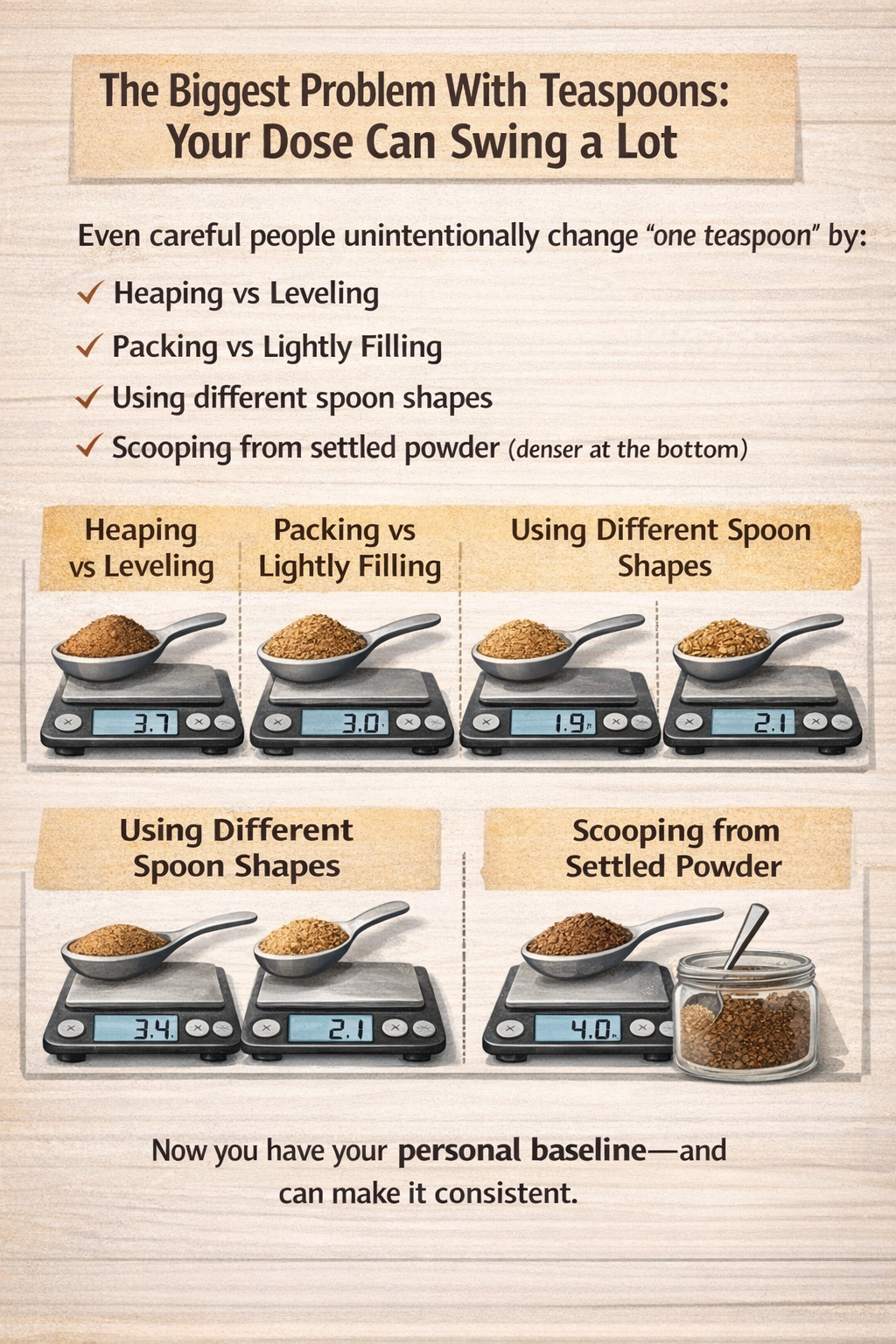
The Biggest Problem With Teaspoons: Your Dose Can Swing a Lot
Even careful people unintentionally change “one teaspoon” by:
-
heaping vs leveling
-
packing vs lightly filling
-
using different spoon shapes
-
scooping from settled powder (denser at the bottom)
-
measuring herbs with mixed particle sizes (dust + chunks)
A realistic variance for spoon-measuring is 30% to 200% depending on the herb form.
That’s why two people can “take the same herb” and have very different experiences.
Why a Scale Makes Herbs More Consistent (and Often More Effective)
Herbs are typically used as part of a routine. Consistency matters.
A small digital scale helps you:
-
Measure the same dose every time (repeatable results)
-
Avoid accidental under-dosing or over-dosing
-
Control taste and strength (especially with bitter herbs)
-
Get better value (no unintentional heavy scoops of powder)
-
Follow directions that use grams (most professional guidance does)
Simple truth:
If your dose changes daily because your spoon changes, your results can feel inconsistent—even when the herb is fine.
Best Practice: Measure by Grams (Takes 20 Seconds)
How to do it (the simplest method)
-
Put a cup/bowl on your scale
-
Press TARE (zeros the scale)
-
Add herb until you reach your target grams
What kind of scale works?
Look for:
-
grams (g) mode
-
0.1 g accuracy
-
at least 500 g capacity
Inexpensive kitchen scales work great for most home herbal use.
If You Don’t Have a Scale Yet: How to Make Teaspoon Measuring More Accurate
For powders
-
Stir or shake the jar before measuring (powder settles)
-
Use a level teaspoon (not heaping)
-
Don’t pack it down
-
Use the same spoon every time
For cut herbs
-
Scoop lightly (don’t crush and pack)
-
Avoid measuring from a bag with lots of dust at the bottom
-
If the herb is fluffy, consider measuring by tablespoon instead of teaspoon for better consistency
Powder vs. Cut Herb: Do They Brew the Same?
Not really—and this is one of the biggest reasons people get inconsistent results.
Even if you use the same herb and even if you measure the same weight in grams, the form (powder vs. cut pieces) changes how water moves through the plant material and how the finished tea tastes, looks, and extracts.
Cut Herbs (especially roots, bark, seeds): Best for Simmering
Cut roots, bark, and seeds are dense. Their structure is tougher, and the good stuff is often locked deeper inside the plant material. That’s why they usually perform better with a decoction (a gentle simmer), not a quick steep.
Best method (decoction):
-
Add the cut herb to water in a pot.
-
Bring to a light boil, then reduce to a gentle simmer.
-
Simmer 20–45 minutes (longer for very dense roots and seeds).
-
Strain well.
Why this works: simmering gives time and heat for water to penetrate dense plant tissue and pull more from the herb—resulting in a stronger, more reliable brew.
Cut Leaves & Flowers: Best for Steeping
Leafy herbs and flowers are lighter and more delicate. They don’t usually need simmering (and can become bitter or “overcooked” if boiled).
Best method (infusion/steep):
-
Pour hot water over the herb.
-
Cover and steep 10–20 minutes.
-
Strain.
Powders: Extract Faster, But Drink Differently
Powders have a massive surface area, so they release compounds quickly—but they also behave differently in water.
Powders can:
-
make tea cloudy, thick, or gritty
-
settle quickly at the bottom of the cup
-
be harder to strain cleanly (fine particles slip through most strainers)
Better ways to use powders (depending on the herb):
-
Mix into warm water and drink “as-is” (stir well; expect settling)
-
Blend into smoothies or food
-
Encapsulate for consistent intake without texture issues
-
If making tea, use a very fine filter (cloth tea bag or nut milk bag) and expect a more “muddy” brew than cut herbs
The Practical Takeaway
Same herb + different form = different brewing method and different drinking experience.
-
Cut roots/bark/seeds usually need time + simmering
-
Leaves/flowers usually do best with steeping
-
Powders may extract quickly but often require mixing, encapsulating, or finer filtering
Friendly Rule of Thumb (Easy to Remember)
If you remember nothing else, remember this:
-
Powder = heavier per teaspoon
-
Fluffy cut herb = lighter per teaspoon
-
Roots/seeds = heavier than leaves
-
A scale removes the guesswork
Frequently Asked Questions
Is 1 teaspoon always 5 grams?
No. That estimate only applies to water-like substances. Herbs have different densities, shapes, and air space.
Why do instructions use grams instead of teaspoons?
Because grams are accurate and repeatable. Teaspoons vary too much between users and herb forms.
Can I substitute cut herb for powder using the same teaspoon amount?
Usually not. A teaspoon of cut herb is often much lighter than a teaspoon of powder. If you’re switching forms, the best approach is to measure grams.
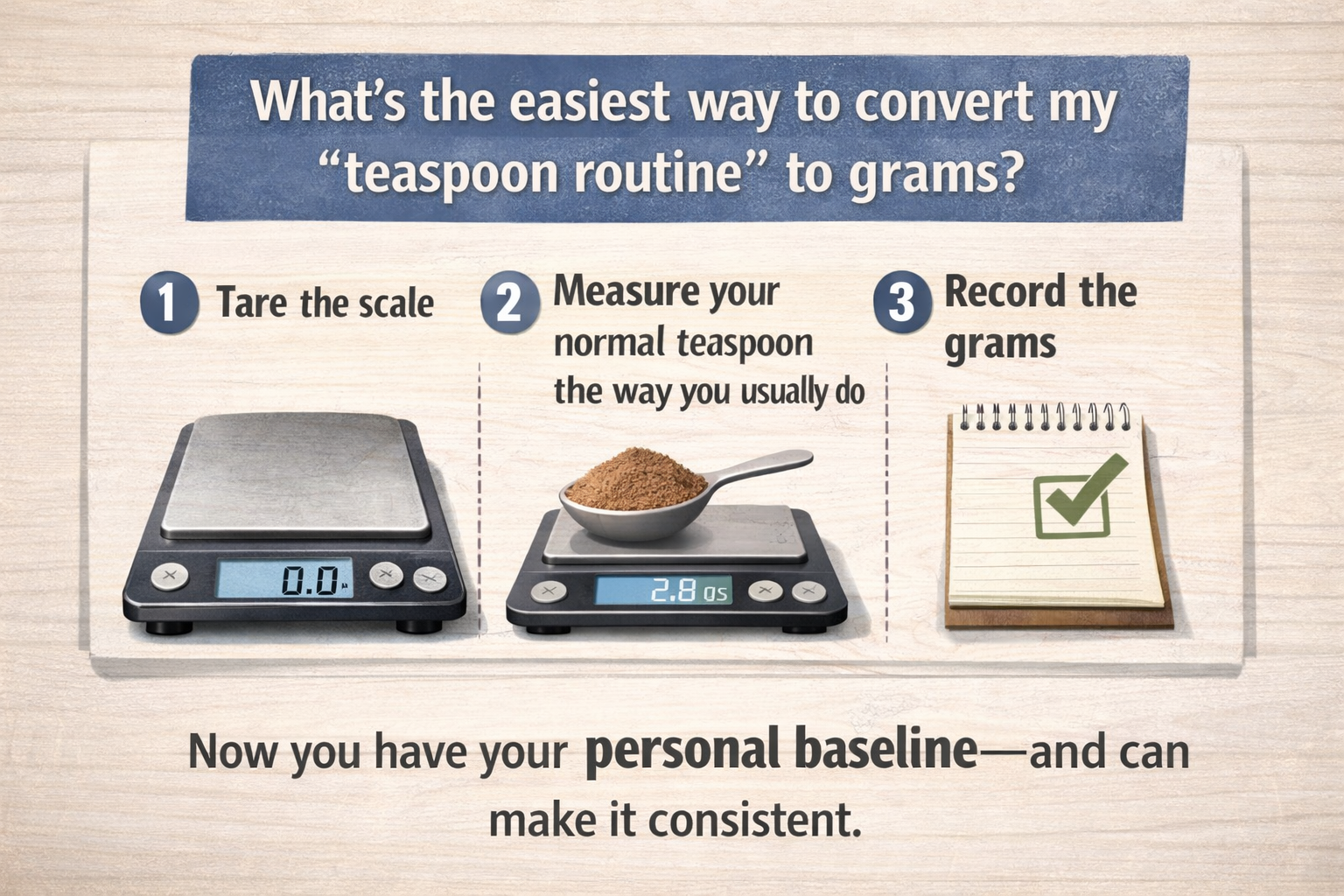
What’s the easiest way to convert my “teaspoon routine” to grams?
Do this once:
-
Tare the scale
-
Measure your normal teaspoon the way you usually do
-
Record the grams
Now you have your personal baseline—and can make it consistent.
Why does this matter if herbs are “natural”?
Natural doesn’t mean uniform. Consistent measurement helps you evaluate what works for you and reduces daily variation.
Quick Takeaway
Teaspoons are an estimate. Grams are a true measurement.
If you want consistency, predictable strength, and a routine you can actually track, use a scale.
Quick Summary Box On Conversions
Teaspoon Conversion Basics
-
1 tsp powder: ~2–4 g
-
1 tsp cut & sifted: ~1–2 g
-
1 tsp fluffy leaf/flower: ~0.3–1 g
-
Best practice: weigh in grams for consistent results
Helpful Links