
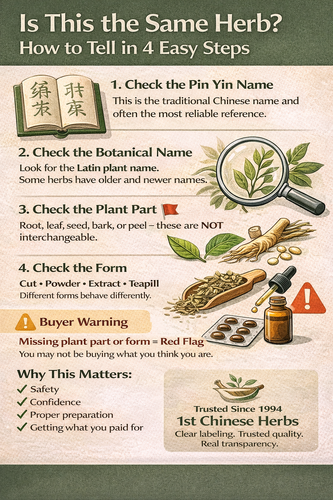
Is This The Same Herb?
Feb 26th 2026
Is This the Same Herb? A Consumer Guide to Herb Synonyms and Confusing Name Changes
A Consumer Guide to Herb Synonyms, Confusing Name Changes, and How to Buy the Right Plant Every Time
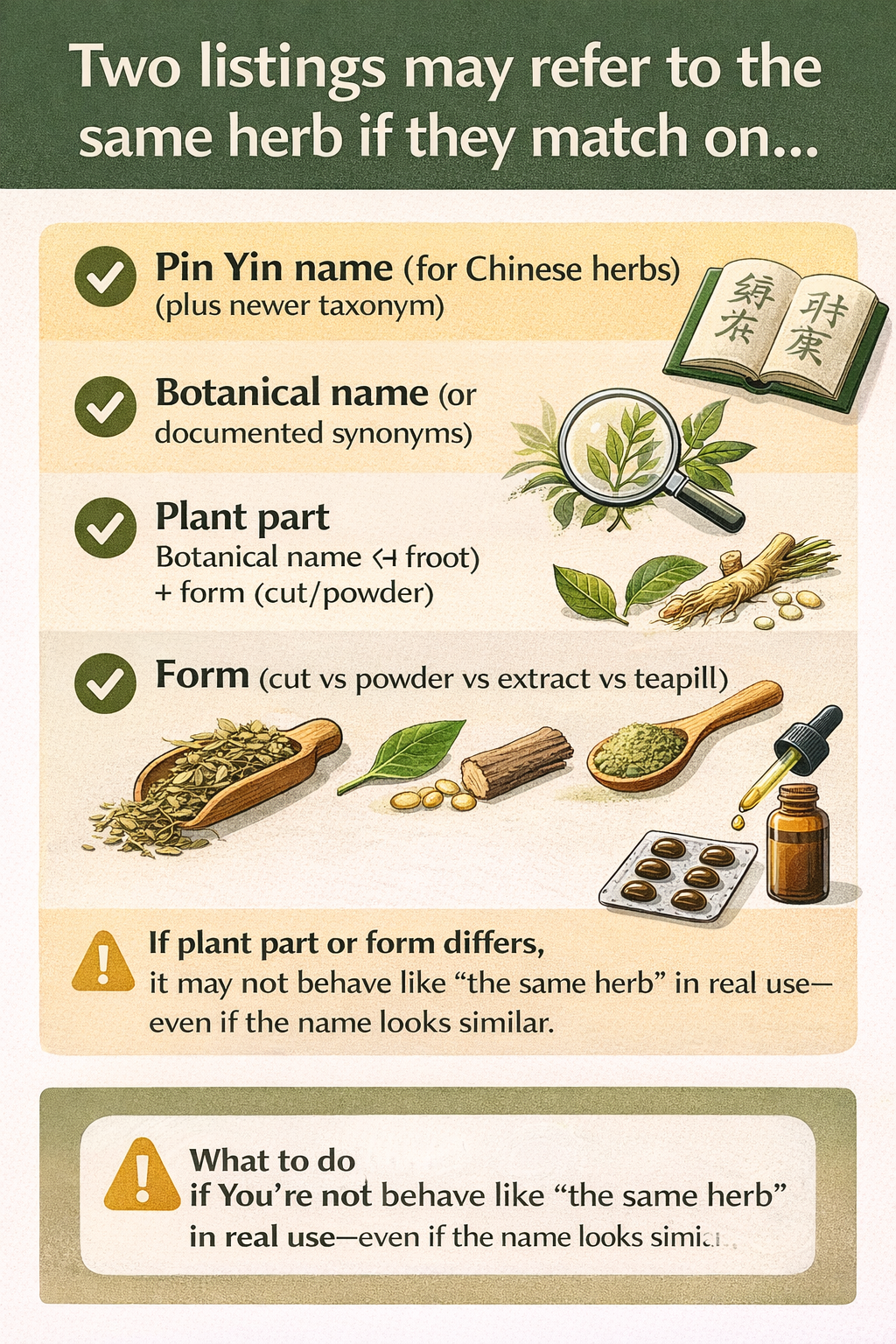 Quick Answer: How to Tell If Two Herb Names Are the Same Thing
Two listings may refer to the same herb if they match on (1) Pin Yin name (for Chinese herbs), (2) botanical name (or documented synonyms), (3) plant part, and (4) form (cut vs powder vs extract vs teapill). If plant part or form differs, it may not behave like “the same herb” in real use—even if the name looks similar.
On This Page
- Why This Matters (Safety, Confidence, Consistency)
- Why Herb Names Change
- The 4 Identity Checks (Name, Part, Form, Source)
- 7+ Real Examples of Confusing Herb Names
- Red Flags: When “Same” Isn’t Really the Same
- What To Do If You’re Not Sure
- How 1st Chinese Herbs Makes It Clear
- FAQ
- Next Steps / Related Guides
Why This Matters
Herb synonym confusion isn’t just annoying—it changes what you’re actually buying.
- Safety: Some “close” herbs are not interchangeable—especially if you have sensitivities, allergies, or take medications.
- Confidence: Incomplete labels make shoppers guess, and guessing kills trust (and causes returns).
- Consistency: Clear identity and form help you prepare herbs correctly and compare products fairly.
- Ethical support: Buying from transparent sellers supports better industry practices and discourages sloppy labeling.
Why Herb Names Change (Even When the Plant Doesn’t)
Most naming confusion comes from a few predictable causes:
- Taxonomy updates: Botanists reclassify plants (genus changes happen).
- Legacy trade names: The herbal marketplace keeps older names because customers recognize them.
- Common names overlap: One English name can refer to multiple species in different regions.
- Translation differences: Pin Yin, Chinese characters, Latin names, and English common names can be mixed inconsistently.
 The 4 Identity Checks Every Buyer Should Use
When you see multiple names for “the same herb,” use these checks before buying.
The 4-Point “Same Herb?” Test
- Name System Match: Pin Yin + botanical name (or documented synonym)
- Plant Part Match: root ≠ leaf ≠ seed ≠ bark ≠ peel (these are different materials)
- Form Match: cut herb ≠ powder ≠ extract ≠ teapill/capsule (preparation and expectations change)
- Source Clarity: brand/seller transparency, clear label, and product details you can verify
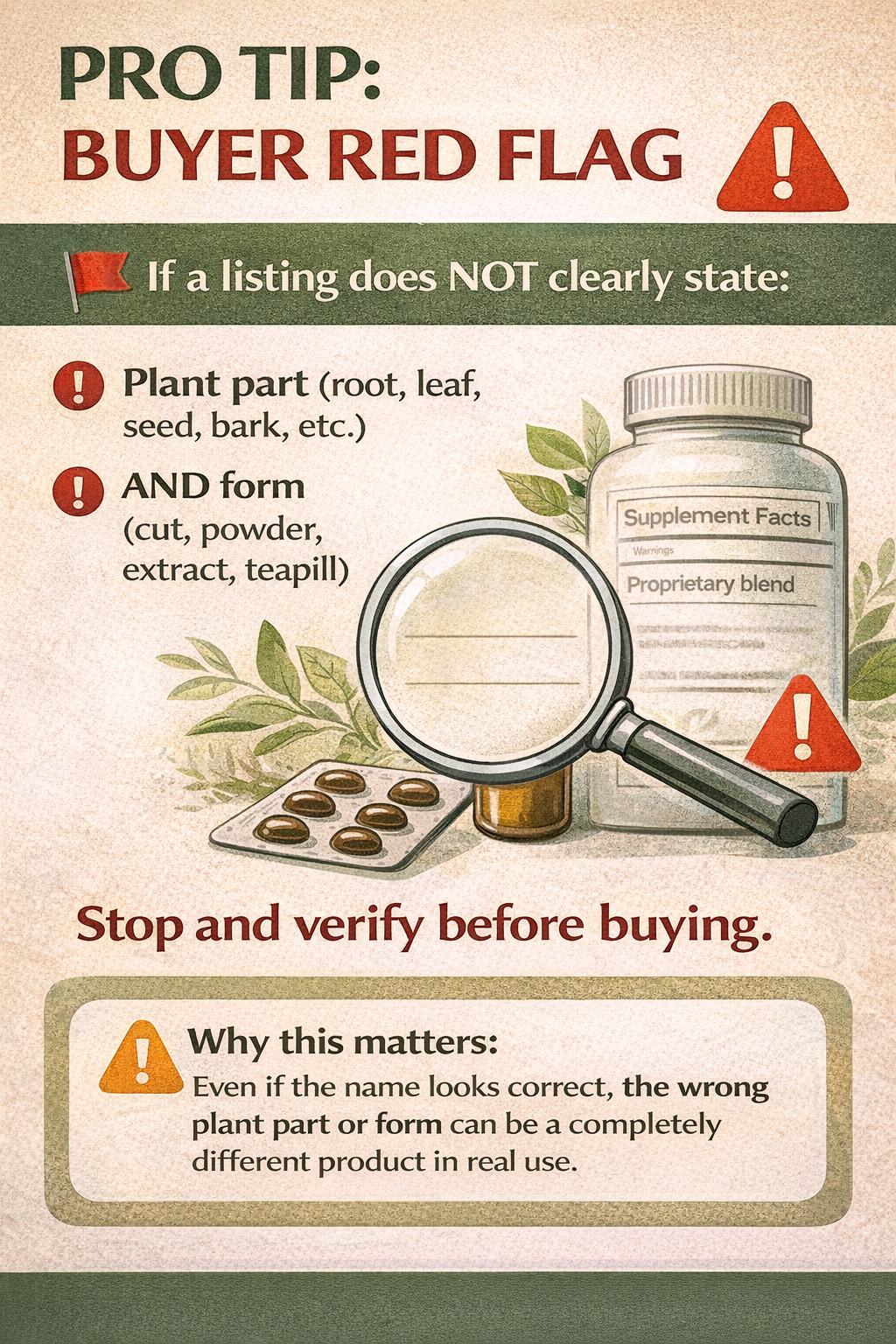
Pro tip: If a listing is missing plant part or form, treat that as a buyer red flag.
7+ Real Examples: Herb Synonyms That Confuse Buyers
Here are common real-world examples where shoppers frequently ask: “Is this the same herb?”
| Herb (Consumer Name) | Common Names You’ll See | Why It’s Confusing | What to Check on the Label |
|---|---|---|---|
| Bai Hua She She Cao | Hedyotis diffusa / Oldenlandia diffusa (plus newer taxonomy names in some references) | Older botanical names remain common even when updated names exist. | Pin Yin + botanical name (as listed) + plant part + form (cut/powder) |
| Eleuthero (“Siberian ginseng”) | Eleutherococcus senticosus / Acanthopanax senticosus | Two botanical names show up in trade. Common name can mislead shoppers into thinking it’s Panax. | Botanical name + root + form; confirm it is Eleuthero (not Panax) |
| Cinnamon | Cinnamomum verum / Cinnamomum zeylanicum (synonym pairing often seen) | Two Latin names may refer to the same identity in many resources; “cinnamon” also has multiple market species. | Botanical name + bark form (chips/powder) + origin (if listed) |
| He Shou Wu | Polygonum multiflorum (older name used widely in commerce) | Legacy botanical names persist; also confusion between raw vs processed forms. | Pin Yin + botanical name + processed vs raw (if applicable) + root form |
| Huang Qi (Astragalus) | Astragalus membranaceus / Astragalus mongholicus (and related naming variants) | Multiple Astragalus naming conventions appear across sellers and references. | Pin Yin + species name + root + slice/cut/powder form |
| Dang Gui | Angelica sinensis (often stable, but confused with “Angelica” generically) | Not all “Angelica” is Dang Gui. Common name confusion is the main issue. | Confirm Angelica sinensis + root + form |
| Gan Cao (Licorice) | Glycyrrhiza uralensis (and other Glycyrrhiza species appear in commerce) | “Licorice” can refer to different species; not all listings specify which one. | Botanical name + root + cut/powder + cautions |
| Chen Pi (Tangerine peel) | Citrus reticulata (plus “mandarin/tangerine” naming overlap) | Citrus naming is a common source of confusion across regions and product styles. | Botanical name (if listed) + peel + cut size + storage tips |
Reality check: Sometimes two names truly are synonyms. Sometimes they are different species sold under the same common name. Your safest move is to verify identity using the label details, not the marketing headline.
Red Flags: When “Same” Isn’t Really the Same
If you see any of these, slow down and verify before buying:
- Only a common name with no Pin Yin or botanical name
- No plant part listed (root/leaf/seed matters)
- No form listed (cut vs powder vs extract vs teapill)
- Vague ingredient language (“proprietary blend” with no details)
- “Miracle” claims that replace clear product identity
- Inconsistent naming across the same store’s listings
What To Do If You’re Not Sure (Simple Buyer Steps)
- Find the Pin Yin name (if it’s a Chinese herb). Pin Yin is often the most reliable “shopping anchor.”
- Look for the botanical name and note any alternate spellings or older names.
- Confirm plant part (root, peel, seed, leaf, whole herb).
- Confirm form (cut/powder/extract/teapill) because preparation and value comparisons depend on it.
- Ask the seller if anything is unclear. A trustworthy seller should answer product identity questions clearly.
Not sure if you’re looking at the same herb?
Contact us and we’ll help you confirm the name, plant part, and best form for your routine: Contact 1st Chinese Herbs.
How 1st Chinese Herbs Makes Herb Identity Clear
We believe labeling clarity is consumer protection. Here’s what we focus on:
- Multi-name clarity: Pin Yin + common name + botanical name (and clarifying notes when synonyms are common).
- Plant part + form visibility: These details reduce mistakes and help customers compare products fairly.
- Education that matches real-life shopping: We create guides that answer the questions shoppers actually ask (not just textbook definitions).
- Support when you’re unsure: If a customer is stuck, we’d rather help than have you guess.
FAQ: Herb Synonyms and Name Changes
Are two different botanical names always two different herbs?
No. Sometimes a newer accepted botanical name replaces an older one, and both names continue to circulate. What matters is whether the listing clearly identifies species, plant part, and form.
What’s the single biggest reason shoppers buy the wrong herb?
Missing label details—especially plant part and form. “Root” and “leaf” are not interchangeable, and “cut herb” vs “powder” changes preparation and expectations.
Is a common English name enough to identify an herb?
Usually not. Common names can refer to different species depending on region and tradition. Look for Pin Yin (for Chinese herbs) and a botanical name whenever possible.
Why do two bags of the “same herb” look different?
Often it’s due to differences in cut size, plant part, harvest time, or processing. That’s why clear labeling and product education matter.
How can I be sure I’m ordering the correct herb online?
Use the 4-Point “Same Herb?” Test: name system match, plant part match, form match, and source clarity. If anything is missing, ask the seller before buying.
Company: 1st Chinese Herbs (Family-Owned Since 1994)
Last reviewed: February 26, 2026