

Prepared Rehmannia (Shu Di Huang): Benefits, How to Use, Who It’s For, and Quality Tips
Posted by Sarah Johnson, M.S. in Holistic Healing, - 1st Chinese Herbs Review Team on Jan 22nd 2026
Shu Di Huang Guide: Prepared Rehmannia Benefits, Uses, Safety, and How to Take It
Shu Di Huang (also called Zhi Di Huang or Prepared Rehmannia Root, Rehmannia glutinosa) is one of the most foundational “rebuilding” herbs in Traditional Chinese Medicine (TCM). People often search for it when they feel depleted, dry, or run down—and then get frustrated because most pages either overpromise or give vague instructions.
• Questions? Contact us
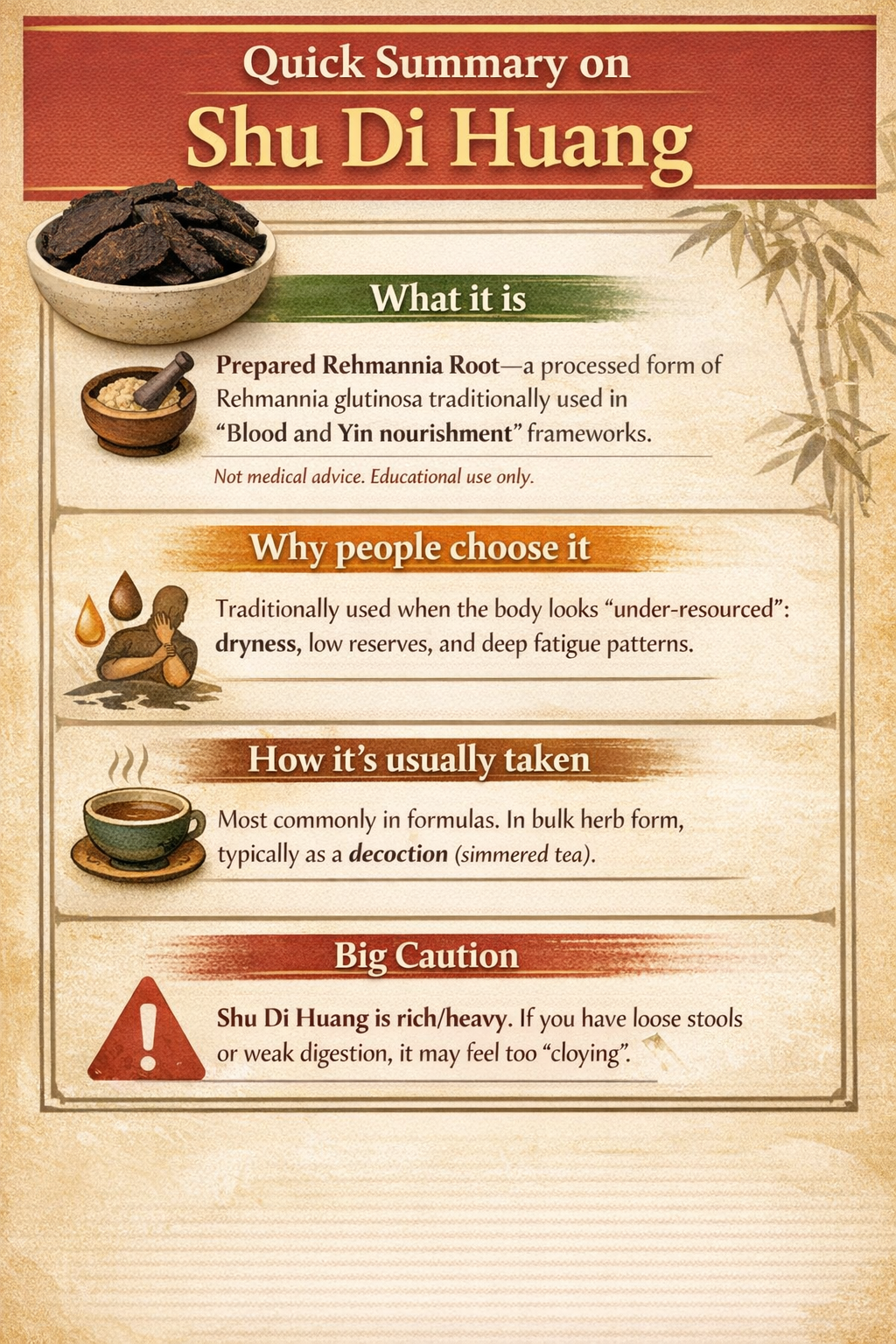
Quick Summary On Shu Di Huang
What it is
Prepared Rehmannia Root—a processed form of Rehmannia glutinosa traditionally used in “Blood and Yin nourishment” frameworks.
Not medical advice. Traditional use language is educational and not intended to diagnose, treat, cure, or prevent disease.
Why people choose it
Traditionally used when the body looks “under-resourced”: dryness, low reserves, and deep fatigue patterns (traditional framework).
How it’s usually taken
Most commonly in formulas. In bulk herb form, it’s typically prepared as a decoction (simmered tea).
Big caution
Shu Di Huang is rich/heavy. If you have loose stools or weak digestion, it may feel too “cloying” (traditional framework).
What is Shu Di Huang?
Shu Di Huang is the prepared (processed) form of Rehmannia root (Rehmannia glutinosa). The “prepared” part is not a marketing word—it is a traditional processing method that changes the herb’s traditional use profile.
Many people first learn about Shu Di Huang through classic formulas. It’s often described as a “foundation-builder” in traditional practice. In modern terms: it’s typically chosen when someone is not looking for a quick stimulant effect—they’re looking for steady rebuilding support (traditional framework).
Why Shu Di Huang Works (Traditional Framework + Modern Insight)
Traditional explanation (TCM)
In Traditional Chinese Medicine, Shu Di Huang is commonly discussed in frameworks of nourishing Blood and nourishing Yin. That’s traditional language for restoring foundational reserves—often described as moisture, substance, and recovery capacity.
Modern research perspective (what scientists study)
Researchers study Rehmannia glutinosa for its phytochemical constituents, including iridoid glycosides (such as catalpol) and other compounds. Studies often focus on antioxidant and inflammation-related pathways in preclinical models. Processing methods can change chemical composition, which is one reason traditional systems distinguish raw vs prepared forms.
Educational note: Research on isolated compounds or extracts does not prove that the whole herb treats a disease. We include references for transparency and to help customers evaluate sources.
TCM Properties & Traditional Use
Traditional descriptions commonly include:
- Nourishes Blood (traditional framework)*
- Nourishes Yin (traditional framework)*
- Supports deep reserves for rebuilding patterns (traditional framework)*
*Traditional framework = the way TCM describes patterns and functions. This is not a claim to treat, cure, or prevent disease.
Shu Di Huang is not “a quick fix.” It’s typically chosen when someone wants steady, foundational support and is willing to be consistent (traditional framework).
Sheng Di Huang vs Shu Di Huang: Which One Do You Actually Need?
This is one of the biggest missing explanations on competitor pages. Here is the simple consumer guide:
| Form | What it is | Traditional orientation | Plain-English feel |
|---|---|---|---|
| Sheng Di Huang | Raw/Fresh Rehmannia | Traditionally more cooling/clearing | Often chosen when “active heat/dryness” signs are more prominent (traditional framework) |
| Shu Di Huang | Prepared/Processed Rehmannia | Traditionally more nourishing/tonifying | Often chosen when the main need is rebuilding reserves and substance (traditional framework) |
If you aren’t sure which form fits you, a qualified practitioner can pattern-match and save you months of guessing.
Who Should Consider Shu Di Huang?
Shu Di Huang is traditionally chosen by pattern, not by a condition label. People often ask about it when they identify with “depletion-style” patterns.
Common reasons people shop for it
- They feel “low reserve” fatigue and want steady rebuilding (traditional framework).
- They notice dryness and want deeper nourishment support (traditional framework).
- They are using a classic formula that includes Shu Di Huang as a foundation herb.
Who Should Not Use This
- Loose stools, heavy digestion, or “Damp” patterns (traditional framework).
- People who feel worse with rich foods or have very weak digestion.
How to Use Shu Di Huang (Decoction Method)
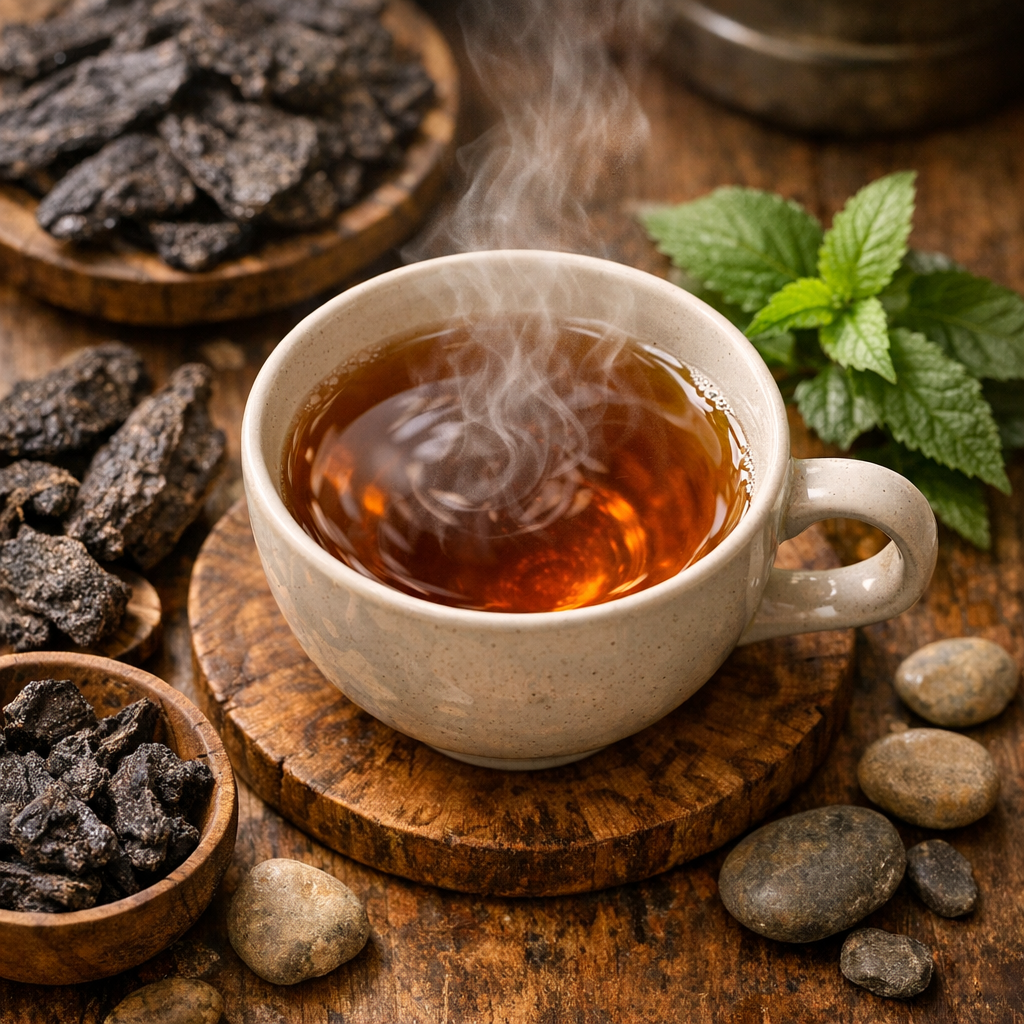
Best method for bulk herb form: decoction (simmered tea)
Simple Decoction Instructions (Educational Example)
- Use 6–15g of Shu Di Huang (typical traditional range; practitioner guidance is best).
- Add to a pot with 3–4 cups of water.
- Bring to a light boil, then reduce to a gentle simmer.
- Simmer 30–60 minutes (richer herbs often do better with longer simmering).
- Strain and drink warm. Many people split into 2 servings.
If you’re combining herbs, some go in later (aromatics) and some earlier (dense roots). A practitioner can optimize timing.
If it feels too rich or “heavy”
- Use it in a balanced formula rather than alone (common traditional approach).
- Try a smaller amount and build slowly.
- Make sure you are using the correct form (prepared vs raw).
For more methods (capsules, tinctures, poultices, foot baths), see: How to Use Bulk Herbs.
How to Choose High-Quality Shu Di Huang
Many marketplace listings are thin on sourcing details. Here’s what informed shoppers look for:
Identity & processing
- Botanical name clearly listed: Rehmannia glutinosa
- Prepared form clearly stated: Shu Di Huang / Radix Rehmanniae Praeparata
- No confusing “Rehmannia blend” labeling without details
Clean handling & trust
- Airtight packaging and sensible storage guidance
- Real customer support (not a marketplace mystery seller)
- COA availability (when available) and transparency
Cautions, Interactions, and Who Should Avoid Shu Di Huang
Shu Di Huang is traditionally considered rich and “cloying,” which is why fit matters.
Use extra caution (and get professional guidance) if you:
- Are pregnant or nursing
- Take prescription medications (especially for blood sugar, blood pressure, anticoagulants)
- Have chronic digestive weakness or frequent loose stools
- Have a complex medical history and want personalized dosing
This content is for educational purposes only and is not intended to diagnose, treat, cure, or prevent any disease. Always consult a qualified healthcare professional for medical decisions.
FAQ: Shu Di Huang (Prepared Rehmannia Root)
What does Shu Di Huang taste like?
Many people describe it as earthy and mildly sweet. In decoction it can feel “thick” or rich compared to lighter herbal teas.
How long does it take to notice effects?
Traditional rebuilding approaches are usually measured in weeks, not days. Timing depends on pattern fit, consistency, dose, and whether it’s used in a balanced formula.
Can I take Shu Di Huang by itself?
Some people do, but it is more commonly used in formulas to balance its richness and support digestion.
Why do some people feel worse on it?
Most commonly: mismatch (wrong pattern), too much too soon, or weak digestion. In traditional practice it’s often balanced with other herbs for better tolerance.
How do I store Shu Di Huang?
Store in an airtight container or sealed bag, away from heat and moisture. Keep it dry and cool to preserve quality.
Related Links:
How to Use Bulk Herbs
What No One Tells You About Chinese Herbs (Common Mistakes + Fixes)
Contact Us
Free Ebook: 10 Vital Medicinal Herbs
References (PubMed / Peer-Reviewed Research Links)
We provide research links for transparency and customer education. Studies may involve extracts/isolated compounds and do not necessarily represent effects of the whole herb in humans.
- Catalpol (Rehmannia-associated compound) review (PMC): https://pmc.ncbi.nlm.nih.gov/articles/PMC7023090/
- Processing and research discussion for Prepared Rehmannia (PMC): https://pmc.ncbi.nlm.nih.gov/articles/PMC9945319/
- Traditional-style monograph overview (professional herbal reference): https://www.herbalreality.com/herb/rehmannia/
Why Customers Trust 1st Chinese Herbs
We’re a family-owned herbal company focused on education and quality-first sourcing. If you need help choosing the right herb form or learning how to prepare bulk herbs safely, reach out anytime.
Quality note: Certificates of Analysis (COAs) may be available upon request depending on the product and lot.