

TCM Patterns Self Check Cold Heat Damp Dry Deficiency Excess
Jan 5th 2026
How to Tell If You’re Cold, Hot, Damp, Dry, or Deficient in Chinese Medicine (A Simple Self-Check)
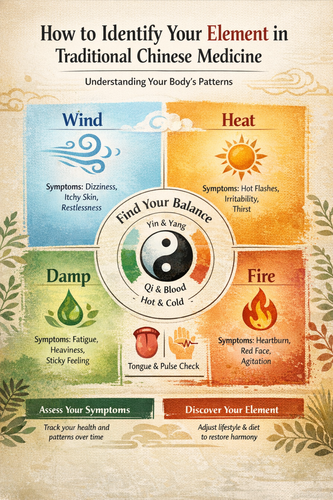
In Traditional Chinese Medicine (TCM), you’re not permanently “a damp person” or “a heat person.” You’re showing a pattern—a cluster of signs that describes what your body is doing right now. This guide helps you identify your likely pattern using the same practical framework taught in TCM education, explained in plain English.
Quick answer (40–60 seconds)
TCM patterns are symptom “clusters” (not diagnoses). Most people can sort their pattern using 3 questions: Hot or Cold? Damp or Dry? Excess (stuck/pressure) or Deficiency (low fuel)? Your best match is usually a combination (example: hot + heavy + stuck = damp-heat excess).
Jump to what you need
- Start here: the 6-question decision tree
- The 3-axis pattern map (the easiest way)
- Pattern cheat sheet table
- Cold, Heat/Fire, Damp, Damp-Heat, Dryness, Deficiency
- The 7 most common mixed patterns (real life)
- Most common misreads (why quizzes confuse people)
- Printable 7-day pattern tracker
- What to do next
- FAQ
Start here: the 6-question decision tree
Answer these quickly. Don’t overthink—choose what’s true most days.
- Temperature trend: Do you feel better with warmth (blanket, hot tea), or better with cool air and cold drinks?
- Thirst: Are you genuinely thirsty (often), or not much?
- Stool: More often loose/sticky, or dry/hard?
- Feeling tone: Heavy/puffy/foggy, or dry/tight/scratchy?
- Energy: Mostly low fuel (fatigue), or more pressure/fullness “stuck” sensations?
- Worst time: Worse with heat/spicy foods and stress, or worse with cold/raw foods and overwork?
Quick interpretation
- Better with warmth + loose stools + low appetite → often Cold/Deficiency
- Worse with heat + thirst + constipation + irritability → often Heat/Excess
- Heavy/foggy + bloating + sticky stools + puffiness → often Dampness
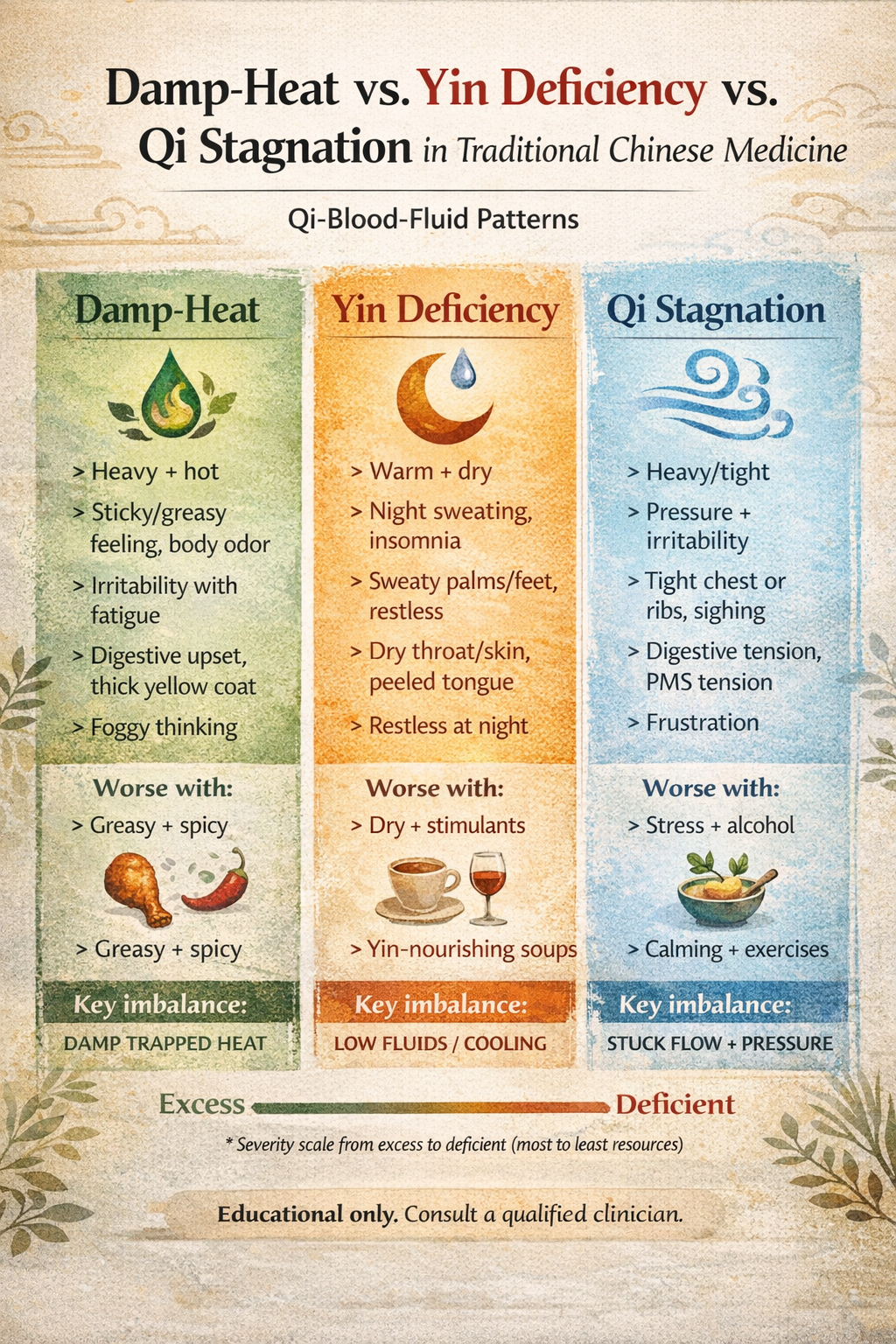
- Heavy + hot + greasy feeling + thick coating → often Damp-Heat
- Dry skin/throat + dry stools + night heat → often Dryness / Yin-fluid deficit
The 3-axis pattern map (the easiest way to be accurate)
Think of patterns like three sliders—not personality labels:
- Temperature: Cold ↔ Heat/Fire
- Fluids: Damp ↔ Dry
- Strength: Deficiency (low fuel) ↔ Excess (stuck/pressure)
Most people land in a combination. Example: Heat + Damp + Excess is “damp-heat excess.” Example: Cold + Damp + Deficiency often looks like “Spleen yang deficiency with damp.”
Pattern cheat sheet table
| Pattern | Key signs (plain English) | Usually worse with | Often feels better with | Most common mistake |
|---|---|---|---|---|
| Cold | Chilled, pale, slow digestion, loose stools, low drive | Cold/raw foods, iced drinks, cold weather | Warm soups, warmth, gentle movement | Doing aggressive “cleanses” that drain more |
| Heat / Fire | Redness, irritability, thirst, constipation, restless sleep | Spicy foods, alcohol, overheating, stress | Cooling foods, hydration, calm routines | Mistaking “stress heat” for infection |
| Dampness | Heavy limbs, puffiness, brain fog, bloating, sticky stools | Greasy/sugary foods, overeating, late-night eating | Light cooked meals, regular movement | Clearing “heat” without addressing damp |
| Damp-Heat | Heavy + hot, sticky sweat, irritability with fogginess, thick/greasy feeling | Alcohol, sugar, spicy/greasy meals, humid weather | Cooling + light meals, consistency | Treating it like “just heat” or “just damp” |
| Dryness | Dry throat/skin/eyes, dry stool, scratchy cough | Dehydration, overly drying foods, very dry climates | Fluids, soups, humidification | Assuming dryness is always “heat” (it can be) |
| Deficiency | Low energy, weak recovery, symptoms worse when tired | Overwork, poor sleep, skipping meals | Rest, routine, gentle nourishment | Using strong draining strategies too long |
The main patterns explained (simple, accurate, practical)
1) Internal Cold
Plain English: your “warmth and movement” are running low.
- Cold hands/feet, prefers warm drinks
- Pale complexion, low appetite
- Loose stools, frequent urination
- Feels worse with cold/raw foods
Common overlap: Cold + damp (puffy + sluggish + chilled).
2) Heat and Fire
Plain English: your system feels overheated—often from stress, diet, or congestion.
- Red face/eyes, irritability, restless sleep
- Thirst, dry mouth, bad breath (often)
- Constipation or darker urine
Heat vs Fire: “Fire” is more intense heat (more agitation, redness, dryness, intensity).
3) Dampness
Plain English: fluid metabolism feels sluggish—things feel heavy, sticky, and slow.
- Bloating, nausea, low appetite
- Loose or sticky stools
- Puffiness/water retention
- Brain fog, heavy limbs
4) Damp-Heat (the most common “I’m not sure” pattern)
Plain English: dampness + heat together (heavy + inflamed).
- Feeling hot but also heavy or sluggish
- Sticky sweating, body odor, greasy skin (often)
- Digestive upset with heat signs (burning, foul stools)
Why it’s tricky: clearing heat alone can fail if damp is trapping it.
5) Dryness
Plain English: your inner “humidity” is low.
- Dry throat/skin/eyes
- Dry stools, constipation tendency
- Scratchy cough, dry nose
Dryness can come from: environment, dehydration, or heat consuming fluids.
6) Deficiency (Qi, Blood, Yin, Yang) — the simplest way to understand it
Deficiency means your resources are low. The label changes depending on what’s low:
- Qi deficiency: low energy, weak voice, shortness of breath, spontaneous sweating
- Blood deficiency: pale, dizziness, numbness/tingling, dry skin/hair, insomnia
- Yin deficiency: dryness + “night heat,” hot palms/soles, restless sleep
- Yang deficiency: cold + fatigue + loose stools + low drive
The 7 most common mixed patterns (because real people are not one label)
- Damp + Qi deficiency: bloat + fatigue + fogginess
- Yin deficiency + deficiency heat: dry + night restlessness + warm sensations
- Qi stagnation → heat: stress + tightness + reflux/irritability over time
- Cold + damp (yang deficiency with damp): chilled + puffy + sluggish digestion
- Phlegm-damp + heat: thick congestion + inflammation or “stuck” feeling
- Blood deficiency + dryness: pale + dry skin/hair + lightheadedness
- Deficient underneath, excess on top: tired baseline + stubborn congestion/pressure symptoms
Most common misreads (why quizzes get it wrong)
- Yin deficiency vs Dampness: Yin deficiency is dry + night heat; dampness is heavy + sticky.
- Qi stagnation vs Heat: stagnation feels tight/pressure; heat feels inflamed/red/thirsty.
- Cold digestion vs “detox needed”: if you’re cold + loose stools, harsh draining tends to backfire.
Printable 7-day pattern tracker (copy/paste)
Track for one week. Patterns become obvious when you see repeats.
Daily checkboxes
- Temperature: □ cold today □ neutral □ hot today
- Fluids: □ heavy/puffy □ normal □ dry
- Stool: □ loose □ sticky □ normal □ dry/hard
- Thirst: □ low □ moderate □ high
- Energy (0–10): ____
- Sleep quality (0–10): ____
- Stress level (0–10): ____
- Notes: foods/alcohol/spicy? weather? cycle? new meds?
After 7 days: circle your most frequent trends → Hot/Cold, Damp/Dry, Excess/Deficiency.
What to do next
- Choose one main direction for 7–14 days: cool heat, reduce damp, moisten dryness, or rebuild deficiency.
- Start with food and routine: these are the safest “first levers.”
- Use herbs with guidance if you’re on medications or have chronic conditions: patterns can overlap and strong strategies can be mismatched.
- Re-check your tracker: the goal is trend improvement, not a perfect label.
Food-style guidance
- Heat/Fire trend: reduce alcohol, very spicy foods; prioritize hydration and calmer evenings.
- Cold trend: favor warm cooked meals; reduce iced drinks and raw-heavy meals.
- Damp trend: reduce greasy/sugary late-night eating; prioritize light cooked meals and daily movement.
- Dry trend: hydrate consistently; consider soups, stews, and humidification in dry seasons.
About this guide
This article is written as educational content using commonly taught TCM pattern frameworks (temperature, fluids, and excess/deficiency). 1st Chinese Herbs has served customers since 1994 with a focus on identity-forward sourcing and quality handling. This page does not diagnose conditions or replace medical care. For personalized guidance, work with a licensed practitioner.
Want the simplest “next best step”? Save your tracker results, then learn correct preparation and usage basics here: How to Use Bulk Herbs →
FAQ
Can I have more than one TCM pattern at the same time?
Yes. Mixed patterns are common (example: dampness in digestion with dryness in the lungs, or deficiency underneath with excess on top).
What’s the difference between “heat” and “fire” in Chinese medicine?
Fire is stronger, more intense heat—often showing more agitation, redness, dryness, and intensity than mild heat.
How do I know if I have damp-heat?
Damp-heat often feels heavy plus hot: sticky sweating, a greasy/thick feeling, digestive upset with heat signs, and irritability with fogginess.
Is this a medical diagnosis?
No. Pattern language is an educational framework. For symptoms that are severe, sudden, or persistent, get medical evaluation.
Related links
- How to Use Bulk Herbs
- 7 Common Mistakes (and how to fix them)
- Contact Us
- Free Ebook: 10 Vital Medicinal Herbs
Educational information only. Herbs are not intended to diagnose, treat, cure, or prevent any disease.
References
1) Pattern differentiation as a real clinical concept (and studied in research)
-
“Pattern differentiation in Traditional Chinese Medicine…” (TCM pattern differentiation used to identify subgroups/response differences in a biomedical condition). PMID: 19757979 PubMed
-
Understanding TCM therapeutics (review of core concepts and clinical application). (Good “TCM theory overview” citation.) PMC full text available. PubMed Central
-
“Understanding traditional Chinese medicine” (mentions standardization components including eight-principle syndrome differentiation). PMC full text available. PubMed Central
2) Cold–Heat framework (hot vs cold) with validated questionnaires
These are very useful because your article teaches people to sort “hot vs cold” with a self-check.
-
Reliability/validity of a Cold–Heat pattern questionnaire (adjunct diagnostic tool). PMID: 20569034 PubMed
-
Developing an optimized cold/heat questionnaire (questionnaire development + reliability testing). PMC full text available. PubMed Central
3) Deficiency frameworks (Qi / Blood / Yin / Yang) with validation studies
-
Yin-Deficiency Questionnaire development/validation. PMID: 17265546 PubMed
-
Yin Deficiency Scale (YDS) development/validation; also examines relationships with cold–heat. PMID: 22950657 PubMed
-
Validation of the Qi–Blood–Yin–Yang Deficiency Questionnaire (QBYY-Q). PMID: 27141228 PubMed+1
-
Kidney Deficiency Syndrome Questionnaire (KDSQ) validity/reliability (useful example of validated syndrome-specific tools). PMC full text available. PubMed Central
4) Dampness / phlegm / heat / qi stagnation as “syndrome elements”
-
Analysis paper listing syndrome elements (includes qi deficiency, dampness, phlegm, yin deficiency, qi stagnation, heat, etc.) PMC full text available. PubMed Central
-
Example condition-focused paper using qi/yin deficiency and heat concepts in syndrome differentiation (diabetes example). PMC full text available. PubMed Central
5) Tongue diagnosis & objectification (evidence + limitations)
Since your article references tongue coating trends, it helps to cite both the promise and the known reliability challenges.
Evidence of reliability/objectification work:
-
Smartphone tongue coating reliability study (supports some tongue coating features can be rated reliably in images). PMID: 32459647 PubMed
-
Agreement study between automatic tongue diagnosis system and TCM doctors (objectification/automation topic). PMID: 22924055 PubMed
Evidence of limitations
-
Inter-/intra-practitioner reliability study of tongue inspection (found reliability issues for certain features). PMID: 18564955 PubMed
-
Review of inter-rater agreement studies in TCM (summarizes reliability research and critiques methods). PMC full text available. PubMed Central
6) Reliability of TCM diagnosis using Eight Principles / Zang-Fu
-
Reliability of Chinese medicine diagnosis according to Eight Guiding Principles and Zang-Fu theory. PMID: 19249997 PubMed