

Why Chinese Herbs Work When Everything Else Feels Like It’s Failing
Posted by Sarah Johnson, M.S. in Holistic Healing on Dec 22nd 2025
Why Chinese Herbs Work When Everything Else Feels Like It’s Failing
(And Why More People Are Turning to Them Now. Is This You?)
A warm, practical guide to Chinese herbs—what makes them different, how to start without overwhelm, and how to choose bulk herbs vs extract powders vs teapills (with quality, safety, and trust built in).
Educational use only. Dietary supplements are not intended to diagnose, treat, cure, or prevent any disease. If you are pregnant, nursing, have a medical condition, or take medications, consult a qualified clinician before use.
Quick Answer: What Makes Chinese Herbs “Work”?
- They match patterns, not just symptoms (your digestion, sleep, stress, and energy all matter).
- They support systems rather than forcing a single outcome.
- Consistency beats intensity: a simple routine done daily often outperforms complicated plans.
- Quality is non-negotiable: correct species, clean processing, and proper storage make a difference.
New here? Use the simple plan below and choose the form you’ll actually use. Jump to Start Here →
Table of Contents
- The moment people find Chinese herbs
- Why Chinese herbs are different
- Why results can feel “quiet” (and why that’s good)
- Start Here: a simple plan that avoids overwhelm
- Bulk herbs vs extract powders vs teapills
- The #1 mistake beginners make (and the easy fix)
- Quality, testing, and trust
- Shop: best sellers + beginner picks
- FAQs
- Related Links

The moment people find Chinese herbs
There’s a quiet moment many people reach. They’ve tried supplements. They’ve followed trends. They’ve “done all the right things.” And still—something feels off. Not broken enough for an emergency. Not well enough to feel like life again.
That’s often when Chinese herbs enter the conversation—not because someone is looking for “alternative” care, but because they’re looking for something that finally makes sense.
Want the simplest possible starting point? Use the Start Here plan → (and choose bulk herbs, powders, or teapills based on what you’ll actually use).
Why Chinese herbs are different from modern supplements
Most modern supplement marketing asks: “What ingredient targets this symptom?” Traditional Chinese herbal practice asks: “Why is this happening in the first place?”
Instead of a one-size-fits-all approach, Chinese herbs are traditionally selected based on patterns that include digestion, sleep timing, stress response, temperature tolerance, energy, and recovery. Two people can have the same complaint—and use different herbs—because the underlying pattern is different.
Why Chinese herbs often “work quietly” (and why that’s a strength)
Many people describe Chinese herbs like this: “Nothing dramatic happened—then I realized I felt more like myself.” That’s not a flaw. That’s the goal.
Chinese herbs are often used in ways that support the body’s natural rhythms—helping you build consistency over time. This is why routines matter: a simple plan you can follow beats an intense plan you quit.
Start Here: a simple plan that avoids overwhelm
If you remember one thing: start with one goal, one form, and a routine you can repeat.
Step 1 — Choose your primary goal
- Stress & tension: traditionally calming and grounding support
- Digestive comfort: traditionally supports smooth Qi movement and after-meal ease
- Fatigue & resilience: traditionally supports daily energy and recovery
- Sleep support: traditionally supports a calmer evening wind-down
Step 2 — Choose the form you’ll actually use
- Bulk herbs (tea/decoction): best if you enjoy brewing and want great value
- Extract powders: best for convenience and consistent daily routines
- Teapills: best for travel, busy schedules, and “take-and-go” habits
Step 3 — Commit to 7 days (minimum)
Don’t judge herbs hour-by-hour. Track weekly: sleep quality, digestion comfort, and daytime steadiness. If you’re sensitive, start low and use one product at a time.
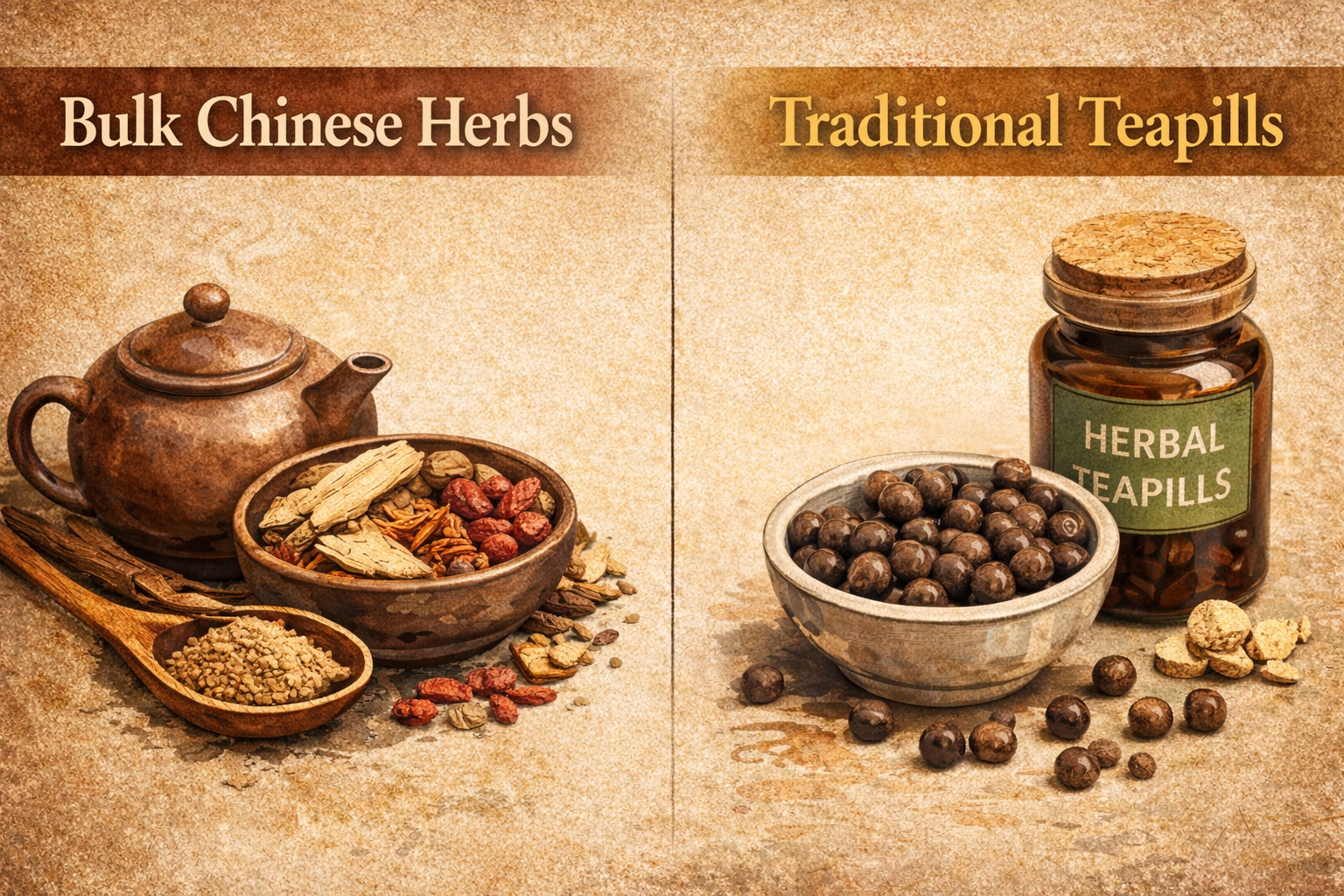
Bulk herbs vs extract powders vs teapills (simple comparison)
| Form | Best For | Why People Love It | Shop |
|---|---|---|---|
| Bulk Herbs | Traditional tea routines | Best value per serving; ritual-friendly | Shop bulk herbs → |
| Extract Powders | Convenience + consistency | Mix into warm water; easy to travel with | Shop powders → |
| Teapills | Busy schedules; no brewing | Most consistent “take-and-go” routine | Shop teapills → |
Pro tip: If you’ve quit routines before, start with teapills or extract powders. If you love the ritual of tea, bulk herbs are a joy.
The #1 beginner mistake that stops results (and the easy fix)
Mistake: starting too many herbs at once.
More is not better. Starting 5 things creates confusion (and sometimes discomfort). The fast path is the simple path: one goal → one routine → 7–10 days → then adjust.
Simple rule: If you can’t explain what’s helping, you’re doing too much.
Quality & Testing
The truth: Chinese herbs can only support you well when the herb is correct, clean, and handled properly. That means identity matters, sourcing matters, and storage matters.
1st Chinese Herbs Promise
- Experience: Serving customers since 1994 with practical, real-world routines.
- Expertise: Clear preparation guidance (bulk, powder, teapills) with responsible language.
- Authority: We prioritize reputable references and transparent labeling.
- Trust: COAs available on request. Quality screening and careful storage matter—especially for long routines.
Shop: Beginner Picks (choose your path)
Pick the option that fits your life. The best plan is the one you follow.
Path 1: Brew-at-Home (Bulk Herbs)
Best for: tea lovers, traditional routines, best value.
Path 2: Quick-Mix (Extract Powders)
Best for: convenience, consistency, daily habits.
Want even more savings?
Do you have a free 1st Chinese Herbs account? Free account holders enjoy even more savings. Log in or Create a free account.
FAQs
Do Chinese herbs work like medications?
No. Chinese herbs are traditionally used to support the body. They are not intended to diagnose, treat, cure, or prevent disease.
How long should I try a new herb or routine?
Many people track results weekly. Start with 7–10 days for tolerance, then evaluate over a few weeks for consistent routines.
What’s the easiest form for beginners?
Teapills and extract powders are often easiest for consistency. Bulk herbs are great if you enjoy brewing tea.
Can I take Chinese herbs with medications?
Sometimes, but interactions are possible. If you take prescriptions, check with a qualified clinician before starting herbs.
What if I don’t know what to choose?
Start with one goal and choose the form you’ll use. You can also contact us for help choosing a simple plan.
References
1) Chinese medicine emphasizes individualized “pattern identification”
-
Zhao FY, et al. (2025). Introducing the TRIPLE-TCM Trial Framework. (Discusses TCM clinical decision-making based on “Pattern Identification and Treatment.”) PMC
-
Lao L, et al. (2011). Evaluating Traditional Chinese Medicine Using Modern Research Approaches. (Explains how TCM syndrome differentiation leads to individualized treatment plans.) PMC
-
Hu Y, et al. (2025). Challenges in Traditional Chinese Medicine Clinical Trials. (Notes the need to balance standardized research with individualized treatment.) PubMed
2) Brewing/decoction matters (preparation affects what’s extracted)
-
Liu S, et al. (2017). Preparation of Herbal Medicine: Er-Xian Decoction… (Describes water decoction as a classic extraction method and provides a detailed protocol.) PMC+1
-
Qiu R, et al. (2018). Comparison of dispensing granules with traditional decoction: systematic review/meta-analysis. (Addresses differences between granules and traditional decoction.) PMC
-
Wang FX, et al. (2025). Research progress on scientific connotations of decocting methods in TCM. (Reviews how decocting methods can change chemical composition.) PubMed
3) Quality control / safety is a real issue (why COAs/testing matter)
-
Wang H, et al. (2023). Herbal medicine quality control practices. (In-depth review on the importance of QC for safety and consistency.) PMC
-
Harris ESJ, et al. (2011). Heavy metals and pesticides in Chinese herbal medicines. (Reports patterns and toxicological significance of contamination in raw CHMs.) PMC
-
Luo L, et al. (2021). Heavy metal contaminations in herbal medicines. (Reviews contamination and health risk concerns broadly in herbal medicines.) PMC
-
Zuo TT, et al. (2020). Concentrations of heavy metals in large batches of Chinese herbal medicines. (Large-batch monitoring study; supports why screening/testing matters.) PubMed
4) Chinese herbal medicine and sleep/insomnia (general evidence landscape)
-
Ni X, et al. (2015). Updated clinical evidence of Chinese herbal medicine for insomnia. (Meta-analysis including PSQI outcomes; shows the kind of clinical literature that exists.) PubMed
-
Yeung WF, et al. (2012). Chinese herbal medicine for insomnia: systematic review. (Explains benefits/limits; useful for “evidence transparency.”) PubMed
-
Li W, et al. (2025). Chinese herbal medicine for insomnia: systematic review / network meta-analysis. (Newer synthesis; useful for current “insomnia” search intent.) PubMed+1
-
Wang J, et al. (2025). Traditional Chinese medicine therapies for insomnia (umbrella review/evidence map). (Supports that multiple SR/MAs exist and quality varies.) PubMed