

Left Side Replenishing Teapills – Zuo Gui Wan – Plum Flower
Left Side Replenishing Teapills (Zuo Gui Wan) are a traditional Chinese herbal formula featuring six carefully combined botanicals: prepared Rehmannia root, Chinese Yam, Cornus fruit, Lycium fruit, Cuscuta seed, and Achyranthes root.
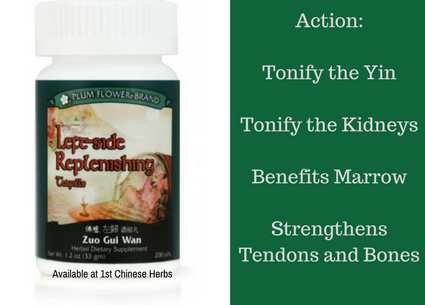
In Traditional Chinese Medicine (TCM), Zuo Gui Wan is traditionally used to nourish Kidney Yin, replenish Jing (Essence), and benefit Marrow. The formula combines Yin-nourishing herbs with botanicals traditionally associated with supporting the Liver and Kidney systems.
Plum Flower offers this traditional formula in convenient, small, round teapills. Each bottle contains 200 pills, providing an alternative to preparing a loose-herb decoction.
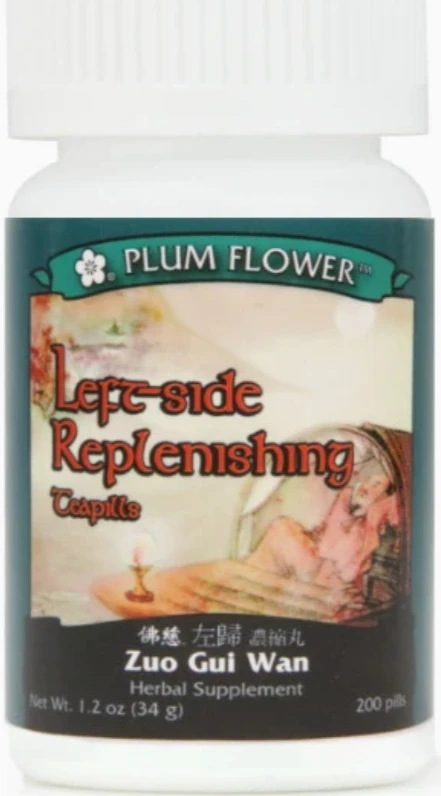 Product Details: Left Side Replenishing Teapills
Product Name: Left Side Replenishing Teapills
Pin Yin Name: Zuo Gui Wan
Chinese Name: 左归丸
Other Names: Restore the Left Pill, Left Returning Pills, Left Side Replenishing Formula
Brand: Plum Flower
Package Size: 200 teapills per bottle
Form: Small round herbal pills
Country of Origin: China
Label Directions: 8 pills, three times daily
Caution: Do not use if pregnant or nursing.
What Is Zuo Gui Wan?
Zuo Gui Wan, commonly translated as "Restore the Left Pill," is a traditional Chinese herbal formula associated with nourishing Yin and replenishing the body's Essence.
In TCM, Yin represents the nourishing, cooling, and moistening aspects of the body. The Kidney system is traditionally associated with storing Jing, or Essence, which plays a foundational role in TCM theories of growth, development, and vitality.
Left Side Replenishing combines six herbs traditionally used to nourish Yin and support the Liver and Kidney systems.
Important: Zuo Gui Wan and Zuo Gui Yin are distinct traditional formulas. This product is Zuo Gui Wan. Its six-herb composition should also be distinguished from classical or other manufacturer versions that contain different ingredients.
Traditional TCM Uses of Left Side Replenishing
According to Traditional Chinese Medicine, the herbs in Zuo Gui Wan are traditionally combined to:
- Nourish Kidney Yin
- Support Liver and Kidney Yin
- Replenish Jing, traditionally known as Essence
- Benefit Marrow in the traditional TCM sense
- Support the traditional concept of healthy tendons and bones
- Promote balance within the Yin-nourishing system
These descriptions reflect traditional Chinese herbal theory. They are not claims that the product treats or prevents a Western medical condition.
Ingredients in Left Side Replenishing Teapills
Plum Flower Left Side Replenishing contains six botanical ingredients. Each herb has a distinct traditional role within the formula.
| Pin Yin Name | Botanical Ingredient | Traditional TCM Role |
|---|---|---|
| Shu Di Huang | Rehmannia glutinosa root (prepared) | Traditionally nourishes Yin and Blood and replenishes Essence. |
| Shan Yao | Dioscorea opposita rhizome | Traditionally supports Spleen Qi and nourishes Kidney Yin. |
| Shan Zhu Yu | Cornus officinalis fruit | Traditionally nourishes Liver and Kidney Yin and helps secure Essence. |
| Gou Qi Zi | Lycium barbarum fruit | Traditionally nourishes Liver and Kidney Yin and supports Essence. |
| Tu Si Zi | Cuscuta chinensis seed | Traditionally supports the Liver and Kidney systems and helps secure Essence. |
| Huai Niu Xi | Achyranthes bidentata root | Traditionally supports the Liver and Kidney systems and benefits tendons and bones in TCM theory. |
Other Ingredients
Talcum, activated carbon, botanical wax.
Ingredient note: Always refer to the current bottle label for the complete ingredient and allergen information. Ingredient lists may change between manufacturing batches.
How Does Zuo Gui Wan Work in Traditional Chinese Medicine?
Traditional Chinese herbal formulas are designed by combining herbs with complementary roles. Left Side Replenishing brings together Yin-nourishing herbs and botanicals traditionally associated with replenishing Essence.
1. Shu Di Huang – The Yin-Nourishing Foundation
Prepared Rehmannia is an important herb in many traditional Yin-nourishing formulas. In TCM, it is associated with nourishing Blood, replenishing Essence, and supporting the Liver and Kidney systems.
2. Shan Yao and Shan Zhu Yu – Complementary Support
Chinese Yam is traditionally used to support the Spleen and Kidney systems, while Cornus fruit is associated with nourishing Liver and Kidney Yin and securing Essence.
Together, they complement the Yin-nourishing role of prepared Rehmannia.
3. Gou Qi Zi and Tu Si Zi – Nourishing Essence
Lycium fruit is traditionally associated with nourishing Liver and Kidney Yin. Cuscuta seed contributes additional traditional support for the Kidney system and Essence.
4. Huai Niu Xi – Supporting the Lower Body
Achyranthes root is traditionally associated with the Liver and Kidney systems and with benefiting tendons and bones in TCM theory.
Its role complements the formula's overall Yin-nourishing character.
Understanding Kidney Yin, Jing, and Marrow
Traditional Chinese Medicine uses concepts that do not have direct equivalents in modern Western anatomy or physiology.
What Is Kidney Yin?
Kidney Yin refers to the nourishing, cooling, and moistening aspects of the Kidney system in TCM.
Kidney Yin deficiency is not the same as reduced kidney function or chronic kidney disease. A traditional TCM pattern should not be interpreted as a Western medical diagnosis.
What Is Jing (Essence)?
Jing is traditionally described as a foundational substance associated with growth, development, reproduction, and constitutional vitality.
In TCM theory, the Kidney system is associated with storing Essence.
What Does "Benefits Marrow" Mean?
In TCM, Marrow is a traditional concept associated with Essence and the nourishment of bones and the brain.
It should not be interpreted as a claim about treating bone marrow disorders, neurological diseases, or other medical conditions.
 How to Take Left Side Replenishing Teapills
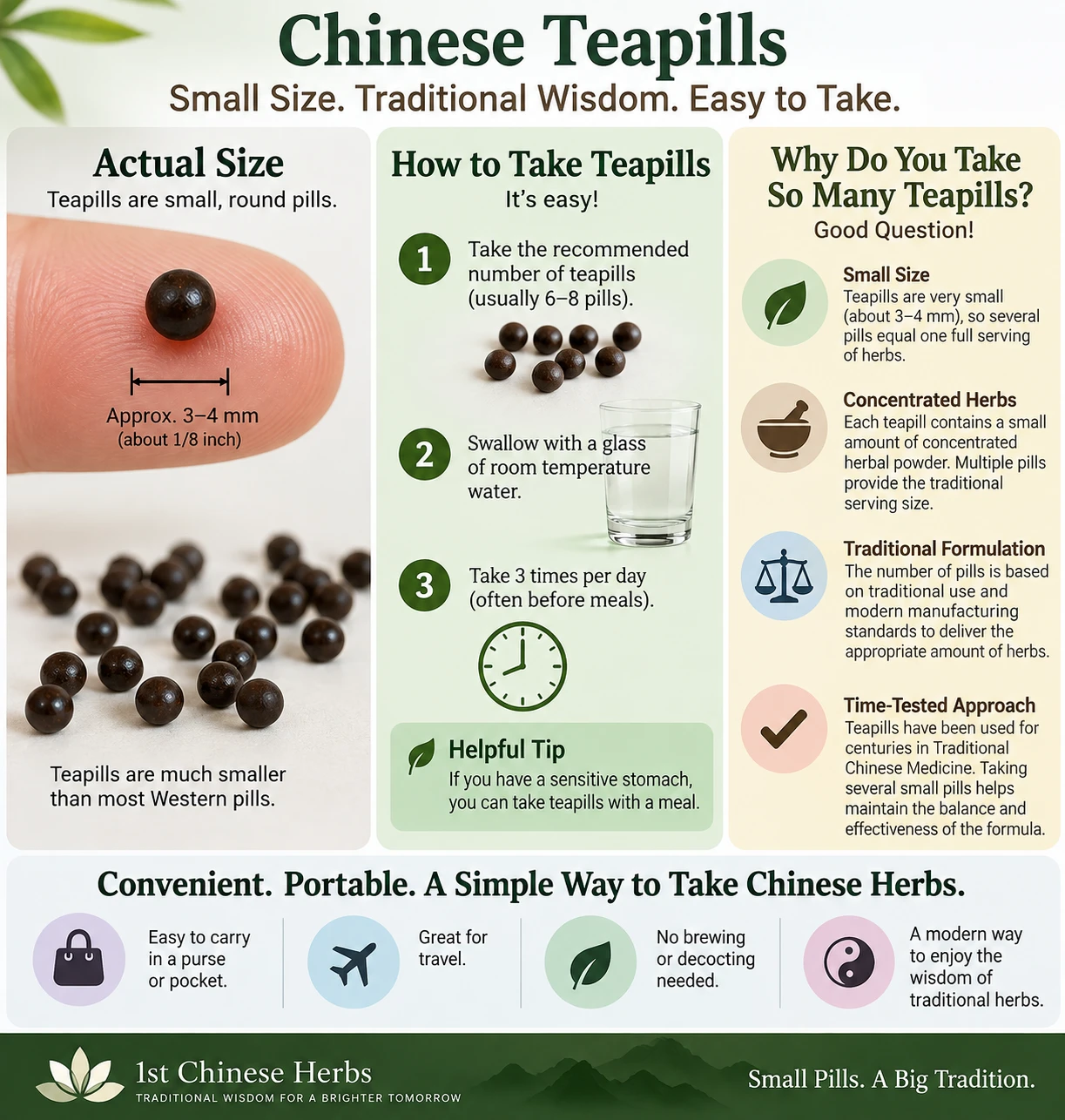
Dosage stated on the bottle: 8 pills, three times daily.
Swallow the recommended number of teapills with water. Read and follow all directions on the product label.
Consult your physician, licensed acupuncturist, or qualified herbal practitioner for individualized guidance.
If you have a sensitive stomach, ask your healthcare professional whether taking the formula with food is appropriate.
What Are Teapills, and Why Do You Take Several?
Teapills, sometimes written as tea pills, are small, round herbal pills. They provide a convenient alternative to preparing traditional loose-herb decoctions.
Because each pill is small, a serving commonly consists of several pills. The number of pills depends on the specific formula, manufacturing process, and product label.
For Left Side Replenishing Teapills, the bottle directions specify 8 pills three times daily.
Teapills are compact, portable, and do not require simmering loose herbs. However, they should not be assumed to be interchangeable with concentrated herbal extract powders or other herbal preparations.
Learn More: What Are Teapills and How Do You Take Them?
About Plum Flower Teapills
Plum Flower is an established brand of traditional Chinese herbal products. Its teapill formulas offer a convenient way to use traditional herbal combinations without preparing loose-herb decoctions.
1st Chinese Herbs has supplied Chinese and Western herbs and herbal products since 1994. We emphasize responsible sourcing, product quality, and clear herbal education.
Laboratory documentation may be available upon request when supplied by the manufacturer.
Frequently Asked Questions About Zuo Gui Wan
What is Left Side Replenishing traditionally used for?
In Traditional Chinese Medicine, Zuo Gui Wan is traditionally used to nourish Kidney Yin, replenish Essence, and benefit Marrow. These are traditional TCM concepts rather than Western medical treatment claims.
What is the Chinese name for Left Side Replenishing?
The Pin Yin name is Zuo Gui Wan, written 左归丸 in simplified Chinese and 左歸丸 in traditional Chinese.
What herbs are in Left Side Replenishing?
The Plum Flower formula contains prepared Rehmannia root, Dioscorea rhizome, Cornus fruit, Lycium fruit, Cuscuta seed, and Achyranthes root.
Is Zuo Gui Wan the same as Zuo Gui Yin?
No. Although their names are similar, Zuo Gui Wan and Zuo Gui Yin are distinct traditional formulas. Their ingredients and traditional applications may differ. Always check the product label.
Does Kidney Yin refer to kidney disease?
No. Kidney Yin is a traditional Chinese medicine concept and is not equivalent to kidney function or kidney disease as defined by Western medicine.
How many teapills are in one bottle?
Each bottle contains 200 teapills.
How many Left Side Replenishing teapills should I take?
The bottle directions state 8 pills three times daily. Follow the product label and consult your healthcare professional for individualized instructions.
Why do I need to take several teapills?
Teapills are small, so a serving often consists of several pills. Serving sizes vary by formula and manufacturer. Always follow the directions for the specific product.
Can I take Left Side Replenishing while pregnant?
No. The product cautions against use during pregnancy or nursing.
Safety and Precautions
Do not use if pregnant or nursing.
Consult a qualified healthcare professional before use if you take prescription medications, have a medical condition, are preparing for surgery, or are receiving medical treatment.
If you have kidney disease, liver disease, diabetes, or another chronic condition, seek medical guidance before using this formula. Do not use it as a substitute for prescribed treatment.
Check the current product label for complete ingredients, allergens, and precautions.
California Proposition 65 Warning Information
Left Side Replenishing – A Traditional Yin-Nourishing Formula
Left Side Replenishing Teapills (Zuo Gui Wan) combine six traditional Chinese herbs in a convenient Plum Flower formula. Traditionally associated with nourishing Kidney Yin, replenishing Essence, and supporting the Liver and Kidney systems, this formula offers an alternative to preparing loose herbs.
Package: 200 teapills per bottle.
FDA Disclaimer: These statements have not been evaluated by the Food and Drug Administration. This product is not intended to diagnose, treat, cure, or prevent any disease.