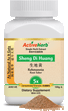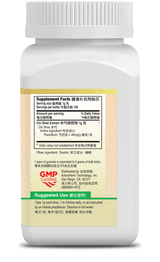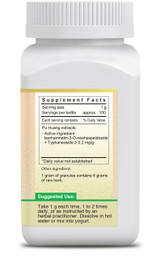


Sheng Di Huang Single Extract Herb (5X) — ActiveHerb
If you’re shopping for Sheng Di Huang (生地黄), you’re not looking for a garden plant or a vague herb blurb — you want the real TCM herb, in a form that’s easy to use consistently.
This product is Sheng Di Huang (Raw Rehmannia root) in 5X concentrated extract granules — designed for modern use while staying rooted in classical tradition. Sheng Di Huang is widely described in Traditional Chinese Medicine as sweet, bitter, and cold, traditionally used to clear heat, cool blood, and nourish Yin fluids.
Quick Facts On Sheng Di Huang
-
Common Name: Raw Rehmannia Root / Tuber
-
Pin Yin: Sheng Di Huang (also seen as Di Huang – Sheng)
-
Botanical Name: Rehmannia glutinosa (raw root)
-
Form: 5X extract granules
-
Net Weight: 100g (3.5 oz)
-
Ingredients: 82% extract + 18% dextrin (carrier)
-
Active Marker (listed): Verbascoside ≥ 0.05 mg/g
-
Origin: China
-
Brand: ActiveHerb
-
Cautions: Not for pregnancy/nursing; avoid large doses; discontinue if adverse effects occur
What is Sheng Di Huang?
Sheng Di Huang is the raw (unprocessed) root of Rehmannia glutinosa. In classical TCM language it is described as cold in nature and traditionally used for patterns associated with heat and Yin fluid depletion. Modern research reviews and studies commonly discuss catalpol (an iridoid glycoside) as one of the notable constituents studied in Rehmannia.
Why that matters: Many people confuse raw Rehmannia (Sheng Di Huang) with prepared Rehmannia (Shu Di Huang) — and they are not interchangeable.
Sheng Di Huang vs Shu Di Huang
Sheng Di Huang (Raw Rehmannia)
-
Nature: cold (traditionally used when “heat” is present)
-
Traditional focus: clearing heat, cooling blood, supporting Yin fluids (TCM pattern language)
Shu Di Huang (Prepared/Cooked Rehmannia)
-
Nature: warm / slightly warm (traditionally more “tonifying”)
-
Traditional focus: nourishing Blood/Yin and Essence in chronic deficiency patterns (TCM pattern language)
Translation: If you meant Shu Di Huang, this is not that product
Why 5X Extract Granules
Granules are a favorite among practitioners and experienced herb users because they can be:
-
Faster and cleaner than decoctions
-
Easier to travel with
-
Simple to measure consistently
-
More practical for daily routines
A 5X extract generally means the granules are made from a larger amount of raw herb to produce a smaller amount of concentrated extract (the exact extraction yield varies by manufacturer and herb).
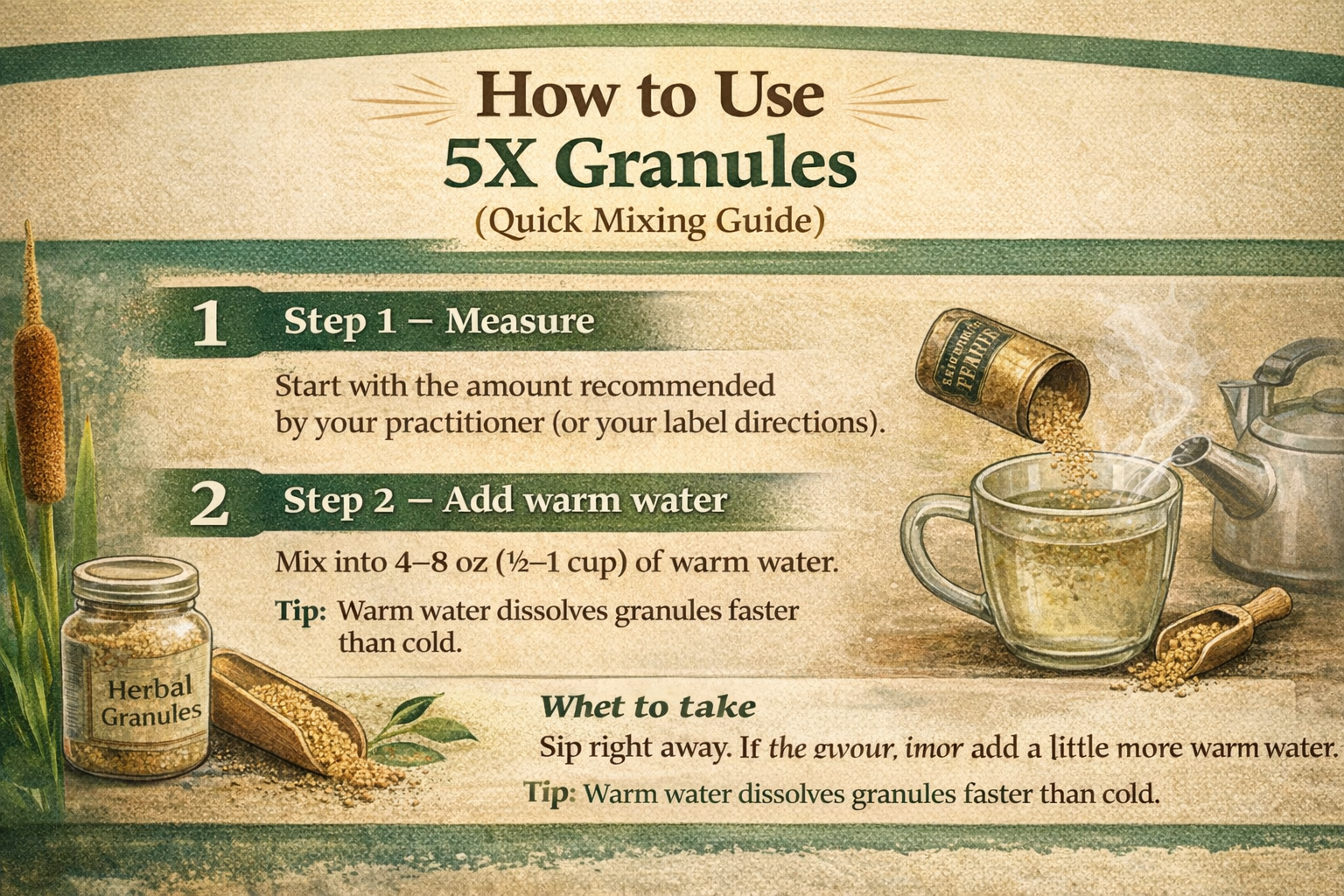
How to Use 5X Granules (Quick Mixing Guide)
Step 1 — Measure
Start with the amount recommended by your practitioner (or your label directions).
Step 2 — Add warm water
Mix into 4–8 oz (½–1 cup) of warm water.
Tip: Warm water dissolves granules faster than cold.
Step 3 — Dissolve fully
-
Stir briskly for 20–30 seconds, or
-
Use a small milk frother for a smoother mix.
Step 4 — Drink & adjust
Sip right away. If the flavor is strong, you can add a little more warm water.
Taste note (what to expect)
Sheng Di Huang granules are often described as earthy and slightly bitter.
If you prefer, mix into a mild tea or add a small amount of honey (optional).
When to take (general guidance)
Most customers take granules in the morning or early afternoon as part of a routine.
If you’re sensitive to flavors or digestion, some people prefer taking them after a small meal.
(For personalized timing and dosage, follow practitioner guidance.)
Quick Tip for busy days
Pre-mix in a small jar with warm water, shake well, and drink within a short time for best texture.
What Does “5X” Mean?
5X means these granules are made from a concentrated extract of the original herb. In other words, more raw herb is used to create a smaller amount of extract.
Because extraction methods and yields vary, “5X” is a concentration reference and can differ by manufacturer.
Why you can trust this product
-
It includes a carrier (dextrin) for consistent granules, and
-
It lists an active marker compound (verbascoside)
Traditionally Uses
Traditional TCM uses (pattern language)
-
Supports the body during “heat” patterns (TCM framework)
-
Traditionally used to “cool blood” and support Yin fluids (TCM framework)
What modern research has explored
Research reviews and preclinical studies have investigated constituents of Rehmannia (especially catalpol) for:
-
Anti-inflammatory and antioxidant activity (experimental studies)
-
Metabolic pathway support studied in experimental settings (e.g., glucose/lipid-related mechanisms)
-
Neuroprotective pathways studied in experimental models
These are research areas, not promises of results. This product is not intended to diagnose, treat, cure, or prevent any disease.
Who should NOT use this product
-
Do not use if pregnant or nursing.
-
Avoid large doses; discontinue if you experience unwanted effects.
-
If you have a medical condition or take medications, consult a qualified clinician before use.
Quality
-
Ingredient transparency (82% extract + 18% dextrin)
-
Marker compound listed (verbascoside specification)
Pro tip “Ask us for the COA”
FAQ Is Sheng Di Huang the same as Shu Di Huang?
No. Sheng Di Huang is raw rehmannia. Shu Di Huang is prepared/cooked rehmannia and has different traditional properties.
Why do these granules contain dextrin?
Dextrin is commonly used as a carrier/binder in granule extracts to improve flow and consistency.
What is catalpol?
Catalpol is a compound widely discussed in the research literature on Rehmannia glutinosa and is studied for multiple biological activities in experimental settings.
Can I combine Sheng Di Huang with other herbs?
Many people do, but combinations depend on the person and the pattern. Practitioner guidance is recommended.
Disclaimer
These statements have not been evaluated by the Food and Drug Administration. This product is not intended to diagnose, treat, cure, or prevent any disease.
RELATED LINKS
- How to Use Bulk Herbs
- What No One Tells You About Chinese Herbs (7 Common Mistakes + Fixes)
- Contact Us
- 10 Vital Medicinal Herbs That Work (Free Ebook)
Check out our How to Use Bulk Herbs page to see how to use herbs correctly. Our web page is constantly expanding, as of today we have articles on:
- How to make salves, poultice, tinctures, teas, capsules, gargles, and foot bathes
- How to make a citrus facial splash
- Cayenne pepper: Caterpillar and aphid spray ( Natural insect repellent )
- Citrus potpourri basket
Chinese Traditional herbs should be regarded as a supplementary aspect to modern Western healthcare, and not as a replacement. Chinese traditional herbs ( Teas ) emphasize harmony, and balance.
Why use Chinese Bulk Herbs?
Traditional Chinese Medicine curative herbal formulas have been developed, improved and perfected for over 5000 years.Traditional Chinese Medicine is an ancient, holistic medical system used all over the world to treat a wide variety of health issues. Traditional Chinese Medicine (TCM) works by helping to balance the bodies’ functions thus restoring health.
As soon as the Chinese people began to carve out a civilization in ancient China it developed a cultural heritage that has continued to the present day. TCM is the oldest and one of the safest, effective systems one can use to care for their body, it promotes health and helps to sustain longevity.
Chinese herbs have been with mankind for 5,000 years and will be with us in the years ahead – it is using nature’s bountiful gifts to have good health.
References
1 Dharmananda, Subhuti. "Classical Physician Zhang Jingyue: The Rehmannia Doc." Institute for Traditional Medicine. June 2012. <http://www.itmonline.org/articles/rehmannia_doc/rehmannia_doc.htm>.
2 Huang Bingshan and Wang Yuxia. Thousand Formulas and Thousand Herbs of Traditional Chinese Medicine, Vol. 2. 1993 Heilongjiang Education Press, Harbin.
https://www.americandragon.com/Individualherbsupdate/ShengDiHuang.html
https://www.sciencedirect.com/topics/medicine-and-dentistry/rehmannia-glutinosa-extract
https://www.cancer.gov/publications/dictionaries/cancer-drug/def/sheng-di-huang
https://www.sciencedirect.com/topics/medicine-and-dentistry/rehmannia
3 Cheung CS and Hirano M (translators), Huang BM. A brief discussion of the use of radix rehmannia by the ancient master Zhang Jingyue.
Journal of the American College of Traditional Chinese Medicine 1982 (4): 33-37.