
Why Chinese Herbs Come Whole, Sliced, Tea Cut, Cubed & Powdered
The Hidden Reason The Same Chinese Herb Can Look Completely Different
Written by 1st Chinese Herbs | Trusted Since 1994 | Educational Herbal Resource
One of the biggest surprises for beginners is discovering that the exact same herb may come in completely different forms.
One version may look like:
- large root slices
- tiny tea cut pieces
- small cubes
- coarse chunks
- fine powder
- whole roots
- granules
- shredded bark
- disc shape
And naturally, consumers start asking:
- Why does the same herb look completely different?
- Is powdered better than sliced?
- Why are some herbs tea cut?
- Why are some herbs sold whole?
- Does herb size affect brewing?
- Why are some roots sliced while others are cubed?
- Does powder work differently?
The answer is surprisingly practical.
Chinese herbs are prepared into different forms based on:
- brewing style
- traditional preparation methods
- consumer convenience
- storage
- drying
- measuring
- usage preference
- processing efficiency
Quick Answer: Chinese herbs may be sold whole, sliced, tea cut, coarse cut, cubed, powdered, or granulated depending on how they are traditionally prepared, brewed, dried, stored, measured, or used by consumers. Different forms are not necessarily “better” than others — they are often designed for different preparation styles and lifestyles.
Why Herb Form Matters More Than Most People Realize
Most consumers only see the finished herb sitting in a bag, bottle, tea cup, or storage jar.
But before herbs ever reach the shelf, many go through:
- harvesting
- sorting
- cleaning
- slicing
- drying
- cutting
- grinding
- powdering
- traditional processing
These preparation choices affect:
- brewing speed
- surface area
- storage stability
- measuring convenience
- tea preparation
- texture
- consumer convenience
- appearance
This is one reason the exact same herb may look completely different depending on how it was prepared.
The Same Herb — Completely Different Forms
Astragalus Root alone may appear as:
- whole root
- root slices
- coarse cut pieces
- tea cut herbs
- powder
- extract powder
Yet all may come from the same plant.
The difference is often how the herb was:
- cut
- sorted
- dried
- processed
- prepared for usage
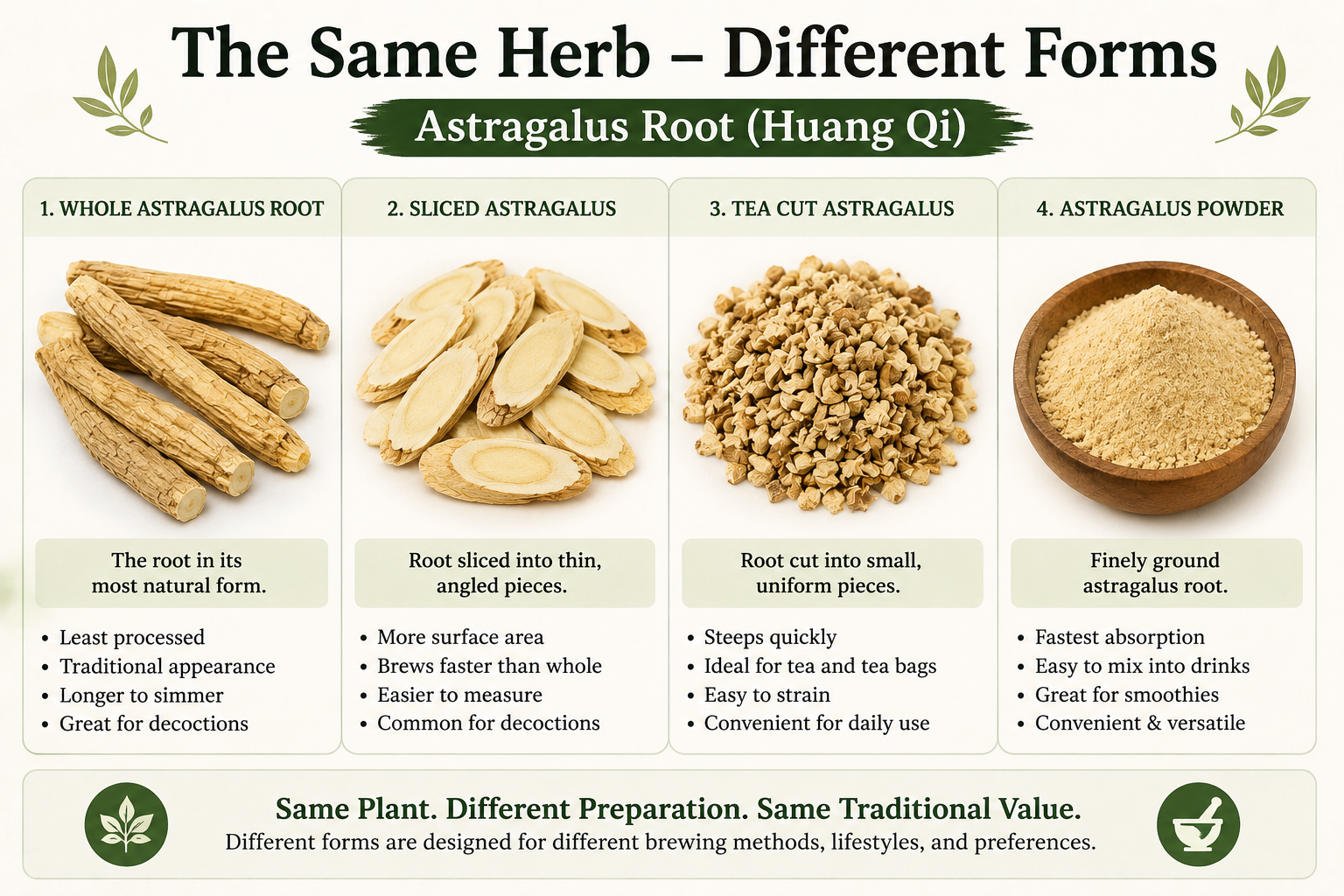
Whole Herbs
Whole herbs are often the least processed form.
Examples may include:
- whole roots
- whole flowers
- whole berries
- whole mushrooms
- whole bark pieces
Consumers often associate whole herbs with:
- traditional appearance
- minimal processing
- decorative presentation
- longer storage potential
However, whole herbs may also:
- take longer to brew
- require cutting before use
- be harder to measure
- require stronger simmering for decoctions
Sliced Herbs
Sliced herbs are extremely common in Chinese herbal preparation.
Roots and bark are often sliced to:
- increase surface area
- improve drying consistency
- improve brewing efficiency
- make measuring easier
- fit decoction preparation
Examples commonly sold sliced include:
- Astragalus Root
- Dang Gui
- Licorice Root
- Ginger
- Rehmannia
Slicing often helps herbs brew more evenly while improving storage and packaging.
Coarse Cut Herbs
Coarse cut herbs are usually chopped into medium-sized pieces.
This form is commonly used for:
- decoctions
- tea brewing
- bulk preparation
- consumer convenience
Many consumers prefer coarse cut herbs because they:
- fit strainers more easily
- measure more consistently
- brew faster than whole roots
- store conveniently
This is one reason many herbs intended for tea use are sold coarse cut rather than whole.
Tea Cut Herbs
Tea cut herbs are usually smaller and more uniform than coarse cut herbs.
This form is often chosen for:
- quick steeping
- tea bags
- daily tea blends
- faster brewing
- convenience
Tea cut herbs typically allow:
- more water exposure
- quicker steeping
- more even blending
- simpler preparation
This is why many modern herbal teas use tea cut herbs instead of large whole pieces.
Cubed Herbs
Some herbs are cut into cubes or chunks.
This may help with:
- uniform sizing
- consistent drying
- controlled packaging
- easier measuring
Cubed herbs often create more predictable packaging and easier portioning compared to irregular root sections.
Powdered Herbs
Powdered herbs are one of the most popular modern herb forms.
Consumers often choose powders for:
- smoothies
- capsules
- travel
- convenience
- faster preparation
Powders may also:
- mix easily
- require less brewing time
- fit modern lifestyles more easily
However, powders may also:
- absorb moisture faster
- clump if stored poorly
- lose aroma more quickly if exposed to humidity
Fine Grind vs Coarse Grind
| Feature | Fine Grind | Coarse Grind |
|---|---|---|
| Texture | Very fine powder | Larger particles |
| Best For | Smoothies, capsules, mixing | Tea brewing and decoctions |
| Brewing | May suspend in liquid | Easier to strain |
| Storage | Needs careful moisture control | Generally easier to manage |
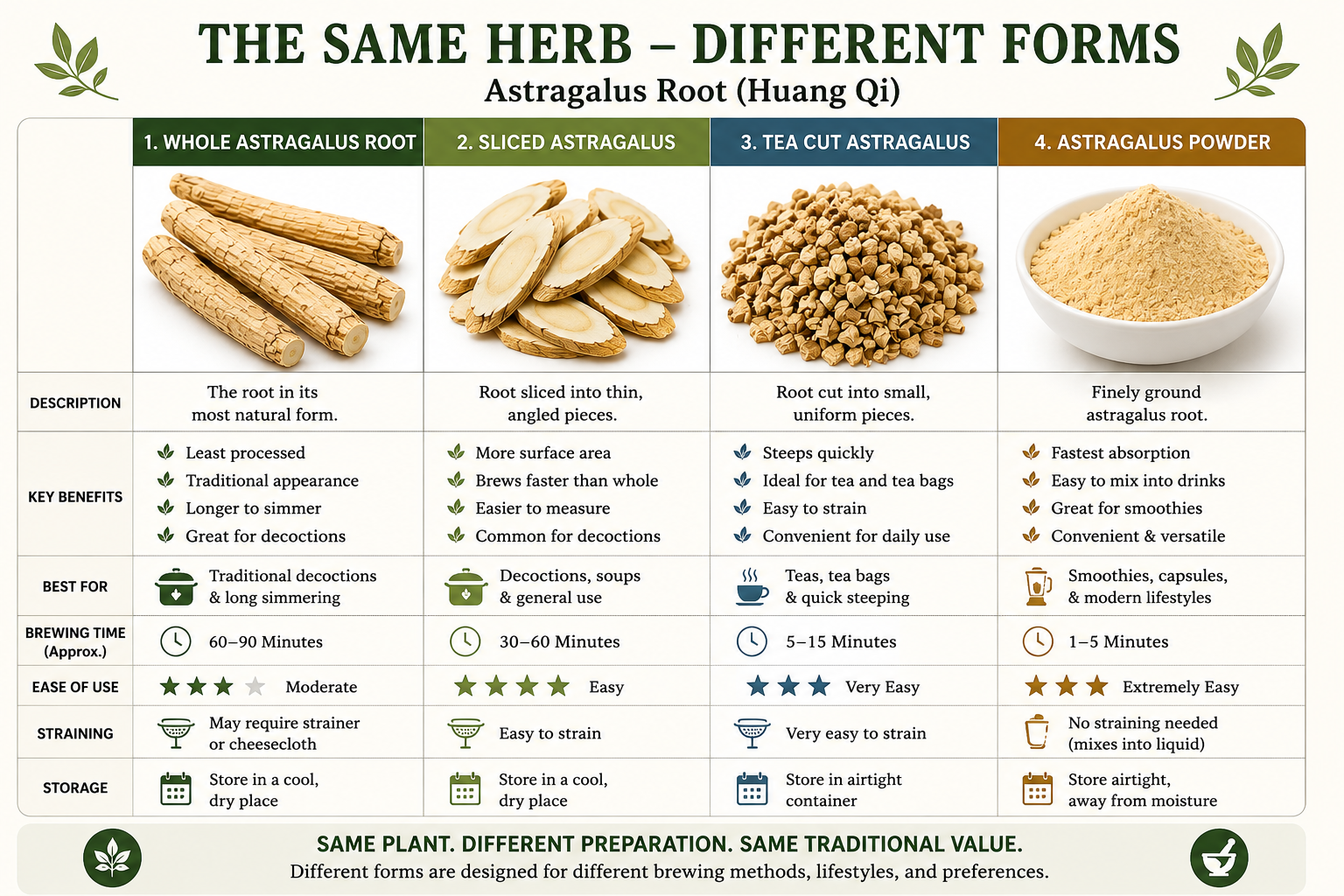
Which Herb Form Is Right For You?
| Herb Form | Often Best For |
|---|---|
| Whole Roots | Traditional preparation and long-term storage |
| Slices | Traditional decoctions and easier brewing |
| Coarse Cut | Tea brewing and convenience |
| Tea Cut | Quick daily teas and tea bags |
| Powders | Smoothies, capsules, and convenience |
What Most Beginners Get Wrong
Many beginners accidentally buy the wrong herb form for their needs.
Common mistakes include:
- buying whole roots without knowing how to simmer them
- buying powders without proper storage containers
- assuming tea cut and powder brew the same way
- thinking one form is automatically “stronger”
- not realizing cut size affects brewing speed
Understanding herb form often makes herbal preparation dramatically easier and less intimidating.
Why Herb Form Affects Brewing
Different herb forms interact with water differently.
Smaller pieces generally expose more surface area to water.
This may influence:
- brewing speed
- straining
- ease of preparation
- mixing
- consumer convenience
For example:
- tea cut herbs often steep faster
- whole roots often require simmering
- powders may suspend directly into liquid
- coarse cut herbs are often easier to strain
This is one reason different forms exist in the first place.
Why Herb Form Affects Price
Consumers often wonder why herb prices vary between forms.
Preparation methods may involve:
- slicing
- sorting
- grinding
- powdering
- screening
- drying
- labor
- specialized equipment
Different forms may also require:
- additional processing
- more handling
- extra packaging
- additional moisture control
This is one reason herb form may influence overall pricing.
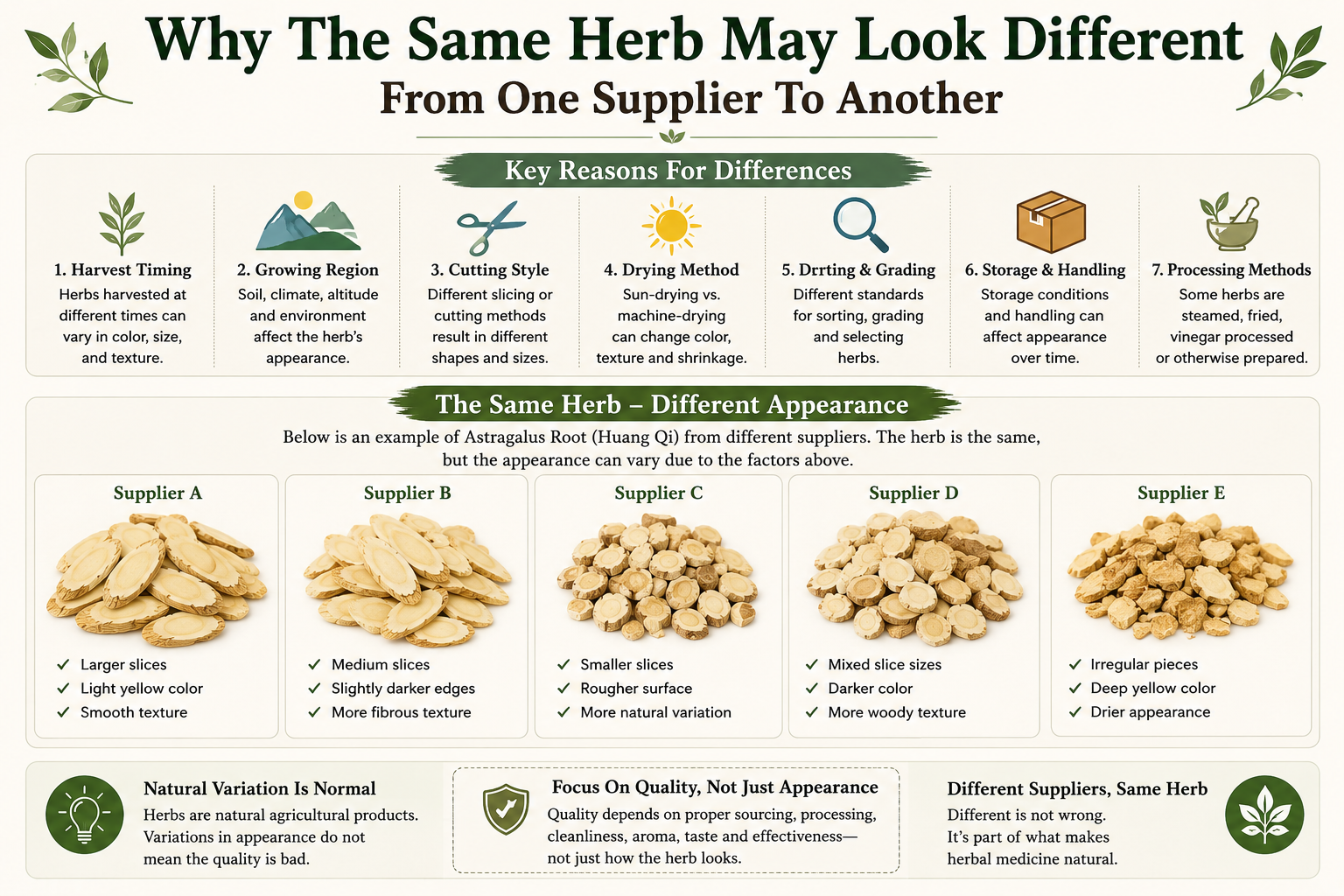
Why The Same Herb May Look Different From One Supplier To Another
This is one of the most common customer questions.
The same herb may vary because of:
- sorting style
- cut size
- drying method
- processing method
- harvest timing
- storage
- regional preparation traditions
Plants are agricultural products.
They are not factory-made plastic objects designed to look identical forever.
Natural variation is normal.
Popular Herbs Commonly Sold In Multiple Forms
| Herb | Common Forms |
|---|---|
| Astragalus Root | Whole, sliced, coarse cut, powder |
| Licorice Root | Slices, tea cut, powder |
| Ginger | Slices, cubes, powder |
| Chrysanthemum | Whole flowers, tea cut |
| Rehmannia | Slices, processed pieces |
Which Herb Form Fits Your Lifestyle?
Not every herb form fits every person equally.
Some people enjoy the slow, traditional ritual of simmering roots for hours. Others want something fast, simple, and easy to add into a busy routine.
Ask yourself:
- Do you enjoy traditional simmering and decoctions?
- Do you prefer convenience and quick preparation?
- Do you make smoothies or capsules?
- Do you want herbs that steep quickly into tea?
- Do you prefer easier measuring and cleanup?
Different herb forms fit different:
- lifestyles
- schedules
- preparation styles
- storage needs
- daily routines
For example:
- Whole roots and slices are often preferred for traditional decoctions and long simmering.
- Tea cut herbs are popular for faster steeping and simple tea preparation.
- Powdered herbs are commonly chosen for smoothies, capsules, and convenience.
- Coarse cut herbs are often easier to strain and measure for tea brewing.
There is not always a “best” herb form.
The better choice is often the one that realistically fits your routine and makes it easier for you to consistently use your herbs.
What You Need To Know
Explore Bulk Herbs, Powders & Tea Cut Herbs
Shop bulk Chinese herbs, roots, flowers, mushrooms, powders, teas, and traditional herbal ingredients carefully selected with freshness and quality in mind.
- Trusted Since 1994
- Fast Shipping from Washington State
- COA Available Upon Request
- Carefully Stored
Explore This Herbal Quality Education Hub
- From Seed to Shelf: What Happens Before Chinese Herbs Reach Your Home
- Sun-Dried vs Machine-Dried Herbs
- Why Chinese Herbs Are Processed
- How Harvest Timing Changes Aroma, Texture, Color & Quality
- How To Use Bulk Herbs
Final Thoughts
The same herb may look completely different depending on how it was prepared.
That does not automatically make one form “better” than another.
Different forms are often designed for:
- different brewing methods
- different lifestyles
- different preparation styles
- different storage needs
- different consumer preferences
And once consumers begin understanding herb forms, the world of Chinese herbs suddenly becomes far less confusing and much easier to explore with confidence.